
Ductile Iron Pipes: Key AWWA and ISO Requirements for Municipal Water Projects
Ductile Iron Pipes: Key AWWA and ISO Requirements for Municipal Water Projects
For municipal water projects, ductile iron pipe is rarely a casual material choice. It sits at the intersection of pressure performance, installation practicality, long-term leakage control, and procurement compliance. On paper, many pipe systems can look acceptable. In the ground, under traffic load, aggressive soil, surge pressure, and decades of maintenance constraints, the difference between “specified correctly” and “simply purchased” becomes expensive very quickly.
That is why the standards conversation matters. When project teams ask about Ductile Iron Pipes, they are usually not asking only about pipe strength. They are trying to understand whether the pipe wall class, joint design, lining, coating, dimensions, and testing framework actually align with the risk profile of a municipal network. In most international tenders, that means reading AWWA and ISO requirements together rather than treating them as interchangeable labels.
Teams that work close to both manufacturing and infrastructure delivery—like the industrial intelligence groups tracking centrifugal casting, machining tolerances, and pipeline compliance across global supply chains—tend to see this clearly. A ductile iron pipe is not just a commodity tube. It is a cast, lined, coated, dimensionally controlled pressure component that has to perform underground for generations.
Why AWWA and ISO are often discussed together
In municipal procurement, AWWA standards are especially common in North America and in projects influenced by US consultants, utility practice, or funding structures. ISO standards are more common in internationally sourced projects, EPC contracts, and cross-border supply chains. Many water authorities reference one system as primary and accept the other only if equivalency is demonstrated. That last phrase—equivalency demonstrated—is where many technical reviews slow down.
The issue is not that one framework is “better” in every case. It is that they organize requirements differently. AWWA often ties selection closely to pressure class, thickness class, laying condition, and utility practice. ISO documents may focus more on product dimensions, general requirements, joint performance, coatings, and testing methods under a harmonized international structure. If the bid documents are vague, suppliers may quote to the least demanding interpretation. That is a project risk, not a paperwork detail.
The AWWA requirements that usually deserve the closest attention
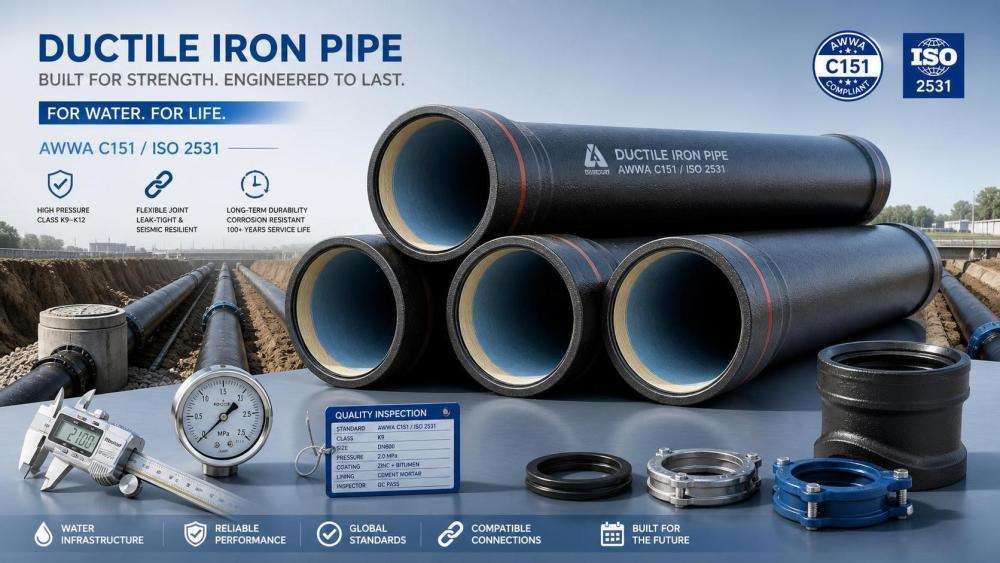
For many municipal water mains, AWWA C151 is one of the central specifications because it covers ductile iron pipe, centrifugally cast, for water. It is typically where project teams begin when reviewing pressure classes, dimensions, wall thickness, and basic manufacturing expectations. But the pipe standard does not stand alone. In practice, engineers also have to review how joints, linings, coatings, and installation assumptions connect back to system performance.
A few points tend to matter more than buyers first expect:
- Pressure class and thickness class should not be selected by habit alone. Working pressure, surge allowance, burial condition, and external loads all affect suitability.
- Cement-mortar lining and external coatings need separate review. A pipe can meet base material requirements and still be a poor match for aggressive water chemistry or corrosive soils.
- Joint configuration matters. Push-on joints may be efficient for standard alignment, but restrained joints may be needed at bends, steep grades, or surge-sensitive zones.
- Hydrostatic and quality testing requirements should be verified against the purchase specification, not assumed from a catalog page.
AWWA references commonly extend into related standards for fittings, linings, disinfection, and installation practices. That is one reason experienced reviewers do not approve Ductile Iron Pipes by looking only at nominal diameter and pressure class. The pipe barrel may comply while the joint, coating, and accessory package do not.
What ISO requirements change in the review process
ISO-based procurement often feels broader because multiple standards can define the complete product package. ISO 2531 is widely referenced for ductile iron pipes, fittings, accessories, and their joints for water applications. Depending on the project, buyers may also review ISO requirements related to joint performance, coating systems, or dimensions for compatibility with local practice.
The practical difference is this: ISO review frequently pushes the team to check interface details earlier. Socket and spigot geometry, allowable angular deflection, gasket material compatibility, coating thickness expectations, and marking requirements can all affect acceptance. This is particularly relevant for EPC projects sourcing from multiple regions, where a pipe mill, fitting supplier, and installer may each be working from slightly different assumptions.
Another point worth watching is dimensional compatibility. Municipal teams sometimes assume all ductile iron systems of the same nominal size will connect without issue. That is not always safe to assume across standards, manufacturers, or joint systems. On rehabilitation jobs and phased network expansion, this is one of the most common technical traps.
AWWA vs ISO: where projects usually get stuck
Most disputes do not come from dramatic pipe failure during factory inspection. They come from mismatched expectations at submittal stage: a consultant expects one joint standard, the supplier quotes another; the utility expects a certain lining or coating system, but the purchase order is silent; the contractor assumes standard deflection capacity, then discovers restraint requirements at thrust locations.
Lining, coating, and corrosion protection are not secondary items
One of the more costly mistakes in municipal water work is treating the pipe body as the main technical decision and everything else as accessory detail. Ductile iron earns its reputation from strength and durability, but field performance depends heavily on the protection system chosen for the actual environment.
Internal cement-mortar lining is common and well established, but water quality, flow regime, and owner preference may require a different internal solution in some systems. Externally, standard coatings may be acceptable in benign soil conditions, yet highly corrosive soils, stray current exposure, coastal zones, or reclaimed land can justify polyethylene encasement or more robust protective systems. The right answer is usually not universal. It depends on soil data, groundwater conditions, and the owner's maintenance philosophy.
This is where technically serious manufacturers and market observers tend to separate themselves from traders. Understanding centrifugal casting quality is important, but so is knowing when a standard coating package is not enough for a 100-year buried asset expectation.
Manufacturing quality: what to verify beyond the certificate
A certificate of compliance is necessary, but it is not a substitute for technical review. Ductile iron pipe performance starts with metallurgy and process control: spheroidization quality, centrifugal casting consistency, heat treatment where applicable, dimensional tolerances, socket formation, and coating application discipline. Those manufacturing realities affect joint fit, pressure resistance, and long-term reliability far more than a polished brochure does.
Teams involved in broader industrial component intelligence often make an interesting connection here. The same mindset used to verify micron-level machining tolerances in precision equipment applies, in a different form, to buried infrastructure: process discipline matters. In pipe production, that means traceable batches, repeatable wall thickness, controlled joint geometry, and test records that actually correspond to delivered lots.
If the project is large or strategically sensitive, it is often worth asking for mill documentation, test reports, marking conventions, and clarification on which exact AWWA or ISO editions govern the supply. Edition mismatch is a small line item until it turns into a contractual argument.
What project managers should lock down before procurement
The cleaner the specification, the fewer surprises later. In practical terms, procurement documents should identify at least the governing standard set, acceptable equivalents if any, required pressure or thickness basis, joint type, lining, external protection, test documentation, and compatibility expectations with fittings and existing network components.
It also helps to state what is not acceptable. If mixed-standard assemblies are prohibited without written approval, say so. If restrained joints are required at specific locations, mark them clearly. If local disinfection procedures, coating repair methods, or inspection hold points apply, include them early rather than relying on contractor interpretation.
This is especially important on international projects, where suppliers may be fully competent but accustomed to another compliance framework. A vague specification does not create flexibility; more often, it creates competing interpretations.
The bottom line for municipal water networks
Ductile Iron Pipes remain one of the most dependable choices for municipal water transmission and distribution, but only when standard compliance is treated as an engineering issue rather than a box-ticking exercise. AWWA and ISO requirements both provide strong frameworks, yet they are not shorthand for automatic equivalence. The real job is to translate those standards into the actual conditions of the project: pressure, soil, water quality, connection interfaces, installation practice, and long-term maintenance exposure.
If there is one useful habit for project teams, it is this: review the pipe system as a buried operating asset, not as a line item. The barrel, joint, lining, coating, and documentation package all have to make sense together. When they do, ductile iron usually just disappears underground and keeps working. In municipal infrastructure, that is about as good an outcome as you can ask for.
Related News
- How to Assess a Rigid Coupling Supplier for Bore Accuracy and Traceable QualityOct 08, 2026Tribology & Kinematics Expert
- Titanium Alloys Compared: Balancing Strength, Corrosion Resistance, and MachinabilityOct 08, 2026CNC Kinematics Architect
- Where Ductile Iron Dismantling Joints Reduce Alignment Risk in Water PipelinesOct 08, 2026Pipeline Metallurgy Scientist
- Selecting a Precision Bearing Sleeve: Fits, Runout, and Material ChoicesOct 08, 2026Tribology & Kinematics Expert
- Face Milling Cutters: How Insert Geometry Affects Finish on Steel and AluminumOct 08, 2026CNC Kinematics Architect
- Single-Acting Cylinders for Clamping: Stroke, Force, and Return Spring ConsiderationsOct 07, 2026Fluid Power Control Strategist