
Steel Castings Explained: Grades, Properties and Industrial Uses
Steel castings make it possible to produce complex, high-strength components for energy equipment, construction machinery, manufacturing systems and fluid handling. Their performance depends on more than the grade of steel: casting design, heat treatment, inspection and final machining all influence how a part behaves in service. Understanding the differences between carbon, low-alloy and stainless steel is a useful starting point, but the right choice also depends on load, temperature, environment and the consequences of failure.
What Makes a Steel Casting Different?
A steel casting begins as molten steel poured into a mold. After solidification, the foundry removes the mold material, cuts away the feeding system and carries out the required finishing, heat treatment and inspection. Functional surfaces are often machined afterward.
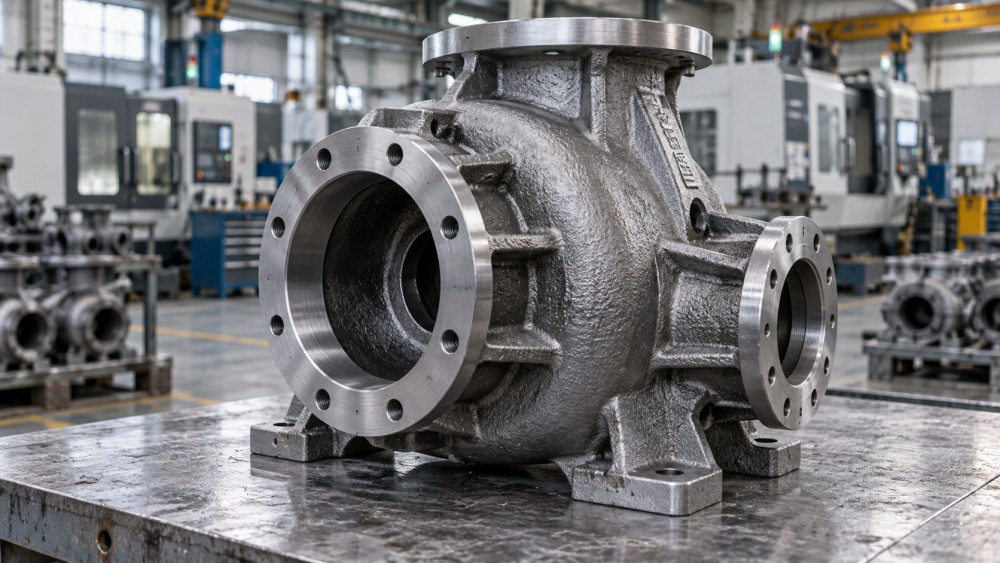
The process is useful when a component needs internal passages, changing wall sections or mounting features that would be difficult to make economically from solid stock. A pump casing is a good example: its flow passages and external connections can be formed near their intended shape, while the flange faces and bearing locations are machined to tighter tolerances.
Casting does not automatically mean a part is ready to install. As-cast surfaces and dimensions are generally less precise than machined features. Designers must also account for how the metal fills and solidifies in the mold. A shape that looks simple on a drawing can be difficult to feed with molten metal as it cools, increasing the risk of shrinkage defects.
Carbon, Low-Alloy and Stainless Steel Casting Grades
Steel casting grades are commonly grouped by their composition and intended service. The groups are useful for comparison, but the actual requirements come from the specified standard, grade and heat-treatment condition—not from the family name alone.
Carbon steel: a practical starting point
Carbon steel castings are widely used for structural components, housings and pressure-containing parts where the service environment does not demand the corrosion resistance of stainless steel. They can provide a useful balance of strength, toughness and cost, although those properties vary with composition, section size and heat treatment.
ASTM A216/A216M, for example, covers carbon steel castings for valves, flanges, fittings and other pressure-containing parts intended primarily for high-temperature service. Grade WCB is commonly encountered under that specification. Its presence on a drawing is not, by itself, proof that a component is suitable for any pressure or temperature: the equipment design and applicable code requirements still have to be checked.
Carbon steel can be an economical choice for a water-handling component, but it needs attention to corrosion protection. The fluid, operating pattern, coating or lining and maintenance plan all matter. An intermittently operated pump can present different corrosion concerns from one that remains continuously full.
Low-alloy steel: properties tailored to demanding service
Low-alloy steels use controlled additions of alloying elements to achieve properties that may be difficult to obtain with a suitable carbon steel grade alone. Depending on the grade and heat treatment, the objective may be higher strength, improved hardenability or better performance at elevated temperature.
For a heavy machinery component exposed to repeated loads, higher strength may allow the designer to manage stresses within a constrained space. But increasing hardness is not a free improvement. It can make machining or repair welding more demanding, and a part that resists deformation still needs adequate toughness for its operating conditions.
Large sections deserve particular attention. Heat does not leave the center of a thick casting at the same rate as it leaves the surface, so achieving a consistent heat-treated condition can be more challenging than it is for a small test piece. Where the application is critical, discuss section thickness and the specified test requirements rather than comparing tensile figures in isolation.
Stainless steel: corrosion resistance with conditions
Stainless steel castings are selected for applications where corrosion resistance is a major concern, including certain pumps, valves and process equipment. ASTM A351/A351M covers austenitic and austenitic-ferritic steel castings for pressure-containing parts; CF8M is one grade that appears in industrial valve and pump specifications.
Stainless does not mean immune to corrosion. Chloride concentration, temperature, oxygen availability, crevices and the duration of exposure can all affect performance. A grade that works well with one water or process fluid may not be the right choice for another. Cast stainless grades should also not be treated as automatic substitutes for familiar wrought grades without checking the relevant specifications and service requirements.
Properties That Matter Beyond the Grade Name
A material certificate may list tensile properties and chemical composition, but a component can fail for reasons that a single number does not capture. The operating question is more useful: what is the part expected to resist, and where?
- Strength helps determine whether the part can carry its design loads without unacceptable deformation or failure.
- Toughness matters when impact, low temperatures or existing discontinuities could make fracture a concern. A minimum impact requirement should be specified when the application calls for one.
- Fatigue resistance becomes important under repeated loading. Surface condition, stress concentrations and internal discontinuities can influence fatigue performance as well as material strength.
- Wear resistance depends on the contact mechanism. Abrasion by sand or mineral particles is not the same problem as sliding wear at a bearing surface.
- Weldability affects fabrication and repair. Composition, section thickness, heat treatment and the qualified welding procedure all influence what is practical.
Heat treatment connects many of these properties. Normalizing, annealing, quenching and tempering are used for different purposes; the applicable grade and specification determine what is required or permitted. A casting should be evaluated in its specified final condition, not simply as an alloy poured into a mold.
How Casting Design Affects the Finished Part
Steel shrinks as it cools and solidifies. Foundries use feeders, often called risers, to supply liquid metal to areas that would otherwise be susceptible to shrinkage. Thick junctions, abrupt changes in section and isolated heavy areas can make this more difficult. Rounded transitions and a more deliberate distribution of material may improve manufacturability, provided the design still meets its structural and functional requirements.
Internal passages add another layer of complexity. A valve body or pump housing may need cores to form its flow path. Core positioning affects wall thickness and the relationship between internal passages and machined connections. This is why a drawing should identify critical dimensions and inspection requirements instead of treating every surface as equally important.
Machining allowance needs thought as well. Too little material can leave a flange face or seal surface incomplete after machining; excessive allowance adds cutting time and can expose subsurface discontinuities that were not visible on the as-cast surface. Foundry and machining teams should agree on datums, allowance and distortion risks before the pattern is finalized.
Where Steel Castings Are Used
Pumps and valves: Bodies, casings and covers combine pressure boundaries with internal flow passages and bolted connections. The material decision depends on pressure, temperature and fluid compatibility. Inspection of pressure-retaining areas and the condition of machined sealing faces are as relevant as the alloy designation.
Construction and mining equipment: Cast brackets, links and structural members can consolidate complex shapes around pins and attachment points. Repeated impact, abrasive contamination and repair access may drive the design. Pin bores often require machining, and the material around them must be assessed for local loads rather than just overall component strength.
Power and process equipment: Housings, valve components and other parts may encounter elevated temperatures or demanding fluids. The selected grade must match the service envelope and governing equipment requirements. Temperature limits should not be inferred solely from a casting specification’s title.
Industrial machinery: Gearbox housings, bearing supports and machine components may benefit from cast shapes that position several features in one part. Alignment depends heavily on subsequent machining and inspection. A sound casting with poorly controlled bearing bores can still create assembly and operating problems.
Casting, Forging or Ductile Iron?
The choice is rarely a contest between universally “better” materials. It starts with the shape and service conditions. Steel casting is attractive for complex geometry and internal cavities. Forging can be a strong candidate for highly loaded shafts or other shapes where the production route and directional properties are advantageous, though the amount of machining and the feasibility of the shape must be considered.
Ductile iron is another established option for many pipe systems, fittings, housings and machine parts. It is not interchangeable with cast steel simply because the components look similar. Their compositions, behavior and applicable standards differ. Pressure service, impact exposure, joining method and project specifications can all change the choice.
Reading Inspection and Material Requirements
No casting process eliminates every discontinuity. The useful question is whether a discontinuity is acceptable for its location and intended service. A small surface indication on a noncritical exterior may be treated differently from an indication near a highly stressed attachment or a pressure boundary. Acceptance criteria need to be agreed against the applicable specification and drawing.
Visual examination and dimensional checks are common starting points. Depending on the component, liquid penetrant or magnetic particle testing may be specified for suitable surface indications; radiographic or ultrasonic testing may be used to assess internal soundness. Each method has limitations, and magnetic particle testing applies only to ferromagnetic materials. A request for “100% inspection” is incomplete unless it also identifies the method, areas, extent and acceptance standard.
For pressure-containing equipment, pressure testing may also be required by the applicable product specification, code or purchase requirements. It is not a substitute for all other examinations: a successful pressure test does not establish fatigue life or demonstrate that every internal feature meets its dimensional requirements.
When reviewing documentation, look for a clear link between the casting, its material identification, heat treatment and required test results. If repair welding is allowed, the procedure, inspection and any subsequent heat treatment should be addressed by the relevant requirements. The level of traceability should match the risk and the project specification.
A sensible next step is to define the service conditions before comparing grades: loads and load cycles, minimum and maximum temperatures, fluid or atmospheric exposure, critical machined features and inspection expectations. That information gives a foundry and the engineering team a basis for discussing a casting that can be produced, verified and maintained—not just an alloy that looks suitable in a table.
Related News
- Why Is Your Heavy-Duty Piston Pump Losing Pressure Under Load?Nov 09, 2026Fluid Power Control Strategist
- Cartridge Valves for Manifold Blocks: Avoiding Cavity Fit ProblemsNov 09, 2026Fluid Power Control Strategist
- Large-Diameter Forged Rings: How Seamless Rolling Affects Grain FlowNov 09, 2026Foundry Phase-Change Fellow
- Sealed Heavy-Duty Roller Bearings: Choosing Seals for Dust and WaterNov 09, 2026Tribology & Kinematics Expert
- Sprockets and Chain Drives: What Determines Replacement Cost?Nov 08, 2026CNC Kinematics Architect
- Monoblock Hydraulic Control Valves: Flow Rating and Spool SelectionNov 08, 2026Fluid Power Control Strategist