
Nickel-Based Alloys Compared: Matching Grade Chemistry to Heat and Corrosion Exposure
Grade names alone do not tell an engineering team whether a nickel alloy will survive a service environment. Two materials may both be described as “high-temperature nickel alloys,” yet one may be selected primarily for oxidation resistance in hot gas, another for strength under sustained load, and another for resistance to chloride-bearing process fluids. A sound comparison starts with the damage mechanism expected in the component, then works backward to the alloy chemistry, product form, fabrication route, and qualification requirements.
For most technical evaluations, the first decision is whether the component is governed mainly by heat, aqueous corrosion, localized corrosion, or a combination of these. That distinction prevents a common specification error: choosing a familiar premium alloy because it has a strong reputation in one environment, while overlooking a more relevant failure mechanism in the actual process.
Start With the Exposure, Not the Alloy Family
Nickel-Based Alloys are commonly grouped by their principal alloying additions: nickel-chromium alloys, nickel-chromium-molybdenum alloys, nickel-copper alloys, nickel-iron-chromium alloys, and precipitation-hardenable nickel alloys. These families overlap in some capabilities, but their chemistry reflects different priorities.
Chromium is central to resistance against oxidation and many oxidizing environments because it supports a protective oxide scale. Molybdenum improves resistance to reducing acids and helps resist localized attack such as pitting and crevice corrosion. Copper is useful in certain reducing acid services, especially where sulfuric or hydrofluoric acid behavior drives selection. Iron may be added for cost, phase stability, thermal properties, or compatibility with specific high-temperature and corrosive environments. Aluminum and titanium support precipitation hardening in selected grades, allowing much higher strength after appropriate heat treatment.
The practical question is therefore not “Which nickel alloy is best?” It is closer to: what is attacking the material, at what temperature, under what stress, in which phase of the process, and with what consequences if the surface condition changes?
A valve trim, pump shaft, heat exchanger tube, exhaust fixture, furnace retort, pressure vessel nozzle, and bolted flange may all be exposed to elevated temperature. They do not necessarily require the same alloy. Gas composition, liquid chemistry, thermal cycling, stagnant zones, chlorides, weld geometry, pressure, and maintenance access can matter more than the maximum design temperature listed on a drawing.
How Chemistry Maps to the Main Service Risks
Oxidation and hot-gas exposure
For dry high-temperature service, nickel-chromium alloys are often considered first because chromium promotes oxidation resistance. Grades in the Alloy 600, 601, and 625 families may all appear in high-temperature equipment discussions, but their intended strengths differ. A chromium-rich alloy such as Alloy 601 is often associated with resistance to oxidation and high-temperature scaling. It can be a logical candidate for furnace components, thermal processing equipment, and certain hot-gas systems where oxide-scale stability is the main concern.
That does not make it a universal answer for all elevated-temperature equipment. Carbon-containing gases, sulfur-bearing species, molten deposits, salts, cyclic temperature excursions, and mechanical loading can change the selection completely. An alloy that forms a stable scale in clean air may perform poorly where deposits disrupt that scale or where carburization becomes dominant. In these cases, material evaluation should include the full gas chemistry and likely contaminants, not only oxygen content and temperature.
Where the component also carries significant load at temperature, creep resistance becomes a separate decision factor. A material can resist oxidation yet lose dimensional stability, relax under bolt load, or deform under sustained stress. High-temperature strength data must therefore be read alongside oxidation data. Short-term tensile strength is not a reliable proxy for long-duration creep performance.
General corrosion in reducing and mixed acids
Nickel-chromium-molybdenum alloys are frequently selected where reducing acids, mixed acid streams, and difficult process fluids create corrosion conditions beyond the range of standard stainless steels. Molybdenum improves resistance in many reducing environments and is particularly valuable where chloride-bearing aqueous media create a risk of localized attack.
Alloy 625 is widely used because it combines a high nickel content with chromium and molybdenum, offering broad corrosion resistance and good fabrication characteristics. It is often evaluated for marine systems, chemical processing equipment, subsea hardware, pollution-control systems, and welded piping components. However, broad resistance should not be interpreted as chemical immunity. Acid concentration, temperature, aeration, oxidizing contaminants, velocity, and crevice geometry can each shift the corrosion response.
Alloy C-276 and related high-molybdenum nickel alloys are often considered for more aggressive chemical environments, especially where reducing and oxidizing species may coexist. Their higher alloy content can provide a larger margin against pitting, crevice corrosion, and certain severe chemical exposures. The increased margin carries implications for cost, availability, welding procedure control, and machining time. Specifying such a material merely as “corrosion resistant” leaves too much room for an unsuitable substitution.
Chloride attack is often a localized problem
Chlorides do not affect every alloy or every system in the same way. The risk rises when chlorides combine with elevated temperature, stagnant liquid, crevices, deposits, wet-dry cycling, or tensile stress. A bulk fluid analysis may look acceptable while a flange gap, gasket interface, threaded connection, tube support, or under-deposit location creates a much more concentrated local environment.
This is why a material comparison should distinguish general corrosion from pitting, crevice corrosion, and chloride stress corrosion cracking. A grade may show low average metal loss but still fail through a deep localized pit or crack. For pressure-containing piping, valves, fasteners, and heat exchanger assemblies, that distinction affects both material grade and mechanical design.
Nickel-rich alloys generally offer better resistance to chloride stress corrosion cracking than common austenitic stainless steels, but the degree of resistance depends on the grade and service details. High nickel content alone is not enough to close the evaluation. Chloride concentration, metal temperature, residual stress, weld condition, and the presence of concentrated evaporative deposits all require consideration.
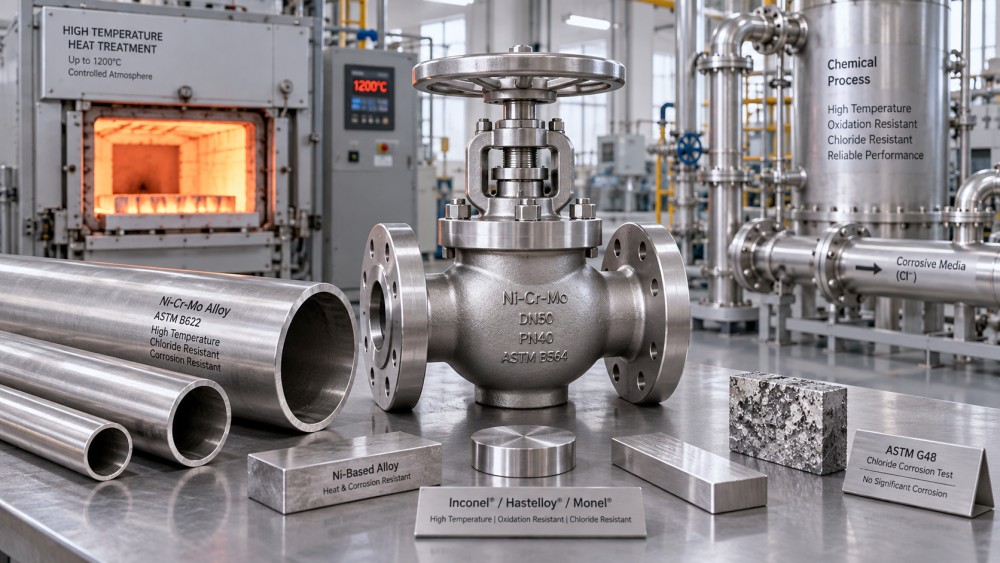
High Temperature Means More Than Maximum Metal Temperature
Engineering specifications often begin with a maximum operating temperature. That is necessary, but it is insufficient for nickel alloy selection. The relevant temperature may be the tube skin temperature, the weld heat-affected zone temperature, the local temperature beneath insulation, or the peak temperature reached during upset conditions. These may differ substantially from the nominal process temperature.
Thermal cycling can be as important as steady-state temperature. Repeated heating and cooling introduces differential expansion, oxide-scale spallation, gasket relaxation, distortion, and fatigue. Components connected to carbon steel, stainless steel, refractory linings, or dissimilar alloy weldments need particular attention because thermal expansion mismatch can impose unplanned stress.
For bolting, springs, turbine-adjacent fixtures, and other loaded components, creep and stress relaxation should be evaluated over the intended operating life. Precipitation-hardenable nickel alloys, including grades in the Alloy 718 family, are used where high strength at elevated temperature is a primary requirement. Their performance depends heavily on controlled heat treatment. A bar, forging, or machined part supplied in the wrong condition may meet nominal chemistry while failing to provide the expected mechanical properties.
There is also a boundary between high-temperature structural alloys and corrosion-resistant nickel alloys. Alloy 718, for example, should not be assumed to replace a high-molybdenum corrosion alloy simply because it is a nickel-based material with impressive strength. Conversely, a highly corrosion-resistant alloy may be mechanically excessive in some areas and inadequate in others if the service load and temperature are not properly defined.
Fabrication Can Alter the Result of a Good Material Choice
An alloy specification that ignores fabrication frequently creates avoidable problems. Many nickel alloys are readily weldable when appropriate procedures, filler metals, cleaning practices, shielding, and heat input controls are used. But “weldable” is not a complete engineering conclusion. Weld metal composition, dilution, restraint, interpass temperature, joint geometry, post-weld requirements, and surface contamination must suit the application.
For corrosion service, a welded assembly should be assessed as an assembly, not as a base-metal coupon. The weld metal and heat-affected zone can have different corrosion behavior from the parent plate or pipe. Surface heat tint, embedded iron contamination from tooling, incomplete root protection, and crevice-producing weld profiles may undermine an otherwise appropriate grade.
Fabricators also need to account for work hardening and machining behavior. Many nickel alloys work harden rapidly and retain strength at cutting temperatures, affecting tool life, cutting parameters, fixture rigidity, and cycle time. Complex machined valve bodies, pump components, forged shafts, and threaded high-pressure fittings can be technically feasible but may require a manufacturing route different from that used for carbon steel or standard stainless products.
Product form matters. Plate, seamless pipe, welded pipe, bar, forgings, castings, and weld overlays do not have identical processing histories or defect risks. A corrosion-resistant wrought alloy may not translate directly into an equivalent casting performance without attention to casting quality, porosity control, heat treatment, machining allowance, and inspection. For thick-section forgings and pressure-retaining parts, chemistry alone should be paired with requirements for mechanical testing, heat treatment records, non-destructive examination where appropriate, and traceable material certification.
Where Grade Comparisons Commonly Go Wrong
The first mistake is treating nominal composition as the whole specification. Two materials sold under a similar commercial designation may differ in governing standard, product form, heat treatment condition, permissible chemistry range, mechanical-property requirements, or supplemental testing. The purchasing description should identify the relevant material standard and the required condition, rather than relying on a shortened grade name.
The second is comparing corrosion resistance without defining the medium. “Seawater,” “acid service,” or “flue gas” are not sufficiently specific design inputs. Seawater systems may include stagnant warm conditions, splash zones, crevices, biofouling, oxygen gradients, and galvanic connections. Acid service may vary by concentration, temperature, impurities, and process upsets. Flue gas may contain moisture, sulfur compounds, chlorides, condensate, ash, or reducing zones. Each can favor a different chemistry.
The third is overlooking galvanic and geometric effects. A nickel alloy component joined to a less noble alloy can change corrosion behavior at the connection. Small carbon steel fasteners, carbon steel support rings, metallic gasket components, deposits at clamp points, and insulation interfaces may become the practical weak point. In piping assemblies, dead legs and crevices deserve review before increasing alloy content across the full line.
The fourth is assuming a more highly alloyed grade is automatically a lower-risk choice. Higher alloy content can improve resistance in a specific mechanism while increasing material cost, lead time sensitivity, fabrication complexity, or the consequence of an uncontrolled substitution. A technically defensible specification identifies the mechanism being controlled and the acceptance criteria used to verify the material.
A More Useful Evaluation Sequence
Technical teams can make grade comparison more efficient by defining the service envelope before requesting quotations or approving a material data sheet. The following questions usually reveal whether the material decision is mature enough to specify:
- What are the normal, startup, shutdown, and upset temperatures at the metal surface?
- Is the exposure dry gas, aqueous liquid, condensate, deposit, slurry, molten material, or alternating wet and dry service?
- Which species control corrosion risk: chlorides, reducing acids, oxidizers, sulfur compounds, caustic compounds, fluorides, or mixed contaminants?
- Is the expected failure mode general thinning, pitting, crevice attack, stress corrosion cracking, oxidation, carburization, sulfidation, creep, or thermal fatigue?
- Will welds, threads, gasketed joints, stagnant zones, deposits, or dissimilar-metal interfaces create local conditions harsher than the bulk process?
- Which product form and material condition are required, and what documentation must demonstrate compliance?
These inputs do not eliminate the need for specialist corrosion review in severe duty, but they prevent the specification from becoming a grade-name exercise. They also make supplier discussions more productive because the fabricator can address weld procedure qualification, stock form, machining method, inspection scope, and traceability against a defined service condition.
Specify the Evidence Along With the Alloy
For critical equipment, the final specification should connect material identity to verification. Heat or lot traceability, chemical analysis, mechanical test reports, heat-treatment condition, dimensional inspection, and applicable non-destructive testing should align with the component’s failure consequences. A pressure-retaining forged body, a corrosion-critical tube bundle, and a machined high-temperature fastener will not require the same evidence package.
Where material substitution is possible, the approval process should require more than a statement that the proposed alloy is “equivalent.” Equivalence must be established against the actual service mechanism, governing standard, product form, strength requirement, weldability, and any corrosion allowance or design-life assumptions. This is particularly important where a familiar nickel alloy grade is being replaced by a variant with a similar name but different molybdenum, chromium, carbon, or strengthening chemistry.
The most reliable nickel-alloy choices are usually made by narrowing the problem first: identify the local environment, separate corrosion resistance from high-temperature strength, and evaluate the finished component rather than the base-metal label alone. Once those conditions are explicit, grade chemistry becomes a practical engineering tool instead of a broad claim of premium material performance.
Related News
- Using Industrial Air Blow Guns to Clear Chips Without Spreading DebrisOct 15, 2026Fluid Power Control Strategist
- Ductile Iron Pipe Valves: Which AWWA Standards Apply to Water Main Projects?Oct 15, 2026Dr. Elias Vance
- Why Vacuum Suction Cups Lose Grip on MDF in Woodworking MachinesOct 15, 2026CNC Kinematics Architect
- Choosing a Variable Displacement Piston Pump Manufacturer: What to VerifyOct 15, 2026Fluid Power Control Strategist
- Parallel vs. Angular Pneumatic Grippers for Confined Assembly StationsOct 15, 2026Fluid Power Control Strategist
- Die Castings vs. Investment Castings: Which Costs Less at Your Production Volume?Oct 14, 2026Foundry Phase-Change Fellow