
How Reliable Is an IMPE Supplier for Municipal Water Project Parts?
Reliability cannot be assumed from a catalog, a stated pressure class, or the fact that a supplier offers ductile iron pipes, fittings, valves, and fabricated components. An IMPE supplier is reliable for municipal water project parts only when its documented capability matches the exact operating, installation, and inspection conditions of the project. The strongest evidence is a consistent chain from material source through manufacturing, testing, packing, delivery, and support during installation.
Municipal water systems are unforgiving of small mismatches. A pipe may meet a nominal size requirement yet create problems because the joint profile does not match the specified gasket system. A valve body may have an acceptable casting appearance but lack traceable test records. A coating may look intact at shipment while being unsuitable for abrasive backfill, aggressive soil, or long storage outdoors. Reliability therefore needs to be judged part by part and document by document, rather than treated as a general supplier characteristic.
What proves reliability before an order is placed?
The first useful signal is whether the supplier can convert the project specification into a controlled supply scope. This should include the required pipe diameter, wall or pressure designation, joint type, coating system, lining, flange drilling, valve end connection, accessory compatibility, inspection records, marking, packing method, and delivery sequence. Vague confirmations such as “standard water pipe available” leave too much room for substitution.
A dependable source asks for clarification where the specification contains a conflict. For example, a flexible push-on joint, a restrained joint, and a flanged connection serve different installation conditions. They should not be treated as interchangeable simply because the nominal pipe diameter is the same. Likewise, a valve intended for isolation has different operating demands from one used for throttling or pressure control. A supplier that identifies these distinctions early is less likely to deliver parts that fit the purchase description but fail in the field.
Material traceability is the next test. Pipes, fittings, valve bodies, gland components, fasteners, and custom machined pieces should be linked to identifiable production lots or heat records where the specification calls for such control. Traceability is useful only when it connects the delivered item to a material certificate, inspection result, and permanent or durable product marking. A loose set of certificates with no connection to shipment markings provides limited assurance.
For ductile iron components, the material record should support the required mechanical properties and relevant production controls. For fabricated steel spools or special flanged adaptors, traceability should extend to the base material and welding-related records when welding is part of the scope. The aim is not paperwork for its own sake. It is to prevent a project from discovering after installation that mixed grades, substituted castings, or undocumented repairs were introduced into the supply chain.
Pressure ratings need to be read in context
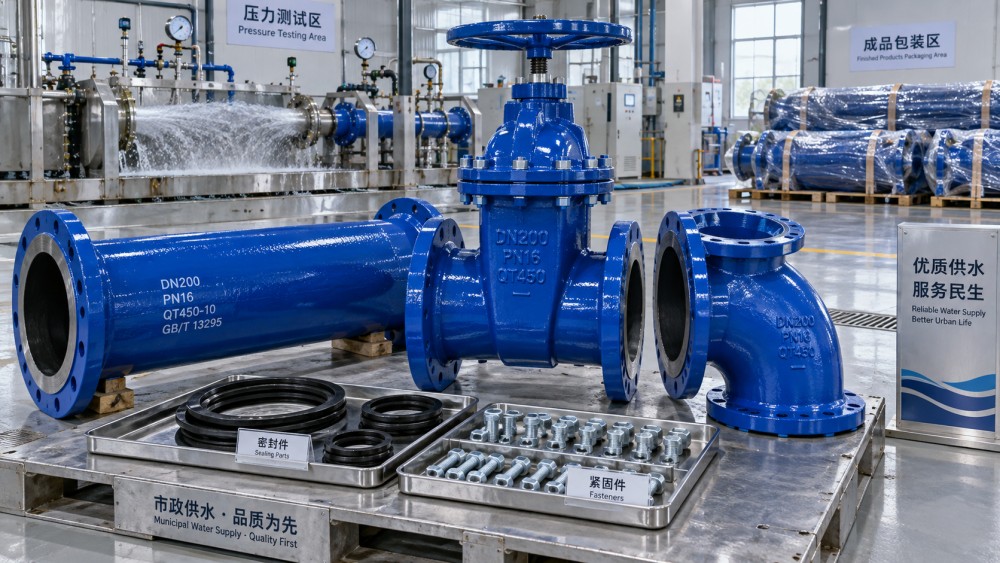
Pressure capability is often misunderstood because a single rating does not describe the entire water system condition. Static working pressure, transient pressure from pump starts or stops, elevation changes, vacuum exposure, and testing pressure can place different demands on pipes and appurtenances. A component suitable for ordinary operating pressure may still be unsuitable at a location exposed to surge events or a difficult hydrostatic test procedure.
The relevant question is whether the supplied assembly has a coherent pressure basis. Pipe, fittings, valves, flanges, couplings, gaskets, bolts, and restrained-joint accessories need compatible limits. The weakest connection governs the assembly. A higher-rated pipe does not compensate for an inadequately rated dismantling joint, thin flange adaptor, or gasket system that is not designed for the expected movement and pressure cycle.
Dimensions deserve the same scrutiny. Nominal diameter does not guarantee fit across different connection systems. Outside diameter, flange face arrangement, bolt circle, gasket seating geometry, insertion depth, and allowable angular deflection can affect installation. A supplier that provides dimensional drawings and confirms mating interfaces reduces the risk of finding an incompatibility once trenches are open or a pump station tie-in has begun.
Coatings and linings reveal whether the supply is suited to the site
External protection must match the route, not merely the product category. Soil moisture, chloride exposure, stray current concerns, rocky backfill, groundwater conditions, and the likelihood of coating damage during handling all influence the appropriate protection approach. A coating system that performs well in one buried environment may need added protection or a different specification in another.
Internal lining should be evaluated against water chemistry, velocity, expected abrasiveness, and the function of the line. Smooth cementitious linings, protective polymer systems, and other internal finishes have different service boundaries. The lining must also remain sound at cut ends, fittings, bends, and field-made connections. A strong supplier can explain how factory-applied protection is continued or repaired after cutting, drilling, or handling damage.
Visual inspection is necessary but incomplete. Pinholes, poor adhesion, insufficient dry film thickness, surface contamination before application, and damaged edges may not be obvious at a casual glance. Reliable delivery records identify the coating or lining system used, the inspection method required by the purchase specification, and the treatment of repair areas. The answer should be specific to the actual items, not a generic statement that all products are corrosion resistant.
Testing capability matters only when it is connected to the shipment
Hydrostatic testing, dimensional inspection, coating inspection, non-destructive examination, functional valve testing, and material verification have different purposes. A supplier does not become reliable merely by listing all of them. The meaningful issue is whether the selected tests address the failure modes of the supplied parts and whether the reports identify the actual batch or serialised item.
For pressure-retaining castings, testing should address casting integrity and pressure containment where required. For valves, functional operation should be considered alongside shell integrity. A valve can pass a static pressure test yet still have unacceptable operating torque, poor seating performance, stem misalignment, or actuator incompatibility. For custom machined components, critical dimensions, surface finish at sealing faces, thread form, concentricity, and bore alignment may matter more than broad general tolerances.
Sampling plans require careful reading. A test on one representative item may be appropriate for a controlled production batch, but it may be weak evidence for mixed items, special castings, low-volume fabricated pieces, or lots produced over a long period. The required inspection level should reflect the consequence of failure, the complexity of the item, and the ability to replace it after installation.
Manufacturing consistency is visible in the details
Reliability is often lost at the interfaces between processes. A casting foundry, machining shop, coating line, assembly area, and logistics warehouse may each perform competently while the handoff between them remains poorly controlled. Examples include machined flange faces exposed before coating, gaskets separated from their matched fittings, valve actuators installed without final travel verification, or pipe bundles shipped without protection at joint ends.
Look for evidence that these interfaces are managed. Clear item identification, controlled revisions of drawings, inspection hold points, records for nonconforming parts, and packaging instructions are practical indicators. Where the project includes special fittings, transition pieces, or custom assemblies, drawing approval alone is not enough. The fabrication route, machining reference surfaces, welding sequence, coating access, and final inspection points should be understood before production begins.
Cast iron fittings and valve bodies deserve attention around areas of geometric change: branch intersections, flange transitions, seat pockets, and thick-to-thin sections. These areas can be more sensitive to shrinkage, machining distortion, or local coating defects than straight pipe sections. A reliable supplier does not need to claim that defects are impossible; it needs a credible method for detecting, segregating, repairing where permitted, or rejecting nonconforming material.
Delivery reliability includes preservation and sequence
Municipal work is commonly delayed by missing small items rather than by missing mainline pipe. Gaskets, bolts, glands, flange adaptors, repair clamps, valve extension components, restraint accessories, and connection pieces must arrive in the correct quantity and with enough identification to prevent mixing. A shipment that is technically complete on paper can still disrupt installation when accessories are packed separately without clear references to the associated main items.
Delivery sequence matters when storage space is restricted or installation follows a staged route. Heavy pipes and fittings need loading arrangements that reduce the chance of damaged linings, chipped coatings, distorted ends, or lost accessories. Packaging should preserve sealing surfaces and joint ends while remaining practical for unloading. Long storage periods also need consideration, particularly for elastomeric gaskets, protective coatings, actuated valves, and parts kept outdoors.
Technical support is tested when conditions change
Project conditions frequently reveal questions that were not obvious at tender stage: an existing pipe has an unexpected outside diameter, a buried valve needs a different extension arrangement, a joint must accommodate local deflection, or a delivered fitting does not align with a revised civil layout. Supplier reliability is reflected in the speed and quality of the technical response, but speed alone is not enough. The response should identify the affected component, confirm whether a proposed change alters pressure capacity or corrosion protection, and provide a controlled drawing or written disposition where needed.
Field modifications are a common source of avoidable failure. Cutting pipe, welding near protected surfaces, drilling for service connections, re-machining flanges, or changing fastener grades can invalidate assumptions made during factory testing. A reliable source gives clear limits for permissible modification and distinguishes between a routine site adjustment and a change requiring engineering review.
Where an apparently reliable offer can still fail
Low apparent risk is sometimes created by comparing only unit descriptions. Two offers for a “ductile iron fitting” may differ in pressure classification, wall geometry, coating preparation, flange dimensions, machining quality, included accessories, or test documentation. The lower-priced description may therefore represent a different technical scope rather than a genuine equivalent.
Another frequent error is accepting a complete set of documents before confirming that they apply to the final production run. Documents issued during qualification, sample approval, or a prior order are not substitutes for records tied to the delivered lot. Revision control is equally important. A fitting produced to an earlier drawing can be dimensionally sound and still be wrong for the final connection arrangement.
Reliability should also be separated from product availability. Stock availability can be valuable for urgent repairs, but stocked items require the same review of age, storage condition, marking, gasket preservation, coating condition, and specification match. Immediate shipment is useful only when the item is genuinely fit for the intended location.
A practical basis for acceptance
A defensible assessment combines four questions: Is the supplied material identifiable and traceable? Does every component match the hydraulic, mechanical, corrosion, and connection requirements of its installed location? Are the test and inspection records linked to the actual shipment? Can deviations, damaged parts, and site changes be resolved through documented technical control?
When the answer to all four is supported by drawings, records, samples where appropriate, and clear communication, an IMPE supplier can be treated as a credible source for municipal water project parts. When confirmation rests mainly on broad product claims or disconnected certificates, the reliability level remains unproven regardless of the stated product range.
Related News
- How to Assess a Rigid Coupling Supplier for Bore Accuracy and Traceable QualityOct 08, 2026Tribology & Kinematics Expert
- Titanium Alloys Compared: Balancing Strength, Corrosion Resistance, and MachinabilityOct 08, 2026CNC Kinematics Architect
- Where Ductile Iron Dismantling Joints Reduce Alignment Risk in Water PipelinesOct 08, 2026Pipeline Metallurgy Scientist
- Selecting a Precision Bearing Sleeve: Fits, Runout, and Material ChoicesOct 08, 2026Tribology & Kinematics Expert
- Face Milling Cutters: How Insert Geometry Affects Finish on Steel and AluminumOct 08, 2026CNC Kinematics Architect
- Single-Acting Cylinders for Clamping: Stroke, Force, and Return Spring ConsiderationsOct 07, 2026Fluid Power Control Strategist