
Are Steel Castings Consistent Across Suppliers for Municipal Projects?
Steel castings used in municipal water, wastewater, drainage, pumping, and treatment projects are not automatically interchangeable simply because two suppliers quote the same grade. A valve body marked “cast carbon steel,” a stainless steel pump casing, or a fabricated-casting transition component may appear comparable on a quotation sheet, yet differ materially in soundness, machining allowance, pressure integrity, corrosion behavior, dimensional stability, and documentation quality.
For municipal projects, where installed assets may remain in service for decades and repair access can be expensive, the practical question is not whether suppliers can produce steel castings to a nominal specification. Most established foundries can. The more important question is whether they can produce repeatable castings that meet the project’s actual design, inspection, assembly, coating, and lifecycle requirements across every production lot.
The answer to “Are steel castings from different suppliers consistent enough for municipal projects?” is therefore conditional. They can be consistent when requirements are well defined, supplier processes are controlled, and verification is built into procurement. They are often inconsistent when buyers rely on grade names, generic certificates, or sample approvals alone.
Nominal grade is only the starting point
Municipal specifications often identify materials through a recognized standard and grade: for example, carbon steel castings under ASTM A216, low-temperature grades under ASTM A352, stainless grades under ASTM A351, or equivalent material systems under EN 10213. Those standards provide an essential baseline for chemical composition, mechanical properties, heat treatment, and acceptance requirements. They do not, by themselves, guarantee that two suppliers will deliver parts with identical field performance.
A material designation tells a buyer what range of properties the casting should achieve under the applicable standard. It does not fully describe:
- the foundry’s melting and charge-control discipline;
- gating, risering, feeding, and solidification design;
- how the supplier controls shrinkage, porosity, inclusions, and hot tears;
- the consistency of heat treatment across casting sections and batches;
- actual machining datum control and wall-thickness distribution;
- the extent and sensitivity of non-destructive examination;
- coating preparation, coating cure, and handling after inspection.
This distinction matters most for pressure-retaining and load-bearing parts. A small casting discontinuity that is acceptable in a lightly loaded support bracket may be unacceptable in a pump casing, sluice gate component, pressure valve body, flange adapter, or treatment-plant actuator housing. Two castings may both pass tensile testing from separately cast test coupons while having different internal integrity in their thickest, slowest-cooling sections.
Municipal teams should also avoid treating “steel casting” as one product category. The risks differ substantially between a carbon steel valve body exposed to treated water, a stainless steel impeller in corrosive wastewater service, a cast steel gate frame exposed to cyclic load and immersion, and a structural casting incorporated into bridge-mounted pipework. Service medium, pressure, temperature, cyclic loading, corrosion exposure, and maintenance access should determine the level of control required.
Where supplier-to-supplier variation usually appears
The most consequential variations are often invisible at incoming inspection. Surface appearance may be acceptable, dimensions may fit a basic gauge, and a material certificate may show compliant chemistry. Problems can still emerge during pressure testing, machining, coating application, assembly, or years later in service.
Metallurgical control and heat treatment
Steel casting chemistry is not merely a matter of keeping carbon, manganese, chromium, nickel, and other elements within permitted limits. The interaction of chemistry, section thickness, cooling rate, and heat treatment affects microstructure and mechanical behavior. A foundry with stable melting practice and documented heat-treatment cycles is better positioned to produce predictable properties than one that relies mainly on final chemistry checks.
For carbon and low-alloy steel castings, excessive hardness or uneven microstructure can complicate machining and increase susceptibility to brittle behavior in certain operating conditions. For stainless castings, incorrect ferrite balance, inadequate solution treatment, or poor control of alloy recovery can affect corrosion resistance and weldability. These issues are especially relevant where castings will be welded into assemblies or exposed to chloride-bearing environments, sewage gases, industrial discharge, or coastal conditions.
Internal soundness and pressure integrity
Foundry process capability becomes critical at changes in section thickness, flange-to-body intersections, heavy bosses, and areas around cores. These geometries are prone to shrinkage cavities, gas porosity, sand inclusions, and other discontinuities if feeding and solidification are not properly controlled.
Hydrostatic testing is valuable, but it should not be interpreted as proof that a casting is free from meaningful internal defects. A pressure test confirms performance at a specified test condition and duration. It may not reveal discontinuities that do not yet communicate with the pressure boundary, or defects that become relevant after machining removes surface stock. For critical zones, the purchase specification may need to state radiographic, ultrasonic, magnetic particle, or liquid penetrant examination requirements, along with acceptance criteria and examination coverage.
The selected method must match the material and defect concern. Magnetic particle testing can identify surface and near-surface discontinuities in ferromagnetic steels. Liquid penetrant testing is useful for surface-breaking defects on suitable clean surfaces, including many stainless grades. Radiography can reveal certain internal volumetric defects, while ultrasonic examination is useful for assessing internal discontinuities in appropriate geometries. None should be specified as a generic checkbox; each has limits related to section thickness, geometry, accessibility, surface condition, and inspector qualification.
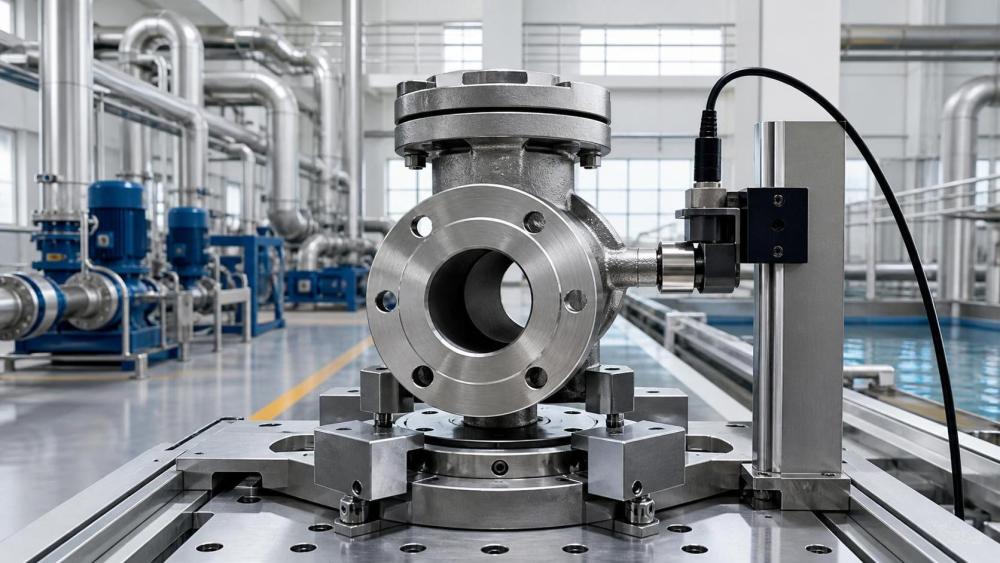
Dimensional repeatability after casting and machining
A common procurement error is to compare suppliers only against final drawing dimensions. That is necessary but incomplete. Consistency also depends on how a supplier controls casting shrinkage, core movement, distortion during heat treatment, machining fixtures, datum strategy, and inspection methods.
For municipal assemblies, dimensional variation can create field consequences beyond the individual casting. Misaligned flange faces, bolt-circle errors, inconsistent bore geometry, poor perpendicularity, or excess runout may delay installation and force site rework. On valve and pump components, dimensional inconsistency can affect seat leakage, stem alignment, bearing fit, impeller clearance, or actuator mounting. A low unit cost can be quickly lost if installation crews must modify parts in the field.
Buyers should separate “as-cast” tolerances from machined tolerances and define critical-to-function dimensions explicitly. General tolerances may be appropriate for non-critical external surfaces, but sealing faces, bores, threaded connections, bearing seats, guide surfaces, and mating interfaces need clear requirements. Where a casting must fit an existing installed system, reverse-engineered dimensions and legacy interfaces require additional verification before serial production.
Surface condition, coating, and corrosion protection
Municipal asset owners frequently focus on base metal while underestimating coating-system variation. In water and wastewater applications, a coating failure can become the first visible sign of inadequate surface preparation, contamination, sharp-edge treatment, or poor cure control.
The casting supplier may supply bare castings, primer-coated parts, or fully coated products. Each arrangement changes responsibility. If the foundry applies the protective system, specifications should define surface-preparation standard, profile requirements where relevant, coating type, dry-film thickness, holiday testing when applicable, curing conditions, repair procedures, and documentation. If coating is performed by an assembler or project contractor, the foundry still needs to deliver surfaces that can be properly prepared without excessive grinding or repair.
Compatibility matters. A coating suitable for external atmospheric exposure may not be suitable for immersion, potable-water contact, abrasive slurry, wastewater gas exposure, or buried service. For potable-water applications, coatings, linings, gaskets, and other wetted materials may need to meet the approval requirements applicable in the destination market. A statement that a product is “water safe” is not a substitute for project-specific compliance evidence.
Why samples and certificates do not always predict production quality
Initial samples are useful, but they are a weak basis for judging long-term supplier consistency if they are not linked to the intended production process. A foundry can devote unusual attention to a first article, use a preferred mold line, machine it with extra care, and pass a controlled inspection. The risk emerges when volume increases, patterns age, operators change, outsourced heat treatment is introduced, or delivery pressure encourages shortcuts.
Similarly, a material test report is essential but limited. It should identify the heat or melt, chemical analysis, mechanical test results, heat-treatment status where applicable, and linkage to the supplied lot. However, a certificate does not independently prove that every casting received the same process control or that all critical areas were inspected. Traceability is meaningful only when heat numbers, casting IDs, machining records, non-destructive test reports, repair-weld records, and final inspection records can be connected.
For projects with meaningful failure consequences, qualification should move beyond a one-off sample. A more reliable approach is to review production-representative castings, preferably including difficult geometries and the full proposed route: pattern making, molding, melting, pouring, heat treatment, rough machining, non-destructive testing, finish machining, pressure testing, coating, packing, and shipment.
Standards should be converted into a project-specific quality plan
Many disputes arise because a purchase order cites a standard but leaves important acceptance details undefined. The standard may permit options, different test frequencies, different repair practices, or different levels of examination. If the project team has a particular expectation, it should be written into the technical specification rather than assumed.
A practical quality plan for municipal steel castings usually addresses the following points:
- Material and service definition: required casting grade, applicable edition of the standard, design pressure, temperature range, fluid exposure, corrosion allowance, and intended service life.
- Manufacturing route: approved foundry location, subcontracting controls, pattern ownership, heat-treatment arrangements, and restrictions on unapproved process changes.
- Critical geometry: drawing revision control, machining datums, wall-thickness requirements, flange and bore tolerances, and clearly identified critical zones.
- Examination scope: type, extent, timing, and acceptance level for visual inspection, dimensional inspection, pressure testing, and non-destructive testing.
- Weld repair policy: whether weld repair is permitted, which areas require prior approval, repair procedure qualification, post-repair examination, and repair-record requirements.
- Documentation and traceability: heat identification, inspection records, certificates, coating records, nonconformance reporting, and retention requirements.
- Release and change control: hold points, witness points, first-article approval, notification of process changes, and handling of deviations.
Weld repair deserves particular attention. Repair welding is not automatically evidence of poor quality; it is an established practice when controlled and permitted by the applicable specification. The concern is undocumented or excessive repair, especially in pressure-boundary or high-stress regions. Buyers should define the approval route in advance rather than discovering the issue after delivery.
Comparing suppliers: capability matters more than catalog breadth
A supplier comparison should evaluate the production system behind the quotation. A broad product catalog, a long list of grades, or a low price does not establish repeatability. More revealing questions include whether the supplier makes similar parts routinely, how it controls melting and heat treatment, what inspection equipment it owns, which operations are outsourced, and how it manages nonconforming material.
Foundry audits are particularly valuable for castings with pressure, safety, or high replacement-cost implications. The purpose is not to assess housekeeping alone. A useful audit follows the actual process: incoming raw materials, charge records, melt analysis, mold and core production, pouring controls, shakeout, heat treatment, fettling, repair welding, machining, inspection, marking, packing, and corrective-action records.
Capacity should also be interpreted carefully. A supplier may have enough theoretical tonnage but insufficient machining capacity, inspection personnel, coating space, or packing discipline to support the delivery schedule. Municipal projects often involve staged deliveries, variable quantities, and coordination with civil works. In that environment, stable lead times and controlled lot segregation can be as important as the casting price.
When multi-sourcing is sensible—and when it increases risk
Using more than one approved source can reduce commercial and delivery risk, particularly for standard, non-critical cast components. It can also improve negotiating leverage and protect a project against disruption. But multi-sourcing should not mean mixing visually similar castings without qualification.
For critical assemblies, suppliers should be qualified against the same technical baseline, and interchangeability should be demonstrated rather than assumed. This is especially important where castings mate with proprietary valve trims, pump internals, actuator interfaces, legacy pipework, or standardized spare-part inventories. A second source may meet material requirements while producing a slightly different geometry, machining interpretation, or coating arrangement that complicates maintenance later.
Where long-term spare availability is important, municipal owners should consider controlling drawings, approved deviations, pattern rights, and documentation access. Depending entirely on one supplier’s proprietary pattern and process knowledge can create a lifecycle procurement problem even when the initial supply performs well.
The decision should be based on consequence, not on fear of variation
Variation between steel casting suppliers is real, but it is manageable. The appropriate level of scrutiny should reflect the consequence of failure. A non-pressure accessory in an accessible installation does not need the same qualification burden as a large pressure-retaining casing in a remote pumping station or a critical component in a flood-control structure.
The strongest procurement decisions do not demand every possible test for every part. They identify what can fail, where it is likely to fail, how detectable the failure is before installation, and what the operational consequence would be. From there, requirements for materials, inspection, traceability, and supplier control can be set proportionately.
Steel castings from different suppliers can be sufficiently consistent for municipal projects, but only when “consistent” is defined in operational terms: fit at installation, integrity under service conditions, documented conformity, reliable coating performance, and repeatable delivery quality. A grade designation establishes the floor. A disciplined specification and supplier-qualification process determine whether the casting is dependable in the field.
Related News
- How to Assess a Rigid Coupling Supplier for Bore Accuracy and Traceable QualityOct 08, 2026Tribology & Kinematics Expert
- Titanium Alloys Compared: Balancing Strength, Corrosion Resistance, and MachinabilityOct 08, 2026CNC Kinematics Architect
- Where Ductile Iron Dismantling Joints Reduce Alignment Risk in Water PipelinesOct 08, 2026Pipeline Metallurgy Scientist
- Selecting a Precision Bearing Sleeve: Fits, Runout, and Material ChoicesOct 08, 2026Tribology & Kinematics Expert
- Face Milling Cutters: How Insert Geometry Affects Finish on Steel and AluminumOct 08, 2026CNC Kinematics Architect
- Single-Acting Cylinders for Clamping: Stroke, Force, and Return Spring ConsiderationsOct 07, 2026Fluid Power Control Strategist