
Machinable Gray Cast Iron: Selecting Grades for Stable CNC Base Components
A CNC base can look acceptable after rough machining and still become the source of accuracy problems later: spindle alignment shifts during long cycles, a precision slide needs repeated compensation, or a finished machine transmits more vibration than expected. In these situations, the issue is not always the machining process or assembly method. The casting may lack the combination of damping behavior, section consistency, stress stability, and machinability required for a structural base.
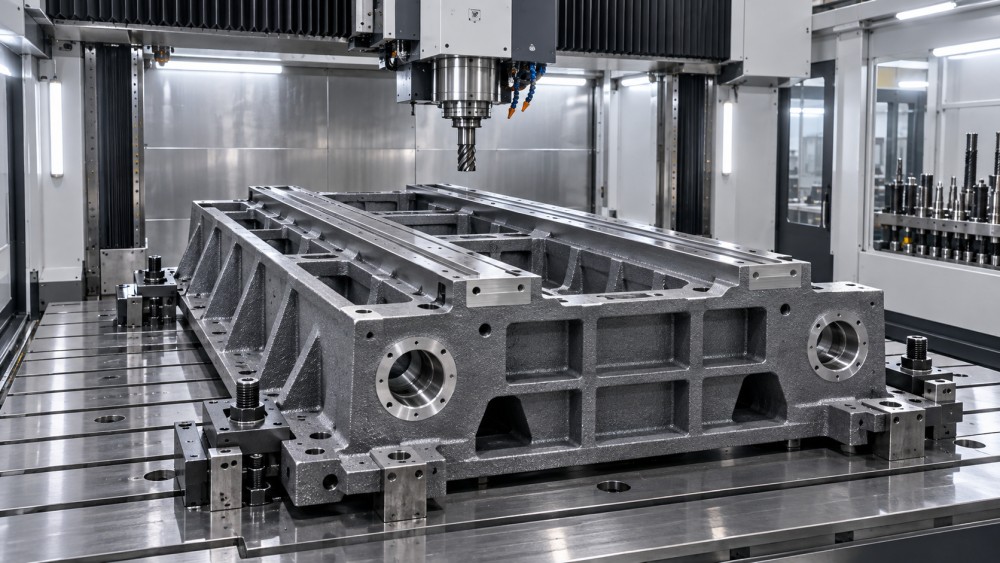
For stable CNC base components, the practical selection rule is to start with a moderate-strength gray iron grade that produces a predominantly fine, well-distributed flake graphite structure in the actual casting section, then verify its casting process and stress-relief route. A higher tensile-strength designation is not automatically better. Machinable gray cast iron must support the geometry, guideway loading, thermal environment, and finishing process of the base—not merely meet a nominal hardness or strength target on a separately cast test bar.
Start with the function of the base, not the grade name
Gray cast iron remains widely used for machine bases, columns, beds, housings, and bearing supports because graphite flakes interrupt vibration transmission and provide useful internal damping. The same graphite morphology also helps with chip formation during machining. Yet these benefits vary substantially with chemical balance, cooling rate, wall thickness, matrix structure, and foundry process control.
A technical review should first identify what the component must do in service. A compact base under a high-speed machining center has a different material demand from a long bed carrying linear rails, a rotary-table housing, or a large foundation casting for a grinder. The critical questions are usually:
- Will the casting primarily resist static load, or must it suppress cutting vibration?
- Are rail seats, spindle bores, hydraulic passages, or precision datum surfaces machined after stress relief?
- Does the geometry contain thick-to-thin transitions that may cool at different rates?
- Will the part experience local heat from motors, coolant circulation, friction, or ambient temperature cycling?
- Is the base expected to receive bonded polymer concrete, steel inserts, hardened guideways, or large bolted assemblies?
These conditions determine whether the main risk is excessive deflection, poor vibration damping, difficult machining, residual-stress movement, or inconsistent properties from one area of the casting to another.
Why nominal strength alone can mislead a selection
Gray iron is often specified through tensile classes, such as ASTM A48 classes or EN gray iron designations such as EN-GJL grades. These labels are useful procurement references, but they do not fully describe the material condition of a machine base. Tensile strength generally rises as the matrix becomes more pearlitic and graphite becomes finer or less abundant. This can improve local strength and wear resistance, but it may also reduce machinability, increase tool wear, and make process variation more consequential.
A lower-strength grade is not inherently more stable, and a higher-strength grade is not inherently less stable. What matters is whether the grade and foundry practice achieve the intended microstructure throughout the casting. A relatively thick machine bed can cool slowly and develop a different matrix than a thin mounting pad cast from the same melt. If the specification only calls for a grade designation without defining critical-section expectations, the supplier may meet the stated class while the machined base still behaves inconsistently across its geometry.
The grade range should match the component’s job
For many machine frames and bases, a medium-grade gray iron is often the starting point because it offers a useful compromise between damping, castability, strength, and machining behavior. In EN terminology, grades in the general EN-GJL-200 to EN-GJL-250 range are frequently considered for structural machine castings, while ASTM A48 Class 30 or Class 40 may be used as reference points in specifications. These are not direct equivalents, and neither system should be substituted without reviewing the applicable standard and required properties.
A relatively lower grade may be appropriate where high damping, easier machining, and low localized stress dominate, particularly in large, well-ribbed castings with generous sections. The concern is that insufficient strength or hardness can leave threaded regions, concentrated mounting pads, or heavily loaded guideway zones vulnerable to deformation or surface damage.
A higher grade can be justified where the base includes heavily loaded bearing seats, compact sections, high bolt preload, or local contact stresses. However, the evaluator should ask whether the higher grade is required throughout the casting. Sometimes a uniform high-strength specification adds machining difficulty without solving the actual structural problem. Better rib placement, steel inserts, local hardening, or a revised load path may be more effective than raising the entire casting grade.
When reviewing machinable gray cast iron for a base, avoid treating “harder” as shorthand for “better.” Excessively high or widely variable hardness can create unstable cutter loading, short tool life, damaged inserts, and uneven surface finish. A base that is difficult to machine also becomes more expensive to inspect and correct after stress relief.
Graphite structure is where damping and machinability meet
The graphite in gray iron is not simply a carbon content issue. Flake shape, size, orientation, and distribution affect how the material absorbs vibration and how it behaves under a cutting edge. A stable machine base generally benefits from a uniform graphite distribution rather than isolated coarse flakes, severe segregation, or abrupt microstructural changes near heavy sections.
Fine-to-medium, evenly distributed flakes are often desirable for structural castings because they support consistent machining and predictable stiffness. Very coarse graphite may improve some damping characteristics but can reduce local strength and produce uneven surface behavior in precision-machined areas. Extremely fine graphite combined with a hard pearlitic matrix can increase strength, but it may remove part of the machining advantage expected from gray iron.
Graphite orientation also matters near loaded surfaces. Gray iron is not isotropic in the way a homogeneous steel billet may be treated in preliminary calculations. Solidification patterns and section transitions can influence local properties. This is especially relevant near rail mounting lands, spindle interfaces, column joints, and large threaded holes. A drawing should identify these functional regions so the foundry can consider gating, feeding, riser placement, chills, and machining allowance accordingly.
Dimensional stability depends on the manufacturing route
Material selection cannot be separated from process sequence. A correctly chosen grade can still move after machining when residual stress remains from uneven cooling, core restraint, heavy ribs, or local geometry changes. The risk becomes visible when a casting is rough machined, held on a fixture, and then released: datum surfaces may shift, bores may lose positional relationship, and long rail seats may require unexpected rework.
Stress relief should be evaluated as part of the component specification rather than treated as a generic supplier promise. Thermal stress relief is commonly used for precision machine castings, but the required cycle depends on grade, mass, geometry, and the foundry’s validated practice. Artificial aging, natural aging, or staged rough machining may also be used in a broader stability plan. The important point is not to prescribe an arbitrary duration without context; it is to define the dimensional outcome and the process evidence needed to support it.
A robust route for demanding bases often includes rough machining before final stress relief or an intermediate stabilization stage, followed by finish machining of precision surfaces. The order may change according to casting mass and fixture strategy, but the logic remains consistent: remove material in a way that does not release major unbalanced stress immediately before final geometry is established.
Questions that expose hidden stability risk
- Which surfaces are machined before and after stress relief?
- Are long guideway pads and precision bores finished in the same clamping condition where practical?
- How are the casting datums established after rough machining?
- Is there enough machining allowance to remove scale, decarburized skin, local distortion, and minor surface discontinuities?
- Are critical dimensions checked after unclamping and after sufficient temperature equalization?
These questions often reveal more about likely base stability than an isolated material certificate.
Specify machinability in operational terms
“Machinable” should not be left as an informal expectation. The machining department needs a material condition that supports predictable milling, boring, drilling, and grinding. For a base component, this commonly means avoiding hard carbides, chilled edges, slag-related inclusions, sand penetration, and severe hardness variation between pads and ribs.
Hard spots are particularly disruptive. They may appear at thin edges, near chills, around section changes, or where local chemistry and cooling history differ. A cutter entering one of these zones can suffer rapid wear or deflection, leaving a surface that appears acceptable at first but does not hold flatness after subsequent passes. Large castings also need sufficient allowance because surface layers can contain foundry-related irregularities that should not remain beneath a finished rail seat or sealing face.
Instead of demanding a single hardness number for the whole casting, define a suitable hardness range and identify locations where readings are meaningful. Surface readings near an as-cast skin may not represent the material that remains after machining. For critical parts, the agreed inspection plan should state whether measurements occur on machined test pads, sacrificial locations, or representative coupons associated with defined casting sections.
Do not ignore casting design when selecting the material
A strong grade cannot compensate for a poor casting layout. Sharp internal corners, abrupt wall changes, isolated heavy bosses, undersized ribs, and concentrated bolt loads can create hot spots and stress concentrations. They also make uniform microstructure harder to achieve. The material decision should therefore be reviewed with the casting drawing, not after the design is frozen.
Long CNC beds illustrate this clearly. Their primary concern may be bending stiffness and straightness over length, while local rail pads require enough hardness and integrity to retain bolted linear guides. Increasing the overall grade may raise hardness everywhere, yet a revised rib network and more uniform wall transitions may do more to control deflection and cooling distortion. Conversely, a compact base with high bearing loads may genuinely need a stronger matrix around bores and mounting regions.
Where local demands differ greatly, technical teams should consider whether inserts, localized design reinforcement, or a different material architecture is more rational than forcing one gray iron condition to satisfy every function. The choice must still account for thermal expansion compatibility, joining method, and machining sequence.
Build the purchase specification around evidence
A material callout such as “gray iron, equivalent to a standard grade” is rarely enough for a precision base. It leaves unanswered how equivalence is determined, where properties are measured, and what happens when the casting contains localized anomalies. A better specification connects the grade to the actual functional requirements.
- Define the governing standard and grade, while stating that any proposed equivalent requires technical review rather than automatic acceptance.
- Identify critical machined zones: rail seats, spindle interfaces, bore centers, sealing faces, threaded mounting pads, and reference datums.
- State acceptable hardness range, required material documentation, and any microstructure or soundness requirements that are genuinely necessary.
- Describe stress-relief expectations and the intended rough- and finish-machining sequence.
- Agree on inspection access, datum scheme, and handling controls for the casting before final machining.
- Set a clear disposition process for porosity, inclusions, weld repair, or hardness outside the agreed range in critical zones.
This approach prevents a common failure in material selection: using a generic grade name to carry responsibilities that actually belong to casting design, process control, machining planning, and inspection.
Questions raised during grade review
Is a higher-strength gray iron always better for a CNC machine base?
No. Higher strength may be useful for concentrated loads or compact structures, but it can bring higher hardness, reduced machinability, and less forgiving process control. A base should be selected around required stiffness, damping, local contact stress, and finishing capability rather than maximum tensile class.
Can a tensile test bar confirm the quality of a large casting?
It confirms a property of the test specimen under the agreed method, but it cannot by itself prove that every thick and thin region of a complex casting has the same microstructure or residual-stress condition. Representative section control and inspection of critical areas remain important.
When should another material be considered?
Alternative materials may deserve review when the component requires unusually high tensile loading, very thin structural walls, exceptional wear resistance, or a damping strategy beyond what a conventional gray iron base can provide. That decision should begin with the load path and machine-performance requirement, not with a preference for a newer material.
Related News
- Using Industrial Air Blow Guns to Clear Chips Without Spreading DebrisOct 15, 2026Fluid Power Control Strategist
- Ductile Iron Pipe Valves: Which AWWA Standards Apply to Water Main Projects?Oct 15, 2026Dr. Elias Vance
- Why Vacuum Suction Cups Lose Grip on MDF in Woodworking MachinesOct 15, 2026CNC Kinematics Architect
- Choosing a Variable Displacement Piston Pump Manufacturer: What to VerifyOct 15, 2026Fluid Power Control Strategist
- Parallel vs. Angular Pneumatic Grippers for Confined Assembly StationsOct 15, 2026Fluid Power Control Strategist
- Die Castings vs. Investment Castings: Which Costs Less at Your Production Volume?Oct 14, 2026Foundry Phase-Change Fellow