
Why Closed Die Forgings Improve Strength and Consistency in Automotive Parts
When a vehicle component fails, the reason is not always obvious from the outside. A steering knuckle may look solid. A connecting rod may appear perfectly machined. A gear blank may pass a quick visual check. Yet inside the metal, the way the material was formed often determines whether that part will survive years of torque, vibration, thermal cycling, and impact. This is one of the clearest reasons closed die forgings for automotive parts remain so important in modern vehicle manufacturing.
In automotive applications, performance is rarely judged by shape alone. Strength, repeatability, fatigue resistance, and dimensional stability all matter at once. Closed die forging helps bring these requirements together by forcing heated metal into a shaped die cavity under high pressure. The result is not simply a part that resembles the final geometry. It is a part with improved grain flow, better internal integrity, and more consistent mechanical behavior than many alternative forming routes can provide.
For engineers, buyers, and sourcing teams researching manufacturing options, the real question is not whether forging is a known process. It is why this specific process is still preferred for so many critical parts in an industry that demands both safety and scale.
Why automotive parts place unusual demands on metal forming
Automotive components operate in a harsh and repetitive environment. Some carry dynamic loads thousands of times per hour. Others must absorb shock loads from potholes, braking events, cornering, or drivetrain engagement. In electric vehicles, torque delivery characteristics may differ from internal combustion systems, but the demand for mechanical reliability does not disappear. In many cases, it becomes even more important because weight, packaging, and efficiency targets are tighter.
That means the forming method cannot be evaluated only by cost per piece. It must be judged by how it affects the final microstructure, machinability, defect risk, and long-term service life. A part that looks acceptable but contains unfavorable grain orientation, porosity, or inconsistent density may become a warranty issue later. Automotive manufacturing leaves very little room for that kind of uncertainty.
What closed die forging actually changes inside the part
Closed die forging, sometimes called impression die forging, shapes a heated billet between two dies that contain the negative form of the required component. Under compressive force, the material flows into the cavity and takes on a near-net or preform geometry. The visible outcome is dimensional shape. The less visible outcome is often more important: the internal grain structure is refined and redirected to follow the contours of the part.
This grain flow matters because metal is not mechanically identical in every direction after processing. When forging is done well, the grain lines can align with the stresses that the part is expected to experience in use. Compared with parts cut from bar stock or produced by some casting methods, forged components often show better resistance to crack initiation and propagation under repeated loading.
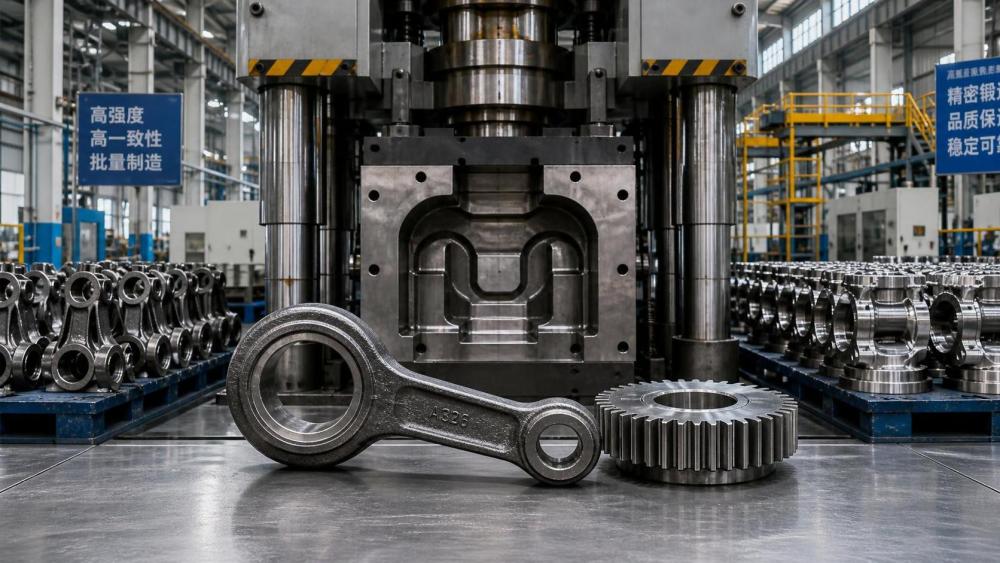
In practical terms, this is why forged automotive parts are commonly selected for connecting rods, crankshafts, transmission gears, wheel hubs, axle components, suspension arms, steering parts, and various shafts. These are not decorative parts. They are structural or torque-transmitting components where the consequences of inconsistency can be serious.
Strength is not just about hardness
A common misunderstanding is that a stronger part simply needs a harder material. In reality, automotive durability depends on a combination of tensile strength, yield strength, toughness, ductility, and fatigue resistance. Closed die forging supports that balance better than many people expect because it improves the soundness of the metal before final heat treatment and machining even begin.
By compressing the material and reducing internal discontinuities, forging can produce a denser, more uniform structure. This does not mean every forged part is automatically superior. Process control still matters. Die design, billet temperature, strain rate, flash control, trimming, and subsequent heat treatment all influence final properties. But when the process is properly engineered, the forged part starts from a stronger metallurgical foundation.
That foundation is especially valuable in parts exposed to cyclic stress. A suspension component may not fail because of one dramatic overload. It may fail because millions of smaller load cycles gradually create and extend a crack. Closed die forging helps lower that risk by creating a flow-oriented structure that is better suited to resist fatigue.
Consistency is where closed die forgings often justify their value
Automotive production is built on repeatability. One excellent part is not enough. Thousands of parts must perform the same way across multiple production batches, often under strict dimensional and material specifications. This is where closed die forgings for automotive parts offer a major advantage over less controlled forming routes.
Because the dies define the part geometry, the process can achieve high repeatability in shape and material distribution. That helps downstream machining become more stable. Tool paths can be optimized with less stock variation. Inspection results become easier to manage. Assemblies fit more predictably. Over time, that consistency affects more than quality reports. It affects scrap rates, machining efficiency, and confidence in supplier performance.
For procurement teams and OEM evaluators, consistency is often the hidden driver behind process selection. A cheaper component that introduces variation into machining, balancing, heat treatment, or assembly may not remain cheaper once total manufacturing cost is considered.
How closed die forging compares with casting and machining from solid stock
Casting remains a valid choice for many complex shapes, especially when geometry is intricate or when large-volume, lower-stress components are involved. Machining from bar or plate can also be effective for prototypes, low-volume production, or parts requiring very specific dimensional control. But neither alternative always matches the mechanical efficiency of a forged structure in high-load automotive service.
Castings can contain porosity, shrinkage-related discontinuities, or microstructural variations depending on alloy, mold design, and solidification control. These risks can be managed, and many cast components perform well. Still, for parts where impact strength and fatigue resistance are central, forging often provides a more favorable starting point.
Machining from solid stock avoids some casting defects, but it cuts through existing grain structure rather than intentionally shaping it around the component geometry. That may be acceptable for some applications, but it does not deliver the same grain flow benefits as forging. It can also generate higher material waste, especially in parts with substantial volume removal.
Automotive parts that benefit most from closed die forging
Not every vehicle part needs to be forged. The best candidates are usually components that combine complex loading with high reliability requirements. Common examples include:
- Connecting rods that experience repeated tensile and compressive forces
- Crankshafts and transmission shafts that must transmit torque without distortion
- Steering knuckles and control arms that face impact and fatigue loads
- Gear blanks that require structural soundness before precision machining and heat treatment
- Wheel hubs and axle parts where dimensional consistency supports assembly accuracy
In these cases, the forging route is not selected simply because it is traditional. It is selected because the part must survive a demanding real-world load profile while still being economical to produce at scale.
What buyers and engineers should evaluate beyond the forging label
A supplier may say a component is forged, but that alone is not enough to judge quality. The value of closed die forging depends on how the process is controlled from raw material to final inspection. For information researchers comparing suppliers or manufacturing routes, a few questions are worth asking early:
- What steel or alloy grade is being used, and is material traceability available?
- Is the die design optimized for grain flow in the highest-stress regions?
- What heat treatment sequence follows forging?
- How much machining allowance is left, and how stable is that stock distribution?
- Are non-destructive testing methods used for critical parts?
- What dimensional inspection and process capability controls are in place?
These questions matter because forging quality is not created by force alone. It depends on metallurgical control, thermal discipline, tooling condition, and inspection rigor. Platforms such as IMPE are valuable in this context because they help business users connect process names with the technical variables that actually affect field performance.
The role of closed die forging in lighter, more efficient vehicle design
Automotive design is under pressure from every direction: lower emissions, higher fuel efficiency, electrification, longer component life, and tighter packaging. That often means engineers must reduce weight without sacrificing safety margins. Closed die forging supports this effort because a forged part can often deliver high strength in a more efficient geometry.
When the material structure is stronger and more uniform, engineers may have more flexibility to optimize shape without relying on excessive section thickness. This does not mean every forged part becomes lighter automatically. It means the process gives designers a better mechanical basis for balancing weight and durability.
That is particularly relevant in driveline and chassis systems, where unnecessary mass affects efficiency, handling, and response. Even small material savings can become meaningful when multiplied across large production volumes.
Common assumptions that deserve a second look
One assumption is that forging always means high cost. In reality, tooling investment can be significant, but unit economics often improve in medium- to high-volume automotive production. Reduced machining time, better material utilization, lower failure risk, and stable quality can justify the process over the life of a program.
Another assumption is that dimensional precision depends only on final machining. In fact, forging consistency influences machining efficiency and final tolerance control. A well-made forging gives the machining process a more predictable starting condition, which is especially useful in parts with tight concentricity, balance, or surface finish requirements.
There is also a tendency to treat all forged parts as equivalent. They are not. Closed die forging quality varies with die wear management, heating practice, lubrication, trimming accuracy, and post-forging process control. A sourcing decision based only on appearance or quotation price can overlook these important differences.
Why this process continues to matter in modern supply chains
Automotive supply chains are becoming more documentation-driven and technically demanding. OEMs and tier suppliers increasingly look beyond headline capacity. They want evidence of repeatable production, stable metallurgy, inspection discipline, and process understanding. Closed die forged components fit well into this environment because the process can be standardized, documented, and optimized for long production runs.
For teams evaluating closed die forgings for automotive parts, the process should be viewed as part of a larger manufacturing system that includes material certification, heat treatment, precision machining, testing, and quality records. The forging itself is critical, but its real value appears when all those steps work together to deliver predictable part behavior in service.
That is the reason closed die forging remains more than a legacy method. It is a practical answer to a very modern challenge: how to produce automotive parts that are strong enough for demanding loads, consistent enough for efficient production, and reliable enough for long-term use. In an industry where performance problems often begin deep inside the material, that combination still carries real weight.
Related News
- How to Assess a Rigid Coupling Supplier for Bore Accuracy and Traceable QualityOct 08, 2026Tribology & Kinematics Expert
- Titanium Alloys Compared: Balancing Strength, Corrosion Resistance, and MachinabilityOct 08, 2026CNC Kinematics Architect
- Where Ductile Iron Dismantling Joints Reduce Alignment Risk in Water PipelinesOct 08, 2026Pipeline Metallurgy Scientist
- Selecting a Precision Bearing Sleeve: Fits, Runout, and Material ChoicesOct 08, 2026Tribology & Kinematics Expert
- Face Milling Cutters: How Insert Geometry Affects Finish on Steel and AluminumOct 08, 2026CNC Kinematics Architect
- Single-Acting Cylinders for Clamping: Stroke, Force, and Return Spring ConsiderationsOct 07, 2026Fluid Power Control Strategist