
When Is an Open Die Forging Supplier the Right Choice for Large Custom Parts?
On many industrial projects, the part that causes the most procurement debate is not the smallest precision item but the biggest one: the shaft, ring, block, hub, or stepped cylinder that carries load, absorbs shock, or keeps a machine train aligned under punishing conditions. When drawings involve unusual dimensions, heavy cross-sections, demanding mechanical properties, or post-forging machining allowances, the question becomes practical very quickly: is an open die forging supplier the right source, or should the team look at casting, plate fabrication, or closed-die forging instead?
For project managers and engineering leads, this is rarely just a manufacturing question. It affects schedule risk, material confidence, downstream machining, inspection planning, and lifecycle reliability. In heavy equipment, energy systems, marine hardware, mining assemblies, infrastructure machinery, and custom OEM builds, open-die forging often becomes the preferred route not because it is fashionable, but because it solves a specific combination of size, strength, and customization challenges.
What open-die forging really solves in large custom part projects
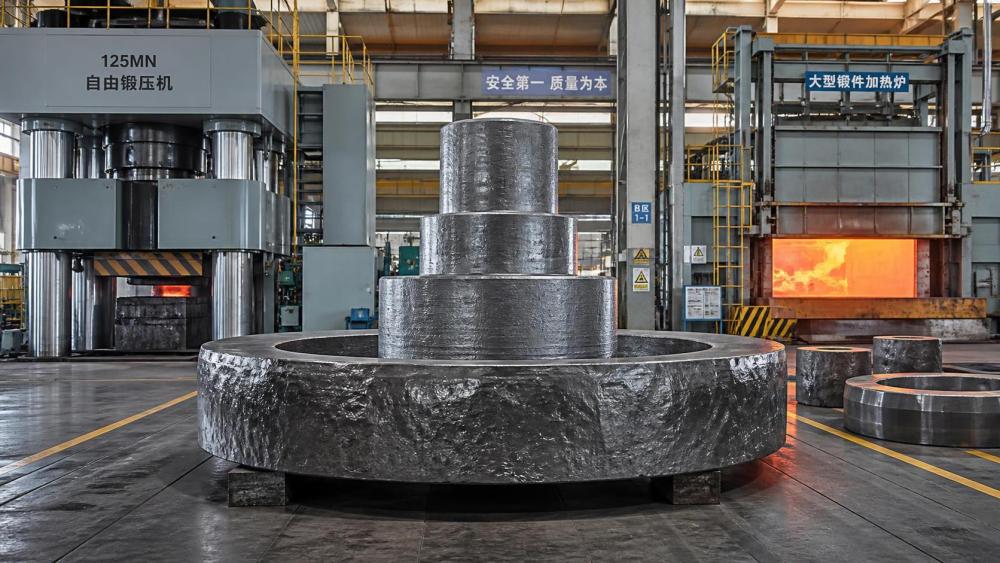
Open-die forging is especially relevant when a component is too large, too thick, too specialized, or too mechanically demanding for more standardized forming methods. Instead of forcing metal into a fully enclosed impression die, the process deforms heated material between flat or simply contoured dies through repeated compressive working. That may sound less precise than closed-die forging, but for large custom parts, it is often exactly the advantage.
The process gives buyers room to specify a forged shape that is closer to the final geometry than raw bar or ingot, while still preserving flexibility for machining. More importantly, the repeated deformation can refine grain flow, reduce internal discontinuity risk compared with less worked stock, and improve the structural integrity that large rotating or load-bearing parts depend on.
If your project includes any of the following, an open die forging supplier deserves serious consideration:
- Very large diameters, long lengths, or heavy section thicknesses
- Custom shafting, sleeves, discs, rings, blocks, or hollows with non-standard dimensions
- Parts exposed to cyclic load, torque, impact, or pressure
- Applications where through-section soundness matters more than near-net decorative form
- Projects that require extensive machining after forging
- Material grades that need controlled heat treatment and mechanical property verification
In other words, open-die forging is not the default answer for every metal part. It becomes the right answer when the part’s internal integrity and scalable geometry matter more than producing a highly finished shape directly out of the die.
Typical situations where an open die forging supplier is the better choice
Project teams often arrive at open-die forging after something else starts to look risky. A large casting may raise concerns about porosity, internal soundness, or long lead times for pattern work. Fabrication from plate or welded sections may be structurally acceptable on paper, but still introduce questions around weld performance, distortion, or fatigue life. Standard mill products may simply not match the section size or metallurgical confidence the application requires.
That is where the open-die route becomes attractive.
Large rotating components
Turbine shafts, generator shafts, gearbox shafts, rolling mill shafts, and marine propulsion elements are classic examples. These components live under torque, bending stress, vibration, and repeated service cycles. An experienced open die forging supplier can produce forged stock with the section size and metallurgical quality needed before finish machining brings the part into final tolerance.
Heavy-duty pressure and load-bearing parts
Forged cylinders, valve bodies in certain designs, hydraulic press components, bearing support elements, and structural hubs often need reliable mechanical properties across substantial cross-sections. Open-die forging is well suited when the part cannot tolerate uncertainty in core material performance.
Low-volume custom parts with demanding geometry envelopes
Some projects only need one, three, or ten pieces. Investing in closed-die tooling may be difficult to justify, especially if the design could still evolve. Open-die forging allows a more adaptable production route for custom dimensions without requiring fully dedicated die development for every revision.
Parts that will be heavily machined anyway
If your final component needs precise bores, shoulders, threads, keyways, sealing surfaces, or bearing fits, machining is already part of the plan. In those cases, the goal is not to source a finished shape at the forging stage. The goal is to source a structurally sound preform with enough stock allowance and the right heat-treated condition for efficient downstream machining.
Why project managers often prefer forged integrity over shape efficiency
From a schedule and risk perspective, large custom parts are unforgiving. If a critical shaft fails ultrasonic testing late in the process, if a cast block reveals internal defects after rough machining, or if the supplied stock cannot meet final mechanical property requirements, the delay does not stay in the machine shop. It reaches assembly, transport, commissioning, and sometimes contract milestones.
That is why many project managers care less about whether the initial forging looks close to the final CAD model and more about whether the supplier can control the things that are harder to recover later:
- Material traceability from the starting ingot or billet
- Forging ratio appropriate to the part section
- Heat treatment planning aligned with grade and required properties
- Non-destructive testing capability for internal quality review
- Machining allowance planning to avoid understock or waste
- Documentation that supports QA, client review, and long-term asset records
In practical terms, a strong open-die source reduces uncertainty before the part ever reaches final machining. That can be more valuable than chasing a lower initial piece price from a route that looks economical but creates inspection or performance doubt later.
When open-die forging is not the best answer
Choosing the right manufacturing path also means knowing when not to force-fit one. Open-die forging may not be ideal if the component is small, geometrically complex, and produced in high volume. In those cases, closed-die forging can deliver better repeatability and less machining stock. If internal pressure containment is moderate and shape complexity is high, certain castings may be more economical. If the part is mostly prismatic and welded construction is acceptable by design code and service conditions, fabrication may remain the most practical route.
The mistake is assuming that “forged” automatically means “best.” The better question is whether the project needs what open-die forging specifically offers: large-size flexibility, worked material structure, and custom preform capability for critical service.
How to evaluate an open die forging supplier beyond basic capacity claims
Many suppliers can say they produce forgings. Fewer can support large custom parts in a way that makes engineering review easier rather than harder. For project teams, supplier evaluation should go beyond press tonnage or broad product lists.
Start with process fit, not brochure language
Ask what part families the supplier actually handles on a routine basis: long shafts, thick rings, stepped discs, hollow forgings, sleeves, blocks, or upset parts. A supplier that regularly produces forged blanks for energy, mining, fluid power, or heavy transmission applications will usually speak more clearly about reduction strategy, grain flow considerations, heat treatment windows, and machining allowances.
Review material and testing discipline
Large custom parts often involve alloy steel, carbon steel, stainless grades, or special metallurgical requirements tied to service environment and stress profile. The supplier should be able to explain how raw material is sourced, identified, processed, heat treated, and tested. Depending on the part, that may include tensile testing, hardness checks, impact testing, ultrasonic testing, or other agreed inspection steps.
Look at post-forging support
Some of the strongest suppliers are not only forgers but part of a broader industrial manufacturing chain that understands machining, dimensional finishing, and documentation flow. This matters because a forged blank is only one stage in a larger production plan. If your platform or sourcing network can connect forging capability with precision machining, inspection, and heavy-part logistics, evaluation becomes more coherent and the handoff between processes is smoother.
That is one reason industrial knowledge platforms such as IMPE are useful to buyers and project coordinators. For complex procurement, the decision is rarely isolated to one process. Forging quality, machining feasibility, tolerance strategy, material performance, and inspection expectations all influence the final component value.
Questions worth asking before placing the order
A good RFQ for a large forging does more than send a drawing and ask for price. It frames the project in a way that helps the supplier assess risk early. These questions tend to reveal whether an open die forging supplier is genuinely prepared for the job:
- What are the final service loads, operating temperatures, and fatigue concerns?
- What material grade and heat treatment condition are required?
- What is the rough-forged size versus final machined size?
- What non-destructive testing scope is expected before machining or after rough machining?
- Are there specific standards, client specifications, or traceability rules to follow?
- Will the supplier provide rough machining, or only forging and heat treatment?
- How will straightness, concentricity, or centerline stability be managed for long parts?
- What lead-time risk exists around furnace capacity, heavy handling, and testing windows?
The value of these questions is not administrative. They help uncover whether the source understands the real operating context of the part. That understanding often separates a technically suitable supplier from one that simply has available capacity.
A common buying mistake: focusing on shape instead of project outcome
It is easy to compare suppliers by quoted dimensions, unit weight, or rough-form appearance. But large custom industrial parts are rarely judged by how efficient they looked at dispatch. They are judged months or years later by machining stability, inspection results, fit during assembly, and performance in service.
A slightly heavier forging with sensible machining allowance and reliable internal quality may be the safer choice than a more aggressive near-net approach that leaves little room for correction. Likewise, a supplier that communicates clearly about process limits can be more valuable than one that says yes to every request but treats engineering review as an afterthought.
For project leaders, that shift in perspective matters. The right source is not just making metal; it is protecting the schedule and reducing the chance of expensive surprises downstream.
So when is an open die forging supplier the right choice?
The answer is usually clear when your part sits at the intersection of size, load, customization, and material risk. If you need a large custom component with dependable internal quality, room for finish machining, and mechanical performance that cannot be left to chance, open-die forging is often the most sensible route.
It is especially suitable for shafts, rings, sleeves, discs, blocks, and other heavy-duty forms used in infrastructure equipment, power systems, mining machinery, fluid power assemblies, marine applications, and industrial transmission systems. In those environments, the question is not simply how to make the part, but how to make it with enough structural confidence to support the whole project.
An experienced open die forging supplier should help you answer that question early, with process clarity, material discipline, and realistic guidance on what the part needs before it reaches the machine shop. When that alignment happens, procurement becomes less about guessing and more about building a component strategy that stands up in the field.
Related News
- How to Assess a Rigid Coupling Supplier for Bore Accuracy and Traceable QualityOct 08, 2026Tribology & Kinematics Expert
- Titanium Alloys Compared: Balancing Strength, Corrosion Resistance, and MachinabilityOct 08, 2026CNC Kinematics Architect
- Where Ductile Iron Dismantling Joints Reduce Alignment Risk in Water PipelinesOct 08, 2026Pipeline Metallurgy Scientist
- Selecting a Precision Bearing Sleeve: Fits, Runout, and Material ChoicesOct 08, 2026Tribology & Kinematics Expert
- Face Milling Cutters: How Insert Geometry Affects Finish on Steel and AluminumOct 08, 2026CNC Kinematics Architect
- Single-Acting Cylinders for Clamping: Stroke, Force, and Return Spring ConsiderationsOct 07, 2026Fluid Power Control Strategist