
When Custom Steel Forgings Outperform Cast Parts in Heavy-Duty Load Applications
In a heavy-duty project, a component choice that looks reasonable on a drawing can become expensive once the machine enters service. A cracked drive shaft, a fractured lifting lug, or a gear blank that fails after repeated shock loading does more than create a replacement-parts issue. It can stop a construction sequence, delay commissioning, expose workers to risk, and place uncomfortable pressure on a project team already managing budgets and deadlines.
This is why custom steel forgings deserve close attention when parts must carry high torque, impact loads, cyclic stress, or sustained mechanical force. Cast components remain essential across industry and can be the right answer for complex housings, fluid passages, and cost-sensitive geometries. But when structural reliability is the governing requirement, forging frequently offers a more dependable foundation.
For project managers and engineering leads, the question is not whether forging is universally “better” than casting. The practical question is: where will the operating conditions make the additional process control and material integrity of a forged part worth the investment?
Start with the load path, not the part price
Procurement discussions often begin with unit cost, lead time, and dimensional requirements. Those factors matter, but they can obscure the more important issue: how the component transfers force through the machine or structure.
A cast part is formed by pouring molten metal into a mold. This makes casting highly useful for complex external shapes, internal cavities, valve bodies, pump housings, machine bases, and other parts where geometry drives the manufacturing decision. A forged part, by contrast, is shaped under controlled compressive force while the steel is in a heated, workable state. Open-die and closed-die processes deform the material rather than simply filling a cavity.
That deformation can align and refine the metal’s grain flow in the direction of the component’s geometry and principal loads. In a shaft, connecting rod, hook, axle, pin, crank component, or heavy-duty gear blank, this is not an abstract metallurgical detail. It can directly influence the part’s ability to resist crack initiation and fatigue growth.
When a part sees mostly static loading in a protected environment, casting may perform very well. When the same part will experience reversing loads, impact, vibration, bending, torsion, or difficult field conditions, the case for custom steel forgings becomes much stronger.
Why forged steel behaves differently under severe service
The advantage of a forging is not simply that it is made of steel. Material grade, heat treatment, design, machining quality, and inspection all remain important. The key distinction is the internal structure produced by the manufacturing route.
Steel forging can reduce the risk associated with certain internal discontinuities that are more common concerns in castings, including shrinkage-related voids, porosity, inclusions, and localized segregation. A well-controlled forging process also supports a denser, more continuous structure. This does not mean every forging is defect-free or every casting is unsuitable; both require sound process discipline and appropriate testing. It means forged material generally provides a better starting point for parts whose failure consequences are high.
For project teams, that difference becomes meaningful in four recurring conditions:
- High-impact service: Construction attachments, mining equipment, rail hardware, press components, and marine machinery can face sudden loading that is difficult to model perfectly.
- Fatigue-driven duty: Repeated rotation, bending, pressure cycles, or starts and stops create small stress reversals that may develop into cracks over time.
- Torque transmission: Drive shafts, splined shafts, hubs, couplings, and gear components must transmit force without losing alignment or suffering torsional fracture.
- Low tolerance for failure: Parts supporting suspended loads, safety-critical mechanisms, remote assets, or expensive shutdowns deserve a more conservative materials strategy.
The grain flow of a forging can be directed around contours such as journals, flanges, and transitions. This is especially valuable where a change in section creates stress concentration. A sharp design detail still needs to be improved through proper radii and machining practice, but the underlying grain orientation can provide a more favorable response than a randomly oriented cast structure.
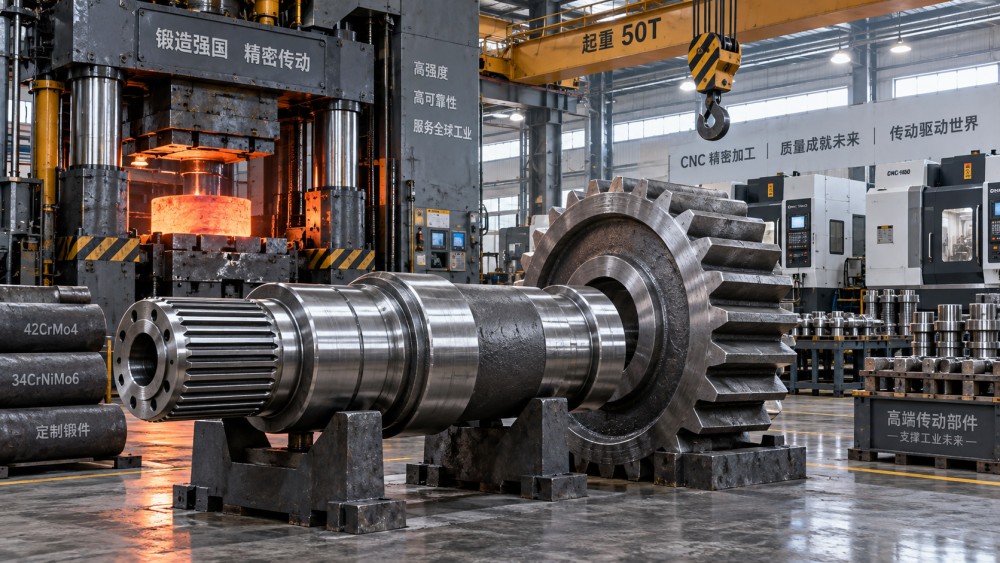
Applications where custom steel forgings are usually the stronger choice
There are familiar categories where forging is often specified because experience has shown what the duty cycle can do to less robust components. These applications are worth examining early, before the project is locked into a material and production route.
Shafts, axles, and rotating transmission parts
Rotating components are often exposed to a combination of torque, bending, vibration, and localized bearing loads. A forged shaft can be machined to precise journal diameters, keyways, splines, and flange interfaces while retaining the structural benefits of the forged stock. This is relevant to gearboxes, wind-energy systems, conveyors, marine drives, pumps, crushers, industrial mixers, and large machine tools.
For a long or stepped shaft, the design review should focus on shoulder transitions, fillet radii, spline roots, keyway geometry, bearing-seat finishes, and heat-treatment depth. The choice between forging and casting should not be made independently of these details, because many shaft failures begin at a local feature rather than in the main body.
Construction, mining, and material-handling equipment
Excavator linkage parts, loader pins, bucket teeth adapters, track components, lifting hooks, crane fittings, and press-frame connections live in a world of shock loads, abrasive contamination, and uneven operator use. The real operating load may differ substantially from the nominal load in a specification.
Custom steel forgings are particularly useful when designers need a compact part with high section strength. Forging can allow the component to handle demanding duty without relying on excessive wall thickness. That can support machine weight targets, improve packaging around adjacent systems, and simplify handling during assembly or field replacement.
Energy, oil and gas, and process equipment
In energy-related equipment, downtime often carries consequences far beyond the cost of the failed component. Forged flanges, valve parts, pressure-retaining fittings, turbine shafts, rotors, and high-strength connectors may be selected where pressure, temperature variation, corrosion allowance, and fatigue interact.
Not every pressure component must be forged. Complex valve bodies and pump casings are frequently cast for sound engineering reasons. Yet stems, bonnets, yokes, flanges, forged rings, and critical rotating elements may benefit from forging when pressure integrity and mechanical loading converge. Material selection should also account for the service environment, including hydrogen exposure, low temperatures, sour conditions, or corrosion mechanisms where relevant.
Heavy gears, couplings, and machine interfaces
Gear teeth are exposed to contact stress, bending stress, and repeated loading. Forged gear blanks are commonly preferred for high-load power transmission because their material structure and heat-treatment response can support reliable tooth performance. The same logic applies to large couplings, hubs, drive flanges, and connecting elements used in mills, crushers, industrial drives, and transportation equipment.
Where casting still makes practical sense
A balanced sourcing decision should recognize the value of casting. If a part requires intricate internal channels, large hollow sections, complex exterior geometry, or a shape that would require substantial machining from forged stock, casting may offer better manufacturability and cost control. Pump housings, valve bodies, gearbox casings, pipe fittings, machine beds, and certain structural frames are obvious examples.
Cast ductile iron, steel casting, and other casting alloys can provide good mechanical performance when properly designed, produced, heat treated, and inspected. The mistake is not choosing casting; the mistake is assuming that a cast component and a forged component are interchangeable because their final dimensions look similar.
A useful rule is to separate shape-driven parts from load-path-driven parts. If internal geometry is the dominant challenge, casting may lead. If the component’s central purpose is carrying force repeatedly and safely, forging deserves priority consideration.
A project review framework before specifying a forged part
Custom steel forgings create value when the specification matches the real service requirement. Over-specifying can add unnecessary cost and lead time; under-specifying can transfer risk into operations. A short cross-functional review between design, quality, procurement, and the equipment owner can prevent both outcomes.
Define the actual duty cycle
Ask more than “What is the maximum load?” Consider the frequency of loading, likely overload events, direction changes, vibration, shock, operating temperature, and expected service life. A component in a municipal water system, a mining conveyor, and a factory press may each carry similar nominal loads but face very different fatigue conditions.
Specify material properties with the geometry in mind
Steel grade should be selected for the required balance of strength, toughness, hardenability, weldability, corrosion resistance, and machinability. Heat treatment may include normalizing, quenching and tempering, induction hardening, carburizing, or other controlled processes depending on the application. The supplier needs the intended service conditions, not merely a generic material callout.
For larger forgings, section thickness matters. Cooling rates and heat-treatment response can vary from the surface to the core. A capable supplier should be able to discuss effective section size, mechanical-property targets, and whether the drawing requires test coupons, hardness checks, or location-specific requirements.
Control transitions and machining allowances
Forged parts are rarely finished parts straight from the die or press. They commonly require CNC turning, milling, drilling, grinding, and surface finishing to achieve final tolerances. The forging design should provide sufficient machining allowance without creating wasteful excess material.
Project teams should also identify critical datums, concentricity requirements, surface roughness at seals or bearings, and the relationship between machined features and forged grain flow. A forgings supplier with in-house or coordinated precision machining capability can reduce handoff risk between forming and final finishing.
Build quality documentation into the procurement plan
For high-consequence applications, traceability should not be an afterthought. The purchase specification may call for material certificates, chemical analysis, mechanical test reports, heat-treatment records, dimensional inspection results, and non-destructive testing such as ultrasonic, magnetic particle, or dye penetrant inspection where appropriate.
The inspection method should be proportionate to the risk. Requiring every possible test on every part is not always necessary, but accepting vague quality language is equally unhelpful. Define the critical zones, acceptance criteria, applicable standards, and documentation package before production begins.
Common assumptions that can weaken the decision
One common assumption is that “forged” automatically means stronger in every direction and under every condition. A poor forging design, unsuitable steel grade, inadequate heat treatment, or aggressive machining can undermine the benefits of the process. Another is that a heavier casting is always a safer substitute. Added mass may increase stiffness, but it does not necessarily resolve fatigue vulnerability or internal soundness concerns.
Project teams can also underestimate the importance of supply-chain communication. Custom steel forgings often require early agreement on die design, forging route, production volume, machining scope, and inspection requirements. Waiting until the final purchasing stage to clarify these points can create avoidable lead-time pressure.
The most reliable approach is to involve qualified forging and machining expertise while the design is still adjustable. Small changes to radii, draft, parting-line location, stock allowance, or test access can improve manufacturability without compromising functional intent.
Making the choice in lifecycle terms
A cast part may carry a lower initial price, and in the right application it can be the responsible commercial choice. But heavy-duty projects should be evaluated through lifecycle exposure: installation access, replacement labor, lost production, safety implications, spare-part availability, and the effect of a failure on the wider schedule.
When a component is difficult to reach, expensive to replace, or fundamental to torque transfer and structural loading, the lowest purchase cost can be a misleading metric. Custom steel forgings often justify themselves by reducing uncertainty in the part of the system that cannot be allowed to fail quietly.
For project leaders, the decision comes down to disciplined matching: use casting where complexity and geometry make it efficient; use forging where load history, impact resistance, fatigue performance, and structural integrity govern long-term success. With the right material specification, heat treatment, machining plan, and inspection package, a forged component becomes more than a stronger alternative—it becomes a deliberate risk-control measure for demanding industrial service.
Related News
- How to Assess a Rigid Coupling Supplier for Bore Accuracy and Traceable QualityOct 08, 2026Tribology & Kinematics Expert
- Titanium Alloys Compared: Balancing Strength, Corrosion Resistance, and MachinabilityOct 08, 2026CNC Kinematics Architect
- Where Ductile Iron Dismantling Joints Reduce Alignment Risk in Water PipelinesOct 08, 2026Pipeline Metallurgy Scientist
- Selecting a Precision Bearing Sleeve: Fits, Runout, and Material ChoicesOct 08, 2026Tribology & Kinematics Expert
- Face Milling Cutters: How Insert Geometry Affects Finish on Steel and AluminumOct 08, 2026CNC Kinematics Architect
- Single-Acting Cylinders for Clamping: Stroke, Force, and Return Spring ConsiderationsOct 07, 2026Fluid Power Control Strategist