
What to Verify When Qualifying a Forged Roller Manufacturer for Mill Duty
A forged roller can look acceptable on a drawing, match a quoted diameter, and still fail early once it enters a mill line. In hot rolling, plate processing, mining, conveying, and other heavy-processing duties, the roller may face cyclic bending, contact stress, thermal exposure, abrasive scale, shock loading, and misalignment at the same time. A purchasing decision based mainly on unit price, nominal material grade, or a polished sample can leave the operating team with unplanned changeouts and difficult root-cause discussions.
To qualify a forged rollers manufacturer for mill duty, verify the complete production and control route rather than the finished roller alone. The essential questions are whether the supplier can produce the required forging reduction and grain flow, control chemistry and heat treatment, machine critical surfaces accurately, inspect internal and surface integrity, preserve traceability, and deliver rollers in a condition that matches the actual operating load and mounting arrangement. A capable supplier should be able to explain these points with process records, inspection evidence, and clear technical responses—not only catalog claims.
Start with the actual mill-duty conditions
The qualification process should begin before requesting quotations. “Mill duty” is not a single technical requirement. A guide roller in a hot strip line, a pinch roller in a tube mill, a support roller in a plate mill, and a roller used in bulk material handling can have very different failure mechanisms. Giving suppliers only an outside diameter, face length, and broad material request encourages them to quote the lowest-risk interpretation for their own production process.
Build the inquiry around the operating conditions that determine roller design and metallurgy:
- roller function: drive, pinch, guide, support, idler, straightening, forming, or tension control;
- maximum radial load, torque, bending moment, and expected load cycles;
- operating speed, acceleration, reversing duty, and vibration exposure;
- temperature at the roller body and journals, including cooling conditions;
- contact material, scale, water, chemicals, abrasive particles, or corrosion exposure;
- bearing arrangement, journal dimensions, coupling details, and mounting tolerances;
- drawing requirements for runout, concentricity, surface finish, hardness, and balance;
- failure history of the existing roller, where available.
A supplier cannot make sound decisions about forging route, heat treatment depth, or inspection scope if these conditions remain unknown. Equally, the buyer should not accept a generic statement such as “suitable for steel mill use” as proof of suitability. Ask the manufacturer to identify which supplied conditions drove its material and process recommendation.
Confirm that forging is real, appropriate, and controlled
The word forged is valuable only when the forging process supports the roller’s duty. A forged roller is generally selected because controlled deformation can refine the internal structure and create grain flow better suited to heavily loaded rotating parts than an equivalent component made from poorly controlled stock. Yet forging quality depends on starting material, reduction ratio, heating practice, deformation sequence, and subsequent heat treatment.
Ask whether the roller is produced from an ingot, billet, bar, or preform, and whether the supplied route is open-die, closed-die, ring rolling, or another method. There is no universally correct route; suitability depends on roller geometry, journal transitions, bore configuration, and load direction. What matters is whether the manufacturer can explain how it avoids undesirable segregation, internal discontinuities, and weak grain orientation in highly stressed zones.
For a long roller with integrated journals, the transition between the barrel and journal deserves special attention. Sharp geometry changes can concentrate stress. The supplier should confirm that forging allowance, machining allowance, and fillet geometry have been considered together. A process that leaves insufficient stock for cleanup may expose surface defects or force dimensional compromises later in machining.
Useful verification questions include:
- What is the starting stock form and melt source?
- What minimum forging reduction is targeted for this roller family?
- How are heating temperatures and holding times recorded?
- How does the process account for the barrel-to-journal transition?
- Are forgings normalized, rough machined, and reinspected before final heat treatment?
- Can the supplier identify locations where material integrity is most critical?
A vague answer does not automatically mean the factory is unsuitable, but it does indicate that engineering review should precede approval. Mill-duty rollers are not good candidates for a quote-only sourcing exercise.
Review material evidence beyond the grade name
A grade designation alone does not establish performance. Two rollers described with the same alloy steel grade can differ in cleanliness, chemistry control, heat-treatment response, and through-section properties. Procurement documents should require a material certificate linked to the roller or heat number, with chemical composition and mechanical properties relevant to the agreed condition.
For high-load applications, ask whether the manufacturer controls elements that influence hardenability, toughness, weldability where applicable, and resistance to temper embrittlement. The answer should remain tied to the specified material standard and approved design; it is not a reason to demand an arbitrarily higher alloy content. Material substitutions should never be accepted merely because they are described as “equivalent.” Equivalence needs review against hardness requirements, core strength, fatigue exposure, operating temperature, machining behavior, and any customer drawing specification.
Traceability must survive production. The forging identifier, heat number, and work order should remain linked through rough machining, heat treatment, final machining, and inspection. If a supplier can provide a mill certificate but cannot show how it is connected to the individual roller, there is a documentation gap. This becomes particularly serious when multiple rollers of different materials or heat-treatment conditions move through the same shop at once.
Heat treatment is often where mill-duty capability becomes visible
Many premature roller problems originate not in the nominal alloy choice but in inconsistent heat treatment. The required property profile may involve a hard working surface with a tougher core, uniform through-hardness, stress relief after machining, or a controlled balance between wear resistance and resistance to cracking. The correct choice depends on contact pressure, thermal cycling, roller diameter, repair strategy, and expected failure mode.
Ask the supplier to state the specified heat-treatment condition in practical terms: quench and temper, induction hardening, carburizing, nitriding, flame hardening, or another controlled process. Then request the acceptance criteria rather than relying on the treatment name. Relevant evidence may include furnace charts, quench records where applicable, hardness maps, case-depth verification, and test locations.
Hardness should not be treated as a standalone acceptance number. A roller can meet a surface-hardness target and still perform poorly if the hardened layer is uneven, too shallow for the expected wear allowance, excessively brittle, or poorly blended near shoulders and journal areas. Conversely, requiring maximum hardness without considering impact and thermal shock can increase crack risk. The manufacturer should be able to explain where hardness is measured, how many locations are checked, and what action is taken when readings vary beyond the agreed tolerance.
Questions that expose weak heat-treatment control
Ask whether the supplier heat treats the roller in-house or sends it to an outside provider. Outsourcing is not inherently a problem, but the forged rollers manufacturer should still control specifications, lot identification, inspection requirements, and release approval. Request clarification on furnace capacity for the roller’s mass and length. A furnace suitable for smaller shafts may not provide uniform heating for a long, heavy roller.
Also establish whether straightening is performed after quenching, what dimensional change is expected, and whether stress relief follows heavy machining. These details affect runout, residual stress, and bearing-seat stability. A supplier that treats heat treatment as an isolated subcontract step may struggle to maintain repeatability on demanding rollers.
Examine machining capability where the roller actually works
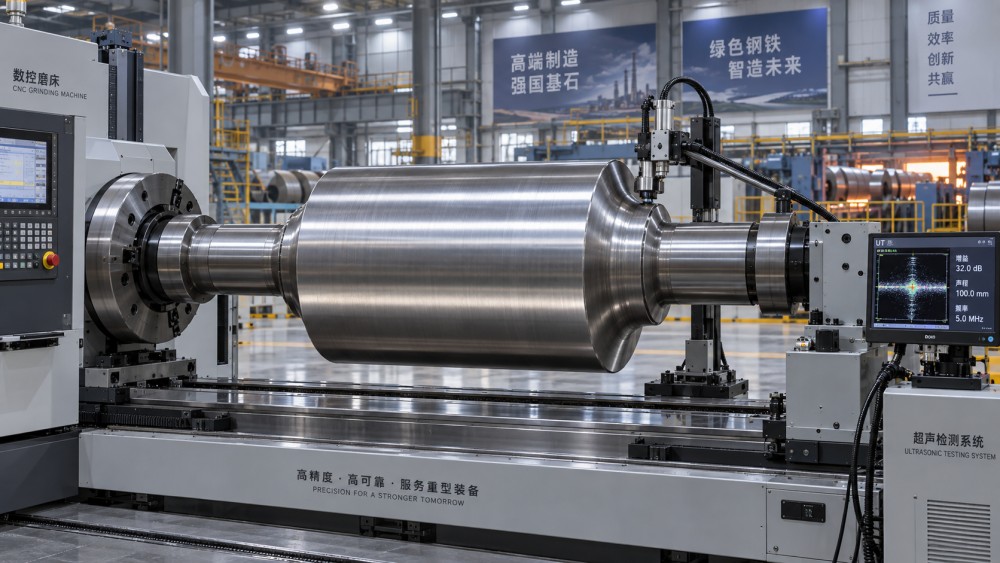
Mill performance depends heavily on the relationship between barrel, journals, bearing seats, keyways or coupling features, and reference datums. A supplier may have adequate turning capacity for the barrel diameter but lack the machine travel, steady-rest arrangement, grinding capability, or inspection setup needed to hold geometry across the full length.
Review the drawing and identify the dimensions that should drive supplier selection. These often include total indicated runout, concentricity between barrel and journals, cylindricality, taper, journal roundness, shoulder squareness, bearing-seat surface finish, and face profile. For driven rollers, keyway location, spline geometry, or coupling alignment may be just as important as barrel diameter.
Do not accept a generic “inspection passed” statement where critical tolerances are involved. The report should show actual measured values, instrument identification where required by the purchase specification, and the datums used during measurement. For large rollers, ask how the part is supported during machining and inspection. Deflection caused by poor support can make a roller appear acceptable in one setup and behave differently after installation.
Match non-destructive testing to the risks, not to a standard phrase
Non-destructive testing is often included in quotations as a short line item, but the scope can vary greatly. Ultrasonic testing is commonly relevant for detecting internal discontinuities in forged sections. Magnetic particle testing may be appropriate for surface and near-surface cracking on ferromagnetic materials. Liquid penetrant testing may be used on suitable surfaces and materials. The correct method, coverage, acceptance level, and inspection stage should be agreed in writing.
For example, ultrasonic testing before final machining may identify internal concerns early, while magnetic particle inspection after final machining can help reveal grinding cracks or surface discontinuities in critical regions. Testing only the barrel while excluding journals, shoulders, or transitions may leave out the locations most exposed to fatigue. Ask the supplier to mark the inspection zones on the drawing or inspection plan.
It is also important to distinguish between a test method and a meaningful acceptance criterion. “UT available” does not state what was tested, to what standard, with what calibration, or whether indications were evaluated against a defined limit. The purchasing specification should identify the agreed test requirement, while engineering retains responsibility for confirming that it is appropriate for the roller’s duty.
Assess production reliability before issuing a repeat order
A first article can be excellent while repeat production remains uncertain. For replacement rollers, delayed delivery can keep a line exposed to downtime risk, so qualification should include operational discipline as well as technical capability. Review whether the supplier has a documented route from material receipt to final packing, realistic capacity for its major machining and heat-treatment bottlenecks, and a process for handling nonconforming material.
Ask how drawing revisions are controlled, especially when a roller has been modified after field failures or equipment upgrades. An outdated fillet radius, incorrect bearing-seat tolerance, or obsolete hardness requirement can be reproduced repeatedly if revision control is weak. Packing also matters: journals, finished barrel surfaces, and machined reference faces need protection against corrosion, impact, and handling damage during transport.
Before approving a forged rollers manufacturer for ongoing mill-duty supply, request a sample document package for a comparable part or the proposed order. It should show how the supplier connects the purchase order, drawing revision, material certificate, heat-treatment record, dimensional report, non-destructive testing report, and release record. A complete package does not guarantee service life, but it makes quality evidence auditable and makes later failure analysis far more practical.
Use quotation comparison to identify risk, not just price differences
When two quotations differ significantly, compare the included manufacturing route before assuming one supplier is simply expensive. One quotation may include forged starting stock, controlled heat treatment, full machining, documented testing, and final inspection. Another may use commercially available bar stock, limited testing, broad tolerances, or excluded reports. Neither offer can be judged fairly until these assumptions are visible.
Ask each bidder to state exclusions and assumptions against the same technical schedule. Pay attention to material condition at delivery, machining allowance, test coverage, heat-treatment scope, dimensional reporting, balancing requirements, preservation method, and responsibility for design review. Price should be evaluated alongside replacement consequences. A lower initial cost can be difficult to justify when a roller failure creates lost production, collateral bearing damage, or an urgent replacement requirement.
The most useful approval decision is therefore not “approved” or “rejected” in isolation. It records the exact roller family, material condition, drawing revision, inspection level, and manufacturing route that were reviewed. That discipline prevents a later purchase from being treated as equivalent when the supplier, process, or technical requirement has changed.
Related News
- How to Assess a Rigid Coupling Supplier for Bore Accuracy and Traceable QualityOct 08, 2026Tribology & Kinematics Expert
- Titanium Alloys Compared: Balancing Strength, Corrosion Resistance, and MachinabilityOct 08, 2026CNC Kinematics Architect
- Where Ductile Iron Dismantling Joints Reduce Alignment Risk in Water PipelinesOct 08, 2026Pipeline Metallurgy Scientist
- Selecting a Precision Bearing Sleeve: Fits, Runout, and Material ChoicesOct 08, 2026Tribology & Kinematics Expert
- Face Milling Cutters: How Insert Geometry Affects Finish on Steel and AluminumOct 08, 2026CNC Kinematics Architect
- Single-Acting Cylinders for Clamping: Stroke, Force, and Return Spring ConsiderationsOct 07, 2026Fluid Power Control Strategist