
What to Specify When Ordering Custom Open-Die Forgings for Critical Load Paths
What to Specify When Ordering Custom Open-Die Forgings for Critical Load Paths
For procurement teams sourcing custom open-die forgings for critical load paths, complete specifications control quality, lead time, total cost, and long-term operational risk.
Dimensions and material grade alone are not enough. Buyers should define performance requirements, heat treatment, inspection, traceability, machining allowances, and acceptance criteria before requesting quotations.
Start With the Actual Load Path and Service Conditions
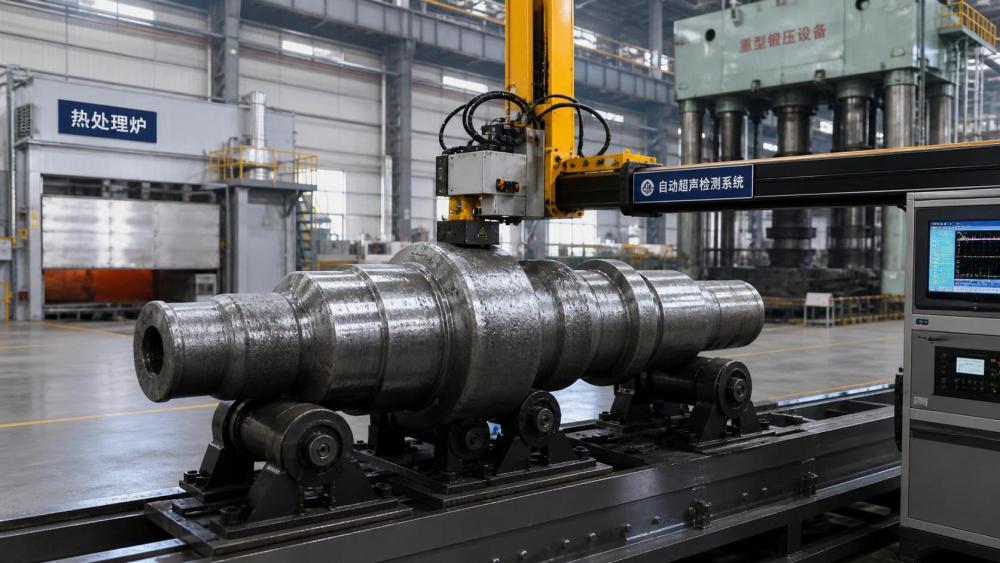
The first question is not which forging supplier offers the lowest price. It is what the component must withstand throughout its expected operating life.
Critical load-path forgings transfer force, torque, pressure, or bending loads through machinery where failure can cause downtime, damage, safety incidents, or major replacement costs.
Examples include turbine shafts, crane pins, press components, mining equipment axles, marine shafts, wind-energy parts, heavy gearbox elements, and hydraulic cylinder components.
Purchasers should provide the supplier with a practical description of the part's function, not only a finished-part drawing or nominal dimensions.
State whether the forging experiences static loading, repeated loading, impact, torsion, compression, vibration, temperature cycling, corrosive exposure, or a combination of operating conditions.
Fatigue-sensitive applications require particularly careful specification because small metallurgical defects, poor grain orientation, or inadequate surface quality can shorten component life significantly.
Define the expected load direction whenever possible. Open-die forging can be planned to support favorable grain flow along the primary stress direction.
Suppliers also need to know whether a part is safety-critical, production-critical, or readily replaceable. This classification affects testing scope, documentation, and inspection hold points.
For procurement teams, the objective is to communicate enough engineering context that the supplier can select a sound forging route without making undocumented assumptions.
Specify Material Grade, Chemistry Limits, and Material Equivalency
Material selection should begin with the governing engineering specification, customer standard, or recognized material standard used by the final equipment manufacturer.
Identify the exact alloy designation, standard revision, and required delivery condition. Broad descriptions such as “alloy steel” leave too much room for inconsistent interpretation.
Common open-die forging materials include carbon steels, alloy steels, stainless steels, tool steels, nickel alloys, titanium alloys, and specialized corrosion-resistant grades.
For high-load applications, buyers should clarify whether the required material is intended for strength, toughness, fatigue performance, hardenability, corrosion resistance, or elevated-temperature stability.
Specify allowable chemical composition limits when they differ from standard ranges. Carbon, sulfur, phosphorus, hydrogen, and residual elements may materially affect performance.
Low sulfur and phosphorus limits can be important where toughness, through-thickness ductility, or resistance to internal discontinuities is essential for critical parts.
Hydrogen control deserves attention for thick sections and high-strength steels. Excess hydrogen can contribute to flakes, delayed cracking, or reduced mechanical reliability.
If an equivalent grade may be accepted, define the approval process clearly. A supplier should not substitute material based solely on commercial equivalency.
Require mill test certificates for raw material and forged product certificates showing heat number, chemistry results, melting route, and applicable material standard.
Where project risk is high, specify vacuum degassed, vacuum arc remelted, electroslag remelted, or other premium steelmaking requirements based on engineering need.
Define Mechanical Properties by Location, Direction, and Section Size
Mechanical property requirements are often the most important missing detail in custom open-die forgings purchase orders. Minimum values must be meaningful for the actual component.
Specify tensile strength, yield strength, elongation, reduction of area, hardness, and impact toughness where applicable to the component's operating environment.
Do not assume that catalog properties apply uniformly across a large forging. Thick sections may cool differently and develop different properties from surface regions.
Buyers should identify the required test location, especially for shafts, rings, blocks, hubs, and stepped forgings with varying cross-sectional dimensions.
For example, a mechanical test coupon taken near the surface may not represent centerline properties in a large-diameter shaft or heavy forged block.
State the required test orientation when directional properties matter. Longitudinal, transverse, and radial values can differ because forging alters the material's internal structure.
Charpy impact testing should include the test temperature and required energy value. “Impact tested” is insufficient for components operating in cold climates.
For cyclic service, procurement teams should ask engineering whether fatigue testing, fracture toughness testing, or additional metallurgical verification is needed before sourcing.
Hardness requirements should include both acceptable range and measurement locations. This prevents disagreements when local geometry or heat-treatment variation affects readings.
When properties conflict, such as high hardness and high toughness, require supplier review before order release. Unrealistic requirements can create delivery delays and costly rework.
Control Heat Treatment and Its Documentation
Heat treatment determines whether the forging develops the intended balance of strength, toughness, ductility, machinability, and dimensional stability after forging.
Specify the required condition at delivery, such as normalized, normalized and tempered, quenched and tempered, annealed, stress relieved, solution treated, or precipitation hardened.
For high-strength alloy steel components, specify the required mechanical properties rather than prescribing a temperature cycle unless the engineering standard requires an exact cycle.
The supplier needs flexibility to adjust furnace practice for section thickness, material chemistry, and loading arrangement while still meeting approved final properties.
However, buyers should require traceable heat-treatment records. These should show furnace identification, charge number, time, temperature range, quenching method, and tempering sequence.
Large forgings may require controlled cooling, multiple tempering operations, or staged heat treatment to reduce residual stress and improve through-section consistency.
Clarify whether final machining occurs before or after heat treatment. This decision affects distortion risk, stock allowance, inspection timing, and final dimensional control.
Where the forging will be finish-machined by another party, specify whether stress relief is required after rough machining or before final machining operations.
For parts requiring hardening depth, surface treatment, or nitriding, define the affected surfaces, target depth, hardness range, and masking requirements explicitly.
Specify Forging Reduction, Grain Flow, and Internal Soundness
Open-die forging is valued because deformation can refine cast structure, close porosity, and produce grain flow aligned with the part's load-carrying geometry.
Those benefits are not automatic. They depend on reduction ratio, billet quality, forging sequence, temperature control, deformation direction, and supplier process capability.
For critical load paths, request confirmation that the forging route provides adequate reduction and avoids leaving unworked material in highly stressed regions.
Specify grain-flow expectations where practical, particularly for shafts, stepped components, hubs, rings, and parts carrying cyclic bending or torsional loads.
Engineering drawings may identify critical zones that require directional forging. Suppliers can then review whether the requested shape supports acceptable metal flow and reduction.
Internal soundness requirements should be tied to a recognized ultrasonic testing standard, acceptance class, scanning coverage, and reporting requirement.
Simply writing “100 percent UT” is incomplete. The purchase order should state whether testing applies before heat treatment, after heat treatment, after rough machining, or all stages.
Surface examination requirements may include magnetic particle testing, liquid penetrant testing, visual inspection, or other methods appropriate for material type and service risk.
Define the acceptance standard for indications, including relevant ASTM, EN, ISO, ASME, customer, or project specifications. Supplier-specific acceptance criteria should not be assumed.
For very large custom open-die forgings, discuss testability before placing the order. Geometry, surface condition, and access can affect reliable non-destructive examination coverage.
Provide Machining Allowances and Dimensional Requirements Clearly
Forging dimensions should never be treated as finished-machined dimensions unless the supplier has explicitly accepted responsibility for final machining and inspection.
Open-die forgings require machining allowance to remove scale, decarburization, surface irregularities, and potential shallow discontinuities created during hot working or handling.
Specify rough-forged dimensions, minimum machining stock, and the datum system used for inspection. These details prevent disputes over usable material after rough machining.
Allowance must account for part size, alloy behavior, heat treatment distortion, surface condition, machining method, and the reliability required at final surfaces.
Excessive allowance increases material weight, machining time, freight cost, and lead time. Insufficient allowance may create scrap risk if clean-up cannot be achieved.
For stepped shafts and complex profiles, identify which areas need extra stock and which areas have weight, envelope, or clearance limitations.
Include geometric requirements relevant at the forging stage, such as straightness, concentricity, bend limits, ovality, taper, or maximum surface decarburization depth.
Do not apply tight machined-part tolerances directly to an as-forged part without supplier consultation. That approach often produces unrealistic pricing or avoidable rejection.
When finished machining will occur at a separate facility, establish responsibility for incoming inspection, machining clean-up, dimensional deviation, and nonconforming material disposition.
Set Testing, Inspection, and Acceptance Documentation Requirements
Procurement risk is reduced when each inspection requirement has a defined method, timing, acceptance criterion, responsible party, and required record.
A typical critical-forging quality package may include chemical analysis, tensile results, hardness readings, impact results, ultrasonic testing reports, surface examination reports, and dimensional records.
Specify whether testing must be witnessed by the buyer, a third-party inspector, an EPC representative, or an authorized inspection agency.
Hold points are useful for high-value forgings. Common hold points include raw-material release, post-forging inspection, heat-treatment completion, non-destructive testing, and final release.
Clarify whether the supplier may proceed beyond a hold point without written release. This protects buyers from discovering technical concerns after irreversible processing steps.
Require material traceability from raw billet through forging, heat treatment, testing, machining, marking, packaging, and shipment. Heat numbers should remain legible and controlled.
For components with demanding project requirements, establish whether documentation must comply with EN 10204 3.1, 3.2, or a specified client documentation format.
Digital documentation should be complete before shipment whenever possible. Missing certificates can delay receiving inspection, customs clearance, project approval, and equipment assembly.
Suppliers should also identify any repairs, deviations, weld repairs, or concessions. Do not assume weld repair is permitted on a critical forged component.
Address Supplier Capability, Lead Time, and Commercial Risk
Not every forging shop can produce large or technically demanding custom open-die forgings. Capacity must be evaluated beyond nominal press tonnage.
Ask about maximum ingot size, forging press capacity, manipulator capability, furnace dimensions, quench facilities, machining capacity, and in-house non-destructive testing resources.
Review whether the supplier has experience with comparable geometry, material, section thickness, quality class, and end-use application. Similarity matters more than general claims.
Lead time should include material procurement, melting route, forging schedule, heat treatment, inspection, corrective work, documentation review, packaging, and freight preparation.
For project-critical components, request a manufacturing schedule with key milestones. This gives procurement teams visibility before a late delivery becomes unavoidable.
Commercial terms should define ownership of patterns, tooling, test coupons, extra material, rejected parts, and any engineering changes after production begins.
Ask suppliers to identify technical assumptions in their quotation. This is often the fastest way to detect missing specifications before issuing a purchase order.
Comparing quotations only by unit price can be misleading. A lower price may exclude premium material, testing, machining stock, traceability, or qualified inspection personnel.
Use a Purchase Order Checklist Before Release
A well-prepared purchase order turns engineering intent into measurable supplier obligations. It should consolidate requirements rather than scatter them across emails and attachments.
Include the controlled drawing revision, part number, quantity, material standard, delivery condition, dimensions, machining allowances, applicable codes, and approved deviation process.
Add mechanical properties, test locations, heat-treatment requirements, non-destructive testing scope, acceptance levels, traceability rules, marking instructions, and documentation requirements.
State packaging and preservation requirements, particularly for machined surfaces, corrosion-sensitive alloys, long shafts, and parts shipped across international supply chains.
Include delivery location, required date, inspection rights, report format, certificate language, and notification requirements for delays, nonconformities, or proposed process changes.
Before release, procurement should ask engineering, quality, and the supplier to review unclear clauses. Early clarification is much less expensive than post-forging remediation.
Conclusion: Buy the Forging Specification, Not Just the Forging
Critical load-path components deserve a specification built around service performance, not a short material description and an approximate shape.
When ordering custom open-die forgings, buyers should define load conditions, material controls, mechanical properties, heat treatment, grain flow, machining allowances, inspection, and traceable acceptance records.
The strongest procurement decisions also verify supplier capability, clarify commercial assumptions, and establish hold points before production begins.
A complete specification may require more effort during sourcing, but it reduces uncertainty, supports accurate quotations, and protects equipment reliability throughout the component's service life.
Related News
- How to Assess a Rigid Coupling Supplier for Bore Accuracy and Traceable QualityOct 08, 2026Tribology & Kinematics Expert
- Titanium Alloys Compared: Balancing Strength, Corrosion Resistance, and MachinabilityOct 08, 2026CNC Kinematics Architect
- Where Ductile Iron Dismantling Joints Reduce Alignment Risk in Water PipelinesOct 08, 2026Pipeline Metallurgy Scientist
- Selecting a Precision Bearing Sleeve: Fits, Runout, and Material ChoicesOct 08, 2026Tribology & Kinematics Expert
- Face Milling Cutters: How Insert Geometry Affects Finish on Steel and AluminumOct 08, 2026CNC Kinematics Architect
- Single-Acting Cylinders for Clamping: Stroke, Force, and Return Spring ConsiderationsOct 07, 2026Fluid Power Control Strategist