
What Drives Forged Steel Components Price in High-Volume Industrial Orders?
What Drives Forged Steel Components Price in High-Volume Industrial Orders?
For procurement teams managing high-volume industrial orders, forged steel components price is shaped by far more than unit weight or raw material cost.
Steel grade, forging method, tooling investment, heat treatment, machining requirements, testing, and order volume all affect the final quotation.
Understanding these cost drivers helps buyers compare suppliers more accurately, control project risk, and secure components that meet performance, traceability, and delivery requirements.
Start With the Cost Structure, Not the Lowest Unit Quote
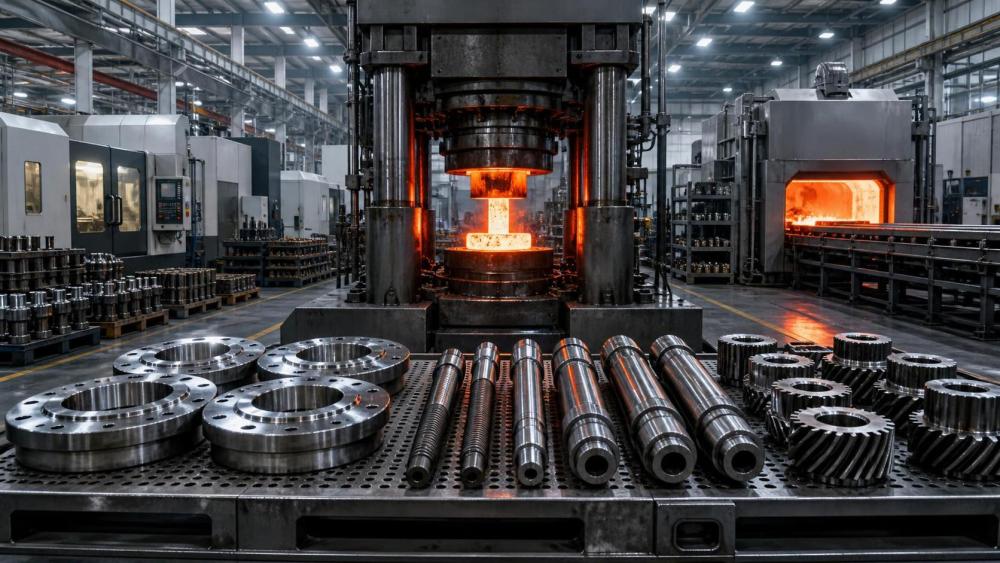
A forged part quotation usually combines material, conversion, tooling, finishing, quality control, overhead, packaging, and logistics costs into one unit price.
Buyers often focus on the quoted price per kilogram or per piece. That comparison is incomplete when suppliers use different production routes or inspection scopes.
Two components with identical external dimensions can have substantially different costs because grain flow, internal soundness, machining allowance, and certification requirements differ.
For high-volume programs, the most useful question is not simply, “Which supplier is cheapest?” It is, “What process and risk assumptions are included?”
A lower initial quote may exclude tooling maintenance, destructive tests, traceability records, rust prevention, export packing, or contingency for raw material price changes.
Procurement teams should request a cost breakdown at a practical level. Suppliers may not disclose every margin, but they should identify the major cost categories.
This transparency makes it easier to determine whether price differences come from legitimate manufacturing efficiency or from omitted technical and commercial obligations.
Steel Grade and Raw Material Strategy Set the Baseline
Material is often the largest direct contributor to forged steel components price, particularly for large shafts, flanges, hubs, connecting rods, and load-bearing parts.
Carbon steel grades generally cost less than alloy steels, stainless steels, tool steels, or specialty low-alloy materials designed for demanding fatigue conditions.
However, grade selection should be evaluated against operating requirements. A cheaper material can create costly field failures when strength, toughness, corrosion resistance, or weldability is inadequate.
Common purchasing specifications may require grades such as ASTM A105, A350 LF2, 4140, 4340, 42CrMo4, 20MnCr5, or stainless steel equivalents.
Each grade has different billet availability, alloy content, forging temperature range, heat-treatment needs, and testing expectations. These variables influence both cost and lead time.
Material form also matters. Suppliers may purchase bar stock, continuous-cast billet, ingot, or customer-approved mill material, with different yield and documentation consequences.
When mill certificates, heat numbers, chemical analysis, and origin documentation are mandatory, procurement should include those conditions before requesting a final price.
Steel market volatility can affect long-term contracts. Buyers should agree whether quotations are fixed, indexed to a published material benchmark, or reviewed periodically.
Forging Method Changes Productivity and Part Performance
The selected forging process strongly influences production cost because it determines equipment requirements, material utilization, cycle time, dimensional accuracy, and achievable mechanical properties.
Open-die forging is suitable for large, simple, or custom parts. It offers flexibility but can require more machining stock and longer handling time.
Closed-die forging produces repeatable shapes using dedicated dies. It is often economically attractive for high volumes because material use and machining time decline.
Upset forging, roll forging, precision forging, and ring rolling may provide better productivity for specific geometries, including shafts, rings, axle components, and flanged parts.
The lowest-cost method depends on annual quantity, geometry complexity, weight, tolerance, and downstream machining requirements. It should never be selected only by initial tooling cost.
Closed-die processes can improve grain flow around critical contours. This can increase fatigue performance and reduce the need for oversized sections in highly loaded components.
For industrial equipment buyers, that performance value may justify a higher conversion price when uptime, safety, warranty exposure, or certification obligations are significant.
Ask each supplier to state the proposed forging route and estimated material yield. This reveals whether quoted pricing reflects an optimized manufacturing plan.
Tooling Cost Must Be Amortized Against Real Demand
Tooling is frequently misunderstood in high-volume forged component sourcing. Dies, trim tools, fixtures, gauges, and inspection equipment may require meaningful upfront investment.
A supplier may charge tooling separately, build it into unit pricing, or recover it over an agreed production volume. Each model creates different commercial risks.
For stable, repeatable orders, amortizing tooling over annual demand can reduce the apparent barrier to launch. Buyers should still clarify ownership and maintenance responsibility.
Tool life depends on forging pressure, steel grade, temperature, flash design, surface treatment, and maintenance discipline. These factors can affect later unit costs.
If demand is uncertain, full tooling amortization across an optimistic forecast can create disputes when actual releases fall below the anticipated quantity.
A practical agreement defines the expected volume, amortization schedule, tool ownership, storage period, replacement criteria, and treatment of unused tooling value.
Buyers should also ask whether the quotation includes sample dies, production dies, repair allowances, trimming tools, calibration fixtures, and gauges for critical dimensions.
Transparent tooling terms allow procurement teams to compare competing offers on total program cost rather than on an artificially low starting unit price.
Part Geometry Determines Yield, Press Time, and Machining Allowance
Component design has a direct effect on forged steel components price. Weight alone does not indicate manufacturing difficulty or the amount of usable finished material.
Long slender shafts, deep hubs, asymmetric arms, thin sections, complex transitions, and closely controlled radii can require specialized dies and additional forming operations.
Design features that interrupt material flow may increase the risk of laps, folds, underfill, or die wear. Suppliers may compensate through slower cycles.
Generous forging radii and consistent section transitions generally support better metal flow. They can reduce reject rates and improve repeatability in volume production.
Machining allowance is another major consideration. Excess stock raises billet weight, forging energy, machining time, tool consumption, and scrap generation.
Insufficient allowance can cause incomplete cleanup after forging, scale removal, distortion, or heat treatment. It may also increase rejection during final machining.
Procurement should involve engineering early when comparing supplier proposals. A small drawing adjustment can produce larger savings than aggressive negotiation on conversion margin.
For mature parts, suppliers should provide feedback on net-shape opportunities, die split location, flash design, machining datum strategy, and recommended tolerance bands.
Heat Treatment and Mechanical Requirements Add More Than Furnace Cost
Heat treatment is essential when forged components require specified hardness, tensile strength, impact toughness, wear resistance, or fatigue performance under cyclic loading.
Normalizing, annealing, quenching and tempering, solution treatment, stress relieving, carburizing, induction hardening, and nitriding create different cost and lead-time profiles.
The furnace cycle itself is only one cost element. Handling, quench media, distortion control, hardness verification, metallographic evaluation, and repeat processing also matter.
Large-section components may need carefully controlled heating and cooling to achieve uniform properties. This can reduce throughput and require more sophisticated equipment.
Procurement teams should avoid specifying overly broad or unnecessarily severe requirements. A requirement that exceeds actual service needs can inflate cost without improving project value.
At the same time, vague heat-treatment language creates risk. Suppliers may use different cycles, producing parts that appear similar but perform differently in service.
The purchase specification should state the applicable standard, required mechanical values, sampling frequency, test location, hardness range, and documentation expectations.
Where component failure has safety or downtime consequences, qualified procedure records and heat-treatment traceability are more valuable than a modest unit-price reduction.
Machining, Surface Finish, and Tolerance Control Can Dominate Final Cost
Many industrial forgings are not delivered as-forged. They require turning, milling, drilling, grinding, broaching, balancing, threading, or precision finishing before assembly.
As machining content increases, the total cost shifts from forging toward machine time, tooling, setup, inspection, fixture design, and scrap exposure.
Tight tolerances on concentricity, runout, flatness, bearing seats, bores, keyways, or sealing surfaces may require multiple setups and specialized inspection equipment.
Surface finish requirements also need careful review. A machined surface for general assembly is different from a ground journal, hydraulic sealing face, or fatigue-critical transition.
Buyers should specify functional tolerances rather than applying tight values uniformly across every feature. Unnecessary precision increases cost and can reduce supplier capacity.
The best suppliers coordinate forging and machining plans. Proper datum design and controlled stock allowance reduce material removal while preserving dimensional stability after heat treatment.
When comparing quotations, identify exactly which features are machined, what reference standard applies, whether threads are gauged, and whether final inspection is included.
A part may appear inexpensive until secondary operations are added. Procurement comparisons should therefore use the required delivery condition, not an incomplete forging price.
Testing, Certification, and Traceability Are Commercial Requirements
Quality documentation is a significant cost driver when forged steel components are used in energy, pressure systems, lifting equipment, transport, mining, and infrastructure projects.
Typical requirements include material certificates, dimensional reports, hardness results, tensile tests, Charpy impact tests, ultrasonic testing, magnetic particle inspection, and dye penetrant testing.
Each requirement affects labor, equipment utilization, sample preparation, waiting time, record retention, and the probability that a batch requires corrective action.
Third-party inspection may add cost, especially when inspectors must witness material verification, forging, heat treatment, final inspection, or packing before shipment.
These controls should be assigned by risk. Routine commercial parts may not need the same inspection plan as pressure-retaining components or fatigue-critical rotating shafts.
Buyers should define acceptance criteria clearly, including applicable standards, test methods, inspection level, batch size, retest provisions, and reporting format.
Ambiguous requirements often create quotation gaps. One supplier may include full ultrasonic testing while another assumes only visual inspection and basic dimensional checks.
Traceability should continue from steel heat through forging lot, heat treatment, machining, inspection, and packing. This is particularly important for recurring OEM programs.
Order Volume Reduces Cost Only When Releases Are Predictable
High annual volume can lower forged steel components price, but only when production releases allow suppliers to plan material purchasing, tooling use, labor, and equipment capacity.
Volume savings usually come from longer production runs, reduced die changes, less setup time per part, better material purchasing, and more consistent process control.
A forecast of 100,000 pieces is less valuable than a released schedule with realistic batch sizes, delivery windows, and a credible commitment from the buyer.
Small and irregular releases can eliminate scale benefits even when annual demand is high. Suppliers may need to carry inventory or repeatedly restart production.
Blanket orders with scheduled call-offs can improve pricing when inventory rules, forecast accuracy, minimum release quantities, and material-price adjustment mechanisms are agreed.
Buyers should distinguish between annual demand, maximum capacity, minimum commitment, and firm purchase orders. These figures have different implications for supplier planning.
Consolidating similar parts may also help. Shared steel grades, common diameters, related tooling concepts, and coordinated production windows can improve total program economics.
However, avoid forcing excessive standardization where application requirements differ. Savings are not worthwhile if commonization weakens durability, compliance, or field serviceability.
Freight, Packaging, and Delivery Reliability Affect Landed Cost
For global orders, the quoted forging price is only part of the procurement decision. Landed cost includes packing, inland transport, export documentation, freight, insurance, duties, and inventory exposure.
Forged steel parts are heavy, and poor packaging can cause corrosion, impact damage, mixed lots, or lost traceability during multimodal transport and warehouse handling.
Export-grade packaging may require rust preventive oil, VCI protection, wooden crates, steel frames, pallets, separators, labeling, and moisture barriers.
Delivery reliability deserves equal attention. A low-cost supplier can create much higher costs if delays interrupt assembly, construction schedules, maintenance shutdowns, or customer deliveries.
Evaluate production capacity, furnace availability, die-shop support, machining bottlenecks, inspection turnaround, historical on-time delivery, and contingency plans for equipment failure.
For critical programs, use delivery terms that make responsibilities clear. Define Incoterms, packaging standards, documentation timing, shipment consolidation, and escalation procedures for delayed lots.
Procurement teams should model total landed cost and supply risk together. The best commercial decision often balances unit price, working capital, quality assurance, and delivery confidence.
How Buyers Should Compare Forged Component Quotations
A structured comparison sheet prevents procurement teams from selecting a price that does not represent equivalent scope. Every supplier should quote against the same technical package.
Include drawing revision, material grade, forging process, heat treatment, machining scope, surface condition, tolerances, inspection requirements, certificates, packaging, and delivery terms.
Request annual capacity, minimum order quantity, sample lead time, production lead time, tooling lead time, quoted validity period, and material escalation assumptions.
Ask suppliers to identify exclusions explicitly. Common exclusions include destructive testing, third-party inspection, special coating, final machining, export crates, and long-term tooling storage.
For high-risk components, review process capability rather than relying only on certificates. Site audits, sample approval, first-article inspection, and trial production runs provide useful evidence.
Supplier selection should consider corrective-action responsiveness and engineering communication. A technically capable supplier that cannot resolve deviations quickly can still create program disruption.
After award, maintain a price and performance baseline. Monitor defect rate, delivery performance, documentation accuracy, change-control discipline, and total cost of quality over time.
Conclusion: Focus on Total Program Value
Forged steel components price is driven by material, process selection, tooling, geometry, heat treatment, machining, inspection, order predictability, and logistics conditions.
For procurement professionals, the objective is not merely to obtain the lowest quoted unit cost. It is to secure repeatable parts with controlled risk and dependable delivery.
The strongest sourcing decisions compare like-for-like scope, verify supplier capability, and connect technical requirements to the actual service conditions of the finished equipment.
When buyers understand the cost drivers before negotiation, they can identify meaningful savings, avoid hidden exclusions, and build more reliable high-volume supply programs.
Related News
- How to Assess a Rigid Coupling Supplier for Bore Accuracy and Traceable QualityOct 08, 2026Tribology & Kinematics Expert
- Titanium Alloys Compared: Balancing Strength, Corrosion Resistance, and MachinabilityOct 08, 2026CNC Kinematics Architect
- Where Ductile Iron Dismantling Joints Reduce Alignment Risk in Water PipelinesOct 08, 2026Pipeline Metallurgy Scientist
- Selecting a Precision Bearing Sleeve: Fits, Runout, and Material ChoicesOct 08, 2026Tribology & Kinematics Expert
- Face Milling Cutters: How Insert Geometry Affects Finish on Steel and AluminumOct 08, 2026CNC Kinematics Architect
- Single-Acting Cylinders for Clamping: Stroke, Force, and Return Spring ConsiderationsOct 07, 2026Fluid Power Control Strategist