
Industrial Forgings or Castings: How Buyers Can Compare Strength, Lead Time, and Cost
When sourcing critical components, buyers often face a high-stakes choice between Industrial Forgings and castings. The right decision can affect mechanical strength, production lead time, lifecycle cost, and long-term reliability. This guide helps procurement teams compare both options through a practical lens, so they can align material performance and supply strategy with demanding industrial applications.
What Buyers Are Really Comparing When They Evaluate Forgings and Castings
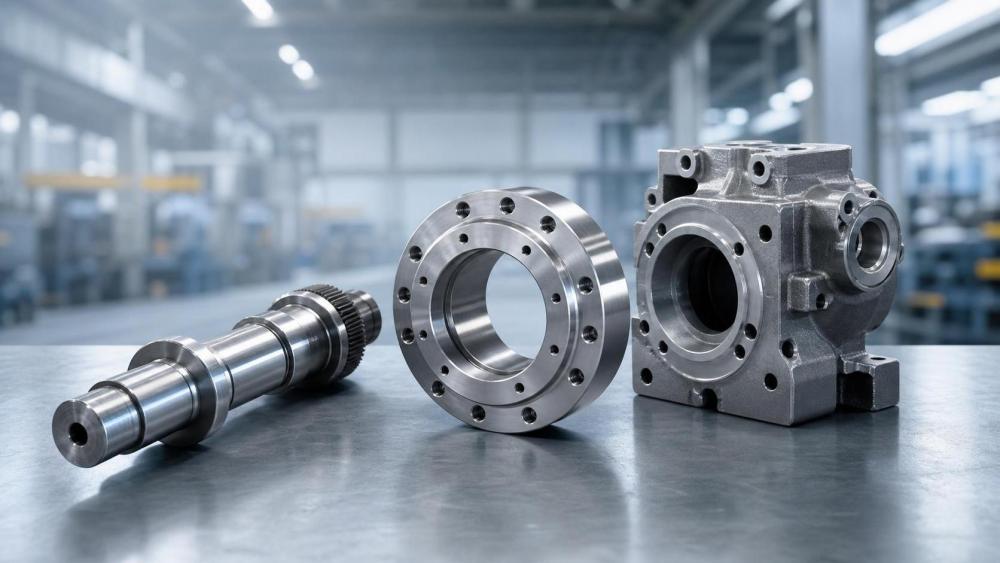
Most procurement teams are not comparing processes in isolation. They are comparing business risk, failure consequences, delivery certainty, machining burden, and total cost over the part's operating life.
That is why the best choice is rarely the one with the lowest unit quote. It is the option that meets performance requirements with the least overall commercial and operational exposure.
As a general rule, Industrial Forgings are favored for high-load, fatigue-sensitive, impact-prone, or safety-critical parts. Castings are often preferred for complex shapes, larger volumes, and parts where geometry efficiency matters more than peak toughness.
For buyers, the decision usually comes down to three filters. First, how severe are the loads and failure consequences? Second, how quickly is the part needed? Third, what cost should be optimized: purchase price, machining cost, or lifecycle cost?
If a component sits inside a wind turbine drivetrain, mining gearbox, heavy excavator linkage, press system, or pipeline pressure assembly, a forging often creates a stronger risk position. If the part needs intricate internal geometry or lower tooling barriers, casting may be the more practical route.
How Industrial Forgings Deliver Higher Strength and More Predictable Performance
The main strength advantage of Industrial Forgings comes from the way metal is deformed under pressure. Forging compresses and refines the grain structure, improving directional flow and reducing internal discontinuities.
That microstructural change matters because many industrial failures start below the visible surface. Cyclic stress, shock loads, and torque reversals exploit weak zones, segregation, porosity, or brittle regions that are more common in cast structures.
Forged components usually provide better tensile strength, impact resistance, and fatigue life than equivalent cast parts made from similar alloys. This is especially important when the part will face fluctuating loads instead of static service.
Buyers should pay close attention to fatigue, not just ultimate strength. A component may survive proof testing yet still crack early in field service if the grain flow and internal soundness are not suited to repeated stress cycles.
Examples where forgings often outperform castings include shafts, rings, hubs, flanges, gear blanks, couplings, crane hooks, high-pressure valve bodies, and structural members exposed to heavy dynamic loading.
In these applications, the value of a forging is not only higher strength on paper. It is the greater reliability margin under imperfect real-world conditions such as misalignment, overload events, vibration, and thermal cycling.
That said, buyers should avoid assuming every forged part is automatically better. Mechanical performance depends on material grade, reduction ratio, heat treatment, process control, inspection, and finish machining quality.
A poorly controlled forging can still fail. The practical lesson is to evaluate certified properties, ultrasonic testing coverage, hardness consistency, and heat-treatment records rather than relying only on the word "forged."
When Castings Make More Sense Despite Lower Mechanical Advantage
Castings remain essential in heavy industry because they solve design and cost problems that forgings cannot always solve efficiently. Molten metal can fill complex cavities, ribs, contours, and near-net shapes with less material waste.
This matters when the component geometry is complicated, when internal passages are required, or when machining a forging down to final form would remove too much stock and inflate cost.
For example, pump housings, machine bases, valve bodies with complex channels, and certain brackets or enclosures are often more economical as castings. Their value comes from geometric freedom rather than maximum toughness.
Castings can also make sense when the part experiences moderate loads, when design standards already validate cast material performance, or when the buyer needs a lower-cost route for larger-volume production.
The key is matching the process to the service environment. If a casting meets all required pressure, impact, wear, and inspection criteria with acceptable safety margin, choosing a forging may add cost without adding practical value.
In other words, buyers should not frame the decision as forged good, cast bad. The real question is whether the application needs the structural discipline of a forging or the geometric efficiency of a casting.
Lead Time: Why the Faster Option Depends on Part Geometry, Volume, and Supply Chain Maturity
Lead time is one of the most misunderstood parts of the forging-versus-casting discussion. Buyers often assume castings are always faster, but that is only true in certain sourcing conditions.
For standard or repeat forgings, established suppliers may already have tooling, ingot routes, die experience, and heat-treatment windows in place. That can shorten qualification and make production surprisingly efficient.
On the other hand, open-die forgings for large shafts, rings, or blocks may require mill scheduling, forging press availability, rough machining, heat treatment, and extensive non-destructive testing. That can extend delivery significantly.
Castings may move faster when near-net geometry reduces machining time and when foundry patterns are ready. However, new pattern development, mold validation, and defect remediation can also create schedule uncertainty.
Buyers should separate quoted production time from true project lead time. Real lead time includes material sourcing, tooling, sampling, heat treatment, machining, inspection, document preparation, packing, and logistics.
It is also wise to ask where the supplier's bottleneck actually sits. In many cases, the longest delay is not forging or casting itself, but outsourced heat treatment, final machining capacity, or third-party testing availability.
For urgent projects, the most useful question is not "Which process is faster?" It is "Which supplier can deliver a conforming part faster with fewer unknowns and lower rework risk?"
That shift in thinking helps procurement teams avoid selecting a theoretically shorter process that becomes slower because of quality escapes, pattern revisions, or delayed documentation.
Cost: The Lowest Piece Price Is Rarely the Lowest Procurement Cost
Direct part price matters, but serious buyers compare total acquisition cost and service-life economics. A cheaper component can become more expensive if it causes extra machining, higher scrap risk, shorter service intervals, or unplanned downtime.
Industrial Forgings often carry a higher initial price because of deformation energy, raw stock sizing, heat treatment, and machining allowances. Yet that premium can be justified when field failure cost is severe.
Castings often look attractive on unit price, especially for shape complexity. Near-net production can reduce machining hours, lower material waste, and simplify downstream operations when tolerances and internal quality are achievable.
However, castings may introduce hidden costs if internal soundness requires repeated repairs, if defect rates rise during ramp-up, or if conservative design forces heavier section thickness to compensate for lower toughness.
Buyers should model at least six cost elements: piece price, tooling cost, machining cost, inspection cost, failure cost, and replacement lead time. This creates a procurement view closer to real business exposure.
For safety-critical or uptime-critical assets, failure cost deserves much more weight than it usually receives in early sourcing conversations. A single shutdown can wipe out years of apparent savings from a lower-priced part.
In contrast, for non-critical housings or moderate-duty structures, paying a forging premium may not improve total economics. The right answer depends on consequence, duty cycle, and the amount of post-processing required.
A Practical Buyer Checklist for Choosing Between Forgings and Castings
The fastest way to improve sourcing quality is to use a structured comparison instead of relying on habit or supplier preference. Buyers should begin with the application, not the manufacturing process.
Start by asking how the part fails if it fails at all. Does it see impact, torsion, bending, pressure cycling, or constant vibration? Is failure a maintenance issue, a safety event, or a plant shutdown?
Next, review geometry. Does the part need complex internal passages, thin-wall sections, or near-net contours? If so, casting may unlock cost and manufacturability advantages that a forging cannot match efficiently.
Then assess specification discipline. What mechanical properties are mandatory? What non-destructive testing is required? Are there hardness windows, grain-flow expectations, pressure tests, or traceability obligations?
After that, examine the machining route. Some forgings require extensive stock removal, while some castings sharply reduce machining time. Buyers should compare finished-part cost, not just raw-blank cost.
Supplier capability should be screened just as rigorously as the process itself. Ask about typical defect modes, in-house versus outsourced heat treatment, NDT scope, dimensional control, and previous performance in similar applications.
Finally, connect sourcing choice to commercial realities. If the project needs stable repeat supply over many years, the most valuable supplier may be the one with stronger process control, not the one with the lowest opening quote.
Questions Procurement Teams Should Ask Suppliers Before Awarding the Order
Well-chosen supplier questions often reveal more than a polished quotation sheet. They expose how mature the manufacturing route really is and whether the supplier understands the operating demands of the part.
Ask forging suppliers about reduction ratio, heat-treatment sequence, ultrasonic testing standards, mechanical test locations, and typical variation between batches. These details directly affect consistency and long-term reliability.
Ask casting suppliers about pattern ownership, process capability, defect control plans, radiographic or ultrasonic inspection, repair policy, and dimensional repeatability after heat treatment and machining.
For both processes, request examples of similar components already delivered into equivalent service environments. Proven application history reduces procurement uncertainty more than generic capability claims.
It is also important to confirm where the supplier adds value internally. A vendor that controls rough machining, heat treatment, testing, and final inspection in-house usually offers tighter schedule control than one managing many outside steps.
Documentation should not be treated as an afterthought. Material certificates, inspection reports, traceability records, and compliance data are part of the deliverable, especially in regulated or high-consequence industries.
How to Make the Final Decision with Confidence
For buyers, the right comparison framework is straightforward. Choose Industrial Forgings when the part is load-critical, fatigue-sensitive, impact-prone, or too risky to fail in service.
Choose castings when geometry complexity, near-net-shape efficiency, and cost control matter more than maximum toughness, and when validated material performance is fully adequate for the application.
If both routes appear technically possible, the decision should be settled by lifecycle economics, supplier process maturity, inspection confidence, and the operational cost of failure or replacement delay.
In practical procurement terms, forgings usually win where reliability margin is the commercial priority. Castings usually win where shape efficiency and cost structure dominate and the service conditions are less punishing.
The most effective buyers do not ask which process is better in general. They ask which process gives this exact component the best combination of strength, lead time, and total cost with the lowest supply risk.
That is the decision standard that turns a sourcing exercise into a reliable industrial purchasing strategy.
Related News
- How to Assess a Rigid Coupling Supplier for Bore Accuracy and Traceable QualityOct 08, 2026Tribology & Kinematics Expert
- Titanium Alloys Compared: Balancing Strength, Corrosion Resistance, and MachinabilityOct 08, 2026CNC Kinematics Architect
- Where Ductile Iron Dismantling Joints Reduce Alignment Risk in Water PipelinesOct 08, 2026Pipeline Metallurgy Scientist
- Selecting a Precision Bearing Sleeve: Fits, Runout, and Material ChoicesOct 08, 2026Tribology & Kinematics Expert
- Face Milling Cutters: How Insert Geometry Affects Finish on Steel and AluminumOct 08, 2026CNC Kinematics Architect
- Single-Acting Cylinders for Clamping: Stroke, Force, and Return Spring ConsiderationsOct 07, 2026Fluid Power Control Strategist