
How to Specify Custom Forged Blocks for High-Load Press and Tooling Systems
Introduction: Specifying custom forged blocks for high-load press and tooling systems requires more than selecting a grade and dimensions. Technical evaluators must balance load paths, fatigue resistance, grain flow, heat treatment, machining allowances, inspection requirements, and traceability to ensure reliable performance.
Start With the Actual Load Case, Not a Material Grade
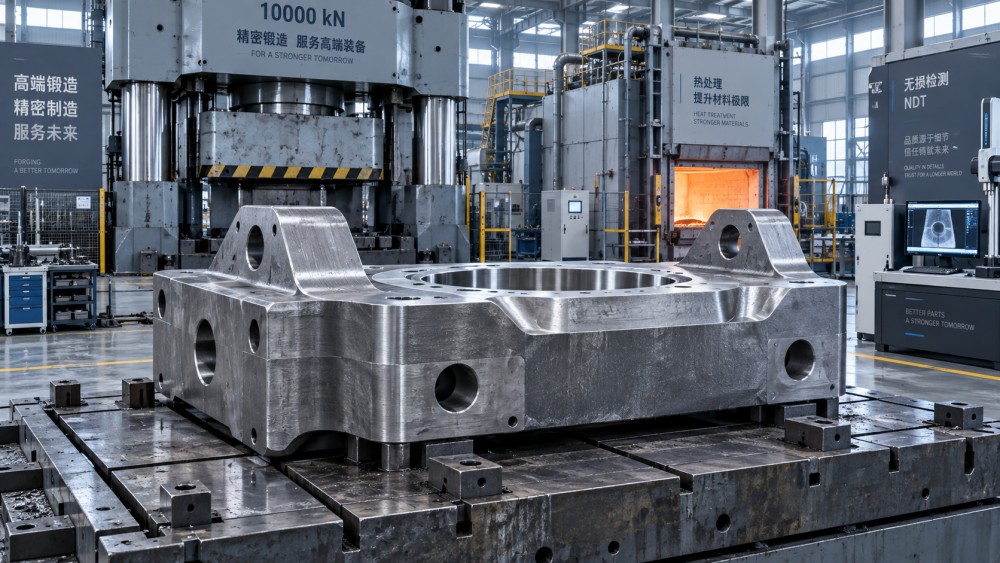
The most reliable custom forged blocks begin with a documented service condition. A material grade is only meaningful after loads, temperatures, stress cycles, and mounting constraints are understood.
Technical evaluators should identify whether the block carries compression, bending, shear, torsion, impact loading, or combined stresses. Each condition changes the required forging design and inspection approach.
For press structures, peak tonnage alone is an incomplete design input. Off-center loading, die misalignment, snap-through forces, and repeated production cycles can create much higher local stresses.
Tooling blocks may experience concentrated contact pressure around cavities, guide features, bolts, or clamping surfaces. These locations often govern component life more than the nominal load rating.
Request a load map from the design team whenever possible. It should show force direction, support points, restraint conditions, cyclic frequency, and expected overload scenarios.
A forged block supporting a hydraulic press platen requires different consideration than one used in an extrusion die holder. Their loads may appear similar while their failure mechanisms differ substantially.
Define the operating temperature range early. Elevated temperatures can reduce yield strength, affect toughness, alter lubrication behavior, and change dimensional stability after heat treatment.
Also distinguish between normal production loading and abnormal events. Emergency stops, jammed workpieces, tooling crashes, and pressure spikes should be considered in the design safety margin.
Define Geometry Around Stress Flow and Manufacturing Reality
Custom forged blocks should be specified from functional geometry, but their design must also support favorable metal flow. Sharp transitions and isolated heavy sections increase cracking and distortion risk.
Provide the supplier with a controlled drawing showing finished dimensions, datum surfaces, tolerances, machined features, threaded holes, and all areas where material removal is expected.
State whether the supplied component will be rough machined, semi-finished, or finish machined. This decision affects forging oversize, heat-treatment sequence, inspection accessibility, and delivery cost.
Machining allowance should be sufficient to remove scale, decarburization, and surface irregularities. Excessive allowance, however, wastes material and may remove beneficial near-surface grain orientation.
Large pockets, deep bores, and interrupted internal features deserve special attention. They can expose internal discontinuities that were not relevant in the original forged blank geometry.
Ask whether the proposed forging shape can reduce machining time without compromising structural performance. Near-net forging may offer value where repeat quantities justify dedicated tooling.
Corner radii should be matched to service stress requirements and forging capability. Tight internal radii frequently cause stress concentration, difficult die filling, and inconsistent material flow.
Where feasible, keep high-stress zones away from parting lines, heavy machining cuts, and weld repairs. These decisions improve both fatigue performance and inspection confidence.
Select Steel by Required Properties at the Finished Section
Material selection should start with required mechanical properties at the final working section, not with a familiar alloy name. Thickness strongly influences achievable strength and toughness.
Common choices for high-load forged blocks include carbon steels, alloy steels, chromium-molybdenum steels, nickel-chromium-molybdenum steels, and hot-work tool steels for specialized applications.
A medium-carbon alloy steel may provide practical strength and machinability for press components. More demanding cyclic loads may require higher hardenability or improved low-temperature toughness.
Specify minimum yield strength, tensile strength, elongation, reduction of area, hardness range, and impact toughness where those properties directly affect the application.
Do not request maximum hardness without explaining the service objective. Higher hardness can improve wear resistance but may reduce toughness, machinability, and resistance to crack propagation.
For blocks exposed to repeated shock, Charpy impact requirements should state the test temperature, notch orientation, minimum average value, and individual test-piece acceptance criteria.
When a block contacts hot tooling or heated workpieces, consider temper resistance and thermal fatigue. Standard room-temperature tensile data does not adequately describe this operating environment.
Require the supplier to identify the governing material standard, such as ASTM, EN, JIS, or customer-controlled specifications. Equivalent grades should be formally reviewed rather than assumed.
Specify Grain Flow and Forging Reduction Where They Matter
The key advantage of custom forged blocks is controlled grain structure. Proper deformation can refine the microstructure and align grain flow with principal load directions.
Technical evaluators should ask how the billet will be reduced and shaped. A supplier should explain whether upsetting, drawing, open-die forging, or closed-die forging is planned.
Forging reduction ratio matters especially for thick sections, critical shafts, die holders, and blocks machined from large ingots. Insufficient working can leave coarse or segregated internal structure.
Specify grain-flow direction when the component has a dominant loading axis. This is particularly valuable for blocks carrying bending loads or supporting highly stressed tooling interfaces.
Open-die forging is often preferred for large custom blocks because it offers flexibility in dimensions and lower tooling investment. It also requires disciplined process control for consistency.
Closed-die forging can provide better repeatability and reduced machining stock for larger production runs. The economics depend on quantity, geometry complexity, and die development cost.
A supplier should not promise ideal grain flow without reviewing the finished machining envelope. Significant machining can cut across flow lines or remove the most favorably worked material.
Request macroetch examination for components with high structural importance. Macrostructure review can reveal flow patterns, centerline condition, segregation, and forging-related discontinuities before final delivery.
Make Heat Treatment a Controlled Part of the Specification
Heat treatment often determines whether custom forged blocks achieve their intended balance of strength, toughness, machinability, and dimensional stability. It should never be treated as a generic finishing step.
Specify the required condition clearly, such as normalized, annealed, quenched and tempered, stress relieved, solution treated, or prehardened. Ambiguous terminology produces inconsistent results.
For quenched and tempered blocks, define the target hardness or mechanical-property range after final tempering. A broad range may be acceptable only when subsequent machining is substantial.
Section thickness must be disclosed because cooling rates differ between surface and core. A supplier cannot responsibly guarantee through-section properties without knowing the finished geometry.
Large blocks may need staged thermal processing to reduce residual stress. Improper quenching can create distortion, excessive hardness gradients, or delayed cracking after machining.
Stress relieving after rough machining is valuable for blocks with deep cavities, asymmetric material removal, or tight final flatness requirements. It reduces movement during finish machining.
Specify whether heat-treatment records are required. Time-temperature charts, furnace batch identification, quench medium details, and post-treatment hardness results strengthen traceability for critical equipment.
Where tooling reliability is central, discuss heat-treatment capability during supplier qualification. Furnace size, temperature uniformity, loading practice, and calibration discipline affect real component quality.
Set Inspection Requirements According to Failure Consequences
Inspection requirements should reflect the consequence of failure, not simply the component price. A block supporting critical press tooling can justify stricter testing than a low-risk fixture base.
Ultrasonic testing is commonly used to detect internal discontinuities in forged blocks. The specification should state the inspection standard, scanning coverage, acceptance class, and report requirements.
Magnetic particle testing is useful for detecting surface and near-surface cracks in ferromagnetic steels. It is particularly relevant after rough machining or heat treatment.
Liquid penetrant testing may be appropriate for nonmagnetic alloys or selected machined surfaces. Define the surfaces to be tested rather than requesting broad testing without a clear purpose.
Dimensional inspection should include critical datums, parallelism, flatness, bore locations, and perpendicularity where assembly alignment affects press accuracy or tooling repeatability.
Hardness testing locations should be agreed before production. Results taken only from accessible edges may not represent the condition in a large working section.
For highly critical blocks, consider independent witness inspection or third-party verification. This is especially useful when components enter safety-sensitive, high-value, or difficult-to-repair machinery.
Inspection reports should be linked to the part number, heat number, drawing revision, and purchase order. Unlinked reports create documentation gaps that are difficult to resolve later.
Protect Traceability From Raw Material Through Delivery
Traceability is not administrative overhead for high-load forged components. It enables technical teams to verify chemistry, heat treatment, testing, and corrective actions throughout the component lifecycle.
Require material test certificates that include chemical composition, mechanical properties, heat number, product form, and applicable standard. Confirm that certificates match the actual supplied material.
Each custom forged block should have durable identification where practical. Marking methods must avoid introducing stress risers or damaging surfaces intended for final machining.
Define whether heat numbers must remain visible after rough machining. If marks will be removed, establish an alternative traceability method using tags, controlled records, or transfer stamps.
Purchase specifications should identify the approved drawing revision and any deviation process. Small undocumented changes in material, heat treatment, or dimensions can alter component performance.
For international sourcing, clarify document language, units, standards hierarchy, and certificate format before order release. Misunderstandings frequently arise when requirements cross regional technical conventions.
Traceability should also cover subcontracted operations, including heat treatment, testing, machining, and coating. The forging supplier remains responsible for controlling these external processes.
Review the supplier's nonconformance procedure. Evaluators should know how deviations are documented, technically assessed, approved, and prevented from recurring in future production batches.
Evaluate Supplier Capability Before Finalizing the Order
A technically correct specification still depends on supplier capability. Evaluate whether the manufacturer has suitable press capacity, forging experience, furnace capacity, machining equipment, and inspection resources.
Ask for examples of comparable forged blocks, including material grade, section size, heat-treatment condition, testing scope, and end-use sector. Relevant evidence is more useful than generic claims.
Confirm the supplier's maximum ingot, billet, and finished forging weights. Capacity limits can influence reduction ratio, process route, delivery schedule, and achievable dimensional control.
Review machining capability if the supplier will deliver semi-finished or finished blocks. Large-scale CNC boring, milling, grinding, and coordinate inspection may be necessary for complex tooling interfaces.
Technical communication is also a measurable capability. A suitable supplier should challenge unclear requirements, identify risks early, and provide a documented manufacturing route for review.
Compare quotations on scope, not only price. Lower-cost offers may omit testing, machining allowance, documentation, special packaging, or controlled heat treatment required for dependable press performance.
For first-time components, a pre-production review should confirm drawings, quality plans, inspection hold points, acceptance criteria, delivery condition, and responsibilities for design changes.
Use a trial order when practical. Initial components can validate machinability, distortion behavior, inspection results, and service performance before larger tooling programs are committed.
Build a Purchase Specification That Prevents Avoidable Failure
An effective purchase specification consolidates engineering intent into clear, verifiable requirements. It should allow the supplier to manufacture confidently while preserving the buyer's critical performance expectations.
Include finished and supplied dimensions, machining allowance, material standard, required properties, heat-treatment condition, grain-flow expectations, surface condition, and allowable repair restrictions.
State all required non-destructive testing methods, acceptance levels, reporting formats, and testing stages. Testing before machining may not be sufficient for surfaces exposed later.
Define documentation requirements, including material certificates, heat-treatment charts, inspection reports, dimensional records, packing lists, and conformity statements tied to the purchase order.
Specify delivery condition carefully. A block delivered stress relieved and rough machined needs different preservation, handling, and storage controls than a scale-covered as-forged blank.
Packaging should protect reference surfaces, corrosion-sensitive areas, and identification marks during transport. Heavy custom forged blocks may require lifting points, skid design, and orientation instructions.
Before release, compare the specification against realistic service needs. Requirements that cannot be measured, interpreted consistently, or justified by risk add cost without improving reliability.
Successful sourcing of custom forged blocks comes from connecting engineering loads, metallurgy, manufacturing controls, and documentation. This disciplined approach improves tooling life, reduces failure exposure, and supports confident supplier decisions.