
How to Qualify a Forged Rings Factory for Traceability, Capacity, and Lead Times
A forged ring can look compliant on a drawing and still create substantial procurement risk if its material history, process route, and delivery promise cannot be verified. For buyers of bearing races, flanges, gear blanks, pressure-retaining parts, rotating equipment components, or heavy-duty structural rings, supplier qualification should begin before comparing unit prices.
The practical question is whether a forged rings factory can repeatedly produce the required ring size, material condition, inspection record, and delivery date under the conditions of the actual order. A supplier with large nominal equipment may still be unsuitable for a tight-tolerance, heat-treated, fully traceable ring program. Conversely, a smaller producer may be a strong fit for lower-volume work if its process control and scheduling discipline are visible.
Qualification should therefore focus on three connected areas: traceability from raw material to shipment, usable production capacity rather than advertised capacity, and lead times that reflect the full manufacturing route. These areas also determine whether a low quotation is genuinely lower cost or simply shifts risk into inspection, rework, expediting, or schedule disruption.
Start with the ring's technical and commercial risk
Not every forged ring requires the same level of supplier scrutiny. A carbon steel ring used as a general machinery blank has a different risk profile from an alloy steel ring for a gearbox, a stainless ring for corrosive service, or a large seamless rolled ring intended for high-load rotating equipment.
Before sending requests for quotation, procurement should align with engineering on the points that control the manufacturing route. Ring outside diameter, inside diameter, height, wall thickness, finished versus forged dimensions, alloy grade, heat treatment, machining allowance, and inspection requirements all affect what the factory must actually do. A drawing that specifies only final dimensions may not be enough for meaningful supplier comparison.
The same applies to quality documentation. A material certificate may be sufficient for a non-critical part, while another application may require heat-level identification, hardness records, ultrasonic examination, dimensional inspection, heat-treatment charts, and documented control of machining after forging. The requested documentation should match the consequences of failure. Requiring a large document package for every low-risk ring raises cost and cycle time; accepting minimal paperwork for a critical component can leave the buyer unable to resolve a later quality dispute.
It is useful to classify the order before qualifying the factory:
- Standard or low-consequence rings: common material, moderate dimensions, limited machining, and no severe service condition.
- Controlled production rings: defined alloy, mechanical-property requirements, repeat orders, tighter dimensional limits, or a functional fit with another component.
- Critical rings: pressure, fatigue, high-speed rotation, safety-related service, demanding non-destructive testing, or formal project documentation requirements.
This classification helps prevent a common procurement error: evaluating every factory through the same checklist while overlooking the controls that matter for the particular ring.
Traceability must survive every production handoff
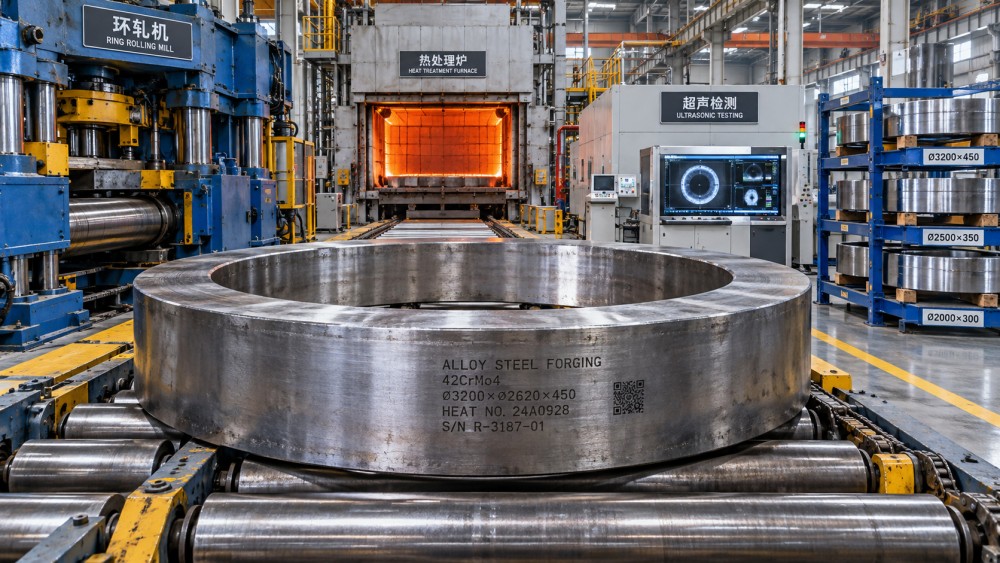
For forged rings, traceability is more than obtaining a certificate at shipment. It is the ability to connect the delivered ring to its material heat, forging batch, heat-treatment lot, inspection record, and any subsequent machining or testing operation. That connection must remain intact when material is cut, heated, forged, rolled, treated, stored, and dispatched.
Ask the factory to explain its identification method in operational terms. Labels alone are not enough, particularly when rings are exposed to scale removal, blasting, heat treatment, or machining. The buyer should understand whether the factory uses physical marking, durable tags, controlled batch containers, traveler documents, or a combination of methods. The method should remain reliable without damaging the part or introducing confusion between similar orders.
A useful document review follows the intended process route rather than requesting a generic quality folder. For a typical seamless rolled ring, the chain may include incoming steel documentation, billet or bloom allocation, forging or piercing records, ring-rolling records, heat-treatment records, chemical and mechanical test results where specified, non-destructive examination results, dimensional inspection, and final release. The exact documents vary by product, but gaps in the chain deserve an explanation.
One frequent concern is the relationship between the certificate supplied by the mill and the actual material used in the ring. A factory may hold valid certificates for a grade in its records without proving that the certified heat was assigned to the buyer's order. Buyers should ask how the factory controls material segregation and how it prevents mixed heats from entering the same production batch when the order requires heat-level traceability.
Traceability becomes harder when outside operations are involved. Heat treatment, ultrasonic testing, rough machining, coating, or final machining may be subcontracted. Outsourcing is not automatically a weakness; many capable forging operations use qualified external specialists. The issue is whether the factory retains control. It should identify the subcontracted step, maintain the part identity through transfer, define the required acceptance criteria, and include the resulting records in the final documentation package.
For repeat programs, request a sample manufacturing record before the first major order. This is often more informative than a broad statement of certification. It shows whether document names, material designations, lot references, test results, and inspection status can be reconciled without interpretation.
Assess capacity by process bottleneck, not by press size
Factories often present large presses, ring rolling mills, extensive floor space, or an impressive list of materials. Those facts matter, but they do not establish usable capacity for a specific order. A factory's real capacity is constrained by the slowest or least available stage in the required route.
For one order, the bottleneck may be billet preparation or a ring rolling mill. For another, it may be a heat-treatment furnace with limited load size, a machining cell needed to meet final dimensions, an ultrasonic inspection station, or an outside testing laboratory. A supplier can forge the ring promptly yet still miss the delivery date because the heat-treatment queue or final inspection release is congested.
Procurement should ask the factory to map the route for the quoted part and identify which stages are in-house. The conversation should cover the actual ring geometry, material, quantity, and delivery pattern, not a generic statement that the factory can produce rings up to a certain diameter or weight.
“Similar orders” should mean similar in the aspects that constrain production: alloy family, diameter range, wall section, forging method, heat treatment, machining level, and inspection scope. A factory that regularly produces large mild-steel rings may not have the same control over smaller alloy steel rings with demanding ultrasonic testing or close concentricity requirements.
Capacity also has a commercial dimension. A supplier may accept a purchase order without having committed raw material, tooling, furnace time, or subcontract capacity. Ask what becomes reserved at order placement and what remains subject to later availability. For long-term agreements, a capacity reservation mechanism may be more valuable than a nominal volume discount, particularly where delayed components can affect assembly or site schedules.
Lead time should be quoted as a route, not a single number
A lead-time promise is credible only when it includes every step between order release and shipment. For forged rings, that can include engineering review, raw material procurement, cutting, forging and ring rolling, normalizing, quenching and tempering or other heat treatment, testing, machining, inspection, preservation, packing, document compilation, and transport handover.
Buyers should separate three dates that are often blurred in quotations: the date material is available, the date the forging is complete, and the date conforming parts are ready for shipment. A factory may describe a short forging cycle while excluding material procurement, heat treatment, machining, or final document review. Such a quote is not necessarily misleading, but it is incomplete for project planning.
Ask for a milestone schedule for the first order, especially for a new supplier, new material grade, or non-standard ring. A useful schedule identifies the expected completion window for raw material, forging, heat treatment, inspection, machining if applicable, final release, and shipment. It does not need to become an administrative burden. Its purpose is to make dependencies visible early enough for the buyer to respond.
Lead times are particularly vulnerable when the order includes requirements that are easy to add to a purchase specification but difficult to integrate late in production. Examples include witnessed testing, special marking, additional non-destructive testing, customer-specific documentation formats, third-party inspection, and final machining after heat treatment. These requirements should be reviewed before the factory confirms its delivery date, not after the material has entered production.
There is also a difference between a factory's normal lead time and its recovery capability when something goes wrong. Procurement teams should ask how the supplier handles failed test results, dimensional nonconformance, late subcontractor returns, or material substitutions. The answer should identify who has authority to communicate deviations, when the buyer is notified, and whether the factory can recover through alternate equipment or an adjusted sequence. A vague assurance that delays are unlikely provides little basis for planning.
Use the quotation to expose hidden cost assumptions
The lowest quoted unit price can reflect a different scope rather than a more efficient forging process. Two suppliers may appear to offer the same forged ring while making different assumptions about material source, heat treatment, machining allowance, test frequency, certification, packing, scrap allowance, and delivery terms.
A quote comparison should therefore normalize the technical baseline. Confirm whether the price covers rough forged rings, heat-treated rings, rings with machining stock, or finished machined rings. Verify the material standard and permitted substitution rules. Clarify whether non-destructive testing is included, whether testing applies to every ring or a lot, and whether reports are part of the price.
Buyers should also examine how the supplier handles variation in quantity. A low price for a large batch may depend on furnace loading, material purchasing volume, or setup efficiency that does not apply to smaller releases. If the project will call off rings in several shipments, the factory should quote against that release pattern rather than against the aggregate annual quantity alone.
For critical parts, the more meaningful cost measure is often the landed cost of acceptable, documented rings delivered when needed. That includes the cost of incoming verification, added project buffer, expediting, reinspection, rejected material, and production interruption. It does not mean price should be ignored; it means price should be compared after scope, quality controls, and delivery assumptions are aligned.
Qualify progressively before awarding the full program
A supplier audit can be useful, but it should not replace part-specific qualification. The strongest approach is usually progressive: review capability and documentation first, validate the process on a sample or initial lot, then expand the award once traceability, dimensions, properties, and delivery performance have been demonstrated.
For an initial order, establish the documents required at each approval point and define who can authorize deviations. Agree on the inspection hold points that matter, particularly before irreversible operations such as final machining or shipment. A clear deviation process protects both sides: the factory knows when it must stop and communicate, while the buyer avoids discovering an unapproved substitution in the final document package.
Once the supplier has demonstrated control, qualification should remain active rather than permanent. Material source changes, equipment changes, new subcontractors, altered heat-treatment routes, or a major increase in order volume can change the original risk profile. Periodic review of delivery adherence, nonconformance records, documentation quality, and process changes is usually more useful than repeating a broad initial audit.
A capable forged rings factory is identifiable through evidence that connects material, process, inspection, and schedule. When procurement asks for that evidence before the purchase order is released, supplier selection becomes a decision about controlled delivery rather than an exercise in comparing prices and advertised machinery.
Related News
- How to Assess a Rigid Coupling Supplier for Bore Accuracy and Traceable QualityOct 08, 2026Tribology & Kinematics Expert
- Titanium Alloys Compared: Balancing Strength, Corrosion Resistance, and MachinabilityOct 08, 2026CNC Kinematics Architect
- Where Ductile Iron Dismantling Joints Reduce Alignment Risk in Water PipelinesOct 08, 2026Pipeline Metallurgy Scientist
- Selecting a Precision Bearing Sleeve: Fits, Runout, and Material ChoicesOct 08, 2026Tribology & Kinematics Expert
- Face Milling Cutters: How Insert Geometry Affects Finish on Steel and AluminumOct 08, 2026CNC Kinematics Architect
- Single-Acting Cylinders for Clamping: Stroke, Force, and Return Spring ConsiderationsOct 07, 2026Fluid Power Control Strategist