
How to Evaluate a Forged Shafts Manufacturer for Heavy-Load Drive Systems
Choosing a forged shafts manufacturer for a heavy-load drive system is rarely a simple price comparison. On paper, two suppliers may both offer the same shaft size, similar steel grade, and a comparable lead time. In service, though, the difference shows up in torsional stability, fatigue life, bearing fit, alignment behavior, and how often the equipment has to be stopped for inspection or replacement.
That matters in applications where shafts are not just rotating parts but load-bearing elements inside crushers, rolling mills, mining conveyors, marine drives, gearboxes, pumps, wind power equipment, and other systems where torque peaks, shock loading, and long operating cycles are normal. In these environments, a weak procurement decision usually does not fail at incoming inspection. It fails months later, under load.
A good evaluation process therefore needs to connect commercial questions with metallurgical and machining reality. The supplier that looks cheapest at RFQ stage can become expensive once rework, delays, or field failure enter the picture.
Start with the application, not the catalog
Before comparing suppliers, make sure the shaft requirement is actually defined well enough. Procurement teams often receive drawings with dimensions and tolerances, but not always with enough operating context. A forged shaft for a slow-speed, high-torque gearbox is not evaluated the same way as a shaft for a high-speed rotor or a marine propulsion train.
Ask internally for the load case: continuous torque, peak torque, bending moments, start-stop frequency, shock events, operating temperature, coupling arrangement, bearing layout, and required surface condition at critical journals or seal areas. If the shaft interfaces with gears, bearings, sleeves, or couplings, the tolerance stack matters just as much as the forging itself.
This is where many industrial buyers benefit from structured technical references rather than generic supplier brochures. Platforms such as IMPE, which organize information on forgings, machining capability, power transmission components, inspection methods, and material performance, are useful because they help teams translate a part drawing into evaluation checkpoints that actually affect field performance.
Check whether the manufacturer is really a forging source or mainly a machining trader
One of the first distinctions to make is whether the supplier controls forging production, or mainly buys rough forgings elsewhere and focuses on machining. Either model can work, but the risk profile is different.
If the supplier is outsourcing the forging stage, you need to know who controls reduction ratio, heating practice, die condition if applicable, and the transition from forging to heat treatment. For heavy-load shafts, internal soundness and grain flow are not small details. They are part of the reason buyers specify forged rather than cast components in the first place.
A capable forged shafts manufacturer should be able to explain:
- whether the shaft is open-die or closed-die forged, and why;
- the size range they actually produce in-house;
- how they manage forging reduction and deformation control;
- what heat treatment route is used after forging;
- what machining allowance is typically left for final finishing and inspection.
If the answer stays vague and quickly returns to price, that is usually a sign to slow the process down.
Material traceability is not paperwork for paperwork’s sake
For heavy-load drive systems, steel chemistry and traceability are practical issues. A shaft may look fine dimensionally and still perform poorly if the material source is inconsistent or the heat treatment record cannot be tied back to the part.
At minimum, the manufacturer should be able to provide a traceable route from raw material heat number to forged blank, heat treatment batch, machining process, and final inspection record. The exact documentation package depends on the project, industry, and contract terms, but the principle is constant: if a problem appears later, you must be able to reconstruct what was made, from what material, and under which process conditions.
This becomes more important when shafts are used in regulated infrastructure, power generation, marine equipment, or safety-critical industrial machines where documentation review is part of supplier approval.
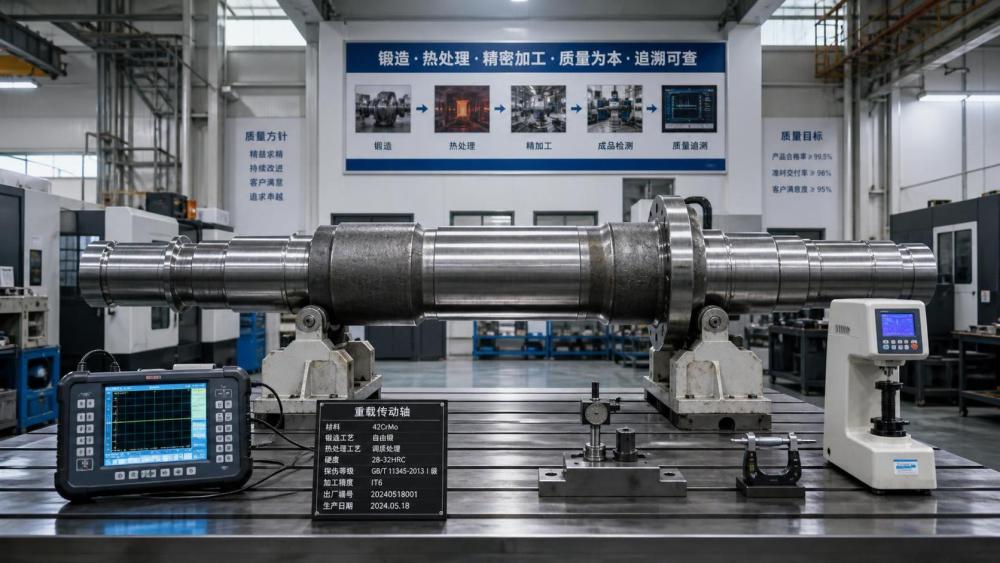
Heat treatment capability often separates reliable suppliers from merely adequate ones
Procurement teams sometimes focus heavily on forging equipment and overlook heat treatment. In real service, heat treatment control often has more to do with shaft durability than the forge press size mentioned in a sales presentation.
For heavy-load shafts, you may need to evaluate quenching and tempering practice, hardness uniformity, core properties, straightness after treatment, and distortion management before machining. If a shaft has critical bearing seats, spline sections, or seal surfaces, poor heat treatment control can create downstream machining problems even before the part reaches assembly.
A serious supplier should be prepared to discuss how they verify mechanical properties and how they handle parts that fall outside the required hardness or dimensional stability window. The right questions are often simple: Do they treat shafts by batch or by controlled individual process? How do they manage large-section temperature uniformity? What is their approach when a part moves during treatment?
You do not need every supplier to have the same process route, but you do need evidence that the route is controlled.
Machining accuracy matters because the shaft lives inside a system
A forged shaft is never judged by forging quality alone. It has to fit bearings, couplings, housings, gears, and seals. That means machining capability is part of supplier evaluation, especially when the shaft includes multiple diameters, shoulders, keyways, splines, threads, or concentric surfaces that affect dynamic behavior.
In practice, the most useful discussion with a supplier is not “What machines do you have?” but “How do you hold coaxiality, runout, roundness, and surface finish on the specific features that matter in this assembly?” A shop with turning, grinding, and proper inspection equipment may be a better fit than a larger facility with more impressive but less relevant capacity.
IMPE’s broader coverage of CNC machining, turning, grinding, tolerance control, and inspection is relevant here because forged shafts sit at the intersection of forging and precision machining. Buyers who evaluate only the raw forging stage often miss the issues that later cause vibration, premature bearing wear, or difficult assembly on site.
Inspection and testing should match the risk of the application
Not every shaft needs the same inspection package, and forcing an overbuilt requirement can raise cost without improving reliability. Still, under-specifying testing on high-load parts is a common procurement mistake.
For critical shafts, the discussion usually includes dimensional inspection, mechanical property verification, hardness testing, and non-destructive testing such as ultrasonic examination or magnetic particle inspection where appropriate. The exact acceptance criteria need to follow drawing requirements, purchase specifications, and any applicable customer or industry standards.
A dependable manufacturer will not just say “we do NDT.” They should be able to explain at what production stage the inspection is performed, what areas are covered, and how nonconformities are handled. That is a more meaningful sign of maturity than a long, unfiltered list of claimed test methods.
Evaluate delivery reliability in the context of the whole manufacturing route
Lead time for forged shafts is shaped by more than machining hours. Raw material availability, forging schedule, heat treatment queue, NDT timing, finish machining, balancing if required, packaging, and export logistics can all affect delivery. A supplier who promises an aggressive lead time without breaking down those steps may simply be pushing uncertainty downstream.
For project-driven purchases, ask where the real bottleneck is. Sometimes it is the forge. Sometimes it is external heat treatment. Sometimes the issue is final grinding capacity or inspection release. If you understand that chain, you can judge whether a quoted schedule is realistic and whether partial deliveries or milestone inspections are worth building into the order.
This is particularly relevant in global sourcing, where transport packaging, corrosion protection, and documentation release can delay shipment even after the part is complete.
Cost evaluation should include failure cost, not just unit price
A low shaft price can be rational for a non-critical spare with easy replacement access. It is much less attractive when the shaft sits deep inside a gearbox, a pump train, or a large rotating assembly that requires long shutdown time to service.
When comparing suppliers, it helps to separate visible cost from exposure cost. Visible cost is the quoted part price, tooling if any, logistics, and inspection charges. Exposure cost is harder to see but often larger: delayed commissioning, assembly mismatch, extra machining, rejected documentation, premature wear, emergency replacement, and lost production.
A practical supplier review usually reveals more than a polished presentation
If the purchase value or application risk is high enough, try to review actual production records, sample inspection reports, and the path a shaft follows from raw material receipt to dispatch. Even a remote audit or structured technical review can expose weak links quickly.
Look for consistency rather than perfection. Can the supplier answer questions directly? Do engineering and sales tell the same story? Are they clear about what is done in-house and what is subcontracted? Do they ask for missing operating data, or do they quote immediately on incomplete information? Experienced manufacturers usually push back on ambiguous requirements because they know where shaft failures begin.
What to do before issuing the purchase order
Before placing the order, align the technical and commercial package. That means confirming the final drawing revision, material grade, required certificates, heat treatment condition, machining scope, inspection hold points if needed, packaging expectations, and Incoterms or delivery terms. If the shaft is part of a larger power transmission assembly, make sure mating-part interfaces are frozen as well.
A forged shafts manufacturer is not just selling a piece of steel. They are taking responsibility for process control across forging, thermal treatment, machining, and verification. For heavy-load drive systems, that chain is what you are really buying.
If a supplier can demonstrate traceable material control, stable processing, realistic lead times, and an understanding of how the shaft behaves in the full drivetrain, the quoted price starts to mean something. Without that, a low number is just a low number.
Related News
- How to Assess a Rigid Coupling Supplier for Bore Accuracy and Traceable QualityOct 08, 2026Tribology & Kinematics Expert
- Titanium Alloys Compared: Balancing Strength, Corrosion Resistance, and MachinabilityOct 08, 2026CNC Kinematics Architect
- Where Ductile Iron Dismantling Joints Reduce Alignment Risk in Water PipelinesOct 08, 2026Pipeline Metallurgy Scientist
- Selecting a Precision Bearing Sleeve: Fits, Runout, and Material ChoicesOct 08, 2026Tribology & Kinematics Expert
- Face Milling Cutters: How Insert Geometry Affects Finish on Steel and AluminumOct 08, 2026CNC Kinematics Architect
- Single-Acting Cylinders for Clamping: Stroke, Force, and Return Spring ConsiderationsOct 07, 2026Fluid Power Control Strategist