
Forged Rollers vs Cast Rollers: Which Performs Better Under Heavy Loads?
When heavy loads, shock forces, and continuous duty cycles define an application, roller material and manufacturing method directly affect reliability, maintenance exposure, and total operating cost.
Forged Rollers are often selected for refined grain flow, higher toughness, and stronger fatigue resistance, while cast rollers can provide useful geometry flexibility and cost advantages.
For most severe load-bearing duties, a properly specified forged roller delivers the lower technical risk. However, the correct choice depends on load spectrum, roller geometry, material grade, and inspection requirements.
Quick Answer: When Do Forged Rollers Perform Better?
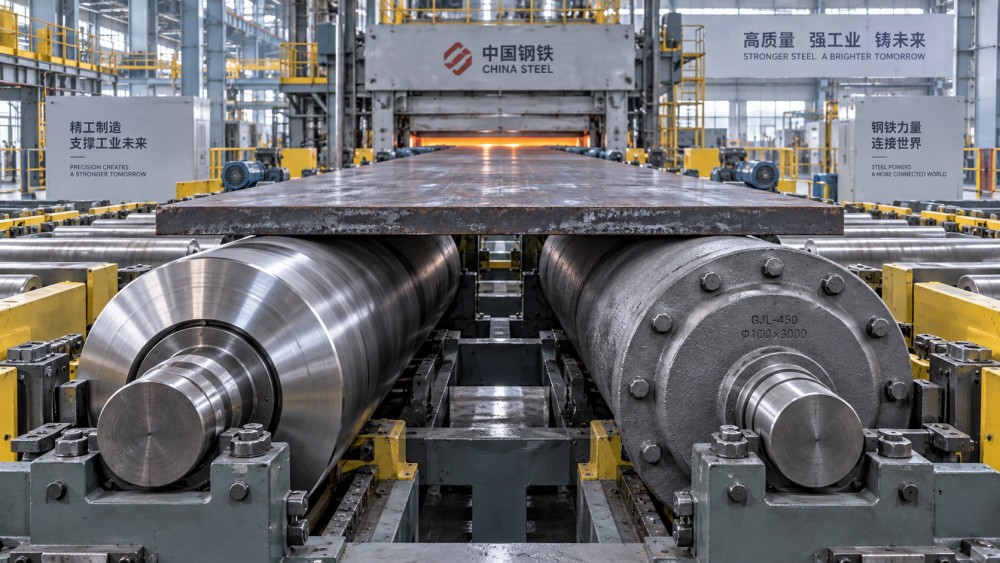
Forged rollers generally perform better under high radial loads, repeated impact, reversing stress, and long-duty cycles because forging improves material continuity and structural toughness.
They are particularly suitable for steel mills, mining conveyors, crushers, heavy presses, shipyards, construction equipment, and industrial processing lines where unplanned downtime carries major cost.
Cast rollers may still be appropriate when loads are stable, geometry is complex, production volumes are high, or the application benefits from cast-in features.
The practical decision is not simply forged versus cast. Technical evaluators should compare fatigue life, defect tolerance, hardness profile, machining allowance, and service consequences of failure.
A cast roller can perform well when the foundry process, alloy selection, solidification control, heat treatment, and non-destructive testing match the intended operating conditions.
However, where overloads, shock loading, misalignment, contamination, or difficult maintenance access are expected, forged rollers usually provide a more conservative engineering choice.
Why Manufacturing Method Changes Heavy-Load Performance
Forging shapes metal through compressive deformation, often using open-die, closed-die, ring-rolling, or upsetting processes followed by controlled heat treatment and machining.
During forging, the metal grain structure is worked and redirected along the component shape. This can reduce discontinuities and improve resistance to crack initiation.
For roller bodies, shafts, and load-bearing journals, favorable grain flow is especially valuable because these areas experience concentrated stresses at shoulders, transitions, and bearing seats.
Casting forms the roller by pouring molten metal into a mold. It enables internal shapes, large diameters, and integrated features that may be expensive to forge.
Its mechanical behavior depends heavily on melt chemistry, gating design, cooling rate, feeding effectiveness, inoculation practice, and the ability to prevent shrinkage-related discontinuities.
Neither method guarantees quality automatically. A poorly forged part may contain laps or inadequate reduction, while a carefully produced casting can meet demanding industrial requirements.
Fatigue Resistance Is Usually the Deciding Factor
Heavy-load roller failures rarely result from one static overload alone. More commonly, they develop through repeated stress cycles that progressively initiate and grow fatigue cracks.
Forged Rollers tend to offer better fatigue resistance because their working process can refine microstructure and reduce the likelihood of large internal voids.
This matters when rollers rotate continuously under variable loads, pass through localized contact zones, or repeatedly absorb impact from uneven material flow.
Fatigue performance is strongly influenced by surface finish, heat treatment, roller alignment, contact pressure, lubrication condition, and local stress concentration around machined features.
A forged roller with poor journal finish or an abrupt shoulder radius can still fail early. Manufacturing method must be supported by sound mechanical design.
Technical evaluators should request expected load cycles, rotational speed, contact conditions, calculated bearing loads, and relevant fatigue assumptions before approving a material route.
Impact Loading Favors Tougher Forged Structures
Impact loading creates high local stresses over short periods. Examples include dropped material, conveyor surges, mill scale, crushing operations, and intermittent press contact.
Under these conditions, toughness becomes as important as nominal tensile strength. The roller must absorb energy without brittle cracking or permanent deformation.
Forged steel rollers commonly provide greater toughness than conventional gray iron castings, especially when properly normalized, quenched and tempered, or induction hardened.
Ductile iron cast rollers can offer substantially better toughness than gray iron and may be a viable intermediate option for selected industrial applications.
Even so, engineers should examine low-temperature behavior, notch sensitivity, impact energy data, and actual alloy chemistry rather than relying on generic material labels.
Where the consequences of fracture include personnel risk, belt damage, shaft release, or line stoppage, a forged steel design usually offers greater safety margin.
Wear Resistance Depends on More Than Base Material
Rollers exposed to abrasive ore, scale, sand, slag, aggregate, or contaminated products need a surface capable of resisting wear without sacrificing core toughness.
Cast rollers can be attractive for abrasion because alloy cast irons may contain hard carbide phases that resist surface material loss effectively.
However, very hard cast structures can become less tolerant of impact. Their wear advantage may disappear if cracking, chipping, or spalling occurs in service.
Forged Rollers can combine a tough steel core with induction hardening, carburizing, nitriding, weld overlay, thermal spray coating, or replaceable wear sleeves.
This layered approach allows engineers to target surface hardness while retaining a ductile interior that better manages shock and cyclic loading.
Selection should consider abrasive particle size, sliding versus rolling contact, moisture, operating temperature, acceptable surface roughness, and whether resurfacing is feasible during maintenance.
How to Compare Strength Data Correctly
Published tensile strength alone is not sufficient for roller selection. It describes a basic material property but does not capture actual fatigue, impact, or defect behavior.
Technical teams should compare yield strength, elongation, reduction of area, Charpy impact values, hardness range, and heat-treatment condition for the proposed roller.
For forged steel rollers, specifications should identify the steel grade, forging reduction ratio, heat-treatment cycle, grain size expectations, and final mechanical-property requirements.
For cast rollers, specifications should identify cast grade, nodularity where applicable, matrix structure, section thickness limits, heat treatment, and acceptance criteria for internal soundness.
Results should be tied to representative test locations. A coupon from a separately cast block may not accurately represent the properties of a thick roller section.
When critical loads are involved, require material certificates, hardness mapping, ultrasonic testing, magnetic particle inspection, and dimensional reports for finished functional surfaces.
Geometry, Size, and Machining Requirements Matter
Casting can simplify the production of rollers with integrated flanges, ribs, hubs, cooling passages, complex profiles, or large hollow sections.
These geometric advantages may reduce assembly steps and raw-material waste, especially for low-speed rollers with moderate, predictable loading conditions.
Forging usually begins with simpler stock shapes, so extensive machining may be required to produce grooves, crowns, shoulders, bearing journals, and mounting interfaces.
Yet machining provides accurate control over concentricity, runout, bearing-seat tolerances, surface finish, and dynamic balance, all of which influence service life.
Large forged components also require realistic review of press capacity, ingot quality, reduction ratio, machining time, heat-treatment furnace capacity, and delivery lead time.
Do not select casting only because a complex shape appears economical. Evaluate whether the integrated geometry creates inspection limitations or difficult-to-repair failure points.
Common Failure Modes to Review Before Procurement
Roller failures often reveal specification gaps rather than isolated supplier mistakes. A meaningful review begins by identifying the actual failure mode the design must resist.
Typical failures include journal fatigue, shell cracking, surface spalling, bearing-seat fretting, shaft bending, weld separation, corrosion pitting, and overload deformation.
Forged rollers are particularly valuable when journal fatigue and shaft bending dominate risk, because these conditions benefit from tougher and more continuous steel structures.
Cast rollers may require additional scrutiny around thick-to-thin transitions, hub intersections, keyways, shrinkage-prone zones, and areas affected by residual solidification stress.
Operational data is essential. Review load peaks, starts and stops, impact events, belt tracking, alignment history, temperature, corrosion exposure, and maintenance access limitations.
A roller that survives laboratory static loading may still fail quickly when field conditions introduce vibration, poor lubrication, debris ingress, or repeated shock events.
Supplier Questions Technical Evaluators Should Ask
Request a documented manufacturing route before comparing prices. The supplier should explain raw-material source, forming or casting method, heat treatment, machining, and inspection sequence.
For Forged Rollers, ask about billet or ingot traceability, forging ratio, die or press process, ultrasonic inspection stage, and final stress-relief practice.
For cast rollers, ask about foundry melting controls, mold design, risering approach, section-thickness capability, radiographic or ultrasonic coverage, and repair-welding policy.
Confirm the inspection methods used after machining. Critical dimensions may include diameter, crown profile, runout, journal concentricity, face width, keyway position, and balance condition.
Also confirm whether test reports apply to every roller, every heat, every batch, or only qualification samples. This distinction affects traceability and project risk.
For critical equipment, purchase specifications should define rejection criteria clearly. Ambiguous requirements often lead to disputes after components have already reached the installation site.
Cost Should Be Measured Across the Full Service Life
Cast rollers often have a lower initial manufacturing cost, especially when production volume is high and the design includes shapes that would require extensive machining.
Forged rollers may cost more initially because of material preparation, forming capacity, heat treatment, machining time, and higher-grade inspection requirements.
That premium can be justified when roller failure stops a high-value production line, damages adjacent equipment, causes safety exposure, or requires difficult field replacement.
Evaluate total cost through expected service life, spare inventory, outage duration, installation labor, lost production, inspection frequency, and the likelihood of consequential damage.
For low-consequence applications, a qualified cast roller may produce the better commercial result. For critical rotating equipment, lower lifecycle risk often favors forging.
The correct comparison uses equivalent designs and operating assumptions. Comparing an inspected forged steel roller with an unspecified casting creates a misleading price benchmark.
Selection Guide for Heavy-Duty Roller Applications
Choose forged steel rollers when the application involves high cyclic loads, severe impact, critical shaft journals, uncertain operating conditions, or expensive downtime consequences.
Consider cast rollers when loads are mainly steady, the design requires complex integrated geometry, wear resistance is the primary concern, and inspection controls are robust.
Consider ductile iron cast rollers where moderate toughness, castability, vibration damping, and economical production are needed without the brittleness of gray iron.
For abrasive and high-impact service, assess hybrid solutions such as forged cores with hardened surfaces, replaceable shells, or engineered coatings matched to wear mechanisms.
Always verify the final selection with load calculations, finite element analysis where appropriate, material certificates, inspection requirements, and representative operating experience.
The best roller is not defined only by manufacturing method. It is the component whose material, geometry, treatment, and quality controls match the real duty cycle.
Conclusion
Under genuinely heavy, variable, and impact-prone loads, Forged Rollers usually provide superior toughness, fatigue resistance, and confidence against internal material discontinuities.
Cast rollers remain valuable where geometry, wear properties, and manufacturing economy align with stable operating conditions and well-controlled foundry quality.
Technical evaluators should prioritize actual loading, failure consequences, verification data, and lifecycle cost. That approach produces a defensible roller decision beyond simple purchase-price comparison.