
Forged Hub Price Breakdown: What Drives Cost in Material, Size, and Heat Treatment?
For procurement teams evaluating heavy forgings, understanding the forged hub price means looking far beyond a single quote. Material grade, hub size, forging ratio, machining allowance, and heat treatment all shape the final cost and long-term performance. This breakdown highlights the key pricing drivers behind forged hubs, helping buyers compare suppliers more accurately, control project budgets, and avoid costly quality risks.
In practice, the biggest purchasing mistakes happen when a forged hub is treated as a simple weight-based commodity. Buyers often receive three very different quotations for what appears to be the same part drawing, then assume the cheapest supplier has a cost advantage. In heavy forgings, that assumption is risky. A lower quote may reflect a different steel route, lower forging reduction, wider internal quality tolerance, reduced test scope, or less machining stock. The unit price only becomes meaningful after the technical and process assumptions behind it are made visible.
A forged hub can serve in wind power, mining, marine propulsion, rolling mills, pressure-retaining assemblies, or other heavy-duty transmission systems. In these applications, the component is not just a shape. It is a fatigue-bearing, load-transmitting part whose metallurgy, cleanliness, and dimensional stability matter. That is why forged hub price is usually driven by a combination of raw material value, process intensity, quality assurance requirements, and delivery risk rather than by mass alone.
Material grade is usually the first cost divider, but not the only one
Material selection affects pricing in two ways: the direct cost of the steel or alloy itself, and the indirect cost of processing that material into a conforming forging. Carbon steel hubs are typically less expensive than alloy steel, stainless steel, or nickel-bearing grades, but buyers should not stop at the chemical name on the drawing.
Two suppliers quoting the same grade may still be working from different starting material conditions. One may use standard ingot-based feedstock; another may source cleaner steel with tighter control over segregation, inclusion content, and ultrasonic soundness. For critical rotating equipment or high-load applications, this difference matters. Cleaner starting material often costs more, but it reduces the likelihood of internal defects appearing during machining or service.
Imported alloy content can also create price volatility. Chromium, nickel, molybdenum, and other alloying elements move with global raw materials markets and energy costs. When buyers request grades such as 42CrMo4, 34CrNiMo6, ASTM alloy steels, or stainless variants, the material line in the quote becomes more sensitive to international steel pricing and lead time fluctuations.
There is also a common procurement error here: over-specifying the grade to create a safety margin. A hub designed for moderate duty may not need a premium alloy steel with elevated hardenability if the required mechanical properties can be met by a lower-cost alternative. Overgrading material can push up not only steel cost, but also heat treatment cost, machining difficulty, and inspection requirements.
Size affects cost nonlinearly, not proportionally
Many buyers expect forged hub price to rise in a roughly linear way with weight. In reality, larger hubs often cost disproportionately more per ton than medium-size parts. The reason is process complexity.
As diameter, section thickness, or overall mass increases, suppliers face more demanding forging and thermal control conditions. Larger parts require larger starting billets or ingots, longer heating cycles, heavier press capacity, more handling time, and more conservative process windows to avoid surface cracking or internal soundness problems. Heat treatment also becomes more difficult because through-thickness property consistency is harder to achieve in thick sections.
This is why two hubs with the same net machined weight can carry very different quotes if one starts from a much larger forging envelope. A large flange-like hub with a thick central section may require far more raw input and process time than a more geometry-efficient part of similar final mass.
For procurement evaluation, gross forging weight is often more useful than finished weight. The gap between the two reveals how much material is being consumed to create machining stock, remove flash or excess, and secure metallurgical integrity. When the buyer only compares finished part weight, key cost drivers stay hidden.
Geometry complexity often appears as “machining” cost, but it starts in the forging stage
Some hubs are near-simple rotational parts. Others include shoulders, stepped bores, integral flanges, transition radii, or asymmetric features that influence die design and process yield. Open-die forged hubs and closed-die forged hubs should not be evaluated the same way.
For lower volumes or large-section parts, open-die forging is common. Tooling cost may be lower, but machining stock is typically higher, and more material will be removed later. For repeat production of smaller or mid-size hubs, closed-die or impression-die routes may reduce waste and machining time, but tooling cost can be significant. That changes the economics depending on annual volume.
If a supplier offers a very low initial price for a small batch, check whether the quote assumes a simplified forging shape with heavy finish machining. That may be acceptable where machining capacity is ample and delivery is flexible. It is less attractive when alloy steel is expensive, spindle time is constrained, or the machining-to-forging conversion introduces schedule bottlenecks.
Forging ratio and reduction practice are major hidden price drivers
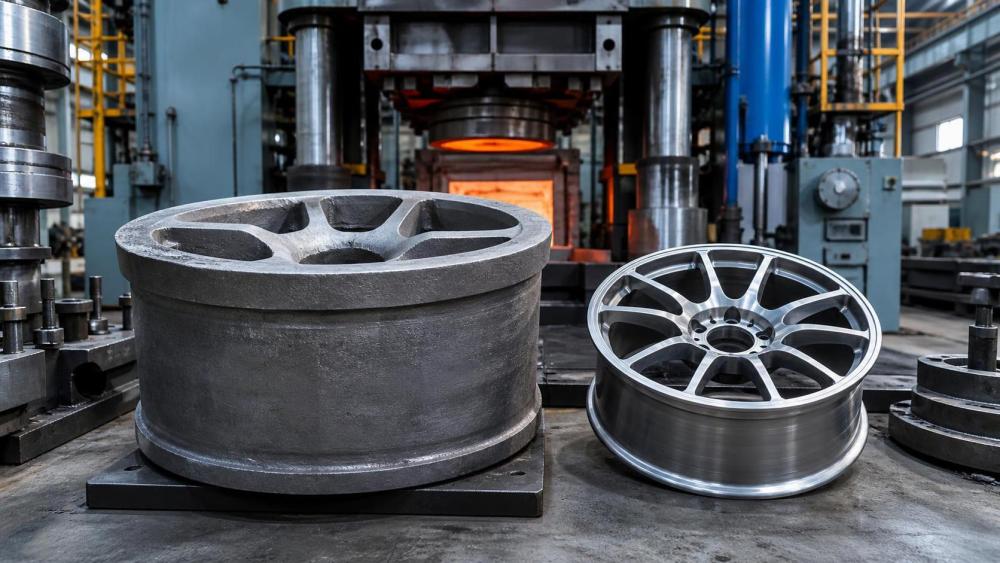
Procurement teams do not always ask about forging ratio, but for critical hubs it is one of the most important indicators behind the price. Forging reduction helps refine grain structure, improve directional properties, and reduce the impact of casting-related internal defects from the original steel feedstock. Achieving sufficient reduction may require larger starting stock and more press work, both of which increase cost.
A lower quotation can sometimes indicate that the supplier is working with minimal reduction or a process route optimized for yield rather than internal quality. This does not automatically mean the part will fail, but it does mean the buyer should verify whether the forging practice matches the application severity.
For non-critical applications, a less intensive route may be commercially rational. For hubs in torque transmission, cyclic loading, or safety-critical assemblies, insufficient reduction is a classic source of false economy. The cost saving on the purchase order can be wiped out by rejection during ultrasonic testing, excessive machining scrap, or reduced fatigue life in service.
Heat treatment can shift the quote more than many buyers expect
Heat treatment is often viewed as a routine line item, but it can materially change both cost and supplier capability requirements. Normalizing, quenching and tempering, solution treatment, stress relieving, and hardness-controlled cycles have very different process costs and risks.
For alloy steel hubs, quench and temper treatment may be necessary to achieve strength and toughness targets. That involves controlled heating, quenching media management, tempering cycles, and post-treatment testing. Larger sections may require more careful recipes and sometimes multiple cycles to meet mechanical properties uniformly. This adds furnace time, energy consumption, handling complexity, and quality verification cost.
Buyers should pay close attention to where the required properties are measured. Surface hardness alone does not prove through-section performance. If the specification calls for tensile, yield, impact, hardness, or toughness values tied to a standard, the quote should reflect both treatment and test burden. If it does not, ask whether the supplier has fully included the requirement.
Another pricing issue is distortion risk. Heat treatment can introduce dimensional movement, particularly in hubs with uneven wall thickness or demanding bore concentricity requirements. The supplier may intentionally leave additional machining allowance to correct post-heat-treatment distortion. That increases both material use and final machining time.
Machining allowance is not waste by default
One of the most common sourcing misunderstandings is to view high machining allowance as inefficiency in every case. Sometimes it is. Sometimes it is a deliberate quality safeguard.
Forged hubs for high-integrity applications are often supplied with extra stock to ensure that decarburized surface layers, forging scale effects, or minor distortion can be fully machined away. If the buyer pushes aggressively for a near-net forging to reduce cost, the supplier may have less room to correct geometry or remove surface anomalies. That can increase rejection risk later in the process.
What matters is whether the allowance is technically justified. If one supplier is carrying significantly more stock than others, buyers should ask why. Possible reasons include conservative forging capability, broad dimensional tolerance control, expected heat treatment movement, or an open-die route requiring more cleanup. Those reasons may be acceptable, but they should be explicit.
Inspection scope, certification, and traceability change the real purchase cost
A forged hub intended for general industrial use is not priced the same as one supplied with full material traceability, mechanical test reports, ultrasonic examination, dimensional records, and third-party witnessing. Documentation is not free. Neither is the process discipline required to produce it.
Standards and test expectations vary by end-use sector and geography. Depending on project requirements, buyers may need to align with ASTM, EN, DIN, ISO, customer-specific specifications, or classification society rules. If the supplier’s quote is materially lower, verify whether non-destructive testing level, test sampling frequency, witness points, and report package are actually equivalent. This is especially important when comparing domestic and export suppliers.
If compliance language on the purchase order is vague, disputes often appear late: after machining, during pre-shipment inspection, or when the end customer requests records that were never budgeted into the forging price.
Supplier equipment and capacity influence price stability as much as price level
Two suppliers can have similar technical competence but very different cost structures because of their equipment footprint. A forge with large press capacity, in-house heat treatment, rough machining, and NDT may quote more consistently because fewer subcontracting steps are exposed to outside delays and markups. A smaller shop may appear cheaper at first but become less reliable on large-diameter hubs or urgent schedules.
For procurement, the key issue is not just whether the supplier can make the part, but whether it can make it repeatedly within the required lead time and documentation framework. Large hubs often compete for furnace slots, press windows, and machining capacity. In tight market conditions, capacity access itself becomes part of the forged hub price.
This is one reason short lead times carry premiums even when material and geometry are unchanged. Buyers are paying for schedule compression, not just metal and labor.
What a buyer should request before comparing quotes
If the goal is a meaningful price comparison, the RFQ package should define more than drawing dimensions. At minimum, buyers should align suppliers on:
- material grade and applicable standard;
- forging route, if critical to performance;
- required heat treatment condition;
- mechanical property targets and test basis;
- NDT scope, such as UT or MT/PT where applicable;
- machining scope: forged blank, rough machined, or finish machined;
- dimensional tolerances and machining allowance expectations;
- documentation package and third-party inspection needs;
- annual volume, batch size, and delivery schedule.
Without this alignment, the lowest quotation may simply be the least complete quotation.
Where buyers usually misread a low forged hub price
There are several recurring warning signs in low-cost offers. One is when the price looks attractive but the supplier does not clearly state gross forging weight or machining condition. Another is when heat treatment is mentioned generally but no property verification is listed. A third is when delivery is unusually short for a large or alloy-steel hub without explanation of stock position or reserved capacity.
None of these automatically indicate a problem. But they do mean the quote should be challenged before award. Procurement teams should ask what is included, what is assumed, and what would trigger a variation order later. The real risk is not simply buying cheap. It is buying ambiguity.
The right cost question is total conformity cost, not ex-works unit price
For routine spend control, it is tempting to reduce forged hub price analysis to a unit figure per kilogram. That can be useful for market screening, but it is weak for supplier selection on critical parts. A more practical approach is to evaluate total conformity cost: the cost of receiving a hub that meets metallurgical, dimensional, documentary, and delivery requirements without downstream disruption.
That lens changes procurement behavior. A quote with a slightly higher ex-works price may be cheaper overall if it reduces machining scrap, avoids reinspection, shortens approval cycles, and lowers field failure exposure. In sectors where downtime or warranty claims are expensive, this difference is far more important than a nominal saving on raw purchase price.
For buyers working internationally, the most useful discipline is to force comparability early. Ask for process assumptions, not just prices. Ask for test scope, not just certificates. Ask for gross weight, forging method, heat treatment route, and machining condition. Once those variables are visible, forged hub price becomes less mysterious—and much easier to negotiate on a technical basis rather than by guesswork alone.
Related News
- How to Assess a Rigid Coupling Supplier for Bore Accuracy and Traceable QualityOct 08, 2026Tribology & Kinematics Expert
- Titanium Alloys Compared: Balancing Strength, Corrosion Resistance, and MachinabilityOct 08, 2026CNC Kinematics Architect
- Where Ductile Iron Dismantling Joints Reduce Alignment Risk in Water PipelinesOct 08, 2026Pipeline Metallurgy Scientist
- Selecting a Precision Bearing Sleeve: Fits, Runout, and Material ChoicesOct 08, 2026Tribology & Kinematics Expert
- Face Milling Cutters: How Insert Geometry Affects Finish on Steel and AluminumOct 08, 2026CNC Kinematics Architect
- Single-Acting Cylinders for Clamping: Stroke, Force, and Return Spring ConsiderationsOct 07, 2026Fluid Power Control Strategist