
Why Dust Caps on Hydraulic Quick Couplers Prevent Contamination Failures
A hydraulic quick coupler can be perfectly serviceable when disconnected and still become the starting point of a system failure before it is reconnected. The exposed valve faces, locking grooves, and hose ends sit directly in the path of dust, wet soil, metal particles, wash-down water, and handling debris. When a coupling cycle opens the flow path, contamination present on either mating half can be carried into the hydraulic circuit.
Dust caps on hydraulic quick couplers are therefore not cosmetic accessories or simple storage covers. They are a contamination-control barrier at one of the few points where an otherwise closed hydraulic system is deliberately opened. A cap that fits, seals reasonably, stays attached, and is kept clean can prevent the chain of events that leads from external dirt to scored spool bores, damaged seals, restricted valves, accelerated pump wear, and unplanned downtime.
The contamination path begins at the disconnected coupler
Hydraulic systems continuously circulate fluid through components with very small functional clearances. Pumps, proportional valves, servo valves, pressure-control cartridges, cylinder seals, and rotary actuators do not respond to contamination in the same way. A particle that passes harmlessly through a large, low-speed actuator may damage a close-clearance valve or contribute to abrasive pump wear. The risk is not limited to visible grit. Fine dust, fibers, rust particles, dried mud, moisture, and residues from damaged caps can all enter during reconnection.
When a quick coupler is disconnected, its poppet, flat face, sleeve, or threaded connection is exposed. Even couplers designed to minimize fluid loss retain a vulnerable exterior interface. Dirt settles on the valve face and around the locking mechanism. If a hose end is dragged across a work surface, rests on wet ground, or is left uncovered near grinding, cutting, or blasting work, the contamination load can become substantial.
Connection creates the transfer mechanism. As the two halves engage, surfaces move against each other, trapped material can be displaced inward, and any dirt on the mating faces can be pushed toward the flow path. A coupler may connect smoothly while still introducing contaminants. The absence of a visible leak is not proof that the connection was clean.
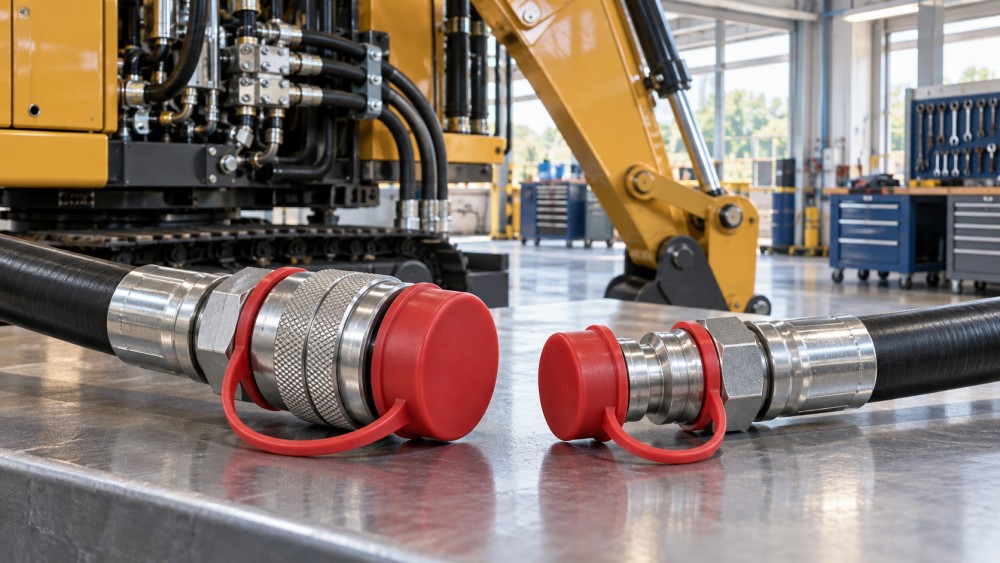
Dust cap hydraulic quick couplers interrupt this process by covering the exposed end before contaminants reach the critical connection surface. A cap also reduces incidental damage to the coupler face, helps keep residual oil from attracting airborne dust, and makes it easier to identify a hose end that has been protected rather than left exposed.
Why external dirt becomes an internal hydraulic failure
The most obvious outcome is abrasive wear. Hard mineral particles can scratch sealing surfaces, score cylinder rods and valve components, and increase leakage paths. In a pump, contamination can damage surfaces that depend on a stable lubricating fluid film. Once wear begins, it may create additional wear debris, turning an isolated contamination event into a continuing source of particles.
Contamination also affects motion and control before a major component fails. A directional valve may stick or respond inconsistently. A pressure-control valve may seat poorly, drift, or leak internally. A proportional valve can lose repeatability if debris interferes with its moving elements. In equipment where hydraulic response governs lifting, steering, clamping, braking, or tool motion, irregular control is not merely an efficiency problem.
Moisture deserves separate attention. Dust caps are not a substitute for a fully watertight enclosure, but they reduce direct exposure to rain, splash, wash-down water, and wet debris. Water entering hydraulic oil can lower lubricity, contribute to corrosion, impair additives, and promote surface damage in components. If disconnected couplers are regularly exposed outdoors, cap condition and retention become more important than they appear in a clean workshop.
A common mistake is to treat contamination as an issue that the return filter will solve. Filtration is essential, but it operates after fluid has entered the system and only according to the circuit layout, filter rating, bypass condition, and particle characteristics involved. A contaminant introduced through a hose connection may reach a sensitive component before it reaches an effective filter. Preventing entry is more reliable than expecting downstream filtration to eliminate every consequence.
A dust cap works only if the cap itself is clean
A cap covered in mud and pressed onto a coupler can trap contamination directly against the connection face. A cracked plastic cap may shed fragments. A cap that has been stored loose in a dirty toolbox can become a carrier rather than a barrier. The practical requirement is not simply “fit a cap”; it is “fit a clean, intact, compatible cap immediately after disconnection.”
Before capping, remove loose contamination from the external coupling area with a clean, lint-free wipe or an approved cleaning method. Avoid wiping a dirty surface in a way that pushes particles into the valve opening or beneath the seal area. Compressed air requires caution: high-pressure air can drive debris into crevices, damage seals, or atomize residual hydraulic fluid. If air is used under site procedures, it should be clean, dry, controlled, and directed away from openings.
Before reconnecting, remove the cap and inspect both the cap and the coupler face. If either side is wet with contaminated fluid, coated with grit, or visibly damaged, cleaning should occur before mating. Reconnecting a dirty coupler because the machine needs to return to service often converts a minor housekeeping task into a much more expensive troubleshooting problem.
Cap the plug and the socket, not only the hose that seems exposed
Quick-coupler assemblies have two mating halves, and both can require protection. The terminology varies by coupler design and supplier, but one half may be described as the plug or male half and the other as the socket, body, or female half. Each has features that can collect dirt. Covering only one side leaves the other available to contaminate the joint during connection.
This is especially relevant where detachable implements, test hoses, service manifolds, and auxiliary circuits are used. An implement hose may be capped while the machine-side coupler remains open to dust, rain, or wash water. The eventual connection then brings the unprotected machine-side contamination into contact with the protected hose end. Protection needs to be treated as a mating-pair requirement.
Captive dust caps and tethered cap sets can reduce the chance of loss, but tether design matters. A short tether that drags the cap through mud, catches on equipment, or prevents the cap from seating correctly can undermine the benefit. Tethers should retain the cap without creating a new contamination or damage hazard.
Not every cap is compatible with every coupler
Dust caps should match the coupler series, body size, connection geometry, and operating environment. A loose cap may fall off or admit dust around the perimeter. An excessively tight or incorrect cap can damage the coupler exterior, distort the cap, or be removed and discarded because it is inconvenient. Flat-face couplers, agricultural breakaway couplers, ISO-style interchange couplers, threaded high-pressure connections, and proprietary designs can require different cap shapes.
Material selection also matters. Flexible elastomer caps can provide a close fit and tolerate repeated handling, but compatibility with oils, fuels, cleaning chemicals, ozone, ultraviolet exposure, and temperature should be checked. Rigid plastic caps may resist deformation but can crack in cold conditions or under impact. Metal protective covers may suit severe mechanical exposure but need to avoid damaging the coupler finish or retaining moisture against the coupling.
Colour coding can help distinguish pressure, return, case-drain, pilot, and auxiliary lines, particularly on complex equipment. Its value is operational rather than decorative: it reduces the chance of connecting the wrong circuit and provides a quick visual indication when a cap is missing. Colour must never replace labeling, hose identification, or verification of pressure and circuit function.
Flat-face couplers reduce exposure, but they do not eliminate the need for caps
Flat-face quick couplers are often selected for environments where cleanliness and low fluid loss matter. Their mating surfaces are easier to wipe than recessed poppet designs, and their geometry can reduce the amount of dirt retained around the valve opening. Those advantages are real, but a flat face is still exposed when uncapped. A thin layer of fine dust or dried slurry on the face may not be obvious until it affects sealing or enters the circuit.
Poppet-style couplers can be more difficult to clean because recesses around the valve and locking sleeve may retain debris. Dust caps are particularly useful here, but they do not remove the need to inspect the valve area and locking mechanism. If contamination prevents full engagement, the coupler may leak, partially connect, or separate under load depending on its design and condition.
The key maintenance decision is based on exposure, not only coupler style. A machine parked in a clean indoor bay faces a different contamination burden from a mobile unit operating in quarry dust, agriculture, demolition debris, marine spray, foundry residue, or roadside maintenance conditions. The more severe the environment and the more often circuits are disconnected, the less defensible it is to leave couplers open.
What to check when contamination-related symptoms appear
Dust caps cannot correct contamination already circulating in the system. When symptoms appear after hose changes, attachment swaps, or repeated field connections, the inspection should extend beyond the cap itself. Relevant warning signs include erratic actuator movement, unexplained pressure instability, sluggish valve response, recurring seal leakage, abnormal pump noise, repeated filter restriction indications, and visible contamination around coupler faces.
The connection point should be examined for damaged locking grooves, worn sleeves, torn external seals, dented flat faces, corrosion, and evidence that caps do not seat fully. A cap that repeatedly falls off may indicate the wrong size, a worn retention feature, an obstructed seating surface, or an unsuitable cap material. Replacing lost caps without identifying why they are lost often leaves the original problem unchanged.
If hydraulic oil analysis, filter inspection, or component teardown identifies elevated particle contamination, disconnected couplers should be considered as one possible ingress route rather than assumed to be the only cause. Reservoir breathers, cylinder rod seals, damaged hose assemblies, poor fluid-transfer practices, unclean repair work, and compromised filler points can also introduce contamination. The useful question is whether the coupler-control practice matches the cleanliness requirement of the system and its operating environment.
Make cap use part of the disconnection procedure
The most reliable approach is to make protection an immediate action rather than a later task. Once pressure has been relieved and the coupler is safely disconnected, inspect the exposed ends, clean them where necessary, and install the correct caps on both halves before hoses are set down or equipment is moved. Leaving caps “to be fitted after the job” creates the interval in which they are most often lost, overlooked, or bypassed.
Caps should be replaced when they are split, hardened, permanently deformed, contaminated beyond practical cleaning, or unable to remain seated. Keeping replacements at service points is preferable to reusing damaged caps or leaving ports uncovered until a suitable part becomes available. For mobile maintenance work, clean capped storage containers for spare caps and hose-end protectors prevent new parts from becoming contaminated in transit.
Training should distinguish between cleaning the outside of a machine and controlling hydraulic cleanliness. A quick wipe that leaves grit around a valve face is not adequate preparation for reconnection. Likewise, a cap does not justify connecting a coupler that has been immersed in mud or exposed to grinding debris. The protective sequence is inspection, controlled cleaning, clean capping during disconnection, and a second inspection before connection.
Dust caps are inexpensive relative to hydraulic pumps, valves, cylinders, flushing work, lost machine availability, and the diagnostic time required to isolate intermittent contamination problems. Their real value lies in closing a small but repeated opening in the contamination-control system. Where quick couplers are routinely disconnected, properly managed caps are a practical reliability measure: they reduce avoidable ingress at the point where external conditions meet the hydraulic circuit.
Related News
- Using Industrial Air Blow Guns to Clear Chips Without Spreading DebrisOct 15, 2026Fluid Power Control Strategist
- Ductile Iron Pipe Valves: Which AWWA Standards Apply to Water Main Projects?Oct 15, 2026Dr. Elias Vance
- Why Vacuum Suction Cups Lose Grip on MDF in Woodworking MachinesOct 15, 2026CNC Kinematics Architect
- Choosing a Variable Displacement Piston Pump Manufacturer: What to VerifyOct 15, 2026Fluid Power Control Strategist
- Parallel vs. Angular Pneumatic Grippers for Confined Assembly StationsOct 15, 2026Fluid Power Control Strategist
- Die Castings vs. Investment Castings: Which Costs Less at Your Production Volume?Oct 14, 2026Foundry Phase-Change Fellow