
Why Air Cylinders Lose Force: Diagnosing Leaks, Friction, and Pressure Drop
A pneumatic actuator that no longer develops enough force is not necessarily defective. The useful starting point is the force balance: a cylinder can only deliver the pressure that actually reaches the working chamber, acting on its effective piston area, minus the force consumed by seal drag, rod-side loading, cushioning, and mechanical resistance.
For an extending double-acting cylinder, the theoretical thrust is:
Force = Pressure × Piston Area
On retraction, the rod occupies part of the piston area, so the effective area and available force are lower. This basic relationship explains why a cylinder may appear satisfactory in one direction but stall in the other. It also explains why a pressure reading at the compressor or filter-regulator-lubricator (FRL) unit is not proof that the cylinder receives adequate pressure under load.
The diagnostic task is to separate three different losses that can produce the same symptom: lost air pressure, lost airflow capacity, and lost mechanical efficiency. Replacing the cylinder before making that distinction often leaves the original fault in place.
Confirm that the force requirement is realistic
Before looking for faults, establish whether the actuator was ever correctly sized for the job. A pneumatic cylinder does not apply its theoretical force continuously through the entire stroke. Breakaway friction is usually higher than running friction, pressure changes as air fills and exhausts through valves and fittings, and the driven mechanism may require a higher force at certain positions.
A vertical load, for example, demands force against gravity at all points. A linkage, toggle mechanism, inclined guide, or cam arrangement can create a sharply changing mechanical advantage. A cylinder that moves an unloaded mechanism may fail when a product load, fixture clamp, or process resistance is added. That is a sizing or application issue unless the machine previously operated correctly under the same conditions.
Check the cylinder bore, rod diameter, stroke, pressure setting, load direction, and the actual force required at the point of failure. Do not rely only on catalog thrust. Allowance is needed for friction and an operating margin, especially where motion must start reliably rather than merely continue after it has begun.
A useful field distinction is whether the cylinder:
- fails at the start of the stroke, suggesting breakaway friction, inadequate initial pressure, or a stuck load;
- starts but slows significantly mid-stroke, suggesting restricted supply or exhaust flow;
- stalls only near end of stroke, suggesting cushion adjustment, mechanical interference, or a changing external load;
- moves normally without load but not with load, suggesting insufficient available thrust or pressure collapse under demand;
- drifts or cannot hold position after reaching the end, suggesting internal bypass, valve leakage, or external air loss.
Measure pressure at the cylinder, while it is working
The most common diagnostic error is checking only static line pressure. A gauge may show the regulator setpoint when the cylinder is stationary, then the pressure at the actuator can fall materially during a fast stroke or when multiple devices cycle together. Static pressure confirms that compressed air exists in the circuit; it does not verify usable pressure at the point of work.
Install a gauge, pressure sensor, or temporary test connection as close as practical to the cylinder port. Record pressure at rest, at the moment motion begins, and while the load is moving. Compare the supply-side and cylinder-side readings under the same operating condition. A significant differential points upstream: undersized tubing, a restrictive fitting, clogged silencer, dirty filter element, weak regulator flow capacity, partly closed isolation valve, undersized directional valve, or excessive demand elsewhere on the air circuit.
Pressure loss can also occur at the exhaust side. During extension, air leaving the rod end must escape. If an exhaust port, speed controller, quick exhaust valve, or silencer is blocked, back pressure builds in the exhausting chamber. The opposing pressure subtracts from the available net force. This condition is often mistaken for low supply pressure because the cylinder slows and may be unable to complete the stroke under load.
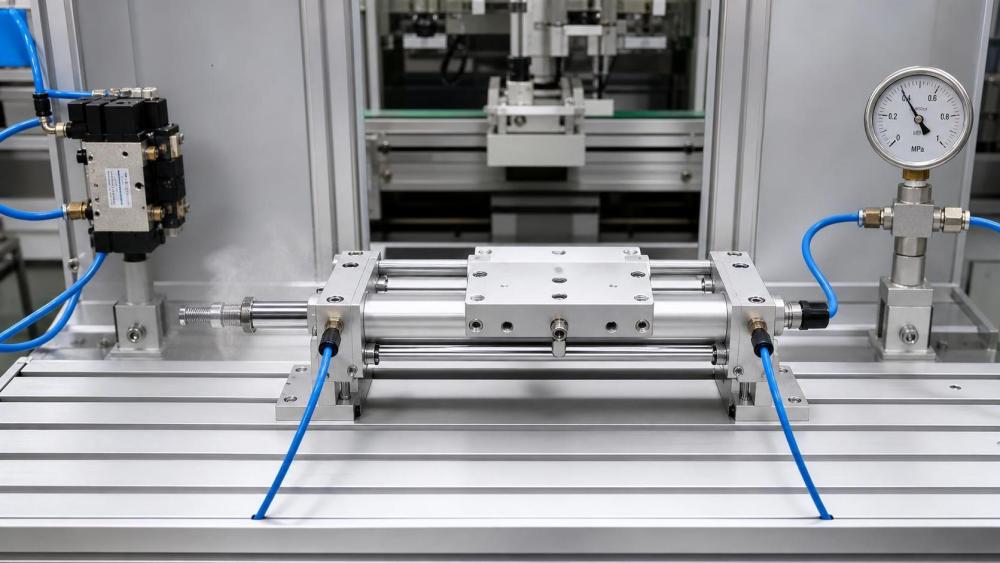
Inspect both paths rather than focusing only on the pressurized port. A cylinder is an air motor with two chambers: one chamber must fill quickly enough, while the other must vent freely enough. Meter-out flow controls are commonly used for stable motion, but excessive restriction can reduce speed and, under some load conditions, contribute to erratic movement or pressure trapping. A flow-control adjustment that was appropriate for a light load may be too restrictive after a tooling or payload change.
External leaks waste air; internal leaks remove working force
External leakage is easy to understand but not always easy to find. Damaged tubing, loose push-in fittings, cracked manifolds, failed valve seals, and leaking cylinder port connections reduce system pressure and increase compressor loading. Audible leakage may be masked by machine noise. A soap-solution test or ultrasonic leak detector is more reliable than listening alone, particularly around fittings and valve islands.
Not every external leak is large enough to explain a force loss at one actuator. Its importance depends on location and flow. A small leak downstream of a regulator may have little effect on a slow, lightly loaded cylinder but can become significant when the same branch has a small tube bore and a high-cycle demand. Look for pressure recovery between cycles: if pressure returns slowly after actuation, the supply branch may be unable to replenish its volume quickly enough.
Internal leakage is more directly connected to lost thrust. In a double-acting cylinder, worn, cut, hardened, or chemically incompatible piston seals can allow air to bypass from the pressurized chamber to the opposite chamber. The result is a lower pressure differential across the piston. The cylinder may still move unloaded, yet become weak under process load. Internal bypass can be difficult to identify from external inspection because no air necessarily escapes to atmosphere.
A practical check is to pressurize one chamber at a time with the directional valve in a controlled condition, then observe whether the opposite port shows unintended airflow or pressure rise. The exact method depends on the circuit and safety arrangement; any test must prevent unexpected rod movement and isolate stored energy. A pressure rise in the nominally unpressurized chamber can indicate piston-seal bypass, although valve cross-leakage must be ruled out before condemning the cylinder.
Rod-seal leakage deserves separate attention. Air escaping around the rod usually indicates seal wear, rod surface damage, side loading, contamination, or inadequate lubrication compatibility. It is visible evidence of a problem, but a rod seal alone does not always account for major loss of piston force. The piston seal, valve condition, and supply flow still need assessment.
Friction can imitate a pressure problem
When supply pressure remains stable at the cylinder port but motion is weak, delayed, or jerky, friction becomes the leading suspect. Pneumatic cylinders are designed to operate with relatively low seal resistance. Excessive drag consumes force that should move the load and can create stick-slip: the rod remains stationary until pressure rises enough to break static friction, then moves abruptly as resistance falls.
Dry seals are one cause, but “add more lubricant” is not a universal correction. Many modern cylinders use pre-lubricated seals intended for dry, filtered air. Introducing an incompatible lubricant can swell elastomers, alter seal behavior, trap contaminants, or create inconsistent lubrication across the machine. Follow the cylinder manufacturer’s stated lubrication requirement and use only compatible pneumatic oil where lubrication is specified.
Contamination is a frequent source of friction and seal damage. Water, compressor oil carryover, rust particles, desiccant dust, and debris from degraded tubing can reach the actuator if air preparation is poor or filters are bypassed. Water is especially problematic where it promotes corrosion inside a barrel or valve, while oil and particulate deposits can impair spool movement and flow-control performance. Inspect filter condition, drain function, bowl integrity, and the quality of air entering the affected circuit rather than treating the cylinder as an isolated component.
Rod condition provides important evidence. Scoring, pitting, bent geometry, damaged chrome plating, or adhered contamination can rapidly wear rod seals and increase drag. A rod that is clean and visually acceptable may still be bent enough to bind during part of the stroke. Roll the rod on suitable supports after removal where appropriate, or use runout measurement against the manufacturer’s allowable limit. Do not pull or push a disconnected rod manually as the sole test; low-speed manual movement does not reproduce side load, pressure forces, or alignment conditions in service.
Check alignment and the driven machine before opening the cylinder
Side load is one of the most persistent causes of premature cylinder wear. Standard Air Cylinders are intended primarily to generate linear motion. They should not be expected to guide a load that can sag, twist, or shift laterally unless the cylinder design and mounting arrangement are specifically intended for that duty.
Misaligned clevis pins, offset brackets, nonparallel slides, worn pivots, distorted frames, and poorly supported tooling transfer transverse force into the rod and bearing. The cylinder may operate acceptably when cold and bind after thermal growth, or it may fail only near a particular point in the stroke where the geometry becomes unfavorable. A replacement cylinder can initially seem to solve the issue because its new seals tolerate the load, then develop the same symptoms after a short operating period.
Disconnect the actuator from the load only after the machine is made safe and stored pneumatic energy is released. Then assess the driven mechanism independently. It should move through its required travel without abnormal resistance, interference, or changing force demand. Check mounting bolts, pivot pins, rod-end bearings, guide rails, and alignment at both stroke ends. If a guided slide is present, the guide system—not the cylinder—should carry side load.
Cushioning can also be mistaken for binding. Adjustable end cushions restrict exhaust air near the end of travel to decelerate the piston. If set too aggressively, a cushion may create enough back pressure to make the actuator appear weak over the final part of the stroke. Confirm that the problem occurs inside the cushion zone before changing the setting, and avoid opening cushions so far that the piston impacts the end cap.
The valve and tubing may be the true restriction
A cylinder can have intact seals and correct bore size yet lose force because its valve circuit cannot supply the required airflow. Long small-bore tubing, numerous elbows, compact push-in fittings, restrictive check valves, and low-flow directional valves all create pressure drop. The effect is most obvious on large-bore or long-stroke actuators, rapid-cycle equipment, and circuits where several actuators operate at once.
Valve faults can be intermittent. A contaminated spool, weak pilot signal, damaged solenoid, or partially shifted valve may not fully open the supply path or exhaust path. Comparing pressure at the valve inlet, working port, and cylinder port during a failed cycle helps isolate this. If pressure is normal at the valve inlet but low at the working port, inspect the valve and its pilot control. If pressure is adequate at the valve working port but low at the cylinder, investigate the tube, fittings, speed controller, and any intermediate components.
Do not assume a larger regulator setting is an acceptable remedy. Raising supply pressure may conceal a restriction, overload a marginal mechanism, increase impact energy, or exceed the allowable pressure of downstream components. It also does not correct friction, internal leakage, or mechanical misalignment.
A fault sequence that avoids unnecessary cylinder replacement
Begin with the exact operating symptom and load condition. Verify the regulated supply and measure dynamic pressure close to the cylinder. Check whether exhaust back pressure is present. Inspect for external leakage, then compare the behavior of the two chambers to identify possible internal bypass. If pressure delivery is sound, inspect rod condition, seal-related friction, mounting alignment, guide loads, and the resistance of the machine being driven.
The order matters. Opening a cylinder before checking pressure under load can turn a simple flow restriction into a costly repair. Conversely, repeatedly adjusting regulators and flow controls can hide a worn piston seal or bent rod until the actuator fails completely.
A cylinder should be rebuilt or replaced when evidence points to damaged seals, a scored barrel, rod damage, excessive internal bypass, or wear that cannot be corrected economically. The repair should also include the cause of failure: contaminated air, side loading, incompatible lubricant, excessive pressure, or a restricted circuit. Restoring force without removing that cause only resets the failure cycle.
Reliable pneumatic motion depends on the complete path from air preparation to valve, tubing, cylinder, load, and exhaust. Measuring where pressure disappears, identifying where force is consumed, and distinguishing leakage from restriction turns an apparently weak actuator into a diagnosable system problem.
Related News
- How to Assess a Rigid Coupling Supplier for Bore Accuracy and Traceable QualityOct 08, 2026Tribology & Kinematics Expert
- Titanium Alloys Compared: Balancing Strength, Corrosion Resistance, and MachinabilityOct 08, 2026CNC Kinematics Architect
- Where Ductile Iron Dismantling Joints Reduce Alignment Risk in Water PipelinesOct 08, 2026Pipeline Metallurgy Scientist
- Selecting a Precision Bearing Sleeve: Fits, Runout, and Material ChoicesOct 08, 2026Tribology & Kinematics Expert
- Face Milling Cutters: How Insert Geometry Affects Finish on Steel and AluminumOct 08, 2026CNC Kinematics Architect
- Single-Acting Cylinders for Clamping: Stroke, Force, and Return Spring ConsiderationsOct 07, 2026Fluid Power Control Strategist