
Where Short Stroke Compact Cylinders Improve Automation in Tight Machine Spaces
In a crowded automation cell, motion hardware often becomes the last item to fit. A fixture grows wider after safety guards are added. Sensors need clearance. Cable routing moves into the same zone as a clamp. What looked like a simple linear movement on a layout drawing can suddenly dictate the size, cost, and serviceability of the whole station.
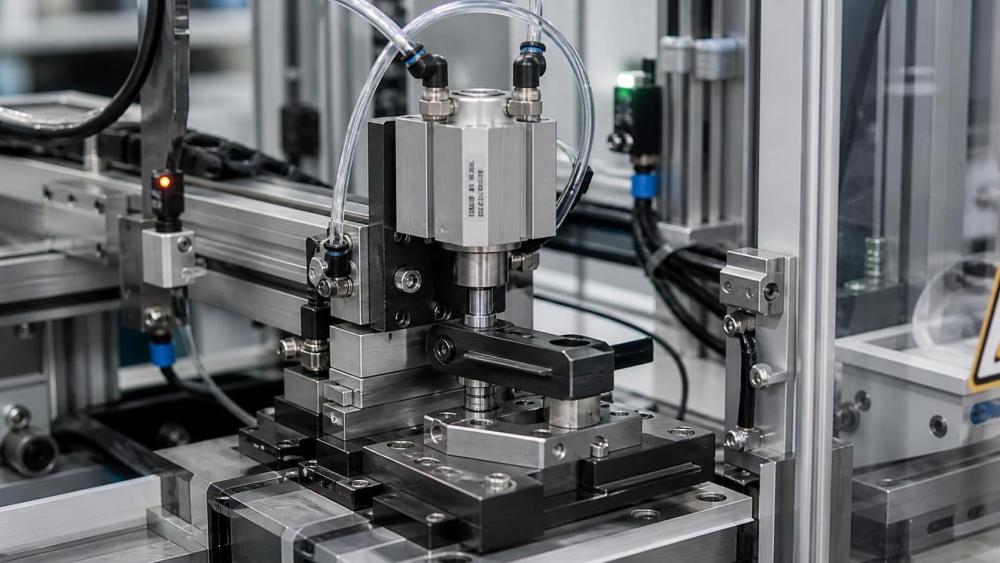
This is where short stroke compact cylinders earn their place. They provide dependable pneumatic linear motion where travel requirements are limited but installation space is not. Used thoughtfully, these actuators can reduce fixture envelope size, simplify mechanical layouts, and keep critical machine areas more accessible for operators and maintenance teams.
For project managers and engineering leads, the question is rarely whether a cylinder can move a part. The more useful question is whether it can deliver the required force, repeatability, mounting arrangement, and service life without creating a new packaging problem somewhere else. That distinction matters in machine tools, assembly equipment, material-handling fixtures, inspection stations, and compact special-purpose machinery.
Why cylinder length becomes a project-level issue
A conventional pneumatic cylinder includes the body length needed to house its piston and sealing system, plus the rod extension required for the selected stroke. When a machine only needs a short movement—such as pressing a component into a nest, locking a pallet, positioning a stop, or clamping a workpiece—the actuator’s overall installed length can appear disproportionate to the actual travel.
Compact cylinder designs address that mismatch. Their reduced body profile allows engineers to place linear actuation closer to the mechanism being moved. In practice, this may permit a smaller fixture plate, a tighter rotary indexing table, or a more compact robot end effector. It may also leave room for a proximity sensor, manual release feature, protective cover, or a technician’s hand during changeover.
The savings are not limited to millimeters. A smaller automation footprint can influence machine guarding, cabinet placement, conveyor spacing, transport dimensions, and the ability to duplicate a cell across a production line. When projects are working against floor-space limitations or retrofit constraints, actuator packaging becomes a genuine design decision rather than a catalog detail.
Applications where short stroke compact cylinders make the clearest difference
Fixture clamping in machining and secondary operations
Machining fixtures are among the most common applications for compact pneumatic actuators. A short-stroke cylinder can clamp a casting, forging, machined blank, or fabricated part against a locating surface while keeping the clamping mechanism below the tool path or within the fixture’s available envelope.
This is especially useful on multi-station machining fixtures, palletized setups, drilling and tapping machines, grinding stations, and automated deburring equipment. Where the part geometry is irregular, compact cylinders can be mounted near the clamp arm, wedge mechanism, or toggle linkage rather than extending beyond the fixture perimeter.
However, clamp force should not be selected from bore size alone. Engineering teams need to account for supply pressure variation, linkage ratio, friction, side loading, machining vibration, and the direction of process forces. A cylinder that appears adequate under ideal air pressure may provide insufficient holding margin when filters clog, line pressure drops, or multiple actuators cycle simultaneously.
Part stopping, separating, and positioning on conveyors
In pallet conveyors, transfer lines, and assembly systems, short stroke compact cylinders are frequently used as pop-up stops, escapement devices, locating pins, and separation gates. The required travel is often only enough to arrest a carrier, create a gap between components, or bring a part into repeatable contact with a datum.
Because conveyor zones are crowded with rollers, sensors, guide rails, drives, and guarding, a low-profile actuator can prevent the stop mechanism from protruding into aisle space or interfering with product flow. The compact format also supports modular conveyor designs, where every station must fit within a standardized width.
For these duties, project teams should consider impact energy rather than treating the cylinder as a simple on/off device. A moving pallet can transfer substantial force to a stop pin. End-of-stroke cushioning, external shock absorbers, controlled valve timing, and rigid mechanical supports may be required to protect both the cylinder and the carried product.
Assembly presses and insertion aids
Many assembly operations require a controlled push rather than a long linear stroke: seating a seal, engaging a retaining clip, closing a connector, holding a component during fastening, or moving a small part into a vision-inspection position. Compact cylinders suit these tasks when the stroke is short and the required force is within pneumatic capability.
The important distinction is between a positioning movement and a quality-critical pressing operation. If insertion force must be measured, recorded, or tightly controlled, a pneumatic compact cylinder may be only one element in a larger system involving pressure monitoring, position sensing, force verification, or an electric servo press. For lower-risk holding and assist motions, pneumatic actuation remains a practical and maintainable choice.
Robot end-of-arm tooling and pick-and-place equipment
Robot tooling is a constant negotiation between capability and mass. An actuator that is too long can shift the tool center point, reduce reach in enclosed machines, or create collision risks around fixtures. An actuator that is too heavy increases inertia and can affect robot cycle performance.
Short stroke compact cylinders are often incorporated into grippers, part-present mechanisms, lock pins, reject gates, and lightweight clamp modules. Their short body helps designers keep pneumatic motion close to the tool structure. Yet compactness alone is not sufficient: air tubing must be secured, fittings must avoid collision zones, and moving hoses must be evaluated through the full robot path. A cylinder that fits perfectly in a static CAD view can still fail a real-world motion study.
Machine-tool auxiliaries and access-limited mechanisms
Inside machine enclosures, compact pneumatic cylinders can operate chip guards, small doors, part ejectors, air-blow shutters, locator pins, and workholding support elements. They are also useful in auxiliary mechanisms around packaging machines, labeling equipment, printing systems, and test benches, where the movement may be small but cycle counts are high.
These environments add their own risks. Machining coolant, abrasive dust, weld spatter, washdown fluids, and elevated temperatures can shorten seal life or contaminate rod surfaces. The cylinder selection must therefore include an environmental review: rod material and finish, seal compatibility, protective boots or covers, mounting orientation, drainage, and accessible replacement procedures.
Compact does not mean “choose the smallest cylinder”
A common project mistake is to optimize only for the smallest physical package. A narrow bore may fit neatly into a mechanism but lack the force reserve needed for reliable operation. Conversely, selecting the largest bore available can increase air consumption, create higher impact loads, and force larger valves and tubing into an already congested layout.
The force calculation begins with effective piston area and actual operating pressure, but it should end with the complete mechanical condition. Consider the following before releasing a design:
- Required working force: Include friction, return springs, part variation, gravity, process loads, and a reasonable operating margin.
- Stroke tolerance: Define the useful travel, not just the nominal stroke. Overtravel can damage parts; insufficient travel can cause incomplete clamping or poor seating.
- Motion speed: Fast cycling may improve throughput, but uncontrolled end-of-stroke impact increases wear and noise.
- Load direction: Cylinder rods are designed primarily for axial loading. Side loads, bending forces, and misalignment should be carried by guides, slides, or fixture structures.
- Mounting method: Through-holes, tapped holes, rear mounts, side mounts, and direct body mounting each affect service access and alignment.
- Sensor requirements: If stroke confirmation is needed, ensure compatible magnetic pistons, sensor grooves, cable exits, and adjustment space are available.
For a project manager, these details are not merely engineering preferences. They influence commissioning time, spare-parts planning, fault diagnosis, and the probability of late design changes. The earlier the actuator is evaluated with its valve, fittings, sensor, linkage, and protective hardware, the less likely the team is to discover an avoidable interference during build.
A practical selection path for tight machine spaces
Start by defining the function in plain operational terms: “hold the workpiece while drilling,” “stop one pallet at a time,” or “move the inspection probe clear of the part.” This helps prevent a cylinder from being specified before the actual motion requirement is understood.
Next, map the true installation envelope in three dimensions. Include clearance for fittings and bend radius for pneumatic tubing, not just the actuator body. A compact cylinder mounted with a tall elbow fitting may occupy more usable space than a slightly longer alternative with a better port orientation.
Then evaluate the mechanism around the cylinder. If the motion is guided externally, the cylinder can focus on generating force. If the rod will push directly against an offset load, add guidance or redesign the load path. Compact units are valuable, but they are not substitutes for a properly supported slide.
Valve placement also deserves attention. Locating a directional control valve close to the actuator can improve response and reduce the compressible air volume in long tubing runs. In a highly compact module, though, local valves may complicate heat management, wiring, service access, or manifold design. There is no universal arrangement; the best layout is the one that supports the required cycle behavior and remains maintainable after installation.
Reliability is usually decided by the surrounding system
Short stroke compact cylinders are often simple and durable components, but their performance depends heavily on air quality and installation discipline. Contaminated compressed air can damage seals and restrict valve operation. Excess moisture may lead to corrosion. Inadequate filtration, poorly managed lubrication practices, loose fittings, and unrestrained tubing can turn an otherwise sound actuator selection into recurring downtime.
Maintenance access deserves special attention in tight machinery. A design that saves space but requires removal of guards, sensors, hoses, and adjacent tooling to replace one cylinder can become expensive over the equipment lifecycle. During the design review, ask a practical question: can a technician inspect the rod, confirm sensor status, disconnect air lines safely, and remove the unit with normal tools?
Standardization can make this easier. Where possible, use a limited range of bore sizes, sensor types, fittings, and mounting patterns across related stations. This supports more consistent commissioning and reduces the number of spare parts that must be stored for a production line or distributed equipment fleet.
When another actuator may be the better answer
Short stroke compact cylinders are not the automatic choice for every restricted-space motion. An electric actuator may be more appropriate when position profiles, force data, multiple intermediate stops, or recipe-driven adjustment are required. Hydraulic cylinders may suit high-force duties where pneumatic bore size would become impractical. Guided cylinders or compact slides may be preferable when the moving load has significant side force. Rotary actuators, cams, and toggle mechanisms can also create motion where a linear cylinder cannot be packaged effectively.
The point is not to force pneumatic hardware into every machine corner. It is to recognize where a compact linear actuator provides the simplest reliable answer—and where a different motion technology avoids complexity later.
Turning a small component into a better machine layout
In automation projects, compact cylinders are easy to underestimate because they are familiar components. Yet their placement can affect fixture geometry, operator access, safety guarding, cycle behavior, and future maintenance. The best use of short stroke compact cylinders is not simply to make a machine smaller. It is to create clean, stable motion exactly where the process needs it, without consuming space needed by the rest of the system.
For engineering leaders reviewing an automation concept, the most productive approach is to assess actuator selection alongside the mechanism, air system, controls, environment, and service plan. When those elements are considered together, a compact pneumatic cylinder becomes more than a space-saving part: it becomes a practical tool for building tighter, more maintainable industrial equipment.
Related News
- Using Industrial Air Blow Guns to Clear Chips Without Spreading DebrisOct 15, 2026Fluid Power Control Strategist
- Ductile Iron Pipe Valves: Which AWWA Standards Apply to Water Main Projects?Oct 15, 2026Dr. Elias Vance
- Why Vacuum Suction Cups Lose Grip on MDF in Woodworking MachinesOct 15, 2026CNC Kinematics Architect
- Choosing a Variable Displacement Piston Pump Manufacturer: What to VerifyOct 15, 2026Fluid Power Control Strategist
- Parallel vs. Angular Pneumatic Grippers for Confined Assembly StationsOct 15, 2026Fluid Power Control Strategist
- Die Castings vs. Investment Castings: Which Costs Less at Your Production Volume?Oct 14, 2026Foundry Phase-Change Fellow