
When Should You Specify Tie Rod Cylinders With Clevis Mounting?
It usually starts with a drawing review or a replacement request that looks simple on paper. A cylinder needs to extend, retract, and fit between two connection points. The stroke is already known. Bore size seems easy to calculate. Then the mounting detail comes up, and that is where many selection problems begin. If the cylinder must work through an arc, follow a moving linkage, or tolerate slight angular change during travel, a rigid mount can quietly create alignment trouble that does not show up until commissioning or after a short period of use.
In many machines, the question is not whether a tie rod cylinder can generate enough force, but whether it can stay aligned while doing real work. A poor mounting choice can lead to rod wear, seal damage, uneven loading at the gland, binding at the end of stroke, and stress being pushed into the frame instead of absorbed through proper motion. That is why technical reviews often spend more time on mounting style than expected. When people ask when they should specify tie rod cylinders with clevis mounting, the useful answer is not “when pivoting is needed” and stop there. The better answer is to look at motion path, support geometry, side load risk, maintenance access, and how the cylinder behaves as part of a larger mechanism.
One common mistake is treating all cylinder mounts as if they only affect installation convenience. In practice, mounting style changes the way force enters the structure. A foot mount or flange mount tends to work best when the cylinder axis remains fixed relative to the machine frame. A clevis mount, by contrast, is usually chosen because the cylinder body or rod end must rotate slightly as connected parts move. That rotation is not a minor detail. It is often the difference between a cylinder that runs smoothly and one that spends its life fighting the mechanism attached to it.
Where the mounting decision usually becomes difficult
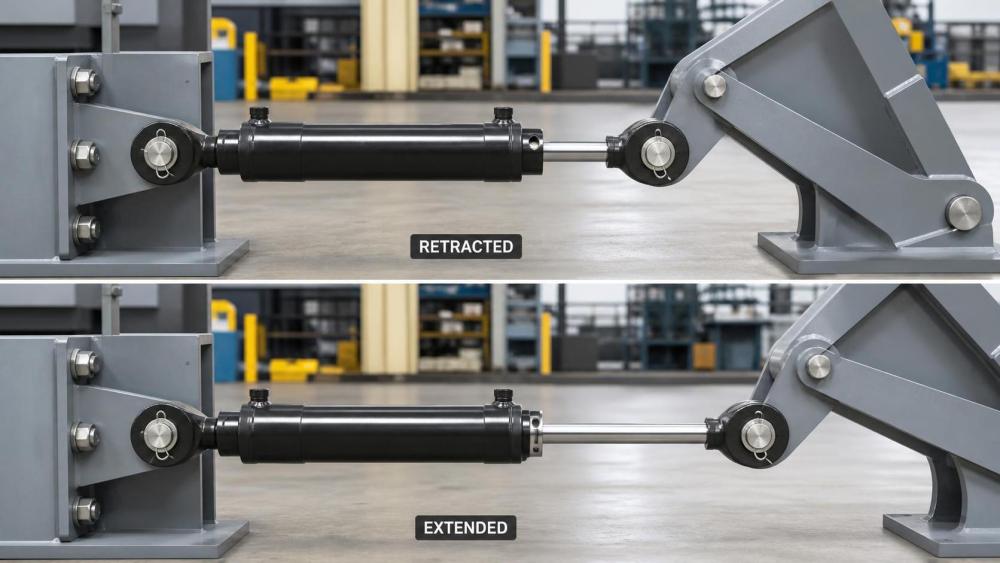
The difficult cases are rarely the ones with a straight push on a rigid guide. The hard cases are mechanisms with arms, gates, dump bodies, clamp frames, transfer devices, material handling attachments, and equipment that changes angle while moving. In those setups, the cylinder is not just extending in a straight line. It is part of a changing triangle or linkage. As the machine moves, the distance between pivot points changes, and the cylinder must follow that movement without twisting the rod or forcing the barrel into a fixed position it cannot maintain.
If you are evaluating a design and see pinned joints at both ends of the cylinder path, that is an early sign that clevis-style mounting may be appropriate. The purpose is to let the cylinder align itself with the moving connection points. Without that freedom, even a well-sized cylinder can become a source of friction and premature wear.
There is also a practical reason engineers return to tie rod construction in these cases. Tie rod cylinders are familiar, serviceable, and widely integrated into industrial equipment. When paired with a clevis arrangement, they can fit applications where angular movement is built into the mechanism and where future disassembly or seal service matters. The mounting choice does not replace proper design of the whole motion path, but it helps the cylinder work with the machine instead of resisting it.
Signs that a rigid mount is the wrong fit
Before specifying a clevis, it helps to recognize what goes wrong when the wrong mount has already been considered. One sign is a layout where the cylinder centerline cannot remain perfectly collinear with the load throughout the stroke. Another is a rod end connection that must swing through an arc while the rear end of the cylinder is assumed to remain fixed. That mismatch usually means the design is transferring bending into the rod, pins, or mounting ears.
Another warning sign is repeated concern about side loading, especially when the machine does not include precise external guidance. Cylinders are built to transmit axial force. They are not ideal structural members for carrying misalignment or resisting bending created by poor mounting geometry. If the design team is already discussing oversized pins, reinforced brackets, or unusual wear on one side of the rod seal in a previous machine version, the problem may be geometric rather than material-related.
Sometimes the issue appears during replacement rather than original design. A maintenance team may want to substitute a different mount style simply because it is available sooner or seems easier to install. But when the original mechanism relied on pivoting movement, replacing it with a more rigid mount can create a hidden fit problem. The cylinder may bolt in, yet still operate under continuous stress because the connection points no longer accommodate angular change.
When clevis mounting makes technical sense
A clevis mount generally makes sense when the cylinder needs to pivot in plane with the motion of the connected mechanism. This often applies when the base end is pinned to a frame bracket and the rod end is pinned to a lever, arm, or moving plate. In this arrangement, the cylinder can swing slightly as stroke position changes, keeping the rod more closely aligned with the true line of force.
That matters in several situations:
- When the load is driven through a lever or crank arm rather than a straight guided slide.
- When the extended and retracted positions place the cylinder at clearly different operating angles.
- When the frame and moving member are both using pinned joints as part of the mechanism.
- When installation tolerances or structural deflection may introduce small alignment changes during operation.
In those cases, specifying tie rod cylinders with clevis mounting is less about preference and more about respecting actual machine motion. The clevis allows the cylinder to follow that motion instead of absorbing it as stress.
It is also worth noting that clevis mounting is helpful when field service conditions matter. Pinned joints can simplify removal in some equipment layouts, especially where a cylinder sits inside a linkage assembly with limited access for bolt extraction. That does not make clevis the default answer, but it is one of the reasons this mount remains common in heavy-duty industrial applications.
The selection question is really about motion, not just hardware
Many selection errors happen because people start with the cylinder catalog and only later look at the mechanism. A better approach is to sketch or review the motion first. Trace the path of both connection points through the full stroke. If those points rotate relative to one another, a mount that allows angular movement should be considered early, not added later as a workaround.
This is also the stage where rod end details matter. A rear clevis alone will not solve misalignment if the rod end is forced into a rigid connection that cannot follow the same arc. In many applications, the correct arrangement is a pinned mount at the cap end and a compatible pivoting connection at the rod end. The goal is not maximum freedom in every direction; the goal is enough freedom in the required plane to prevent side loading while still controlling the motion.
That distinction matters because too much freedom can create its own instability. If the mechanism needs strict guidance, the external structure should provide it. The cylinder should supply force, not act as the guide for a moving load that is free to wander.
Points to compare before you finalize the specification
When evaluating whether to go with clevis mounting, the first comparison is between true axial loading and probable off-axis loading. If the machine can keep the force path centered on the rod throughout travel, a rigid mount may be completely appropriate. If the force path changes angle during stroke, clevis mounting deserves serious consideration.
The second comparison is between theoretical alignment and real-world alignment. On paper, many assemblies look straight. In service, brackets flex, welded structures shift slightly, and assembly tolerances stack up. Clevis-mounted cylinders are often more forgiving in these conditions because they can accommodate small angular variation without forcing that variation into the rod bearings and seals.
The third comparison is between the cylinder and the machine’s existing joint philosophy. If the surrounding mechanism is already built around pin-connected members, a clevis-mounted cylinder is often more compatible with the rest of the structure. If everything else is bolted into fixed alignment and guided precisely, a different mount may be cleaner.
Another point that should not be skipped is stroke-end behavior. Some mechanisms are well aligned mid-stroke but become more angular near full extension or retraction. That is where wear often starts. Reviewing only the nominal working position can hide this risk. A proper evaluation checks the whole travel range, including startup, idle, and any position where the mechanism may pause under load.
Practical review steps during design or replacement
When the mounting decision is still open, it helps to slow down and review the mechanism in the way it will actually operate. Start with the pivot locations and stroke path. Do not begin with the cylinder series. Determine whether the cylinder centerline remains stable or swings relative to the frame. If it swings, quantify that angular change as part of the mounting decision.
Next, look at the support around the mounting points. Clevis connections depend on pin integrity, bracket stiffness, and proper spacing. A good mounting concept can still perform poorly if the bracket allows pin distortion or if the ears are not aligned. The mount style and the surrounding steelwork need to be evaluated together.
Then review side load sources beyond pure geometry. Hoses can pull on smaller cylinders. Poorly supported attachments can twist the rod end. Uneven payload distribution can shift the line of action. These issues do not always rule out a clevis mount, but they affect whether the cylinder will run as intended.
Finally, consider service conditions. Tie rod cylinders are often selected where maintainability matters, but service access still depends on how the clevis pins, retainers, and surrounding guards are arranged. A technically correct mount can become a long-term headache if routine removal requires dismantling nearby machine sections.
Misunderstandings that often lead to the wrong choice
One misunderstanding is that clevis mounting is only for light-duty or loosely aligned equipment. In reality, it is frequently the correct choice in serious industrial mechanisms precisely because heavy loads amplify the damage caused by misalignment. Allowing controlled pivoting can protect the cylinder under demanding duty rather than weaken the system.
Another misunderstanding is that clevis mounting solves side loading by itself. It does not. It reduces side loading caused by angular motion between connection points, but it cannot compensate for a badly guided load, a bent bracket, or a rod end connection that is still being forced off-axis. The mount helps the cylinder follow the mechanism; it does not fix the mechanism.
There is also a tendency to think of tie rod cylinders as interchangeable once bore and stroke match. That is risky. Mounting envelope, pin dimensions, retracted length, rod end style, and available swing clearance all affect whether a replacement will really function like the original. In applications where pivoting motion matters, small dimensional differences can change the operating angle enough to create interference or unfavorable loading.
Questions that usually come up during evaluation
Should a clevis mount be specified at one end or both ends?
That depends on the motion path. Many applications use a clevis or pinned connection at the cap end and a pivot-capable rod end connection. The key is that the cylinder must follow the mechanism without being overconstrained. If one end pivots but the other is forced rigidly against the actual motion path, the alignment problem may remain.
Is clevis mounting better whenever the machine has vibration?
Not automatically. Vibration alone is not the deciding factor. The real question is whether the cylinder needs angular freedom and whether the support structure can carry pin-connected loads properly. A vibrating machine with a fixed axial force path may still use another mount style successfully.
Can clevis mounting compensate for poor fabrication tolerances?
It can tolerate some angular variation, but it should not be used as a substitute for sound fabrication and alignment practice. If brackets are noticeably out of position or the load is not guided, the cylinder may still see harmful stress.
When is a rigid mount still the better answer?
If the application keeps the cylinder in a fixed axis, the load is externally guided, and the structure is designed to maintain alignment through the stroke, a rigid mount may provide a simpler and more direct installation. Clevis mounting is valuable when the mechanism needs the cylinder to pivot, not when the cylinder path is truly fixed.
In the end, specifying tie rod cylinders with clevis mounting is usually the right move when the cylinder is part of a moving linkage rather than a purely straight push. If the connected members change angle during stroke, if pinned joints define the rest of the mechanism, or if you are trying to reduce alignment-related wear, clevis mounting deserves priority in the evaluation. The best decisions come from reviewing the actual motion, not just the mounting options listed in a catalog. When the cylinder is allowed to move the way the machine moves, the rest of the design usually becomes easier to trust.
Related News
- How to Assess a Rigid Coupling Supplier for Bore Accuracy and Traceable QualityOct 08, 2026Tribology & Kinematics Expert
- Titanium Alloys Compared: Balancing Strength, Corrosion Resistance, and MachinabilityOct 08, 2026CNC Kinematics Architect
- Where Ductile Iron Dismantling Joints Reduce Alignment Risk in Water PipelinesOct 08, 2026Pipeline Metallurgy Scientist
- Selecting a Precision Bearing Sleeve: Fits, Runout, and Material ChoicesOct 08, 2026Tribology & Kinematics Expert
- Face Milling Cutters: How Insert Geometry Affects Finish on Steel and AluminumOct 08, 2026CNC Kinematics Architect
- Single-Acting Cylinders for Clamping: Stroke, Force, and Return Spring ConsiderationsOct 07, 2026Fluid Power Control Strategist