
When Do Hydraulic Actuators Outperform Pneumatic Systems in Heavy-Load Applications?
In heavy-load applications, the choice between hydraulic and pneumatic motion control is rarely a simple matter of “more force” versus “lower cost.” For project managers and engineering leads, the real question is whether the motion system can hold load, survive duty cycles, tolerate the site environment, and support predictable maintenance over the life of the equipment. That is where hydraulic actuators tend to separate themselves. In many industrial settings, they are not just a stronger option. They are the more controllable and lower-risk option once load, safety, and system stability begin to dominate the decision.
Searchers looking into this topic are usually trying to answer a practical selection question: at what point does compressed air stop being efficient or reliable enough, and when does fluid power become the better fit despite higher system complexity? The answer depends less on theory and more on what the machine has to do under real operating conditions.
Heavy load changes the decision logic
In light automation, pneumatic systems are often attractive because they are clean, fast, and relatively simple. They fit repetitive pick-and-place tasks, clamping, sorting, gate control, and other motions where forces are moderate and end-position control is enough. But heavy-load applications create a different set of priorities. Once a machine must lift, press, hold, tilt, compact, or position a substantial mass, the weaknesses of compressed air become more visible.
Air is compressible. That characteristic is useful in some fast-cycle applications, but it also makes the system less rigid under load. When the load varies, pneumatic motion can become less stable, less precise, and harder to hold at a fixed position without drift or bounce. Hydraulic fluid, by contrast, is effectively incompressible in most practical system conditions, which gives hydraulic actuators a clear advantage in force transmission and load control.
That difference matters in construction machinery, material handling, metal forming, mining equipment, agricultural systems, and large industrial tooling. In those environments, the actuator is not just moving a component. It is resisting gravity, absorbing shock, maintaining pressure, and often serving as part of the machine’s overall safety envelope.
When hydraulic actuators clearly outperform pneumatic systems
There are several conditions where the balance shifts decisively toward hydraulics.
1. When high force must fit into limited space
Hydraulic systems offer much higher power density than pneumatic systems. That means they can generate substantial force from a relatively compact actuator package. In heavy equipment design, available installation space is usually limited by frame geometry, guarding, hose routing, and adjacent components. If the required force rises beyond what a pneumatic cylinder can deliver without becoming oversized, hydraulic actuators become the more practical choice.
This is common in lifting arms, pressing units, bucket control, stabilizer legs, forging equipment, and load-bearing machine attachments. A pneumatic design may still be technically possible, but it often becomes bulky, less efficient, and harder to package cleanly.
2. When the load must be held steadily for meaningful periods
One of the most important real-world advantages of hydraulics is load holding. In many heavy-duty applications, the actuator does not simply extend and retract. It must stop and maintain position while external forces continue acting on the system. Examples include suspended loads, elevated work platforms, positioning tables, mold clamping units, and hydraulic gates.
Pneumatic systems can hold position in some arrangements, but under heavier loads they are typically more vulnerable to drift, compliance, and unstable behavior, especially when downstream leakage, fluctuating air supply, or variable load conditions are present. Hydraulic actuators combined with appropriate valves and load-holding circuits are generally far better suited to this duty.
3. When smooth controllability matters more than cycle speed alone
A common misconception is that heavy-load applications only care about brute force. In practice, many of them also require controlled acceleration, deceleration, and intermediate positioning. A heavy load that moves too abruptly can damage tooling, reduce product quality, increase structural fatigue, or create safety risks for nearby operators.
Hydraulic actuators usually provide better modulation for these conditions, especially when paired with proportional or servo-hydraulic controls. That allows project teams to manage motion profiles with more consistency than a basic pneumatic setup can typically deliver. In pressing, forming, lifting, or synchronized motion systems, that controllability can have more value than the raw force number itself.
The practical threshold is not just “how heavy is the load,” but “how controlled must the load be while moving and while stopped.”
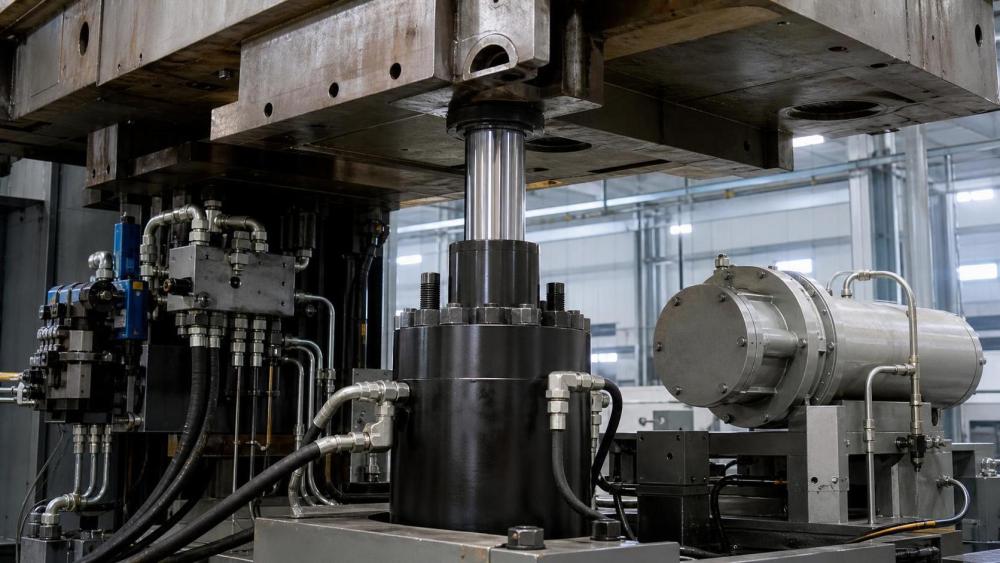
4. When shock loading and harsh duty cycles are unavoidable
Heavy industrial systems rarely operate under ideal, laboratory-like conditions. Loads shift unexpectedly. Operators work across variable cycles. Components face vibration, impact, dust, moisture, and temperature swings. In these environments, hydraulic actuators generally tolerate demanding duty more effectively than pneumatic systems designed for lighter automation roles.
That does not mean hydraulic systems are maintenance-free. They are not. But their architecture is often better aligned with repeated high-load work, particularly where structural stiffness and controlled force transfer are essential.
5. When energy use under load needs a more realistic review
Pneumatic systems are often perceived as simpler and cheaper to run, but that assumption becomes less reliable in heavy-load applications. Compressed air is convenient, yet it is also an inefficient energy medium in many industrial settings, especially when leaks, pressure losses, and oversized compressors are involved. If a pneumatic system must work harder to produce and sustain heavy force, its lifecycle operating cost can become less attractive than expected.
Hydraulic systems have their own losses and maintenance demands, but in high-force applications they often deliver energy more directly and effectively. The right comparison is not component price or utility familiarity. It is total system efficiency under the actual load profile.
Where pneumatic systems still make sense
Hydraulics are not automatically the better answer whenever load increases. Pneumatic systems still have a place, even in industrial environments that include some heavy equipment nearby. They remain useful when the motion is short-stroke, binary, fast-cycling, and does not require fine load control. They are also attractive where plant air is already available, cleanliness is critical, and oil leakage creates unacceptable process risk.
For example, auxiliary clamping, simple gates, diverters, and support motions may remain pneumatic even if the main working axis is hydraulic. Hybrid system design is often more rational than forcing one technology to do every job.
For project teams, the mistake is not choosing pneumatics. The mistake is extending pneumatics into a duty range where the control, stability, or force margin is no longer comfortable.
What project managers should evaluate before choosing hydraulics
The decision should be built around application conditions, not supplier claims or legacy preference. Several questions usually reveal whether hydraulics are justified.
- What is the true peak load, including shock factors and worst-case operating conditions?
- Does the system need to hold position under load, and for how long?
- Is intermediate positioning required, or only end-of-stroke motion?
- What happens if the actuator drifts, drops, or overshoots?
- How sensitive is the application to vibration, bounce, or inconsistent speed?
- What is the duty cycle across a full shift, season, or project life?
- How severe is the environment in terms of dust, moisture, heat, contamination, and maintenance access?
- Does the site already support hydraulic power units, filtration discipline, and fluid maintenance capability?
These questions matter because a hydraulic actuator is never just a cylinder or motor in isolation. It depends on the surrounding system: pump sizing, pressure control, valve behavior, sealing quality, hose integrity, contamination control, reservoir design, and maintenance practices. A technically correct actuator choice can still underperform if the hydraulic package around it is poorly specified.
The hidden risks are usually in the system, not the actuator body
Many procurement discussions focus heavily on actuator size, stroke, and nominal pressure. Those are necessary inputs, but they do not capture the main operational risks. In heavy-load service, the most common failures often come from system-level weaknesses: contaminated fluid, poor heat management, inadequate sealing, improper hose routing, unstable valve control, or insufficient safety logic for suspended or over-center loads.
This is one reason experienced buyers increasingly evaluate supplier capability beyond the catalog. They want to know whether the supplier can provide material traceability, pressure testing, seal compatibility guidance, dimensional consistency, and support for the valve-and-power-unit side of the application. In practice, lifecycle reliability depends on how well the full motion chain is engineered.
For international projects or multi-party EPC procurement, standards and documentation may also become important, although exact requirements vary by region and application【待核实】. It is often worth confirming early whether the package will require specific pressure vessel rules, safety documentation, test certificates, or site acceptance procedures.
Hydraulics win more often when downtime is expensive
In project economics, the choice is not only about capex. It is about the cost of unstable operation. A motion system that struggles with heavy loads can create secondary losses: slower cycle times, poor product consistency, repeated adjustment, structural wear, operator intervention, and unplanned stoppages. Those costs are harder to see during quotation review, but they usually become obvious after commissioning.
Hydraulic actuators tend to outperform pneumatic systems when failure to control the load has consequences beyond the actuator itself. If lost stability can affect tooling, output quality, machine alignment, or jobsite safety, the stronger business case often points toward hydraulics even if the upfront design is more involved.
This is especially relevant in infrastructure equipment, metal processing, mining support systems, heavy fabrication, and municipal utility machinery, where machines are expected to run under variable load for long periods and where service interruptions can cascade into broader project delays.
A better way to frame the decision
Instead of asking whether hydraulic actuators are “better” than pneumatic systems, project teams should ask a narrower and more useful question: when does load behavior become important enough that force density, rigid control, and secure holding outweigh the simplicity of air?
In many heavy-load applications, that point arrives sooner than expected. Once the machine must move substantial weight with repeatability, stop without instability, and hold position under real industrial conditions, hydraulic actuators usually provide a more defensible engineering basis. Pneumatics remain valuable where motion is light, fast, and simple. But when the application becomes load-critical, hydraulics are often the technology that aligns better with safety, uptime, and long-term operating value.
For project managers, that is usually the most important conclusion: the right actuator choice is not the one with the lowest entry cost or the simplest utility connection. It is the one that keeps the load under control when the operating environment stops being forgiving.
Related News
- How to Assess a Rigid Coupling Supplier for Bore Accuracy and Traceable QualityOct 08, 2026Tribology & Kinematics Expert
- Titanium Alloys Compared: Balancing Strength, Corrosion Resistance, and MachinabilityOct 08, 2026CNC Kinematics Architect
- Where Ductile Iron Dismantling Joints Reduce Alignment Risk in Water PipelinesOct 08, 2026Pipeline Metallurgy Scientist
- Selecting a Precision Bearing Sleeve: Fits, Runout, and Material ChoicesOct 08, 2026Tribology & Kinematics Expert
- Face Milling Cutters: How Insert Geometry Affects Finish on Steel and AluminumOct 08, 2026CNC Kinematics Architect
- Single-Acting Cylinders for Clamping: Stroke, Force, and Return Spring ConsiderationsOct 07, 2026Fluid Power Control Strategist