
When Do Custom Cylinder Seal Kits Improve Leakage Control and Service Life?
A cylinder that begins weeping around the rod, loses holding force under load, or comes back from overhaul only to fail again creates a familiar frustration for aftermarket maintenance teams. The replacement seal kit may have matched the cylinder model on paper, yet the machine’s real operating conditions tell a different story. Pressure spikes, contaminated oil, a scored rod, unusual stroke frequency, or a change in hydraulic fluid can quickly expose the limits of a standard repair kit.
Custom cylinder seal kits improve leakage control and service life when the sealing system must be matched to the actual cylinder, its surface condition, and its working environment rather than to a broad catalog category. They are not necessary for every routine rebuild. For a clean, lightly loaded cylinder operating within the original design envelope, a standard OEM-equivalent kit may be entirely appropriate. Customization becomes valuable when repeat leakage is costing time, when the original specification is unavailable, or when the equipment is working in conditions that the original seals were never intended to handle.
The practical question is not simply, “Can a custom kit fit this cylinder?” It is, “Will a tailored seal arrangement remove the reason this cylinder keeps failing?” Answering that requires looking beyond the piston seal alone.
Start with the failure pattern, not the part number
Maintenance personnel often receive a cylinder with one visible symptom: oil at the rod end. But external leakage is only one outcome of a wider sealing problem. A cylinder may also drift internally, lose speed, draw in contamination during retract motion, or show intermittent behavior when pressure rises. Each pattern points toward a different area of the seal system.
- Rod-end oil leakage may indicate a worn rod seal, damaged wiper, excessive rod surface roughness, side loading, pressure trapped between seals, or a rod that has been chrome-damaged.
- Internal bypassing is often linked to piston-seal wear, barrel scoring, incorrect seal energization, extrusion under pressure, or an unsuitable clearance gap.
- Premature wiper failure commonly appears in dusty construction, mining, agricultural, steel-processing, and outdoor handling equipment where abrasive contamination is constantly present.
- Repeated seal blowout after repair may signal pressure spikes, blocked return paths, wrong gland dimensions, incorrect installation, or a seal material that softens in the working fluid.
- Short life after a rod replacement can result from an unsuitable rod finish, sharp lead-in edges, plating defects, or geometry that no longer matches the original seal design.
A custom kit should be considered when the same failure mode returns despite competent installation and normal preventive maintenance. In that situation, replacing identical components often repeats the same mismatch. The rebuild needs diagnosis, measurement, and a more suitable combination of seals, guides, and wipers.
When standard cylinder seal kits begin to fall short
Standard kits are built around a defined cylinder design and expected operating range. Their advantage is simplicity: known dimensions, familiar materials, and predictable assembly. Their limitation is that they cannot always accommodate equipment that has aged, been modified, or moved into a more demanding duty cycle.
1. The cylinder sees pressure peaks beyond its normal working pressure
Many hydraulic systems operate with transient pressure events that are more severe than the gauge reading suggests. Sudden directional-valve shifts, load shock, end-of-stroke impact, and high-inertia motion can produce short spikes that force soft sealing lips into clearance gaps. The visible result may be nibbling, lip damage, or pieces of seal material found during teardown.
In these conditions, custom cylinder seal kits may use an anti-extrusion ring, a harder backup element, a different piston seal profile, or a reinforced rod-seal design. The goal is not merely to select “harder seals.” Excessive hardness can reduce low-pressure sealing ability and increase friction. The right arrangement balances pressure resistance with the cylinder’s actual bore finish, operating temperature, and motion profile.
2. Fluid chemistry has changed
A seal compatible with conventional mineral hydraulic oil may not perform the same way with water-glycol fluids, biodegradable hydraulic oils, fire-resistant media, synthetic lubricants, or process fluids. Swelling, shrinkage, hardening, softening, and loss of elastic recovery can all occur when elastomer chemistry is poorly matched to the fluid.
This is a common reason to specify a custom kit during conversions or fleet standardization. Nitrile rubber remains widely used in hydraulic applications, but it is not a universal answer. Fluorocarbon, polyurethane, PTFE-based materials, fabric-reinforced compounds, and other formulations may be more suitable depending on the medium and temperature. Material selection should be based on the actual fluid specification, including additives, rather than on a generic description such as “hydraulic oil.”
3. Temperature is changing the behavior of the seal
Cold starts can make certain seal materials stiff enough to leak until the system warms up. High ambient temperature, radiant heat from nearby equipment, or sustained high oil temperature can reduce material strength and accelerate aging. A cylinder operating outdoors in winter and beside a hot process line in summer may need more consideration than a warehouse actuator with stable conditions.
Custom seal configurations are especially useful where temperature range is broad, because the chosen materials must retain flexibility at the low end while resisting thermal degradation at the high end. Friction also matters. A seal that is technically temperature compatible but generates excessive stick-slip may cause jerky movement, poor position control, and operator complaints.
The rod, barrel, and gland decide whether a better seal can succeed
It is tempting to treat seal replacement as a soft-parts repair. In reality, sealing performance depends heavily on the metal surfaces that the seals must run against. A premium seal installed on a rough, pitted, or scored rod cannot deliver its intended service life.
Before ordering a tailored kit, measure the rod diameter, cylinder bore, seal groove width and depth, gland geometry, and any clearance conditions relevant to the design. Compare these dimensions with the cylinder drawing where available, but do not assume an old cylinder still matches nominal dimensions. Wear, prior machining, corrosion removal, rechroming, and non-original replacement parts can all change the sealing environment.
Rod inspection deserves particular attention. Look for longitudinal scratches, corrosion pits, flaking chrome, weld spatter, dents, and sharp transitions near the threaded end or rod eye. A rough surface can abrade the seal lip; a deep scratch can form a direct leakage path. Likewise, inspect the barrel for scoring and measure for ovality or taper. A piston seal that works in a round bore may bypass in a worn barrel even if the seal itself appears undamaged.
When repair work includes machining, honing, rechroming, or fabrication of a replacement gland, custom cylinder seal kits create an opportunity to specify grooves and running surfaces around a known sealing design. This is often more dependable than trying to force an obsolete seal profile into a modified component.
A complete kit is a sealing system, not a bag of rings
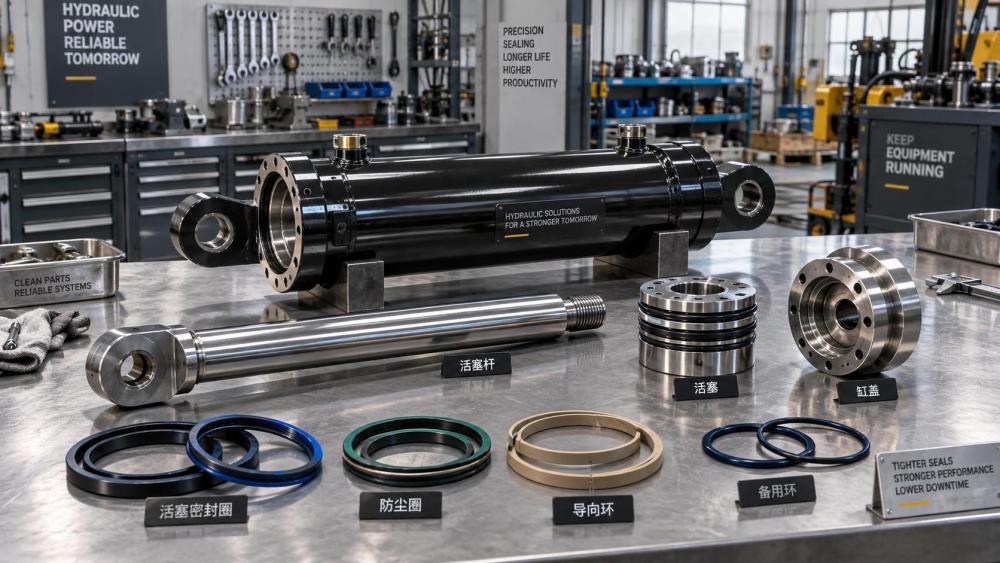
Leakage control is shared by several components, each with a distinct job. A useful custom specification looks at the whole system:
- Rod seal: retains hydraulic fluid at the moving rod and must manage pressure, speed, side load, and surface quality.
- Wiper or scraper: removes dirt, water, scale, and abrasive particles before they enter the gland. In contaminated environments, this is a primary defense rather than an accessory.
- Buffer seal: protects the primary rod seal from pressure surges and can relieve damaging inter-seal pressure when properly designed.
- Piston seal: separates pressure chambers and limits internal bypassing. Its selection affects efficiency, heat generation, and holding stability.
- Wear rings or guide bands: keep metal components from contacting each other and help control side loading. Their condition is often overlooked during quick repairs.
- Static seals: such as O-rings and backup rings, prevent leakage at glands, caps, ports, and other stationary joints.
For example, a cylinder on a loader attachment may require a stronger wiper and improved guiding because mud and side load are the dominant threats. A high-cycle industrial press cylinder may benefit more from a low-friction piston-and-rod sealing combination that reduces heat and stick-slip. A marine or water-exposed actuator may need greater attention to corrosion, water ingress, and compatible static sealing materials.
Situations where customization produces a clear maintenance benefit
Not every unusual cylinder needs a fully engineered package. However, the case for a custom solution is strong in several recurring situations.
Obsolete or undocumented cylinders: Older machines, imported equipment, rebuilt attachments, and legacy production lines often lack reliable part numbers. A dimension-based kit built from verified gland and bore measurements can restore serviceability without relying on uncertain cross-references.
Modified equipment: If a cylinder has been lengthened, fitted with a new rod, converted to another fluid, or installed on equipment with different loads, the original kit may no longer reflect the application. Customization brings the seal package back into alignment with the modified assembly.
High-cost downtime assets: On mining equipment, municipal pumping systems, production presses, marine machinery, or critical material-handling equipment, a repeat repair can be more costly than a carefully specified kit. The benefit comes from reducing the likelihood of another unplanned shutdown, not from claiming that every seal will last indefinitely.
Severe contamination exposure: Dust, slurry, fertilizer residue, washdown water, metal fines, and outdoor debris can defeat a basic wiper arrangement. A more robust exclusion system, combined with rod protection and disciplined cleaning, can make a meaningful difference.
Persistent low-speed leakage or chatter: Precision positioning cylinders and slow-moving hydraulic actuators can suffer from stick-slip. A different material or seal geometry may lower breakaway friction and produce more stable motion, provided the system’s valve control and lubrication conditions are also sound.
How to specify custom cylinder seal kits without creating a new problem
A custom order should begin with accurate technical information. Sending only photographs and a rough cylinder length often leads to avoidable delays or an incomplete solution. Maintenance teams should document the cylinder type, bore diameter, rod diameter, stroke, mounting style, working pressure, peak pressure if known, operating temperature, fluid type, and equipment application.
Include the condition findings from teardown. Was the old rod seal worn evenly or damaged on one side? Were guide rings crushed? Did the piston seal show extrusion? Was contamination embedded in the wiper? These observations are valuable because they distinguish a material failure from an alignment or mechanical problem.
Dimensional verification is essential. Seal profiles can look similar while differing enough in lip geometry, energizer design, groove fit, or clearance tolerance to cause leakage. If possible, provide groove dimensions and cross-sectional sketches. For nonstandard cylinders, a sample of the removed seal can help identify the original profile, but it should never replace measurement.
It is also wise to clarify the maintenance objective. Is the priority longer interval between overhauls, lower friction, compatibility with a new fluid, better dirt exclusion, or restoring an obsolete cylinder quickly? The answer guides trade-offs. A seal optimized for aggressive contamination control may create more friction than one selected for high-speed, clean indoor service.
Installation discipline still determines the outcome
Even the best-designed custom kit can fail early if installation damages the sealing lips or ignores the cause of the previous failure. Cleanliness is fundamental. Fine debris introduced during assembly may circulate through the system and scratch new sealing surfaces within hours of startup.
Deburr ports, threads, cross-holes, and groove edges. Use proper installation tools and protective sleeves when seals must pass over threads or sharp shoulders. Lubricate with a fluid compatible with the seal material, and avoid twisting PTFE-based or energized components during fitting. Wear rings should be seated correctly, and the piston assembly must be tightened according to the cylinder manufacturer’s procedure where that information is available.
After reassembly, do not judge success only by the absence of an immediate drip. Test the cylinder through its full stroke, under realistic load where safe, and inspect for rod-end leakage, internal drift, abnormal heat, and irregular movement. Review filtration and breather condition as well. Contamination entering through a neglected reservoir breather can undermine an otherwise excellent cylinder repair.
A practical decision rule for aftermarket teams
Choose a standard replacement kit when the cylinder is identifiable, operating conditions remain close to original design, surfaces are in good condition, and there is no history of repeated failure. Move toward custom cylinder seal kits when the cylinder is obsolete, modified, exposed to severe temperature or contamination, subject to unusual pressure loads, or repeatedly leaking after correct standard repairs.
The most durable answer is rarely a single “stronger” seal. It is a matched package: suitable materials, correct profiles, controlled clearances, healthy rod and bore surfaces, effective guiding, and careful assembly. For aftermarket maintenance personnel, that broader view turns seal replacement from a temporary patch into a more reliable restoration of cylinder performance.
Related News
- How to Assess a Rigid Coupling Supplier for Bore Accuracy and Traceable QualityOct 08, 2026Tribology & Kinematics Expert
- Titanium Alloys Compared: Balancing Strength, Corrosion Resistance, and MachinabilityOct 08, 2026CNC Kinematics Architect
- Where Ductile Iron Dismantling Joints Reduce Alignment Risk in Water PipelinesOct 08, 2026Pipeline Metallurgy Scientist
- Selecting a Precision Bearing Sleeve: Fits, Runout, and Material ChoicesOct 08, 2026Tribology & Kinematics Expert
- Face Milling Cutters: How Insert Geometry Affects Finish on Steel and AluminumOct 08, 2026CNC Kinematics Architect
- Single-Acting Cylinders for Clamping: Stroke, Force, and Return Spring ConsiderationsOct 07, 2026Fluid Power Control Strategist