
What to Verify Before Selecting a Hydraulic Actuator Supplier for OEM Projects
Choosing a hydraulic actuator supplier for an OEM program is rarely a simple catalog exercise. Two actuators may appear similar on a quotation—same bore, stroke, pressure rating, and mounting style—yet perform very differently once they are installed on a machine that cycles all day, operates outdoors, handles shock loads, or must meet strict safety expectations.
For procurement teams, the difficult part is not finding a supplier that can produce an actuator. It is determining whether that supplier can repeatedly deliver the right actuator, with stable quality, complete documentation, practical engineering support, and dependable lead times. A weak choice can lead to leakage claims, premature seal failures, mounting misalignment, production delays, and costly field-service work. A well-qualified hydraulic actuator supplier becomes part of the OEM’s product reliability strategy.
The review should therefore begin before price negotiation. The following checkpoints help buyers compare suppliers in a way that reflects real operating risk rather than headline specifications alone.
Start with the application, not the actuator drawing
An actuator drawing is essential, but it does not fully describe the duty it must survive. Before requesting quotations, procurement and engineering teams should align on the operating conditions behind the part number. This creates a clearer technical brief and makes supplier comparisons more meaningful.
Ask what the actuator is actually expected to do: lift a load, clamp a workpiece, position a boom, control a gate, steer equipment, operate a press, or move a valve under process pressure. These applications create very different demands on rod strength, seal selection, cushioning, corrosion protection, and fatigue life.
- Required operating pressure, pressure peaks, and proof or burst-test expectations
- Dynamic load, side load, buckling risk, shock loading, and duty cycle
- Stroke length, speed, acceleration, and end-of-stroke cushioning needs
- Ambient temperature, humidity, washdown exposure, dust, salt spray, or chemical contact
- Hydraulic fluid type, cleanliness target, filtration level, and contamination risk
- Mounting geometry, pin tolerances, installation space, and service access
- Expected machine life, warranty conditions, and field replacement strategy
This step prevents a common purchasing mistake: comparing suppliers against a basic dimensional specification while leaving critical duty conditions open to interpretation. A supplier may quote a standard cylinder that fits the envelope but is not engineered for the real load spectrum. For OEM equipment, “fits” and “performs reliably” are not the same thing.
Verify engineering depth and customization boundaries
Many suppliers can modify a standard hydraulic cylinder by changing stroke length, port position, paint color, or mounting bracket. That is useful, but OEM projects often require deeper engineering capability. The supplier should be able to explain how it validates rod diameter, tube wall thickness, weld design, bearing length, piston construction, seal stack, and mounting strength for the intended application.
During supplier evaluation, ask who reviews load calculations and drawings. Is there an internal engineering team? Can the supplier provide dimensional models, tolerance recommendations, assembly drawings, and revision control? How are design changes communicated once production has started?
A capable partner should also be candid about limits. If a requested stroke creates a buckling concern, if side loading requires a different mounting arrangement, or if a high-cycle application needs upgraded guidance and sealing, the supplier should raise the issue early. Silence is not always a sign of flexibility; sometimes it signals that the design has not been examined closely enough.
For custom hydraulic actuators, clarify ownership and control of tooling, drawings, test requirements, and design revisions. Procurement teams need to know whether the quoted product is a standard configuration, a supplier-controlled adaptation, or a dedicated OEM design. That distinction affects future sourcing options, spare-parts continuity, and engineering change management.
Material traceability is a practical risk control, not paperwork
In hydraulic equipment, material quality is directly connected to pressure containment, fatigue resistance, corrosion performance, and sealing life. A cylinder barrel with inconsistent internal finish, a rod with inadequate plating quality, or a forged clevis without reliable material control can become a field problem long after the actuator leaves the factory.
Buyers should verify which materials are used for pressure-bearing parts, piston rods, end caps, mounting eyes, glands, and welded structures. The supplier should be able to identify material grades and explain how they are controlled from incoming inspection through final assembly.
For higher-risk OEM applications, request clarity on:
- Material certificates for cylinder tubes, rods, forgings, and critical cast or machined components
- Heat numbers or batch identification that connects materials to production records
- Rod surface treatment, hardness expectations, and corrosion-resistance requirements
- Welding procedures, welder qualification practices, and inspection methods where welded cylinders are used
- Heat treatment controls for pins, shafts, and load-bearing interfaces
- Seal and bearing material specifications, including compatibility with the specified hydraulic fluid and temperature range
Traceability does not need to be equally extensive for every component or every equipment category. The right level depends on application risk. However, the supplier should have a defined system rather than relying on verbal assurances. For municipal equipment, construction machinery, industrial presses, mining systems, and mobile machinery, traceable records can make root-cause analysis far faster if a quality issue emerges.
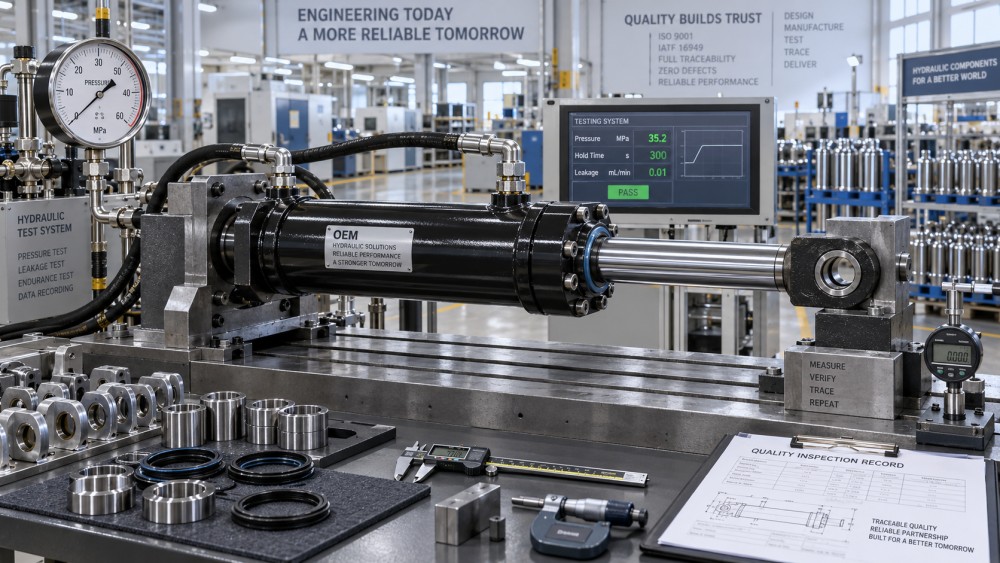
Look beyond “pressure tested” and examine the test process
Nearly every hydraulic actuator supplier will state that products are pressure tested. The meaningful question is how the test is performed, documented, and linked to the individual unit or production batch.
A useful supplier discussion should cover test pressure, hold time, leakage criteria, test medium cleanliness, functional cycling, cushioning checks, and whether both extension and retraction functions are verified. If the actuator includes valves, sensors, position feedback, or integrated manifolds, the scope should extend to those interfaces as well.
Pressure testing alone may not reveal every manufacturing weakness. Depending on the application, procurement teams may need to ask about rod straightness inspection, bore finish measurement, thread gauging, weld inspection, coating thickness checks, and final dimensional verification. The supplier’s answer should show a repeatable inspection plan, not a collection of isolated checks.
Questions worth putting into the supplier questionnaire
Assess manufacturing consistency, not only factory capacity
A factory tour can be useful, but the presence of machining centers, honing equipment, welding stations, or test benches does not automatically prove production consistency. Procurement teams should look for the connection between machinery, process control, and the actual actuator being sourced.
For example, a supplier may machine glands and pistons in-house but purchase cylinder tubes, chrome rods, seals, or weldments from outside sources. There is nothing inherently wrong with this model. What matters is whether incoming components are qualified, whether approved sources are controlled, and whether changes in sub-suppliers are communicated.
Review the supplier’s capability across the full production route: cutting, machining, honing, welding, surface treatment, cleaning, assembly, testing, painting, packaging, and dispatch. Where critical steps are outsourced—such as chrome plating, nitriding, or specialized coatings—ask how quality is verified. This is particularly important when actuators will operate in corrosive, abrasive, or high-cycle environments.
Production capacity also needs context. A hydraulic actuator supplier that can make large quantities of standard cylinders may still struggle with frequent configuration changes, low-volume variants, or tightly sequenced OEM releases. Discuss batch size, minimum order quantities, prototype support, ramp-up capacity, and the lead time for replacement parts. The best sourcing decision balances scale with responsiveness.
Confirm standards, documentation, and application-specific compliance
Standards should be treated as a starting point for alignment, not as a vague line on a quotation. The relevant requirements may involve dimensional interchangeability, pressure equipment rules, material declarations, coating performance, welding practices, environmental restrictions, or customer-specific quality systems.
Rather than asking only, “Are you certified?”, provide the supplier with the standards and documentation expected for the project. These may include ISO-based cylinder dimensional conventions, OEM drawing requirements, inspection and test plans, material certificates, declarations for restricted substances, or project documentation required by an EPC contractor or end user.
Then verify the supplier’s interpretation. Can it identify which standard applies to the actuator itself, which applies to supplied materials, and which is only a customer preference? This discussion often reveals whether the supplier has experience supporting formal OEM programs or is accustomed mainly to general replacement-market sales.
Documentation quality matters because it follows the actuator into receiving inspection, assembly, service, and warranty analysis. A complete document package is especially valuable when equipment is exported across regions or incorporated into infrastructure, water-control, energy, and heavy-equipment projects with multiple stakeholders.
Evaluate delivery reliability as an engineering issue
Late actuator deliveries can halt an OEM assembly line, but delivery risk is not only a planning problem. It may be caused by long-lead seals, inconsistent rod stock, outsourced coating delays, incomplete drawings, late customer approvals, or weak change control.
Ask the supplier to describe its lead-time assumptions. Which components drive the schedule? What happens when demand rises? Does it hold common materials or build only after order release? How does it manage urgent service orders? A transparent answer is more useful than an unrealistically short promise.
Packaging deserves attention as well. Rod surfaces, ports, threads, and sensor connections can be damaged in transit if protection is inadequate. Actuators should arrive capped against contamination, secured against movement, and labelled clearly enough for receiving teams to identify model, revision, and order status without opening every package.
Make commercial comparison reflect lifecycle cost
Unit price matters, particularly in competitive machinery markets. Still, an actuator that is marginally cheaper at purchase can become expensive if it causes assembly rework, higher inspection labor, inconsistent delivery, frequent warranty claims, or difficult spare-parts sourcing.
When comparing quotations, separate the base component price from the broader cost picture: tooling charges, engineering changes, testing documentation, packaging, freight terms, inventory commitments, warranty response, and replacement lead time. A low quote that excludes necessary testing or uses an unverified seal configuration is not truly comparable to a quote built around the complete OEM requirement.
It is also wise to evaluate the supplier’s communication habits before awarding volume business. Are technical questions answered directly? Are drawings marked up carefully? Are deviations stated in writing? Early interactions tend to predict how the relationship will function when a production issue requires fast, disciplined coordination.
A practical approval path before production release
For a new OEM project, supplier selection should not end with a purchase order. A staged approval path reduces the chance that assumptions reach mass production. Begin with a technical review of drawings and duty conditions, followed by a documented quotation that identifies exclusions and proposed deviations. Then move through prototype samples, dimensional inspection, pressure and functional testing, and fit checks on the actual equipment.
Where operating risk is substantial, consider pilot production or monitored field validation before a full release. The objective is not to create unnecessary bureaucracy. It is to identify issues—hose clearance, pin fit, cushion setting, corrosion exposure, mounting stress, or service accessibility—when they are still manageable.
The right hydraulic actuator supplier should welcome this process because it creates a more stable production relationship. Procurement teams gain confidence that the supplier understands the product beyond its catalog dimensions, while engineering teams gain a clearer route for changes, records, and future support.
Final purchasing perspective
A dependable actuator supply decision is built on evidence: application understanding, design review, controlled materials, repeatable testing, manufacturing discipline, usable documentation, and credible delivery planning. Price remains part of the decision, but it should sit within a broader evaluation of technical and operational risk.
For OEM buyers, the most valuable supplier is not necessarily the one that says yes to every request. It is the one that can explain how the actuator will be made, tested, identified, delivered, and supported throughout the life of the machine. That level of clarity is what turns a component purchase into a reliable supply partnership.
Related News
- Why Is Your Heavy-Duty Piston Pump Losing Pressure Under Load?Nov 09, 2026Fluid Power Control Strategist
- Cartridge Valves for Manifold Blocks: Avoiding Cavity Fit ProblemsNov 09, 2026Fluid Power Control Strategist
- Large-Diameter Forged Rings: How Seamless Rolling Affects Grain FlowNov 09, 2026Foundry Phase-Change Fellow
- Sealed Heavy-Duty Roller Bearings: Choosing Seals for Dust and WaterNov 09, 2026Tribology & Kinematics Expert
- Sprockets and Chain Drives: What Determines Replacement Cost?Nov 08, 2026CNC Kinematics Architect
- Monoblock Hydraulic Control Valves: Flow Rating and Spool SelectionNov 08, 2026Fluid Power Control Strategist