
What to Verify Before Choosing a Cylinder Seal Kit Manufacturer
A hydraulic cylinder may look straightforward until a seal failure stops a machine, contaminates a work area, or turns a planned maintenance job into an urgent repair. Procurement teams often receive a quotation that appears acceptable because the kit contains familiar items—rod seal, piston seal, wiper, O-rings, and backup rings. Yet a kit can be unusable if one groove dimension is wrong, the elastomer is unsuitable for the fluid, or the supplier cannot maintain the same material and profile from batch to batch.
Before choosing a cylinder seal kit manufacturer, verify five fundamentals first: the exact cylinder configuration, material compatibility with the operating environment, dimensional control, documented quality procedures, and the supplier’s ability to support repeat orders. Price should be compared only after those points are clear. A lower initial purchase price has little value when a seal kit causes premature leakage, scoring on a rod, repeated disassembly, or avoidable equipment downtime.
Start with the cylinder, not the supplier catalog
The most common purchasing mistake is selecting a kit from a nominal cylinder bore and rod size alone. Those figures are important, but they do not define every sealing component. Two cylinders with the same nominal dimensions may use different gland depths, piston widths, groove radii, seal cross-sections, retaining methods, or wear-ring arrangements.
Before requesting samples or quotations, assemble the technical information that actually identifies the sealing arrangement. A supplier should be able to review this information and point out missing dimensions rather than simply confirm that a catalog number “should fit.”
- Cylinder manufacturer, model, serial reference, and equipment application where available
- Bore diameter, rod diameter, stroke, and piston dimensions
- Gland and piston groove drawings, including widths, depths, chamfers, and radii
- Existing seal profiles or clear photographs with measured cross-sections
- Hydraulic fluid type, expected temperature range, system pressure, and pressure spikes
- Rod surface condition, plating type, surface finish requirement, and contamination exposure
- Whether the cylinder is single-acting, double-acting, telescopic, welded, tie-rod, or custom-built
This preparation matters most when replacing kits for older machinery. The original part number may no longer be readable, previous repairs may have changed components, and aftermarket cylinders can differ from the OEM configuration. In that situation, a manufacturer that asks for groove data and application conditions is generally making a more reliable technical assessment than one that selects a kit solely by machine model.
Match seal materials to fluid, temperature, and duty cycle
A seal kit is a material system, not simply a collection of rubber rings. The rod seal, piston seal, wiper, O-rings, energizers, guide rings, and backup rings may each require different compounds or polymers. Material selection must reflect the actual operating environment, especially where cylinders work outdoors, near heat sources, in high-cycle machinery, or with fluids other than standard mineral hydraulic oil.
Nitrile rubber is commonly used with mineral-oil hydraulic fluids and offers a practical balance for many industrial applications. However, it may not be suitable for every temperature range or chemical exposure. Fluoroelastomer can provide stronger resistance in certain high-temperature or chemical-contact conditions, while polyurethane is often selected where abrasion resistance and dynamic sealing performance are important. PTFE-based sealing elements can suit demanding pressure, speed, friction, or chemical requirements, but their design often depends on an energizer and precise groove geometry.
Ask the manufacturer to identify the material for each critical component, not merely describe the kit as “rubber” or “high quality.” A useful response specifies the seal profile, polymer family, hardness where relevant, and any special construction such as fabric reinforcement or PTFE lips. When material substitutions are proposed, the supplier should explain why the alternative fits the service condition and whether the installation dimensions remain unchanged.
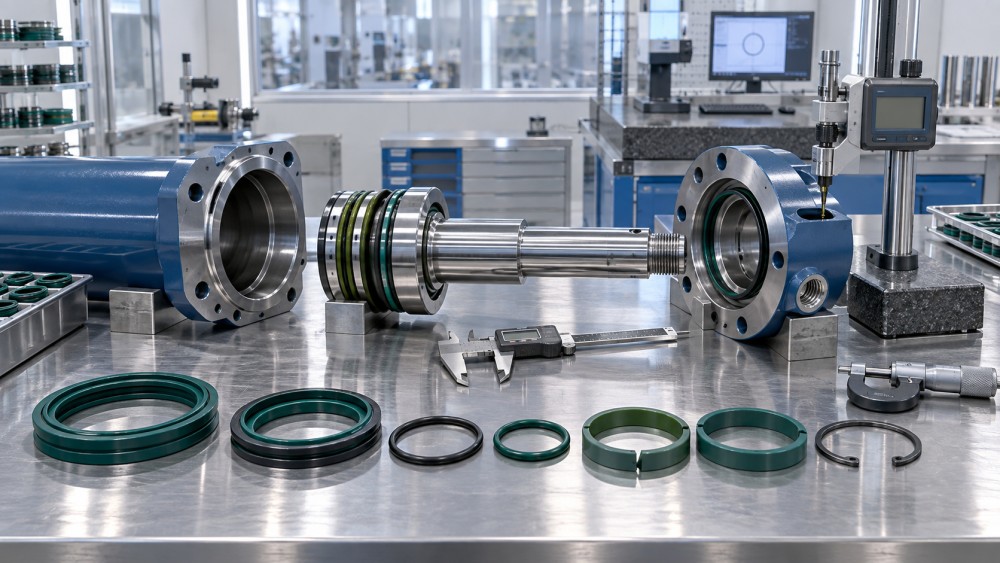
Fluid compatibility deserves particular attention when equipment uses biodegradable fluids, water-glycol fluids, fire-resistant fluids, synthetic esters, or lubricants with aggressive additive packages. A compound that performs adequately in one fluid may swell, harden, soften, crack, or lose extrusion resistance in another. Procurement should confirm the fluid by its actual specification whenever possible, rather than assume all hydraulic oils behave the same way.
Do not treat pressure rating as a single number
Suppliers may state that a seal is suitable for a certain pressure level, but the useful question is whether the full sealing arrangement can withstand the real pressure conditions inside the cylinder. Pressure spikes, side loading, temperature changes, extrusion gaps, and contaminated fluid can change how a seal performs. A piston seal operating in a stable factory press faces different conditions from a rod seal in mobile construction equipment exposed to shock loads, dust, vibration, and frequent extension cycles.
Discuss the operating pattern, not just maximum system pressure. A cylinder that moves slowly under constant load may need strong resistance to static leakage and compression set. A high-cycle actuator may require low friction, controlled breakaway force, and resistance to heat buildup. Long-stroke cylinders used outdoors often place greater demands on wipers, rod seals, and guide elements because dirt can be carried toward the gland over a larger travel distance.
Verify dimensional control beyond the finished kit label
A correctly labeled kit can still fail to fit if its actual dimensions vary beyond the tolerance required by the gland. This is especially relevant for molded elastomer seals, machined PTFE rings, split guide bands, and custom profiles. Small deviations can affect interference, compression, friction, and resistance to extrusion.
Request the manufacturer’s dimensional inspection approach. For standard catalog seals, this may include incoming material checks, mold control, sampling plans, visual inspection, and final packing verification. For custom kits, ask how the supplier approves drawings, controls revisions, measures critical dimensions, and prevents mixed components from entering the same package.
The discussion should distinguish between nominal size and functional fit. A rod seal may have a correct inside diameter but an unsuitable lip geometry for the rod finish. A piston seal may fit the groove but create excessive drag because its width or interference is wrong. Backup rings must match the related O-ring and groove; guide rings need the correct radial thickness to support the piston or rod without binding.
Where the application is critical, request pre-production samples and inspect them against the cylinder components before committing to volume. Installation trials should be controlled: inspect the grooves, remove burrs, verify lead-in chamfers, lubricate with a compatible medium, and use proper installation tools. A damaged seal installed during a rushed trial does not provide useful evidence about the manufacturer’s product quality.
Ask for traceability that helps when something changes
Traceability is not only for regulated or highly specialized equipment. It is a practical way to manage repeat purchasing and investigate failures. If a kit performs differently from the last delivery, the buyer should be able to identify the production batch, material compound, seal profile, and order reference without relying on memory or photographs.
At a minimum, verify how the supplier identifies packed kits and whether that identification connects to production records. For recurring orders, establish a controlled bill of materials listing every component in the kit, including material designation and quantity. This prevents a supplier from quietly replacing a wear ring, O-ring compound, or wiper profile because a familiar-looking alternative is available.
Relevant documentation may include material declarations, inspection records, dimensional reports for critical parts, and certificates requested by the purchase specification. The appropriate level depends on the application. A general maintenance kit may not need the same documentation as seals used in safety-sensitive equipment, but every buyer benefits from clear part identification and revision control.
Questions that reveal whether quality control is usable
- Can the manufacturer identify the compound and profile used in each component?
- Are material changes, mold changes, or profile substitutions communicated before shipment?
- How are mixed kits counted and verified before packaging?
- What happens when a dimension falls outside the agreed specification?
- Can the supplier provide retained samples or batch records for repeat programs?
- Are shelf-life and storage conditions controlled for elastomer parts?
A vague promise of “strict inspection” is less useful than a clear explanation of these controls. Procurement teams do not need every internal manufacturing detail, but they do need enough evidence to judge whether consistency is managed rather than assumed.
Evaluate the complete kit, including the parts that are easy to ignore
Some quotations look favorable because the visible seals are included while secondary components are omitted or changed. A proper cylinder rebuild may require more than one rod seal and piston seal. Depending on the design, the kit can include wipers, buffer seals, static O-rings, backup rings, guide rings, bearing strips, piston nuts or locking items, and gland-related seals.
Compare quotations against an agreed component list. Do not compare only the total number of pieces, because two kits with the same count can contain different profiles or material grades. Confirm whether guide rings are supplied as full rings, scarf-cut bands, or strips to be cut during assembly. Check whether backup rings are single or paired where the design requires anti-extrusion support. These details affect both fit and installation time.
Packaging also has operational value. Individual kit labeling reduces the chance that parts from several cylinders are mixed during maintenance. Clear internal separation can protect thin PTFE elements and prevent small O-rings from being lost. For distributors or repair workshops, confirm whether outer packaging supports part-number identification, lot tracking, and stock rotation.
Test the supplier’s responsiveness before relying on emergency delivery
Seal-kit purchasing often becomes urgent only after a cylinder is already leaking. That makes delivery performance important, but promises of fast shipment should be tested against the supplier’s planning discipline. Ask which components are stocked, which are molded or machined to order, and what information is required before production can begin. A supplier may hold standard O-rings but need additional time for a custom energized PTFE seal or a nonstandard polyurethane wiper.
For planned maintenance programs, separate parts into three groups: routine stock items, application-specific repeat items, and rare custom components. This makes it easier to define sensible inventory levels and avoids holding excessive stock of compounds with limited storage life. It also gives the manufacturer a clearer forecast for materials, molds, and production slots.
Technical communication is part of supply reliability. When drawings are incomplete or a requested profile appears unsuitable, the manufacturer should identify the issue early. A supplier that immediately agrees with every request may be convenient during quotation, but it offers little protection when the information provided is inaccurate.
Compare total procurement cost rather than unit price alone
The cost of a seal kit includes more than the quoted unit price. Consider inspection time, sample approval, installation labor, machine downtime, shipping reliability, minimum order quantities, rejected-part handling, and the risk of ordering the wrong configuration. A low-priced kit may create higher total cost if it requires repeated verification, arrives without traceability, or has inconsistent component materials across orders.
For a first order, it is reasonable to use a staged approach: verify drawings and service conditions, obtain samples or a small trial quantity, inspect the kit contents, complete a controlled installation, and then approve the exact bill of materials for repeat purchases. This process is particularly valuable for custom cylinders, imported equipment with uncertain part references, and applications where access to the cylinder is difficult.
Once the kit is approved, retain the confirmed drawing, sample reference, installation notes, and supplier documentation with the purchasing record. That small amount of control makes future sourcing faster and reduces the risk that an urgent replacement order is based on an incomplete description rather than the sealing arrangement that has already been proven to fit.
Related News
- Why Is Your Heavy-Duty Piston Pump Losing Pressure Under Load?Nov 09, 2026Fluid Power Control Strategist
- Cartridge Valves for Manifold Blocks: Avoiding Cavity Fit ProblemsNov 09, 2026Fluid Power Control Strategist
- Large-Diameter Forged Rings: How Seamless Rolling Affects Grain FlowNov 09, 2026Foundry Phase-Change Fellow
- Sealed Heavy-Duty Roller Bearings: Choosing Seals for Dust and WaterNov 09, 2026Tribology & Kinematics Expert
- Sprockets and Chain Drives: What Determines Replacement Cost?Nov 08, 2026CNC Kinematics Architect
- Monoblock Hydraulic Control Valves: Flow Rating and Spool SelectionNov 08, 2026Fluid Power Control Strategist