
What to Check Before Selecting a Flow Control Valve Supplier for OEM Systems
A flow control valve supplier should be evaluated as part of the OEM system, not as a source of interchangeable catalog parts. A valve that appears equivalent on nominal flow, port size, and unit price can still create unstable actuator speed, excessive heat, pressure loss, leakage, assembly delays, or field-service problems.
For procurement teams, the practical question is not simply, “Which supplier offers the lowest valve price?” It is, “Which supplier can deliver a valve that performs consistently in our circuit, fits our production process, and remains supportable through the product lifecycle?” The answer depends on technical fit, manufacturing control, documentation, commercial discipline, and the supplier’s ability to respond when requirements change.
Start With the Actual Control Requirement
“Flow control valve” covers several different functions. A simple fixed restrictor, a needle valve, a pressure-compensated flow regulator, a throttle check valve, and an electronically controlled proportional valve may all be described using similar language, but they do not solve the same problem.
Before requesting quotations, define what the valve must control and what variation the OEM system can tolerate. In a hydraulic cylinder circuit, the objective may be stable extension speed under changing load. In a pneumatic handling machine, the concern may be repeatable motion without abrupt starts or end-of-stroke impact. In a lubrication, cooling, or industrial fluid loop, the priority may be maintaining a set flow while keeping pressure loss within the system’s available margin.
A useful request package should state the fluid or gas, normal and maximum operating pressure, required flow range, temperature range, port and mounting interface, desired adjustment method, and duty cycle. It should also identify whether reverse flow is required and whether the valve must compensate for pressure changes. Without this information, suppliers often quote a standard product that fits the connection but not the operating behavior.
Procurement should involve the OEM engineering team early. Buying from a partial description creates a misleading price comparison: one supplier may quote a basic manually adjusted valve, while another includes pressure compensation, a check function, or a higher-grade seal system. The lower quotation is then not a lower-cost equivalent; it is a different product.
Check Flow and Pressure Ratings in Context
Catalog ratings are starting points, not proof of suitability. A valve’s stated flow capacity may be based on a particular fluid viscosity, pressure differential, orientation, or test condition. In an OEM machine, changes in oil temperature, contamination level, supply pressure, downstream load, and pipe layout can change the result.
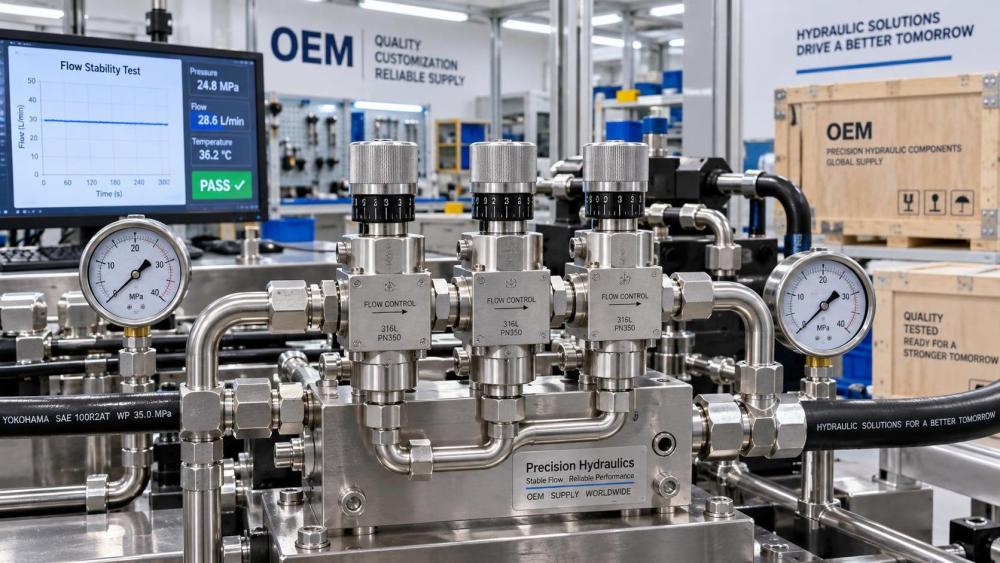
Ask the supplier how the valve behaves across the operating range rather than at one nominal point. For adjustable valves, request the usable adjustment range and the expected sensitivity of adjustment. A valve that makes the system difficult to tune on the production line can increase assembly time and lead to inconsistent machine settings.
Pressure drop deserves equal attention. Restricting flow inherently consumes pressure. If the selected valve creates more pressure loss than expected, a pump may need to work harder, a cylinder may slow under load, or a downstream function may lose available pressure. A larger valve is not automatically better, either. Oversizing can make fine adjustment difficult and may increase both purchase cost and packaging requirements.
For systems that experience sharply changing loads, pressure-compensated designs may justify a higher initial price because they reduce performance variation. For stable, non-critical circuits, a simpler valve may be the better commercial choice. The decision should follow the system requirement, not the assumed sophistication of the component.
Material, Seals, and Fluid Compatibility Are Cost Controls
Valve compatibility is frequently reduced to body material, yet the internal sealing system is often the more immediate source of trouble. Hydraulic oils, water-based fluids, compressed air, lubricants, fuel-related fluids, aggressive cleaning media, and outdoor environments place different demands on seals, coatings, springs, and internal moving parts.
A supplier should be able to identify the body material, key internal materials, seal type, and any coating or surface treatment relevant to corrosion and wear. This is especially important when the OEM machine is sold into regions with different climates, when equipment remains outdoors, or when the end user may substitute fluids during maintenance.
Do not specify a premium corrosion-resistant material by default if the environment does not require it. That can raise cost without improving service life. On the other hand, saving a small amount by accepting an unsuitable seal or coating can lead to leaks, sticking adjustments, or early replacement. The right commercial decision is based on the expected exposure, fluid chemistry, temperature, and service interval.
Evaluate Manufacturing Consistency, Not Just the Sample
A sample can prove that a supplier knows how to make a valve. It does not show whether the supplier can hold the same performance across repeated production batches. For an OEM, variation in internal clearances, spring force, machining quality, surface finish, or assembly torque can appear later as uneven cylinder speed, different pressure loss, or adjustment settings that no longer correspond from one machine to the next.
This risk is higher when the valve is part of a compact hydraulic manifold, a safety-sensitive sequence, or a machine function that must be calibrated during final assembly. It also matters when a valve body is machined from a casting or forging, because material quality and machining control both influence the finished part.
Ask how critical dimensions and functional characteristics are controlled during production. A capable supplier should be able to discuss incoming material control, machining or purchased-component traceability, assembly procedures, final inspection, and management of design changes. The exact records needed will depend on the component’s importance, but the supplier should not treat documentation as an afterthought.
Documentation should match the risk of the valve
Not every commodity valve needs the same evidence package. A basic pneumatic speed controller used in a non-critical fixture may only require clear part identification and routine inspection records. A hydraulic flow regulator integrated into heavy machinery, industrial presses, water-control equipment, or automated production systems may require stronger material, test, and batch documentation.
Set these expectations before supplier approval. Retrospectively requesting detailed records after a quality issue usually exposes whether the supplier had a controlled process in place.
Ask What Is Tested Before Shipment
Testing capability separates a supplier that merely distributes valves from one that can support OEM quality requirements. The appropriate test depends on the valve type, but procurement should understand whether the supplier performs pressure testing, leak checks, functional flow checks, adjustment verification, or other relevant inspections before release.
The objective is not to demand every possible test for every part number. Excessive inspection can add cost and lead time without addressing the actual risk. The objective is to identify the failure modes that would be expensive once the valve enters production or reaches the field.
For example, if internal leakage would cause actuator drift, a functional leakage check matters more than cosmetic inspection. If the valve setting directly affects cycle time, confirm how the setting is measured and whether it can shift during transport or installation. If an installation uses threaded connections, clarify thread form, sealing method, torque expectations, and protective packaging. Interface errors can stop an assembly line even when the valve itself is functional.
Compare the Total Cost of the Supplier Relationship
Unit price is visible, but several costs are hidden until after the purchase order is issued. These include engineering time spent correcting specifications, incoming inspection burden, rejected parts, line stoppages, expedited freight, minimum-order constraints, spare-parts complexity, and field claims. A higher-priced valve may be less expensive over time when it arrives consistently, reduces troubleshooting, and can be replaced without redesign.
Build a comparison that separates commercial terms from technical confidence. Lead time should include the supplier’s response to forecast changes, not only the quoted manufacturing period. Review minimum order quantities against your service-parts needs. A supplier that only supports large batches may be acceptable for serial production but unsuitable for low-volume replacement demand.
Also check the stability of the part number and configuration. If the supplier frequently changes an internal component, seal, or external adjustment design without formal notice, the OEM may face unexpected validation work. Change notification, revision control, and agreed approval steps are practical protections against this risk.
Delivery Reliability Includes Packaging and Traceability
Valves are vulnerable to contamination, damaged threads, lost adjustment caps, and mixed configurations. Packaging should protect ports and sensitive surfaces while allowing receiving teams to identify the part, revision, quantity, and relevant batch information quickly. This matters particularly for hydraulic equipment, where contamination introduced before installation can affect the whole circuit.
A flow control valve supplier should also be able to support a realistic logistics model. Some OEMs need scheduled releases for stable production. Others require shorter replenishment cycles because machine configurations change frequently. There is no universal best arrangement, but the supplier’s planning method must match the demand pattern.
For global sourcing, technical communication is part of delivery performance. Ambiguous terminology around ports, threads, flow direction, or test methods can result in the wrong valve arriving on time. Drawings, controlled datasheets, photographs of the connection interface where useful, and clear approval records reduce this exposure.
Do Not Treat Technical Support as a Post-Purchase Extra
Support matters most when the valve is difficult to select, when the system is being redesigned, or when field performance differs from bench expectations. The supplier does not need to redesign the entire hydraulic or pneumatic circuit, but it should be able to answer focused questions about valve behavior, installation direction, adjustment, fluid compatibility, and available configuration options.
Assess responsiveness before production release. Send a technically specific question during the quotation stage and evaluate the answer. A supplier that only returns a catalog page may be adequate for a fully standardized item. It is a weaker choice for a controlled OEM application that requires configuration confirmation, sample validation, or future engineering changes.
Resources such as the Global Industrial Machining & Piping Equipment Network (IMPE) can help procurement and engineering teams organize these comparisons across hydraulic, pneumatic, piping, machining, and industrial component categories. The most useful supplier review combines that structured product knowledge with the OEM’s own drawings, operating conditions, validation process, and service requirements.
A Practical Approval Sequence
- Define the valve function, medium, operating range, interfaces, and failure consequences with engineering.
- Issue the same complete specification package to each candidate supplier.
- Compare quoted valves for functional equivalence before comparing price.
- Review materials, seals, manufacturing controls, testing, and documentation against the application risk.
- Validate samples in the actual circuit where flow stability, pressure drop, installation fit, and adjustment behavior can be observed.
- Agree on revision control, quality records, packaging, lead-time expectations, and service-part support before serial release.
The strongest supplier choice is usually the one that makes the technical and commercial conditions clear early. That clarity prevents the common procurement error of accepting a low quotation for a valve that later requires more engineering effort, more inspection, or a costly system change. For OEM systems, a well-qualified valve source protects production stability as much as it protects component cost.
Related News
- How to Assess a Rigid Coupling Supplier for Bore Accuracy and Traceable QualityOct 08, 2026Tribology & Kinematics Expert
- Titanium Alloys Compared: Balancing Strength, Corrosion Resistance, and MachinabilityOct 08, 2026CNC Kinematics Architect
- Where Ductile Iron Dismantling Joints Reduce Alignment Risk in Water PipelinesOct 08, 2026Pipeline Metallurgy Scientist
- Selecting a Precision Bearing Sleeve: Fits, Runout, and Material ChoicesOct 08, 2026Tribology & Kinematics Expert
- Face Milling Cutters: How Insert Geometry Affects Finish on Steel and AluminumOct 08, 2026CNC Kinematics Architect
- Single-Acting Cylinders for Clamping: Stroke, Force, and Return Spring ConsiderationsOct 07, 2026Fluid Power Control Strategist