
What to Check Before Choosing a Directional Control Valve Manufacturer
Choosing a directional control valve manufacturer is not mainly about finding the lowest quoted unit price. For technical evaluators, the real question is whether the supplier can deliver consistent spool movement, reliable sealing, contamination tolerance, and stable valve performance under actual operating pressure, flow, duty cycle, and maintenance conditions.
That means the core search intent behind “directional control valve manufacturer” is supplier evaluation. Readers are usually trying to build a practical checklist: how to compare manufacturers, what technical evidence to request, which risks are easy to miss, and how to confirm that a valve source is suitable for long-term hydraulic or pneumatic system use.
Technical evaluators care most about issues that can affect field reliability. These include manufacturing precision, material quality, seal compatibility, leakage control, pressure rating accuracy, contamination sensitivity, testing methods, documentation, and the manufacturer’s experience with comparable applications. They also want to know whether the supplier can support troubleshooting, replacement consistency, and future production stability.
The most useful article, therefore, is one that helps readers judge manufacturers with clear technical criteria. It should focus on machining quality, testing capability, standards compliance, application engineering support, and supply consistency, while avoiding generic statements about “high quality” or “excellent service” that do not help procurement or engineering decisions.
What Matters Most Before You Compare Any Directional Control Valve Manufacturer
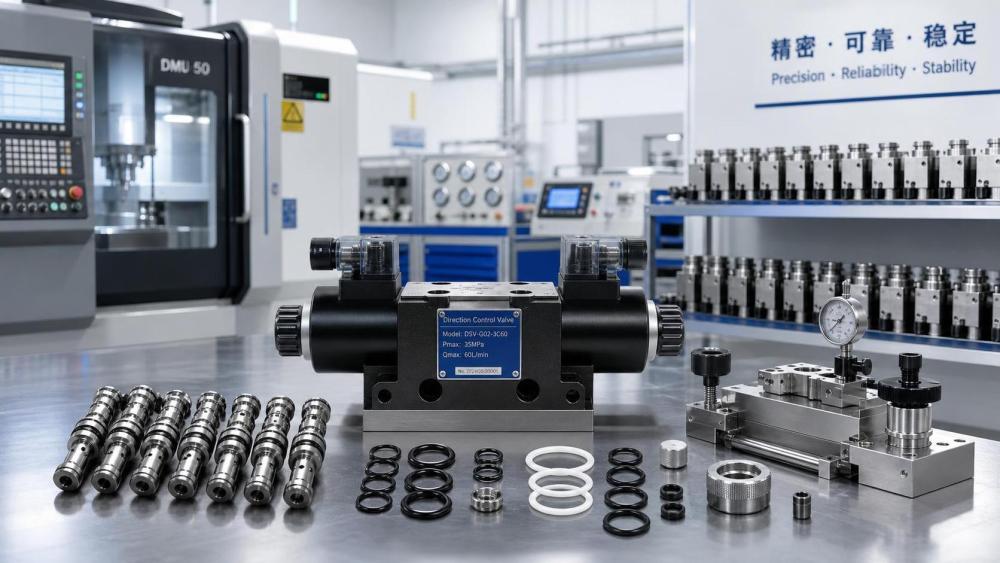
Before reviewing quotations, technical evaluators should first define the valve’s actual operating context. A directional control valve that performs well in a clean factory pneumatic line may fail quickly in a mobile hydraulic circuit exposed to pressure spikes, vibration, oil contamination, and temperature variation.
This is why the first check is not brand visibility, product range, or even catalog appearance. It is the manufacturer’s ability to match valve design, machining accuracy, internal clearances, sealing materials, and actuation method to the real service conditions of the application.
In practice, the best directional control valve manufacturer is usually the one that can explain why a certain valve structure fits your circuit, not merely the one that offers the widest model list. Technical clarity during evaluation often predicts product consistency after purchase.
Check Whether the Manufacturer Understands Your Application Conditions
A serious manufacturer should ask detailed questions before recommending a valve. At minimum, they should review fluid type, operating pressure, peak pressure, flow rate, switching frequency, temperature range, mounting standard, and contamination level.
For hydraulic systems, they should also understand viscosity range, filtration level, shock loading, and whether the machine operates continuously or intermittently. For pneumatic systems, they should consider air quality, lubrication condition, response requirements, and ambient moisture exposure.
If a supplier immediately recommends a model without clarifying these factors, that is a warning sign. Directional valves are highly application-dependent, and poor selection can lead to slow response, internal leakage, overheating, seal wear, or unstable actuator behavior.
Application knowledge also matters when evaluating special conditions. Construction machinery, mining equipment, agricultural machinery, marine systems, and industrial presses each create different demands on pressure stability, contamination resistance, corrosion protection, and maintenance access.
Review Machining Accuracy and Internal Component Quality
Directional control valves rely heavily on internal dimensional precision. Spool-to-bore fit, surface finish, concentricity, and port geometry all influence switching accuracy, leakage behavior, pressure loss, and repeatability over the valve’s operating life.
For this reason, technical evaluators should ask how the manufacturer machines valve bodies, spools, sleeves, and sealing surfaces. A supplier with strong CNC capability, controlled finishing processes, and stable inspection methods is more likely to deliver repeatable valve performance.
It is also important to understand whether the manufacturer controls critical tolerances in-house or outsources key machining operations. Outsourcing is not automatically a problem, but the supplier should be able to explain how dimensional consistency is verified across every batch.
Surface quality deserves special attention. Poorly finished bores or spools can increase friction, accelerate wear, and affect response time. In hydraulic applications, even small internal deviations can change leakage characteristics and reduce control accuracy under load.
Verify Material Selection and Heat Treatment Control
Valve performance depends not only on design but also on material behavior. The manufacturer should specify body material, spool material, seal material, spring material, and any surface treatment used to improve wear resistance, corrosion resistance, or fatigue life.
Technical evaluators should check whether these materials fit the actual service medium and environment. For example, a valve used in high-temperature hydraulic service may need different seal compounds than one installed in standard industrial equipment with moderate duty cycles.
Spool hardness and body wear resistance are especially important where switching frequency is high. Improper heat treatment can reduce dimensional stability, shorten service life, and increase the risk of sticking or uneven internal wear during long-term operation.
Traceability matters here as well. A capable directional control valve manufacturer should be able to provide material certificates, heat treatment records where relevant, and a clear explanation of how material substitutions are controlled between production lots.
Look Closely at Sealing Design and Leakage Control
One of the fastest ways to judge valve quality is to evaluate how the manufacturer addresses leakage. Directional valves must control both internal leakage and external leakage, and the acceptable threshold depends on system function, safety expectations, and circuit sensitivity.
Technical teams should ask what leakage classes or internal leakage limits apply to the valve type being quoted. They should also request test conditions, because leakage values mean little unless pressure, temperature, fluid type, and measurement methods are defined.
Seal compatibility is another critical issue. The manufacturer should confirm elastomer selection for mineral oil, water glycol fluids, synthetic fluids, compressed air, or other media. A low-cost seal compound may reduce price while increasing swelling, hardening, or premature failure risk.
When evaluating spool valves, it is also worth asking how the manufacturer balances response speed with leakage control. Extremely tight fits may reduce leakage but increase sensitivity to contamination, while looser clearances may sacrifice accuracy for durability.
Ask for Testing Standards, Not Just General Quality Claims
Many suppliers describe their valves as fully tested, but technical evaluators should go further and ask what that actually means. A useful evaluation requires clarity on pressure testing, leakage testing, functional switching tests, endurance testing, and contamination-related validation.
A reliable manufacturer should be able to explain its test procedures, acceptance criteria, and sampling logic. Ideally, they should also clarify whether every valve is function tested or whether testing is performed only by batch for selected performance characteristics.
Where applicable, ask about relevant standards or internal specifications used for valve verification. Even when a buyer does not require a specific international standard, disciplined test documentation often indicates better process maturity and lower field failure risk.
For demanding applications, endurance testing is particularly valuable. A manufacturer that has cycle-life data, pressure impulse data, or application-specific validation results offers stronger evidence than one that only provides a static pressure rating in the catalog.
Evaluate Contamination Tolerance and Maintenance Practicality
In real industrial systems, contamination is not a theoretical issue. It is one of the main reasons directional valves stick, leak, or respond inconsistently. Technical evaluators should therefore examine how sensitive the valve design is to particles and fluid cleanliness variation.
The manufacturer should be able to recommend filtration levels and explain how spool clearances, surface treatment, and seal design affect contamination resistance. This is especially important in mobile hydraulics, retrofit systems, and field-maintained equipment.
Maintenance practicality also matters. Ask whether seal kits, coils, solenoids, springs, or subcomponents are available as spare parts. A valve may look acceptable during procurement but become costly if replacement parts are unavailable or inconsistent across later batches.
It is also worth checking whether the valve can be serviced easily in the field or whether replacement is the only realistic maintenance path. The answer affects lifecycle cost, downtime planning, and distributor support requirements.
Confirm Documentation, Traceability, and Configuration Control
Technical evaluation should include document quality, not just hardware quality. A capable manufacturer should provide clear drawings, port specifications, mounting details, pressure-flow data, seal material information, and installation guidance that match the actual delivered product.
Configuration control becomes critical when valves are used in OEM production or repeat infrastructure projects. If model coding is unclear or options are poorly controlled, two valves with similar part numbers may behave differently in service, creating commissioning and maintenance problems.
Traceability supports both quality assurance and root-cause analysis. Buyers should ask whether the manufacturer can trace production batch, material source, test records, and major process history when a performance issue appears after installation.
This capability is especially important for companies supplying equipment into regulated, export, municipal, or large project environments, where technical files and after-sales investigations often require more than a simple invoice and product label.
Assess Production Capacity and Supply Stability
Even a technically sound valve design becomes a risk if the manufacturer cannot maintain stable production. Technical evaluators should therefore review capacity, lead time discipline, component sourcing, and the manufacturer’s ability to keep dimensions and performance consistent across repeat orders.
This is particularly important for OEMs and project buyers who need validated samples to match future serial production. A common failure in supplier selection is approving an excellent initial sample from a manufacturer that lacks mature process control during scale-up.
Ask whether critical parts such as coils, seals, cast bodies, machined spools, or springs are produced internally or sourced from approved partners. Then assess how incoming quality control and supplier qualification are managed for those outsourced elements.
Stable packaging and export handling should also be reviewed. In hydraulic and pneumatic components, damage, corrosion, or contamination introduced during storage and shipment can undermine an otherwise acceptable manufacturing process.
Measure Engineering Support After the Sale
Technical support should be part of manufacturer evaluation, especially when the valve will be integrated into new equipment, replaced in an existing circuit, or adapted for regional standards and operating conditions. Problems rarely end at the moment of shipment.
A useful manufacturer should be able to assist with installation questions, performance troubleshooting, coil specifications, wiring clarification, spare parts identification, and replacement recommendations when an original model is discontinued or upgraded.
This matters because many valve issues that appear to be product defects are actually caused by fluid contamination, incorrect mounting, mismatched voltage, unsuitable seals, or circuit design assumptions. Suppliers with real engineering support can help separate product problems from system problems.
For technical evaluators, responsive and competent communication is often a strong indicator of future cooperation quality. Slow, vague, or purely sales-driven responses during pre-purchase review usually become more problematic after delivery.
A Practical Checklist for Comparing Manufacturers
When narrowing supplier options, technical evaluators should compare manufacturers against a structured checklist rather than relying on catalog claims alone. This makes the review process more defensible for procurement, engineering, and project stakeholders.
At minimum, check these points: application understanding, valve design fit, machining precision, material traceability, heat treatment control, seal compatibility, leakage performance, test documentation, contamination tolerance, spare parts availability, production consistency, and technical support response.
It is also useful to request sample reports, dimensional inspection records, pressure or leakage test evidence, and references from similar industries. Comparable application history is often one of the strongest predictors of whether a supplier can support your project well.
In many cases, the best directional control valve manufacturer is not the one with the broadest marketing message. It is the one that can prove process discipline, explain technical choices clearly, and deliver stable valve behavior over time.
Conclusion
Before choosing a directional control valve manufacturer, technical evaluators should focus on performance evidence rather than general reputation alone. The key decision factors are application fit, machining quality, material and seal control, leakage management, test rigor, contamination resistance, documentation, and supply stability.
A valve is a control component, but the manufacturer behind it is a process risk decision. If the supplier can support technical review with clear data, disciplined production, and realistic engineering communication, the chances of reliable system performance improve significantly.
For industrial buyers, OEM engineers, and project teams, that is the real purpose of supplier evaluation: reducing hidden failure risk before the valve enters the machine, pipeline system, or fluid power assembly where replacement becomes far more expensive than careful selection.
Related News
- Using Industrial Air Blow Guns to Clear Chips Without Spreading DebrisOct 15, 2026Fluid Power Control Strategist
- Ductile Iron Pipe Valves: Which AWWA Standards Apply to Water Main Projects?Oct 15, 2026Dr. Elias Vance
- Why Vacuum Suction Cups Lose Grip on MDF in Woodworking MachinesOct 15, 2026CNC Kinematics Architect
- Choosing a Variable Displacement Piston Pump Manufacturer: What to VerifyOct 15, 2026Fluid Power Control Strategist
- Parallel vs. Angular Pneumatic Grippers for Confined Assembly StationsOct 15, 2026Fluid Power Control Strategist
- Die Castings vs. Investment Castings: Which Costs Less at Your Production Volume?Oct 14, 2026Foundry Phase-Change Fellow