
Selecting Pneumatic Actuator Valves for Hygienic Food Processing Lines
Choosing pneumatic actuator valves for a hygienic food line is a process-design decision before it is a component purchase. A valve can meet the required line size, pressure class, and air-supply specification yet still create avoidable cleaning problems, product loss, control instability, or maintenance exposure. For project leaders, the practical question is whether the selected valve-and-actuator assembly can reliably isolate, divert, regulate, or protect the process without introducing hard-to-clean areas or compromising the line's cleaning regime.
For most sanitary applications, the best selection starts with the product path and the cleaning path together. The valve must suit the fluid being handled, but it must also tolerate repeated clean-in-place cycles, chemical exposure, temperature changes, and the operating sequence imposed by the automation system. Pneumatic actuation is often well suited to these duties because it provides rapid motion, repeatable cycling, and a straightforward fail-safe response. Those benefits only hold when the valve body, seals, actuator, position feedback, and air-quality arrangement are specified as one system.
Begin with the process duty, not the valve catalog
“Food processing” covers very different valve duties. A dairy transfer line, a viscous sauce filling system, a beverage blending skid, and a dry-food pneumatic conveying installation may all use pneumatically actuated valves, but their operating constraints are not interchangeable. The first specification review should define what the valve must do at each point in the line: shut off flow, divert product, control flow, maintain pressure, prevent backflow, isolate a cleaning circuit, or protect an upstream process from downstream conditions.
For on-off duties in liquid food lines, sanitary butterfly valves are common where full-bore flow, compact installation, and frequent cycling are needed. Single-seat or double-seat valves may be more appropriate where leakage control, seat lifting, or separation between incompatible fluids is important. Mixproof designs can be justified at crossings between product and cleaning media, particularly where an unintended interface could contaminate product or create unnecessary product loss. Diaphragm valves are often considered where product purity and drainability outweigh the need for unrestricted flow. A control valve should be selected from its required flow behavior and pressure-drop range, not simply converted from an isolation-valve size.
Project teams should map each valve location against several operating states: production, startup, product recovery, flushing, CIP, sterilization where applicable, shutdown, and maintenance. Many poor selections perform acceptably during normal production but reveal their limitations during transitions. A valve that traps product after a batch, cannot be fully cleaned in its installed orientation, or closes too abruptly during a pump stop can become a recurring operational issue.
- What media will contact the wetted surfaces, including product, rinse water, cleaning chemicals, and any recovery fluid?
- What are the temperature and pressure limits during both production and cleaning cycles?
- Does the valve need to modulate, or only provide fully open and fully closed positions?
- What is the consequence of seat leakage: quality loss, cleaning-media carryover, process upset, or a contained maintenance issue?
- Can the valve drain in its installed position, and can the surrounding pipework drain with it?
- How often will it cycle, and what is the required response when air, power, or control signal is lost?
Hygienic design has to include the installed assembly
A polished stainless-steel valve body alone does not establish hygienic performance. Cleanability depends on the complete wetted geometry: body cavities, seat areas, stems, clamps, connections, dead legs in nearby piping, drain orientation, and the way cleaning solution moves through the assembly. A nominally sanitary valve can still be difficult to clean if it is installed with an unsuitable branch arrangement or if the actuator configuration prevents the intended drain position.
For liquid and semi-liquid products, smooth internal surfaces and controlled surface finish matter because deposits tend to accumulate where flow slows, changes direction sharply, or encounters crevices. Product viscosity, particulate content, fat or protein behavior, sugar concentration, and cleaning chemistry all influence how severe that risk becomes. A valve intended for clear beverage service may not be an appropriate choice for a sticky confectionery ingredient or a particulate sauce, even when the nominal size is the same.
Valve connections deserve the same attention as the valve body. Hygienic clamp, welded, and other sanitary connection arrangements need to match the plant's pipe standard, maintenance approach, and disassembly requirements. A connection selected only for convenience can complicate inspection, create alignment stress, or introduce nonstandard spare-part requirements. For a new line, standardizing a limited set of valve body sizes, connection types, seal materials, and actuator interfaces can reduce commissioning complexity and later maintenance inventory.
Seal selection is often the point where a technically attractive valve becomes unsuitable for the actual line. Elastomers must be compatible with the product, cleaning chemicals, temperature range, and repeated mechanical movement. They also need to retain sealing performance through the planned maintenance interval. A seal material that performs well in a mild water-based application may age differently when exposed to hot alkaline cleaning, acidic rinses, oils, flavor compounds, or prolonged steam service. Engineers should request the applicable material declarations and define which seal sets are interchangeable across the project before approving a standard.
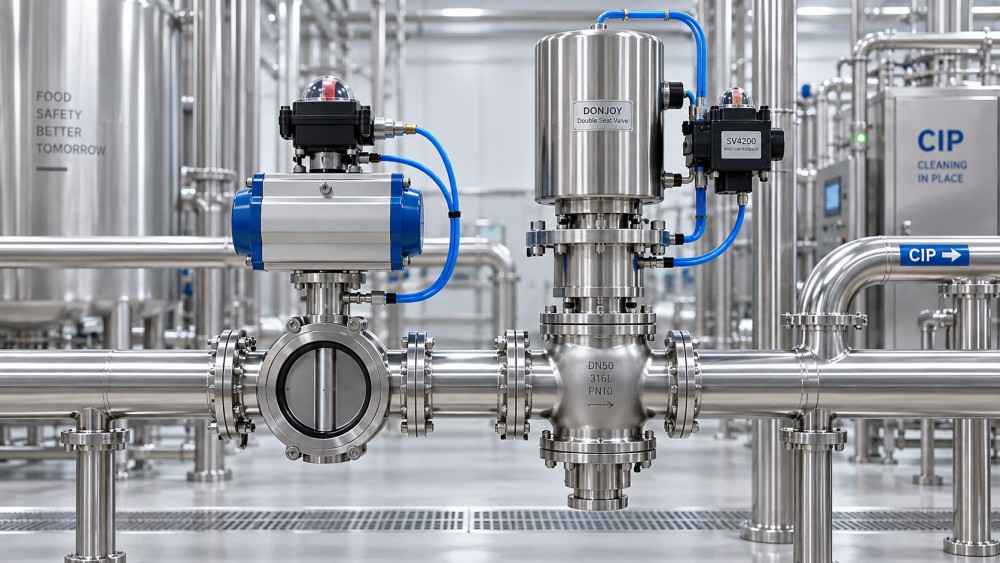
Actuator selection should follow failure mode and control philosophy
Pneumatic actuator valves for food processing are often specified by valve diameter and actuator type, then supplemented with a solenoid valve. That sequence can overlook the most important design question: what position should the process take when the actuator loses air or the control system loses power?
A spring-return actuator can move the valve to a defined position upon air loss, while a double-acting actuator generally remains dependent on the available air and control arrangement to move in either direction. Neither approach is universally better. The correct choice depends on process hazard, product protection, pump protection, cleaning sequence, and the impact of an unexpected stop. A valve that should fail closed in one product-transfer duty may need to fail open in a utility or pressure-relief-related arrangement. For certain automated manifolds, the required safe state can only be determined after reviewing the sequence for all connected valves rather than one valve in isolation.
Actuator sizing also requires more than checking nominal supply pressure. The available force must overcome the differential pressure across the valve, friction at seals and bearings, spring force where used, and any additional resistance created by process deposits or repeated thermal cycling. Undersized actuators may show up as intermittent closing faults, slow response, or inconsistent seat loading. Oversizing can produce unnecessarily aggressive motion, shock loading, and increased wear. Where closing speed affects water hammer, product surge, or pump operation, a controlled-speed arrangement may be necessary.
Position indication is another area where the minimum specification can become costly later. Basic open/closed feedback may be adequate for a manually supervised batch operation. High-cycle automated systems typically benefit from reliable feedback units that provide clear valve status to the PLC and support diagnostics during commissioning. The feedback device, solenoid, cable connection, enclosure rating, and washdown exposure should be reviewed together. A hygienic valve line can lose availability because a poorly protected external control component fails under repeated washdown, even while the valve body itself remains serviceable.
Compressed air quality is part of food-contact risk control
Because compressed air powers the actuator rather than normally contacting the product, it is sometimes treated as a minor utility detail. That is too narrow for a hygienic line. Air leaks, moisture, oil carryover, particles, and poorly maintained air-preparation equipment can reduce actuator reliability and may create contamination concerns where exhaust air or a damaged actuator interface is close to the process zone.
The air system should provide clean, dry air at stable pressure to the valve island or local actuator network. Its filtration and maintenance plan should be compatible with the food facility's internal quality requirements. Teams should also consider the routing of exhaust air. In washdown areas, exposed pneumatic components and vent points need to be located and protected so that cleaning water, debris, or process splash does not compromise their operation.
Air consumption is a project-level consideration when a line contains many high-cycle valves. Large actuator volumes, long tubing runs, pressure losses, and simultaneous switching can cause response delays if the distribution network is undersized. The issue is often most visible during CIP sequences, when many valves may move in coordinated steps. Reviewing peak demand and control timing during design is less disruptive than correcting inconsistent motion after startup.
Do not separate cleanability from maintainability
A hygienic valve must be cleanable, but it must also be maintainable without turning routine service into an extended line stoppage. Project managers should examine how seals are changed, whether the actuator can be removed without disturbing adjacent pipework, what tools are required, and whether the valve can be reassembled with a repeatable seal condition. This matters especially on dense valve manifolds, filler skids, and utility panels where access is limited after installation.
Service intervals should be based on duty rather than calendar assumptions. High-cycle valves, abrasive or viscous products, elevated temperatures, and demanding chemical exposure can accelerate wear. The procurement package should identify recommended wear parts, acceptable replacement materials, lubrication requirements if any, and the information needed to verify correct reassembly. For critical process locations, a small number of strategically held complete valve assemblies may be more useful than an unstructured stock of individual parts.
Documentation also has direct operational value. Material certificates for wetted metallic components, elastomer traceability where required by the site's quality system, pressure-test information, actuator data, wiring diagrams, and spare-parts drawings allow engineering and quality teams to resolve issues without relying on assumptions. The aim is not to collect paperwork for its own sake. It is to preserve a clear record of what was installed, what may be replaced, and which changes require process review.
Use a line-level review before releasing the purchase order
The most reliable valve specification is usually developed in a cross-functional review involving process engineering, automation, maintenance, quality, and the project team. Each discipline sees a different failure mode. Process engineers focus on flow, pressure drop, and cleaning paths. Automation engineers need clear states, response times, and interfaces. Maintenance teams see access, spare parts, and wear patterns. Quality personnel focus on hygienic construction, material suitability, and the possibility of unintended product or CIP crossover.
Before final release, the project team should verify the valve schedule against P&IDs, cleaning sequences, line elevations, pipe specifications, instrument architecture, and utility conditions. It is useful to challenge apparently identical valves that serve different duties. Two valves may share a size and body style while requiring different fail positions, seal materials, feedback capability, or actuator speeds.
Procurement comparisons should therefore evaluate more than unit price. A lower-cost assembly can increase lifecycle cost when it requires nonstandard spares, has limited service access, lacks clear documentation, or cannot support the planned CIP regime. Conversely, a more complex valve design is only justified where its separation, cleaning, or leakage-control capability solves a defined process problem. Applying premium configurations everywhere can add cost and control complexity without improving the line.
For project leaders, the selection decision becomes clearer when every valve is tied to a documented process function, hygienic requirement, fail position, control requirement, and service approach. That discipline keeps pneumatic actuation from being treated as a generic accessory and turns it into what it should be on a food line: a controlled, cleanable, and maintainable part of the process boundary.
Related News
- Using Industrial Air Blow Guns to Clear Chips Without Spreading DebrisOct 15, 2026Fluid Power Control Strategist
- Ductile Iron Pipe Valves: Which AWWA Standards Apply to Water Main Projects?Oct 15, 2026Dr. Elias Vance
- Why Vacuum Suction Cups Lose Grip on MDF in Woodworking MachinesOct 15, 2026CNC Kinematics Architect
- Choosing a Variable Displacement Piston Pump Manufacturer: What to VerifyOct 15, 2026Fluid Power Control Strategist
- Parallel vs. Angular Pneumatic Grippers for Confined Assembly StationsOct 15, 2026Fluid Power Control Strategist
- Die Castings vs. Investment Castings: Which Costs Less at Your Production Volume?Oct 14, 2026Foundry Phase-Change Fellow