
Rodless Cylinder Price: What Drives Lifecycle Cost in High-Cycle Automation?
Rodless Cylinder Price: What Drives Lifecycle Cost in High-Cycle Automation?
A rodless cylinder quotation can look deceptively simple: bore size, stroke length, quantity, and unit price. In a high-cycle automated machine, however, the purchase price is often the least complicated part of the decision. The real question is whether the cylinder can run reliably through its expected duty cycle without creating maintenance work, positioning issues, unexpected air consumption, or production stoppages.
For procurement teams, comparing rodless cylinder price only by catalog specification is risky. Two units with the same nominal bore and stroke may differ substantially in carriage guidance, sealing design, cushioning, corrosion resistance, sensor options, mounting interfaces, and serviceability. Those differences may not matter on a low-frequency transfer mechanism. On a packaging line, automated assembly cell, pallet shuttle, or machine-tool loading system running repeated cycles every shift, they can determine whether the component remains a routine spare part or becomes a recurring uptime problem.
The practical buying target is not the lowest initial price. It is the lowest defensible lifecycle cost for the actual motion, load, environment, and maintenance capability of the plant.
Why Initial Price Rarely Tells the Whole Story
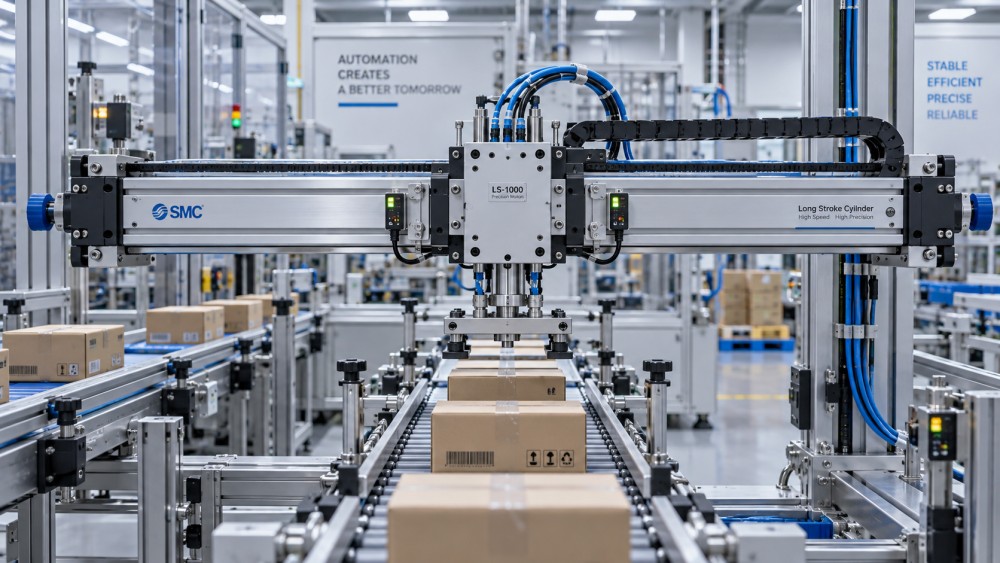
Rodless cylinders are selected when a long stroke is needed in a compact envelope. Unlike a conventional rod cylinder, the moving carriage travels along the cylinder body, avoiding the extra installation length created by an extended piston rod. This makes them common in material handling, pick-and-place equipment, printing and converting machinery, guarding systems, electronics assembly, and production lines where space is tight.
That compactness comes with engineering trade-offs. The carriage has to carry the external load while the internal piston is driven by compressed air. Depending on the design, force is transferred through a mechanical coupling or a magnetically coupled arrangement. The profile, guide system, sealing arrangement, and connection between piston and carriage all affect how the cylinder behaves under side load, acceleration, vibration, and long-term wear.
A low rodless cylinder price may reflect a basic actuator intended for light loads and controlled motion. That can be entirely appropriate for a simple sliding task. Problems begin when a basic model is used as both actuator and structural guide in an application with an offset load, fast reversing motion, or a cantilevered fixture. The cylinder may still move the load at commissioning, but premature guide wear, seal damage, or carriage looseness can surface later.
Procurement should therefore treat the quotation as the beginning of technical comparison, not the conclusion. Ask what is included in the price and what is assumed to be supplied elsewhere: external linear guides, shock absorbers, mounting brackets, sensors, air-preparation equipment, spare seal kits, and commissioning support can all change the real installed cost.
The Specification Details That Move the Price
Stroke length is an obvious cost driver. Longer bodies require more material, more careful extrusion or machining control, and more demanding handling during transport and installation. A long-stroke unit also has greater exposure to alignment errors. If the machine frame is not sufficiently straight or rigid, a cylinder selected only on stroke and bore may be forced to absorb distortion that should have been controlled by the structure.
Bore size affects available pneumatic force, but it should not be treated as a standalone performance number. Actual usable force depends on operating pressure, friction, speed requirements, cushioning, load orientation, and the margin needed to overcome breakaway conditions. Oversizing a bore can increase the purchase cost and air demand; undersizing it can produce sluggish motion, inconsistent end-of-stroke behavior, or sensitivity to ordinary pressure variation in the plant air network.
Guide configuration is frequently where quotations diverge. A basic carriage may suit a centered, light payload. A guided rodless cylinder generally costs more because it includes bearings, rails, rollers, or other load-supporting elements designed to manage moment loads. Yet an integrated guide may reduce the number of separate parts, simplify alignment, and eliminate the need to source an additional linear motion assembly. The right comparison is therefore not “guided versus unguided price,” but “integrated guided actuator versus complete actuator-plus-guide solution.”
Sealing is another area where cheap comparisons break down. In dusty production environments, welding areas, washdown zones, or installations exposed to oil mist, seal materials and protective bands deserve close attention. Pneumatic rodless cylinders often rely on a longitudinal sealing arrangement along the body. Contamination, poor lubrication conditions, damaged cover bands, and misalignment can affect this area more quickly than buyers expect. A seal design that is suitable for a clean assembly cell may not be the economical option for abrasive dust or frequent washdown.
High-Cycle Use Changes What “Economical” Means
High-cycle automation puts repeated stress on components that may appear lightly loaded in a static calculation. Every acceleration, deceleration, reversal, and end-of-stroke event contributes to wear. A carriage moving a modest mass at high speed can create substantial dynamic loading, particularly when the load center is offset from the guide plane.
The common procurement mistake is to compare only payload weight. Engineers should also review load moments in the relevant directions, travel speed, acceleration profile, orientation, cycle pattern, and the way the tooling attaches to the carriage. A vacuum gripper, cable carrier, sensor bracket, or fixture plate can change the center of gravity enough to make a seemingly acceptable actuator selection marginal.
Cushioning deserves the same attention. Internal pneumatic cushions are useful, but they are not a universal substitute for external shock absorbers or controlled deceleration. If the machine must stop sharply at the end of a long travel, the energy needs to be managed by a properly designed system. Repeated hard impacts can loosen mountings, damage carriage bearings, and make position repeatability less stable over time. The cheaper cylinder is rarely economical if it must absorb stopping energy it was not selected to handle.
This is also where valve selection becomes part of lifecycle cost. An actuator may be correctly sized, while the valve, tubing, fittings, and exhaust controls are too restrictive for the target cycle time. The resulting motion can be inconsistent or difficult to tune. Conversely, an oversized valve with poorly controlled exhaust may drive the carriage too aggressively. Cylinder procurement should not be separated completely from the pneumatic circuit that controls it.
A Practical Lifecycle Cost View
A useful internal comparison does not require invented precision. It requires the purchasing, maintenance, and engineering teams to identify which cost categories are genuinely exposed in the application.
Downtime is often the largest unknown because its cost varies by line and shift pattern. Procurement may not need to assign a universal monetary value to every minute of lost production. It is still useful to classify a cylinder as non-critical, production-critical, or safety- and schedule-critical. That classification should influence spare-part policy, supplier qualification, and the degree of design margin expected.
Air Quality Is Not a Side Issue
Compressed air is the working medium, but it is also a source of hidden variation. Water, particulate contamination, excessive oil, incompatible lubricants, and unstable pressure can shorten seal life or alter motion behavior. A cylinder supplier can specify air-quality expectations, yet the machine will experience the condition of the actual plant network.
Before accepting a low-cost option, check whether the line has adequate filtration, drainage, pressure regulation, and maintenance discipline. In some plants, the cylinder is blamed for issues that originate upstream in the air system. In others, a supplier’s recommendation for non-lubricated operation conflicts with a legacy lubricator arrangement. These details should be settled before purchase orders are released, not during troubleshooting after installation.
Temperature and ambient contamination also matter. A rodless actuator installed inside an enclosed, clean machine has a very different risk profile from one mounted near cutting fluid, foundry dust, outdoor moisture, or hot process equipment. Where environmental exposure is unusual, the buyer should request a written review of materials, protective options, and any limitations rather than assuming a standard catalog configuration will be suitable.
Questions That Make Supplier Quotes Comparable
The most effective RFQ is not simply a request for “one rodless cylinder, 32 mm bore, 1,000 mm stroke.” It gives suppliers enough application context to identify risks early. At minimum, include the stroke, available pressure, load mass, mounting orientation, desired cycle time, load center relative to the carriage, expected operating environment, end-of-stroke requirements, position sensing needs, and whether an external guide is already present.
For a high-cycle station, ask suppliers to state the guide arrangement, permissible load and moment conditions, recommended cushioning approach, available seal or repair kits, sensor compatibility, and lead time for standard replacement parts. If a supplier proposes a substitute, require confirmation of mounting dimensions, sensor interface, fittings, stroke tolerance, and any changes needed to the existing machine design. “Equivalent” is a commercial term unless the technical interfaces have been checked.
It is also worth reviewing documentation quality. Clear drawings, part numbers, maintenance instructions, and material or inspection information where relevant reduce risk for OEM builders and maintenance teams. This is consistent with the wider industrial purchasing principle seen across machined parts, fluid-power equipment, cast components, and power-transmission assemblies: production consistency and technical communication are part of the product, even if they do not appear as a separate line on the quote.
When a Lower-Priced Cylinder Can Be the Right Choice
Not every application requires the most robust guided actuator available. A lower-priced model may be entirely sensible when the load is centered, speed is moderate, external rails carry the side loads, the environment is clean, replacement is easy, and the station is not a bottleneck. Paying for unused capability is not good procurement either.
The decision changes when the cylinder is long-stroke, rapidly cycled, difficult to access, exposed to contamination, or responsible for positioning an expensive fixture. In those cases, the better purchase may include stronger guidance, more suitable seals, compatible cushioning, readily available service parts, and a supplier able to answer application questions before the machine is built.
Industrial equipment decisions are rarely isolated. The same discipline used to evaluate machining tolerances, hydraulic valve compatibility, gearbox loading, or piping-system durability applies here: understand the operating condition, verify the interfaces, and compare the complete installed solution. A rodless cylinder price becomes meaningful only after that work is done. For high-cycle automation, the safest procurement decision is usually the one that makes wear, maintenance access, air quality, and downtime visible before they become expensive.
Related News
- Using Industrial Air Blow Guns to Clear Chips Without Spreading DebrisOct 15, 2026Fluid Power Control Strategist
- Ductile Iron Pipe Valves: Which AWWA Standards Apply to Water Main Projects?Oct 15, 2026Dr. Elias Vance
- Why Vacuum Suction Cups Lose Grip on MDF in Woodworking MachinesOct 15, 2026CNC Kinematics Architect
- Choosing a Variable Displacement Piston Pump Manufacturer: What to VerifyOct 15, 2026Fluid Power Control Strategist
- Parallel vs. Angular Pneumatic Grippers for Confined Assembly StationsOct 15, 2026Fluid Power Control Strategist
- Die Castings vs. Investment Castings: Which Costs Less at Your Production Volume?Oct 14, 2026Foundry Phase-Change Fellow