
Pneumatic Cylinder Buying Checklist for Packaging Lines: Lifecycle Cost and Air Use
Compressed air is a recurring operating cost on a packaging line, so a cylinder with the lowest unit price can become the more expensive choice after installation. The practical starting point is to define the motion at the machine station: the mass being moved, orientation, stroke, required end position, cycle profile, available pressure at the valve island, and the number of cycles expected during normal production. Bore and stroke remain essential, but neither predicts air use, impact loading, seal life, or replacement disruption by itself.
A sound selection should link the actuator to the complete motion system. This includes the load, guides, tooling, rod connection, valve, tubing, flow controls, air-preparation equipment, sensors, and the surrounding washdown or dust conditions. A cylinder that performs well in a short, horizontal carton stop may fail prematurely when used as an unsupported vertical pusher, even when its nominal thrust appears adequate.
Start with the duty at the station
Document the actual force requirement before choosing a bore. Resistance is rarely limited to the product mass. Include guide friction, acceleration, package contact force, return springs, vacuum cups or grippers carried by the slide, accumulated debris, and any side force transmitted through the rod. For vertical movement, gravity changes the force requirement between extension and retraction. For pressing, sealing, or clamping stations, the process force at contact is often more important than the force needed to move freely through the stroke.
Theoretical extension force is derived from effective piston area and working pressure; retraction force is lower because the rod occupies part of the piston area. That distinction is routinely missed when a mechanism must pull a load or hold it during the return stroke. Air pressure should be evaluated where the cylinder is supplied during the demanding part of the cycle, not solely at the compressor or main header. Pressure loss across undersized tubing, restrictive fittings, filters, regulators, and directional valves can make a correctly sized actuator behave as though it were undersized.
Allow a sensible operating margin, then examine what happens at the margins of the process. A carton jam, adhesive buildup on a guide, a heavier pack format, or a temporary reduction in plant pressure should not immediately turn a routine movement into a stalled motion. Oversizing without examining the mechanism is also costly: a larger bore fills a larger volume every cycle, increases air demand, and can create excessive end-of-stroke energy unless speed is controlled.
Speed is a motion profile, not a catalog velocity
Line rate alone does not specify cylinder speed. A station can have a modest machine rate but require a fast out-and-back motion because product spacing is short. Conversely, a long stroke may occupy most of the available dwell time and need controlled acceleration rather than maximum speed. Ask for the usable time window, commanded stroke, load, and whether the rod is moving a guided carriage or directly contacting a package.
High rod speed increases the kinetic energy that cushioning, external stops, and the machine frame must absorb. Built-in pneumatic cushioning is useful near the end of travel, but it is not a substitute for a properly designed hard stop where position repeatability or high moving mass is involved. Adjustable cushions should be accessible after installation; a cylinder mounted behind guarding with its adjustment screws unreachable will be difficult to tune when formats change.
For rapid cycling, valve flow capacity and tube volume deserve the same attention as bore size. A large cylinder fed through a small valve or long narrow hose may have ample static force yet accelerate slowly. Increasing supply pressure may mask the problem while increasing air consumption and impact energy. Locating the valve close to the cylinder reduces dead volume and can improve response consistency, especially on short cycling stations.
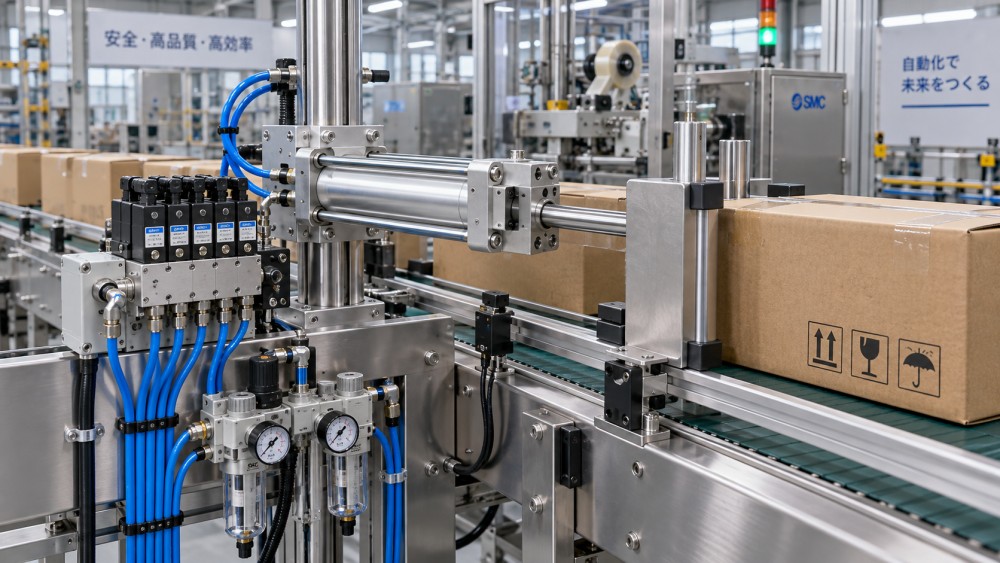
Translate air use into an operating comparison
Each full stroke fills one side of the cylinder and exhausts the other. The air demand is therefore related to bore area, stroke, number of actuations, operating pressure, and whether the application uses full strokes or intermediate positions. A double-acting unit consumes air on both extension and retraction. The rod side has less internal volume, but it is still a meaningful part of the cycle calculation.
Compare alternatives using normalized free-air consumption at the same reference conditions, supplied by calculation or tested data. A quoted internal cylinder volume is not enough because operating pressure changes the amount of compressed air required. The calculation should include the volume of connecting tube and valve cavities when they are repeatedly pressurized and exhausted. On a long run, those small volumes can be material, particularly where the cylinder itself has a short stroke.
Air cost should not be considered separately from leakage. A cylinder may have low calculated consumption and still impose a substantial load on the compressor system through leaking fittings, worn rod seals, damaged tubing, or a solenoid valve that does not fully shift. Specify a commissioning test that checks static leakage, commanded cycle behavior, and pressure recovery under normal machine operation. A simple pressure gauge at the local regulator is useful, but it will not reveal a transient drop fast enough to affect a high-speed movement; instrumentation must match the cycle being investigated.
Choose the construction around the environment and mounting
Packaging machinery often combines dry paper dust, abrasive product fines, washdown, cleaning chemicals, temperature variation, and frequent format changes. The correct cylinder construction follows the local exposure rather than the general factory environment. A standard body and rod arrangement can suit a clean, guarded station. Exposed use near washdown or corrosive cleaning residue calls for a closer review of rod material, fasteners, end-cap construction, sensor protection, and the compatibility of seal and wiper materials with the cleaning process.
Rod surface quality matters because the wiper and rod seal run on it every cycle. Scratches, corrosion pits, dried product, and misalignment damage seals and create leakage paths. Stainless rod material alone does not solve an application where a side-loaded rod is dragged through a misaligned clevis. Where the load must be guided, use an external guide system or an actuator designed to carry moment loads. A plain rod cylinder is intended primarily to generate linear force; it is not a substitute for a linear bearing.
Mounting style affects both life and motion quality. A rigid front or rear mount works well when the actuator stays aligned with a guided load. Pivot mounts accommodate angular travel but require correct pin alignment. Misplaced pivots transmit bending force into the rod and bearing. Clevis connections need enough freedom to follow the mechanism without binding, while excessive clearance can create shock and poor repeatability. Drawings should identify the mounting plane, rod-end connection, allowable envelope, adjustment access, and whether the cylinder must be removed without dismantling guards, conveyors, or adjacent tooling.
Stroke length and rod diameter must be reviewed together
Long extension strokes increase the risk of rod buckling under compression. The concern is greatest where the rod pushes a load, the mounting arrangement leaves the ends less restrained, or the motion can encounter a jam. A larger bore does not automatically address this condition; rod diameter, extended length, mounting geometry, and load direction govern the stability question. Ask for the supplier's applicable load and buckling limits for the intended configuration, rather than accepting a force rating as evidence that the assembly is suitable.
Very short strokes create different issues. End cushioning may have little distance in which to operate, and sensor switching positions can become crowded. At compact stations, confirm that the chosen magnetic sensors fit the body profile and that their cables can be routed without being crushed during format adjustment. If the control system relies on both end-position signals, specify the sensor type, electrical connection, indicator visibility, and replacement access with the actuator rather than treating them as incidental accessories.
Lifecycle cost is shaped by replacement work and lost production time
A useful cost comparison separates the initial assembly price from the costs that appear later: compressed-air demand, spare inventory, sensor replacement, fitting and tubing work, planned service labor, emergency troubleshooting, and the consequences of a station remaining unavailable. These costs vary with machine architecture. A low-cost component in an open, easily isolated location can be economical. The same component behind fixed guarding, with difficult cable access and a line-wide interlock, can carry a much higher replacement burden.
Seal selection and lubrication requirements should be explicit. Some cylinders are designed for non-lubricated air and should not be connected to an oiler unless the supplier confirms that arrangement; introducing lubrication may create an ongoing requirement that is later neglected. Air quality also needs definition. Water, oil carryover, rust particles, and desiccant dust shorten valve and seal life. The local filter arrangement must be sized for actual flow, maintained before excessive pressure drop develops, and located so that downstream contamination sources are not ignored.
Service intervals should be based on observed duty and condition, not a calendar label alone. Record cycle count where machine controls allow it, inspect rod condition and mounting looseness during planned stops, and investigate changes in cycle time, end-position reliability, or regulator pressure. These symptoms do not always point to a failed cylinder. A sticking valve spool, restricted silencer, contaminated flow control, loose sensor, or worn guide can produce nearly identical machine behavior. Replacing the actuator without isolating the cause can repeat the failure.
Information that should accompany the quotation
A technically comparable quotation needs more than a part number and unit price. It should state bore, stroke, action type, rod diameter, effective areas, operating pressure range, mounting arrangement, cushioning arrangement, magnetic piston availability, sensor details where included, port size, body and rod materials, seal material, stated temperature limits, and dimensional drawing revision. For assemblies that use a nonstandard rod end, mounting plate, extended rod, special port orientation, or custom sensor lead, the approved drawing should control the order.
- Request calculated or documented air consumption at the intended pressure and cycle arrangement, with the basis clearly identified.
- Confirm whether quoted force refers to extension or retraction and whether it excludes friction, pressure drop, and external load effects.
- Review the maximum allowable side load, moment load, and buckling condition when the rod is connected directly to tooling or a moving slide.
- Set spare-part identity at the assembly level: cylinder, sensors, mounting hardware, repair kit where practical, and the fittings that are difficult to source during a shutdown.
- Require packaging that protects the polished rod, threads, ports, and sensor grooves during storage and transport. A damaged rod surface can turn an unused spare into an early leak source.
Acceptance at installation should verify stroke, mounting orientation, port accessibility, sensor actuation, cushioning adjustment, and leak-free operation at the machine's regulated pressure. Run the station through its fastest intended cycle and its heaviest approved format. The final setting should deliver repeatable motion without forcing the regulator upward simply to overcome restrictions elsewhere in the circuit.
The best choice is usually the actuator that meets the required motion with stable guidance, adequate force at the local pressure, controlled end-of-stroke energy, and the lowest justified air volume over its real cycle count. That standard keeps a catalog comparison connected to the behavior and cost of the packaging station where the cylinder will operate.
Related News
- How to Assess a Rigid Coupling Supplier for Bore Accuracy and Traceable QualityOct 08, 2026Tribology & Kinematics Expert
- Titanium Alloys Compared: Balancing Strength, Corrosion Resistance, and MachinabilityOct 08, 2026CNC Kinematics Architect
- Where Ductile Iron Dismantling Joints Reduce Alignment Risk in Water PipelinesOct 08, 2026Pipeline Metallurgy Scientist
- Selecting a Precision Bearing Sleeve: Fits, Runout, and Material ChoicesOct 08, 2026Tribology & Kinematics Expert
- Face Milling Cutters: How Insert Geometry Affects Finish on Steel and AluminumOct 08, 2026CNC Kinematics Architect
- Single-Acting Cylinders for Clamping: Stroke, Force, and Return Spring ConsiderationsOct 07, 2026Fluid Power Control Strategist