
Hydraulic Proportional Pressure Valves: Key Buying Factors for Stable Pressure Control
Cost pressure usually pushes valve selection toward catalog comparison, but stable pressure control depends on details that are easy to miss during sourcing. A proportional pressure valve sits at the point where electrical command, hydraulic force, contamination level, machining quality, and installation conditions all meet. If any one of those factors is weak, the result may be drifting set pressure, oscillation, excessive heat, slow response, or repeated adjustment in the field. The purchasing decision therefore has to focus on control behavior over time, not on nominal pressure figures alone.
The first filter is application fit. Pressure control in a test rig, an injection unit, a lifting circuit, and a mobile hydraulic power pack may require very different valve behavior even when the rated pressure looks similar. Some circuits need fast proportional response to changing commands; others need pressure stability under near-constant load. A valve selected only by maximum pressure rating may still perform poorly if the required flow range is narrow, if the expected duty cycle causes coil heating, or if the machine sees frequent shock loads. The source specification should describe actual operating pressure, control signal type, expected oil temperature band, peak flow during transients, and whether pressure must remain stable during load reversals.
Pressure Range Is Only the Starting Point
Many quotations highlight rated pressure and flow capacity because those values are easy to compare. They do not explain how the valve behaves near the lower end of control range, during rapid command changes, or after the oil warms up. In pressure-sensitive equipment, the usable control range matters more than the advertised upper limit. A valve that reaches the required maximum but has poor low-end resolution can create unstable clamping, uneven forming force, or inconsistent actuator motion.
It is worth asking for the pressure hysteresis, repeatability, linearity, and response characteristics under defined test conditions. These parameters are often where real quality differences appear. If the supplier cannot state test conditions clearly, the values may not be comparable across offers. The same caution applies to pilot-operated designs versus direct-acting designs. Pilot-operated valves may support higher flow and pressure capacity, yet they can react differently to contamination, drain line backpressure, and low-temperature oil. Direct-acting designs may simplify some applications, but they may not offer the same capacity or stability in larger systems.
Internal Construction Affects Control Stability
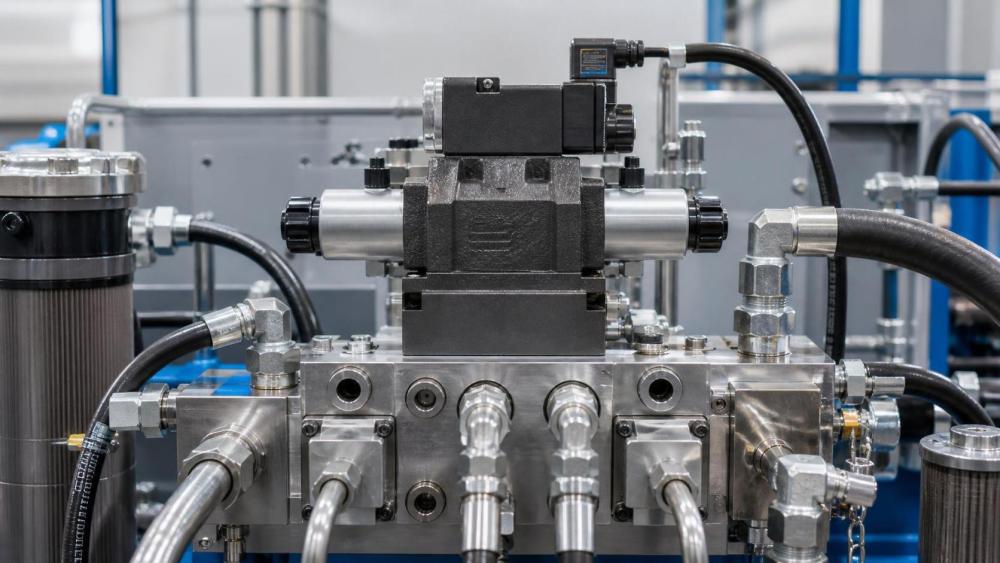
Hydraulic proportional pressure valves are precision components, and their machining quality has a direct effect on pressure behavior. Spool roundness, bore finish, edge geometry, and fit between moving parts influence leakage, stick-slip tendency, and repeatable movement under command signal. Poor machining may not be obvious during incoming inspection, but it often appears later as unstable control near setpoint or drifting performance after contamination exposure.
Material selection also matters. Valve bodies generally need adequate strength and dimensional stability under cyclic pressure. Spools and sleeves should have appropriate hardness, wear resistance, and surface finish for the intended oil cleanliness and operating frequency. If the application runs for long periods at elevated oil temperature, seal material compatibility becomes important as well. A seal suitable for standard mineral oil at moderate temperature may not remain reliable in systems with higher thermal load or specialized hydraulic fluid. When the fluid type is unusual, compatibility should be confirmed in writing rather than assumed from a general catalog note.
Manufacturing control should be reviewed through the evidence behind the part, not through broad claims. Dimensional inspection records for critical bores, spool matching methods, cleanliness control during assembly, and functional testing before shipment usually say more about long-term stability than generic quality language. For proportional valves, contamination left inside the component at delivery can create immediate commissioning issues even when the valve was correctly designed.
Signal Compatibility Should Be Verified Early
A valve can be mechanically suitable and still fail in service because the electrical control side was treated as a secondary issue. Proportional pressure control depends on signal integrity. Before ordering, the command input should be matched against the machine controller, amplifier, power supply, connector style, and cabling environment. Questions that deserve early attention include whether the valve accepts current or voltage command, whether onboard electronics are included, how feedback is handled, and whether the valve requires a separate amplifier with tuned parameters.
Response behavior may differ substantially between a valve with integrated electronics and one using an external driver. Integrated electronics can simplify wiring and reduce setup variation, but replacement practices, heat exposure, and enclosure constraints should be reviewed. External amplifier arrangements may offer more tuning flexibility, yet they also introduce another component that can cause troubleshooting delays if documentation is incomplete. In both cases, electrical protection level, electromagnetic compatibility, and connector sealing should align with the installation environment, especially on mobile machinery or in high-vibration industrial areas.
Flow Path and Circuit Layout Change the Result
Stable control does not come from the valve alone. The surrounding hydraulic circuit can either support or disturb pressure regulation. During evaluation, it is useful to look at where the valve sits relative to pump pulsation, accumulator position, downstream restrictions, and return line conditions. A proportional pressure valve installed in a circuit with strong pressure ripple may appear inaccurate when the actual issue is insufficient damping or poor line layout.
Drain line requirements deserve particular care. Some valve types are sensitive to backpressure on tank or pilot drain ports. If that requirement is ignored, the machine may show pressure offset, hunting, or heat generation that appears to be a valve defect. Mounting standard, subplate quality, manifold flatness, and port cleanliness should also be specified. Small deviations in manifold machining, burrs in ports, or trapped debris can affect spool movement and create commissioning faults that are expensive to isolate after installation.
Cleanliness Is a Purchasing Variable, Not Only a Maintenance Topic
Contamination control often enters the conversation too late. Proportional valves usually tolerate dirt less well than simpler on-off valves because their control edges and moving clearances are more sensitive. That means sourcing decisions should include acceptable cleanliness level at delivery, protective packaging, port sealing during transport, and evidence of flushing or internal cleanliness control before packing.
Filter strategy in the machine should be considered at the same time. If the planned system filtration is marginal, buying a highly sensitive valve may create service issues that are blamed on the component supplier. Conversely, a robust valve design may still suffer if transport packaging allows moisture ingress or particulate contamination before installation. Storage conditions matter too. Long transport cycles, marine shipment, or humid warehouse environments may require better corrosion protection and tighter packaging requirements than domestic short-route delivery.
Total Cost Extends Beyond Unit Price
Two offers can look similar on paper and diverge sharply in actual project cost once commissioning effort, spare part handling, and downtime exposure are considered. A low unit price may come with limited test documentation, uncertain lead-time consistency, poor interchangeability between batches, or weak support for tuning parameters. Those gaps often surface when a machine is waiting on startup and the pressure loop will not settle.
The cost model should include several practical items: whether the valve ships with a test report tied to serial or batch identification, whether spare coils and electronics are available separately, whether seals or repair kits are standardized, and whether mounting interfaces truly match the drawing without adaptation work. Re-machining a manifold, replacing connectors, rewriting control logic, or adding external damping can remove any apparent saving from the lower-priced option.
Lead time should be reviewed with the same discipline as technical fit. If a project depends on repeat orders, consistency between batches matters more than a single successful sample. Changes in coil resistance, connector sourcing, spool grading, or electronics revision can alter tuning behavior in the field. Supply continuity and change notification are therefore part of technical risk, not merely logistics.
Documents That Actually Reduce Risk
Large document packages are not automatically useful. The valuable set is the one that supports design verification, installation, and future replacement without ambiguity. At minimum, the file should make clear the hydraulic symbol, porting, pressure range options, control signal details, dimensions, mounting interface, electrical connector specification, fluid requirements, allowable temperature range, filtration expectation, and any drain line restrictions. A test curve without stated oil viscosity or supply conditions should be treated cautiously.
Drawings need enough detail to verify manifold compatibility and service access. Electrical documents should show pin assignment and command scaling. If the machine builder intends to stock replacement units, part numbering logic should also be understood so that pressure range, electronics option, and connector type are not mixed across otherwise similar model codes. Confusion at this stage commonly causes wrong-part deliveries that are only discovered during assembly.
Common Misjudgments During Sourcing
- Assuming the valve will behave the same as a previous model because the mounting pattern and rated pressure are similar. Dynamic response and control electronics may be different enough to require retuning.
- Using quoted flow capacity as proof of suitability without checking where the valve actually controls best. A wide nominal flow rating may still hide a narrow stable control window in the intended operating zone.
- Treating proportional valves as ordinary line items and leaving circuit review until after order release. That tends to expose issues with drain routing, manifold accuracy, and electrical command compatibility too late.
- Accepting generic material or test statements when the application has unusual fluid, vibration, or thermal conditions. If the environment is severe, conditional confirmation is safer than catalog interpretation.
Release Conditions Before Order Placement
A practical approval process usually works best when the valve is reviewed as part of the whole pressure-control loop. The drawing, manifold detail, electrical interface, fluid specification, and operating profile should be aligned before the purchase order is issued. If a pre-production sample is involved, acceptance should focus on pressure stability, repeatability after warm-up, and response under realistic load transitions rather than on a simple bench confirmation at room temperature.
It is also sensible to define what accompanies the shipment: identification labels, preservation method, protective caps, installation instructions, and functional test evidence. These details reduce avoidable disputes at receiving and speed up root-cause analysis if commissioning problems appear. In hydraulic systems, small omissions often consume more time than major design flaws because they delay diagnosis.
When the application is sensitive, the best purchasing outcome usually comes from a valve package that matches the circuit, the control signal, and the site conditions with very little interpretation left to the installer. That level of clarity tends to produce steadier pressure control, fewer release delays, and less hidden cost after the component arrives.
Related News
- How to Assess a Rigid Coupling Supplier for Bore Accuracy and Traceable QualityOct 08, 2026Tribology & Kinematics Expert
- Titanium Alloys Compared: Balancing Strength, Corrosion Resistance, and MachinabilityOct 08, 2026CNC Kinematics Architect
- Where Ductile Iron Dismantling Joints Reduce Alignment Risk in Water PipelinesOct 08, 2026Pipeline Metallurgy Scientist
- Selecting a Precision Bearing Sleeve: Fits, Runout, and Material ChoicesOct 08, 2026Tribology & Kinematics Expert
- Face Milling Cutters: How Insert Geometry Affects Finish on Steel and AluminumOct 08, 2026CNC Kinematics Architect
- Single-Acting Cylinders for Clamping: Stroke, Force, and Return Spring ConsiderationsOct 07, 2026Fluid Power Control Strategist