
How to Evaluate a Rodless Cylinder Manufacturer for Speed, Load, and Air Quality?
A capable rodless cylinder manufacturer should be evaluated against the motion your machine must produce, not against catalog stroke length alone. A cylinder that moves quickly on an empty test bench may become unstable when carrying an offset load, running a long horizontal stroke, or receiving poorly prepared compressed air. For procurement teams, the practical question is whether the supplier can match cylinder design, guidance, sealing, valve sizing, and air preparation to the full operating condition.
Start with the application data. Before requesting quotations, define the moving mass, payload position, stroke, cycle rate, required travel time, mounting orientation, stop position, duty pattern, ambient contamination, and available air supply. This information turns a general product inquiry into a technical evaluation that engineering and purchasing can both use.
Evaluate speed as a system requirement
Rodless cylinders are often selected where a conventional rod cylinder would consume too much installation length. Their compact envelope is useful in transfer lines, packaging machinery, pick-and-place equipment, guarding systems, material handling, and automated assembly. That space advantage does not mean every rodless cylinder will achieve the same speed reliably.
Cylinder speed depends on more than bore diameter and supply pressure. Air must enter and exhaust the cylinder chambers fast enough to move the intended load. A supplier that only states a maximum speed without discussing valve flow, port size, tubing length, cushioning, and load inertia is providing an incomplete basis for selection.
Ask the manufacturer to review the proposed pneumatic circuit, including the directional valve and speed-control arrangement. Undersized valves or restrictive fittings can cause slow extension, uneven movement, delayed reversal, and inconsistent cycle times. On high-speed applications, exhaust restriction also affects deceleration. A cylinder may reach the required average travel time but still strike the end of stroke too hard if the pneumatic control is poorly matched.
Speed must be judged together with repeatability. In a simple transfer application, a small variation in arrival time may be acceptable. In synchronized handling, labeling, feeding, or robotic support tasks, variation can disrupt the next operation. Clarify whether the movement needs only to be fast, or whether it must stop at a consistent position and time. Those are different design requirements.
Procurement teams should also distinguish between short bursts of rapid movement and continuous fast cycling. Repeated high-speed operation increases the importance of sealing quality, guide bearing design, carriage rigidity, end cushioning, and heat generated by air compression and exhaust. A supplier should be able to explain the limits of the proposed configuration under the intended duty cycle rather than offering a single headline speed figure.
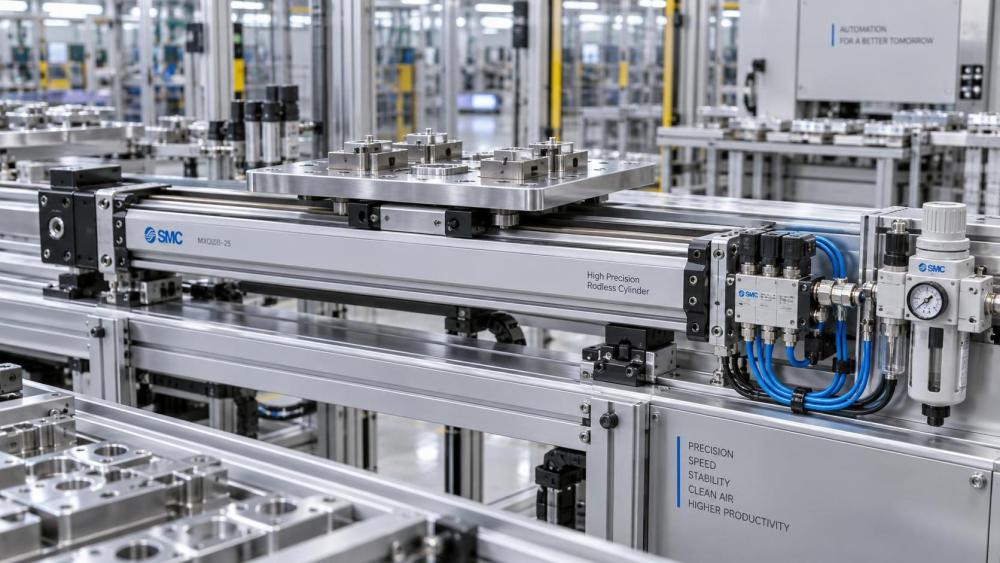
Load capacity is not the same as usable load
The most common purchasing error is to compare only the stated load rating. A rodless cylinder carriage may support a certain vertical or horizontal load under controlled conditions, but real installations introduce moments, side loading, acceleration forces, and mounting inaccuracies.
For a horizontal carriage, the payload’s center of gravity matters as much as its total mass. A load mounted far from the carriage creates a turning force that acts on the guide system. The same effect occurs when a bracket, gripper, cable carrier, or tooling plate extends outward from the slider. This can accelerate guide wear, reduce running smoothness, and place extra stress on the cylinder’s coupling system.
Ask suppliers to evaluate the application using the actual load geometry, not simply a payload weight. The quotation process should identify:
- Moving mass, including fixtures, brackets, grippers, hoses, and cable carriers
- Center-of-gravity location relative to the carriage guide
- Vertical, horizontal, or inclined mounting orientation
- Acceleration and deceleration requirements
- External forces from process contact, drag, or cable tension
- Whether the cylinder must hold a load when air pressure is interrupted
A basic rodless cylinder can be appropriate for a light, centrally supported load with limited side force. A guided rodless cylinder is generally more suitable when the carriage carries tooling, overhangs the guide, or must maintain better stability through the stroke. For high moments or precise positioning, an externally guided linear axis or a different actuator architecture may be the better choice. A manufacturer that recommends the same cylinder family for every application is not helping the buyer control risk.
Air quality determines seal life and motion consistency
Compressed air is part of the cylinder specification. Oil, water, pipe scale, abrasive particles, and pressure fluctuations can affect seals, internal sliding surfaces, and control valves. When a rodless cylinder begins to stick, leak, or move inconsistently, the cylinder is often blamed first even though the air system is contributing to the failure.
During supplier evaluation, describe the source and condition of the available air. Is it supplied by a centralized compressor network? Is the point of use far from the compressor room? Are there moisture concerns after shutdowns or seasonal temperature changes? Does the line use lubricated air, or is the system designed for clean, non-lubricated operation? These questions influence seal compatibility and the required level of filtration and water separation.
Do not assume that adding a lubricator improves every pneumatic cylinder. Some cylinder designs are intended to operate with properly prepared, non-lubricated air. Introducing lubrication into part of a system can create an ongoing maintenance dependency: once an application relies on added oil, stopping it may affect seal behavior. The better decision is to follow the supplier’s stated lubrication approach and maintain a consistent air-preparation strategy across the machine.
Air quality also affects speed. Moisture and contaminants can impair valve performance, while fluctuating pressure changes available force and travel time. A manufacturer should be prepared to discuss the air preparation unit, drainage approach, filter placement, and pressure regulation needed at the machine. This is especially important when several cylinders share one supply branch or when rapid cycles create temporary pressure drops.
Inspect the cylinder design behind the catalog drawing
Two suppliers may offer similar bore sizes and strokes while using different sealing arrangements, carriage couplings, guide structures, and manufacturing controls. These differences become important when the machine runs continuously or access for replacement is limited.
Rodless cylinder designs commonly use either a mechanical connection through the cylinder body or a magnetically coupled carriage. Mechanical designs can be suitable where higher force transfer and broad stroke options are needed, but their sealing band and internal-to-external coupling arrangement deserve close attention. Magnetic designs avoid a physical slot through the tube, yet their usable force and resistance to separation must be considered carefully, especially where external shock or high acceleration is present.
The correct choice depends on the application; neither design is automatically superior. Ask how the manufacturer protects the sealing path, controls contamination entry, manages wear in the carriage interface, and handles end-of-stroke cushioning. Where a long stroke is involved, ask about support and mounting recommendations. Cylinder alignment can change when a long body is mounted unevenly or when the machine frame lacks stiffness.
Material and finish details should also be discussed in functional terms. In a clean indoor assembly machine, the main concern may be low friction and stable sealing. In a humid, corrosive, or particulate environment, external corrosion resistance and protective covers may deserve more weight. Procurement should ensure that the quotation states the intended environmental configuration rather than relying on a standard indoor version by default.
Test the manufacturer’s engineering process, not just its sample
A sample can demonstrate basic fit, but it does not prove that a supplier can support production equipment over its service life. A stronger evaluation looks at how the manufacturer handles application review, quality documentation, delivery continuity, and technical issues after installation.
Send the same application brief to each candidate supplier and compare the quality of the response. Useful suppliers ask clarifying questions about load position, cycle conditions, air supply, mounting, and safety behavior. They identify assumptions in the request and explain what must change if the duty cycle or load geometry changes. A quick quotation that ignores missing operating data may be convenient, but it shifts design risk to the buyer.
Request drawings with mounting dimensions, port information, moving-envelope details, and load-related limits that engineers can review. For custom brackets, special stroke lengths, sensors, or corrosion-resistant versions, confirm drawing approval, change control, and replacement-part identification. A cylinder that cannot be clearly identified later can make maintenance unnecessarily difficult.
Manufacturing consistency matters when a machine builder needs repeated assemblies or a distributor must support installed equipment. Discuss inspection methods, material traceability where relevant, production capacity, packaging protection, lead-time communication, and spare seal or service-part availability. The objective is not to demand paperwork for every low-risk application. It is to establish whether the supplier can provide evidence and support proportionate to the operational consequence of a failure.
Use a staged buying decision
For a new or demanding application, avoid approving a rodless cylinder solely because it fits the preliminary layout. Start by screening suppliers for the right cylinder architecture and willingness to review the full motion condition. Then compare technically complete proposals, including cylinder, guide arrangement, sensors, valves, fittings, and air preparation. The lowest component price can become expensive if the selected configuration needs repeated tuning, guide replacement, or unexpected downtime.
Before issuing a purchase order, have the machine engineer confirm four items: the required force at the lowest expected operating pressure, the load and moment condition through the full stroke, the achievable speed with the selected valve circuit, and the air-quality arrangement at the point of use. Also confirm how the machine should behave during an emergency stop or pressure loss, particularly for vertical or suspended loads.
IMPE’s industrial equipment guidance can help procurement and engineering teams organize these cross-functional checks across pneumatic actuators, valves, air-preparation equipment, and related mechanical components. The same purchasing discipline applies across fluid-power systems: performance claims are meaningful only when the component, installation, and operating environment are evaluated together.
Questions worth asking before supplier approval
- Can you size the proposed rodless cylinder using our actual mass, center of gravity, stroke, orientation, and cycle requirement?
- What guide arrangement is appropriate for the stated moment loads and external forces?
- Which valve flow capacity, tubing arrangement, and cushioning method support the required motion?
- What air filtration, moisture control, and lubrication condition does this seal design require?
- How will the carriage and load behave if supply pressure falls or is removed?
- Which drawings, inspection records, replacement parts, and technical contacts will remain available after delivery?
A manufacturer that answers these questions clearly gives procurement a more defensible basis for comparison. The preferred supplier is not simply the one offering the fastest cylinder or the largest stated load rating. It is the one whose proposed configuration remains stable when speed, load geometry, air condition, mounting, and maintenance reality are considered together.
Related News
- How to Assess a Rigid Coupling Supplier for Bore Accuracy and Traceable QualityOct 08, 2026Tribology & Kinematics Expert
- Titanium Alloys Compared: Balancing Strength, Corrosion Resistance, and MachinabilityOct 08, 2026CNC Kinematics Architect
- Where Ductile Iron Dismantling Joints Reduce Alignment Risk in Water PipelinesOct 08, 2026Pipeline Metallurgy Scientist
- Selecting a Precision Bearing Sleeve: Fits, Runout, and Material ChoicesOct 08, 2026Tribology & Kinematics Expert
- Face Milling Cutters: How Insert Geometry Affects Finish on Steel and AluminumOct 08, 2026CNC Kinematics Architect
- Single-Acting Cylinders for Clamping: Stroke, Force, and Return Spring ConsiderationsOct 07, 2026Fluid Power Control Strategist