
How to Evaluate a Hydraulic Motor Manufacturer for OEM Quality and Lead Time
It often starts with a familiar problem: a machine program is ready, the assembly team is waiting, and purchasing has two or three hydraulic motor suppliers on the table that look almost identical in a catalog. The drawings seem covered, the quotation is acceptable, and everyone wants to move quickly. Then the harder questions appear. Can this supplier hold consistent machining quality from batch to batch? Will the seals, housings, shafts, and internal clearances stay stable when the motor is used in real equipment? If the first samples are fine, will the tenth shipment still be fine?
That uncertainty matters more than many teams expect. A hydraulic motor that arrives late can interrupt a wider build schedule. A motor that passes a simple visual check but has weak process control behind it can create field failures, rework, warranty disputes, and awkward conversations between engineering, sourcing, and production. When you are evaluating a hydraulic motor manufacturer for OEM supply, price is only one line in a larger risk picture. The better approach is to review how the supplier actually makes, tests, communicates, and delivers the product.
Where many sourcing decisions go wrong
A common mistake is treating hydraulic motors like interchangeable catalog items. For some replacement or low-demand applications, that might be workable. For OEM purchasing, it usually is not. The motor has to match the machine’s operating pressure, flow range, mounting dimensions, shaft interface, duty cycle, contamination sensitivity, and expected service life. Even when two products share a similar external specification, internal process quality can vary in ways that are not obvious at quotation stage.
Another mistake is assuming that a fast response from sales means a stable production system. Responsive communication is useful, but it is not the same as manufacturing discipline. Lead time problems often come from upstream material planning, subcontract heat treatment, machining bottlenecks, inspection capacity, or final testing availability. If those areas are weak, a polite email response does not reduce supply risk.
Start with the application before you compare suppliers
Before asking a manufacturer to prove anything, make sure your own requirement is clear enough to evaluate against. Many delays in supplier selection happen because the buying side requests a quote with only a general model reference and later discovers that shaft style, mounting flange, drain requirement, coating, rotation direction, or pressure peaks were not fully aligned.
At minimum, the internal review should clarify operating conditions, duty expectations, interface dimensions, material concerns, testing expectations, packaging needs, and documentation requirements. If the motor is going into construction equipment, agricultural machinery, industrial handling systems, or other heavy-duty service, ask whether continuous and intermittent conditions have both been defined. If your team has past failure modes, include them early. A capable supplier can only respond well to problems that are visible in the RFQ package.
Look past the brochure and examine manufacturing fit
When reviewing a hydraulic motor manufacturer, the first serious question is not “Can they make hydraulic motors?” but “Can they make this type of motor repeatedly under OEM conditions?” That means looking at process fit rather than general product availability.
Ask how major components are produced and controlled. Housings, end covers, shafts, valve plates, and other precision parts all depend on machining accuracy, material stability, and surface quality. If a supplier relies heavily on outsourced operations, that is not automatically a problem, but you need to know where quality ownership sits. The more critical the application, the more important it becomes to understand whether machining, grinding, heat treatment, cleaning, and assembly are managed as a controlled chain rather than separate disconnected jobs.
This is also the point where broader industrial capability matters. A supplier that understands precision machining, cast or forged base materials, sealing interfaces, and hydraulic assembly discipline is usually easier to evaluate than one that only presents a finished product sheet. If the team can explain tolerance-critical features, wear surfaces, and inspection points in practical terms, that is a useful sign. If every answer stays at catalog level, you may be looking at a trading response rather than real technical control.
Questions that reveal real OEM quality control
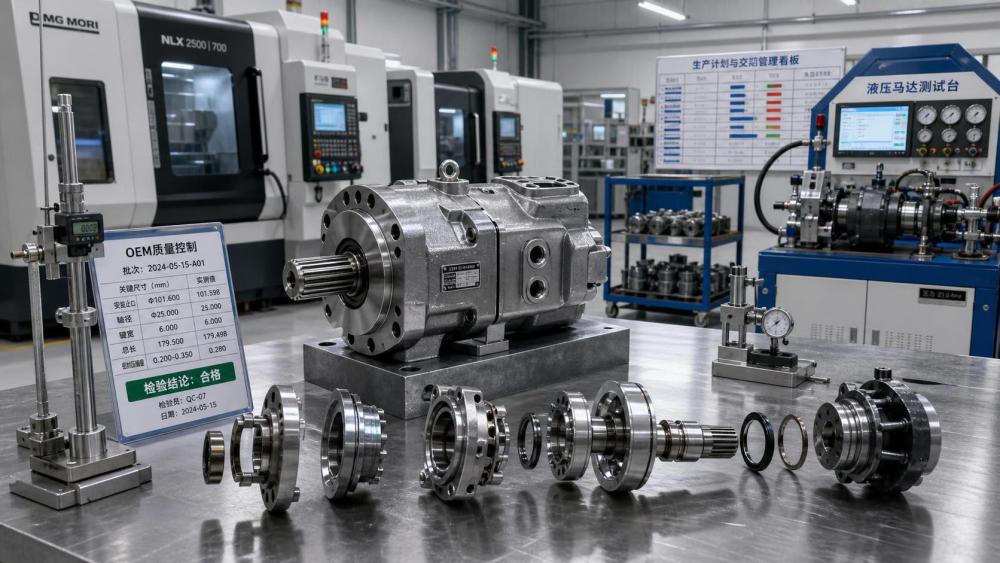
You do not need to turn the supplier review into an audit report to get useful signals. A focused discussion can reveal a lot. Ask how incoming materials are verified, how critical dimensions are inspected, how assembly cleanliness is controlled, and what testing is performed before shipment. The quality of the answers often matters as much as the answers themselves.
For example, if the manufacturer can clearly explain material traceability, inspection flow, pressure or leakage testing, and nonconformance handling, that usually shows a system that exists beyond sales language. If they answer with broad statements like “everything is checked carefully,” that is harder to rely on.
Pay attention to the following areas during evaluation:
- Whether material certificates can be linked to actual production lots
- How critical dimensions and fits are identified and monitored
- Whether there is documented process control for machining and assembly
- How sealing components are selected, stored, and verified
- What end-of-line functional tests are routine rather than optional
- How rejected parts are isolated and prevented from re-entering production
None of these points guarantee perfect supply, but together they show whether the manufacturer is working from a repeatable process. That is what OEM buyers need more than a one-time promise.
Lead time is not just a date on the quotation
Many teams ask for lead time, receive a number, and move on. That usually misses the real issue. A quoted lead time is only useful if the supplier can explain what supports it. One of the simplest ways to evaluate delivery reliability is to break the timeline into its actual parts: raw material availability, machining queue, outsourced processing, assembly, testing, packing, and shipment release.
If a manufacturer gives a short lead time but cannot explain where the pressure points are, that date may be optimistic rather than dependable. On the other hand, a supplier who identifies which parts are made to stock, which components are made to order, and which steps create schedule risk is often easier to work with because you can plan around reality.
For OEM programs, it also helps to distinguish between sample lead time and production lead time. A supplier may accelerate a first sample through manual effort, special scheduling, or temporary material allocation. That does not necessarily mean repeat orders will move the same way. Ask separately about prototype, pilot batch, and ongoing production windows. If there is no difference in their explanation, ask again until the flow is clear.
Engineering support often predicts future purchasing friction
One overlooked factor in supplier selection is how the technical team handles questions before the first order. If your engineers raise issues about displacement, pressure peaks, drain requirements, shaft load, mounting stress, or contamination control, does the manufacturer respond with usable clarification? Or do they repeat the data sheet and avoid the application details?
Strong engineering support does not mean the supplier redesigns your machine. It means they can confirm limits, identify mismatch risk, and suggest practical adjustments before production starts. This becomes especially important when there are custom ports, special flanges, nonstandard shafts, coating requirements, or packaging conditions for export shipment.
Good support also reduces lead time surprises. Technical changes made after order release are one of the most common causes of delay. A supplier who reviews drawings carefully, flags unclear tolerances, and checks test expectations early can save time even if their quotation stage feels slightly slower.
Sample approval should be treated as a process review
Procurement teams sometimes focus so heavily on getting a sample approved that they forget to ask whether the approved sample reflects normal production. A sample should not only prove fit and function. It should also tell you whether the supplier’s regular process can sustain the same result.
During sample review, try to confirm which operations were standard, which were expedited, and whether the same inspection and testing method will apply in production batches. Ask for the actual documents you expect to receive later, not just the part itself. That may include dimensional records, test results, material references, or lot identification methods, depending on your program.
This step matters because many supply problems are not design failures. They are transfer failures between sample stage and mass production. A supplier that performs well only when a project receives special attention may not be the right long-term source.
Comparing suppliers when prices are close
When several offers are in a similar range, the decision should shift from unit cost to cost of disruption. The cheaper source is not really cheaper if it creates inspection burden, inconsistent delivery, urgent air freight, line stoppage risk, or repeated engineering clarification.
One practical way to compare suppliers is to look at how much management effort each one is likely to require after the order is placed. A manufacturer with stable documentation, clear communication, and predictable process control often reduces hidden internal cost. That includes fewer follow-up emails, less incoming inspection uncertainty, and fewer emergency escalations between departments.
This is also where cross-category industrial knowledge helps. Suppliers operating in environments that already manage precision machining, cast or forged components, fluid power parts, and dimensional inspection are often better positioned to support OEM expectations because they understand how process variation affects mechanical performance, not just shipping volume.
Warning signs that deserve a second look
Not every concern is a reason to reject a supplier, but some signals should slow the decision down. Be careful if the manufacturer gives very broad quality claims without naming any inspection method, avoids discussing material origin, cannot separate sample timing from production timing, or changes technical answers depending on who replies.
Also watch for confusion around drawings and revision control. If there is uncertainty about which print governs the order, later disputes become much more likely. The same goes for unclear responsibility between the manufacturer and outside subcontractors. If no one can explain who controls heat treatment, surface finishing, or final test release, that gap may appear again when a delivery problem occurs.
A practical way to decide without overcomplicating it
If you are choosing a hydraulic motor supplier for OEM use, the most useful decision method is usually simple: verify requirement clarity, compare process control, test communication quality, and pressure-check the lead time logic. You do not need endless supplier presentations. You need enough evidence to judge whether the manufacturer can produce the right motor consistently and deliver it in a way your operation can actually plan around.
In many industrial buying situations, the supplier that looks slightly less aggressive on paper ends up being easier to work with because their process is visible and their commitments are better grounded. That does not remove the need for cost control. It just places cost in the right order, after technical fit and delivery credibility.
When evaluating a hydraulic motor manufacturer, the safest path is rarely the fastest quote or the lowest opening price. It is the supplier whose machining, material control, testing routine, engineering response, and production timing make sense together. If those parts connect cleanly during evaluation, procurement decisions become less reactive and far easier to defend later.
Related News
- Using Industrial Air Blow Guns to Clear Chips Without Spreading DebrisOct 15, 2026Fluid Power Control Strategist
- Ductile Iron Pipe Valves: Which AWWA Standards Apply to Water Main Projects?Oct 15, 2026Dr. Elias Vance
- Why Vacuum Suction Cups Lose Grip on MDF in Woodworking MachinesOct 15, 2026CNC Kinematics Architect
- Choosing a Variable Displacement Piston Pump Manufacturer: What to VerifyOct 15, 2026Fluid Power Control Strategist
- Parallel vs. Angular Pneumatic Grippers for Confined Assembly StationsOct 15, 2026Fluid Power Control Strategist
- Die Castings vs. Investment Castings: Which Costs Less at Your Production Volume?Oct 14, 2026Foundry Phase-Change Fellow