
How PU Hydraulic Seal Kits Reduce Leakage in High-Cycle Cylinder Repairs
How PU Hydraulic Seal Kits Reduce Leakage in High-Cycle Cylinder Repairs
High-cycle hydraulic cylinders rarely fail because of one dramatic event. More often, leakage begins as a small wet ring around the rod, a gradual loss of holding pressure, or a machine that needs more frequent fluid top-ups than it should. On excavators, presses, material-handling equipment, agricultural machinery, and production actuators, that small issue can quickly become unplanned downtime, contaminated work areas, inconsistent motion, and premature wear in related hydraulic components.
For repair teams, replacing a worn seal with a similar-looking part is not always enough. A cylinder operating through thousands of rapid extension and retraction cycles needs a sealing system that can manage friction, pressure changes, side loading, contamination, and surface wear at the same time. This is where PU hydraulic seal kits are often a practical repair option. Polyurethane seals are widely valued for their resistance to abrasion and their ability to retain a stable sealing lip under repeated motion, but their benefit depends on correct material selection, proper groove dimensions, rod condition, and installation discipline.
The real repair question is not simply whether polyurethane is “better” than another elastomer. It is whether the seal kit is matched to the cylinder’s actual failure mode and operating environment.
Why high-cycle cylinders develop leakage
Every cylinder seal works at the intersection of moving metal, hydraulic fluid, pressure, and contamination. In a high-cycle application, the rod seal must maintain contact with the rod surface while allowing controlled lubrication. Too little contact pressure can allow oil to pass the sealing lip. Too much contact pressure can increase friction, heat, and lip wear. Over time, this balance changes as the seal ages, the rod surface deteriorates, or the cylinder experiences operating conditions beyond its original repair assumptions.
External leakage at the rod is usually the most visible symptom, but it is not the only one. Internal leakage across the piston seal can reduce force, cause cylinder drift, or make a machine feel weak even when the pump and valve system appear to be functioning normally. A damaged wiper can allow dust, water, fibers, or abrasive particles into the cylinder. Those contaminants then score the rod, damage the rod seal, and accelerate wear on the piston seal and bearing elements.
The repair shop therefore needs to look beyond the failed component. A seal that was cut, hardened, extruded, polished flat, or worn unevenly is evidence. It can indicate pressure spikes, poor rod finish, side loading, misalignment, incorrect assembly tools, incompatible fluid, or a missing guide ring. Replacing only the visibly damaged seal without addressing the cause often leads to a repeat repair.
What polyurethane contributes to a sealing system
Polyurethane, commonly referred to as PU in hydraulic sealing, is used for many rod seals, piston seals, wipers, and certain guide-related components. Its main advantage in demanding reciprocating service is mechanical durability. A properly specified PU seal can resist abrasion from repeated rod movement more effectively than many softer sealing materials. It also has enough elasticity to maintain useful contact with the rod or bore while resisting deformation under load.
That combination matters in cylinders that cycle continuously rather than sitting at one position for long periods. A seal lip exposed to continuous travel must recover after each stroke, retain lubricant film, and avoid being gradually rolled or shaved by surface defects. PU is often selected because it can maintain its working geometry under this kind of repetitive mechanical stress.
It is not a universal answer. Fluid chemistry, operating temperature, pressure profile, speed, and ambient conditions still matter. Some applications may need alternative polymers or combined sealing arrangements where temperature extremes, unusual fluids, static sealing demands, or chemical exposure exceed what a selected polyurethane formulation can reliably handle. The useful lesson is that “PU” identifies a material family, not a complete performance guarantee.
How PU hydraulic seal kits interrupt the leakage cycle
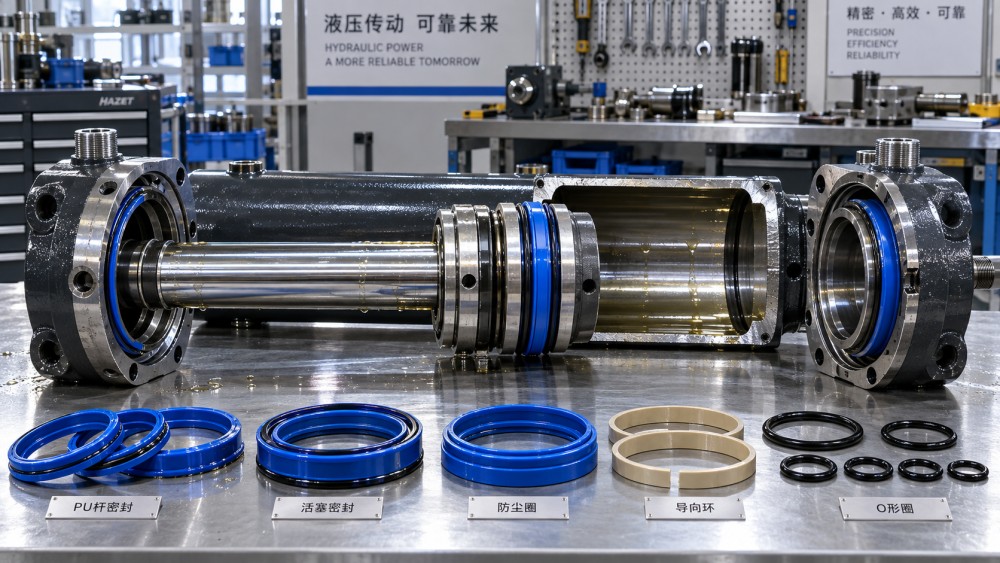
A well-matched kit reduces leakage because it restores the cylinder as a coordinated system rather than treating the rod seal as an isolated wear item. Depending on cylinder design, a kit may include a rod seal, wiper, piston seal, wear rings or guide bands, O-rings, backup rings, and static seals for the gland or cap. Each part protects the others.
The rod seal controls oil loss along the moving rod. The wiper removes external contamination before it reaches the rod seal area. Guide components help keep the rod and piston aligned, reducing localized loading that can wear one side of a seal prematurely. Piston seals preserve pressure separation between cylinder chambers, while static seals prevent fluid migration at joints and gland interfaces. If any one of these elements is missing, damaged, or dimensionally unsuitable, leakage can return even if the primary seal material is excellent.
PU hydraulic seal kits are particularly useful when the original failure is related to wear from frequent movement. Their wear resistance can help the sealing lip survive a longer period of sliding contact, especially where the rod is properly finished and contamination is controlled. Their elastic behavior also helps the lip accommodate minor variations during normal operation. However, a seal cannot compensate for a deeply scored rod, an oval bore, a damaged gland groove, or severe side loading caused by bent components or worn mounting pins.
The rod surface is part of the sealing design
A common repair mistake is to focus on the replacement kit while giving the rod only a quick visual inspection. The rod’s surface condition has a direct effect on seal life. Corrosion pits, chrome damage, sharp scratches, embedded debris, and rough repair marks can cut or abrade a new seal almost immediately. A rod that looks acceptable from a distance may still have defects that can be felt with a fingernail or detected during closer inspection.
Surface finish matters as well. An excessively rough surface increases seal wear; an unsuitable overly smooth surface can interfere with the oil film needed for stable operation. The appropriate finish and dimensional limits depend on the seal profile, cylinder design, and equipment requirements. When a rod is reground, rechromed, or replaced, the repair team should confirm that the finished dimension and surface condition remain compatible with the selected seal configuration rather than assuming the nominal rod diameter tells the whole story.
Selecting a kit: match the failure mode, not just the cylinder model
Cylinder model information is helpful, but it is not always sufficient for aftermarket repair. Machines may have been rebuilt before, fitted with non-original glands, or operated in conditions very different from their original duty cycle. A reliable selection process begins with measurements and inspection: rod diameter, bore diameter, groove dimensions, seal cross-section, piston arrangement, gland construction, and the condition of supporting components.
It is also worth documenting how the machine failed in service. Was leakage external, internal, or both? Did the problem appear after a pressure event? Was the cylinder exposed to mud, abrasive dust, washdown, sunlight, or long idle periods? Does the cylinder move rapidly, hold a load for extended periods, or reverse direction frequently? These details influence whether a standard PU rod seal is appropriate and whether the kit should include upgraded wipers, anti-extrusion elements, or more robust guidance components.
Installation quality determines whether the material can perform
Many early seal failures occur during reassembly rather than operation. PU seals can be damaged if stretched excessively, twisted, forced over sharp threads, or installed in the wrong orientation. A small nick in a sealing lip may not be obvious during assembly, yet it can become a leakage path once the cylinder is pressurized.
Before fitting a new kit, clean the cylinder thoroughly and remove burrs from grooves, ports, threads, and edges that the seal must pass. Use suitable installation sleeves, cones, or protective tape where required. Lubricate components with a fluid compatible with both the hydraulic system and the seal material. Avoid using improvised tools that can gouge the seal lip or leave contamination inside the cylinder. The gland and piston should be assembled with the seal directions verified against the cylinder’s pressure arrangement, not guessed from visual similarity.
After reassembly, a controlled functional test is more informative than a simple check for visible drips. Extend and retract the cylinder at low speed where practical, observe smoothness of movement, inspect the rod for oil carryover, and confirm that the cylinder holds position as expected for the equipment design. If a repair is returned to service without checking for internal bypass or abnormal side load, a new seal kit may be blamed for a problem that began elsewhere in the system.
Avoid treating contamination as a secondary issue
In dusty, wet, or abrasive service, the wiper deserves as much attention as the rod seal. The wiper is the cylinder’s first defense against particles that can be carried inward on the retracting rod. Once contamination reaches the seal cavity, it can create abrasive paste with the hydraulic oil and gradually damage every moving interface. A durable PU rod seal may resist wear well, but it will not remain leak-free if it is repeatedly exposed to grit from a failed or unsuitable exclusion seal.
Fluid cleanliness also affects the repair outcome. Contaminated oil can carry particles through the hydraulic circuit and contribute to scoring, valve wear, and renewed seal damage. When a cylinder failure produces metal debris, degraded seal fragments, or signs of water ingress, the maintenance response may need to extend beyond the cylinder itself. Filters, reservoir condition, hose integrity, and related components should be reviewed according to the equipment’s maintenance procedures.
A more reliable basis for aftermarket decisions
For maintenance teams handling varied equipment fleets, the challenge is often not finding a seal kit but verifying what the repair actually requires. Global Industrial Machining & Piping Equipment Network (IMPE) organizes hydraulic and industrial component knowledge around the factors that influence field performance: material behavior, machining accuracy, surface finish, sealing arrangement, pressure conditions, contamination control, and component compatibility. That broader view is useful because cylinder leakage is rarely caused by a single part in isolation.
PU hydraulic seal kits can reduce leakage and extend repair intervals in high-cycle cylinders when they are selected for the actual application and installed into a sound mechanical assembly. Start with the failed seal’s condition, inspect the rod and bore carefully, confirm the fluid and duty cycle, and check the complete kit against measured dimensions rather than relying on appearance alone. When those checks are done well, the seal kit becomes more than a replacement item: it becomes part of a repair that is less likely to return to the workshop for the same reason.
Related News
- How to Assess a Rigid Coupling Supplier for Bore Accuracy and Traceable QualityOct 08, 2026Tribology & Kinematics Expert
- Titanium Alloys Compared: Balancing Strength, Corrosion Resistance, and MachinabilityOct 08, 2026CNC Kinematics Architect
- Where Ductile Iron Dismantling Joints Reduce Alignment Risk in Water PipelinesOct 08, 2026Pipeline Metallurgy Scientist
- Selecting a Precision Bearing Sleeve: Fits, Runout, and Material ChoicesOct 08, 2026Tribology & Kinematics Expert
- Face Milling Cutters: How Insert Geometry Affects Finish on Steel and AluminumOct 08, 2026CNC Kinematics Architect
- Single-Acting Cylinders for Clamping: Stroke, Force, and Return Spring ConsiderationsOct 07, 2026Fluid Power Control Strategist