
How Hydraulic Servo Valves Improve Motion Control Accuracy in High-Response Systems
In a high-response hydraulic axis, the difference between stable motion and constant correction often comes down to one component: the valve that meters oil into the actuator. When a system must reverse quickly, hold position under changing load, or follow a tight command profile, ordinary directional or proportional control is often not enough. Hydraulic Servo Valves are used because they can translate a small electrical command into a very precise hydraulic reaction, with much finer control over flow gain, spool position, and dynamic response.
That sounds straightforward on paper. In practice, servo valve performance is tied to the rest of the hydraulic loop: pump stability, oil cleanliness, actuator friction, manifold geometry, feedback quality, and even the machining accuracy of valve lands and bores. Technical evaluation is rarely about the valve alone. It is about how the valve helps the whole system track motion accurately and keep doing it after months of pressure cycling.
Why high-response systems expose control weakness so quickly
Many hydraulic machines can tolerate a little overshoot or lag. A compacting press, a rough positioning cylinder, or a basic lifting circuit may still perform acceptably with slower valve behavior. But in servo-controlled applications—test rigs, injection systems, rolling mills, flight simulators, vibration tables, precision forming equipment, machine tools, or synchronized industrial actuators—small delays are no longer small. They show up as contour error, chatter, hunting, heat build-up, or poor repeatability.
The reason is simple: hydraulic power is dense, and the load can change fast. If the valve cannot meter flow with enough speed and resolution, the controller starts compensating harder. Then one problem becomes three: position error, pressure spikes, and unstable tuning margins.
This is where Hydraulic Servo Valves earn their place. Compared with more general proportional valves, servo valves are typically selected when command fidelity, null stability, hysteresis control, and dynamic response matter more than cost simplicity.
How the valve improves motion accuracy at the control level
A servo valve improves accuracy in several linked ways, not just one. The first is flow metering precision. The valve spool moves in very small increments, so the actuator can receive the exact amount of fluid needed for a correction rather than a coarse step. In a well-tuned loop, that means smoother low-speed motion and less tendency to overshoot a target position.
The second is response speed. If a command signal changes quickly, the valve has to shift quickly enough that the cylinder or hydraulic motor sees the correction before the mechanical error grows. On paper, this is often discussed in bandwidth or frequency response terms. During evaluation, the more useful question is practical: can the valve keep the actuator following the profile when load, direction, and pressure differential are changing at the same time?
The third is repeatability around null. High-response systems spend a surprising amount of time making tiny corrections near center. If the valve has excessive hysteresis, deadband, or drift, the controller must keep “pushing through” those irregularities. That creates uneven micro-motion, especially in applications requiring fine positioning or force control.
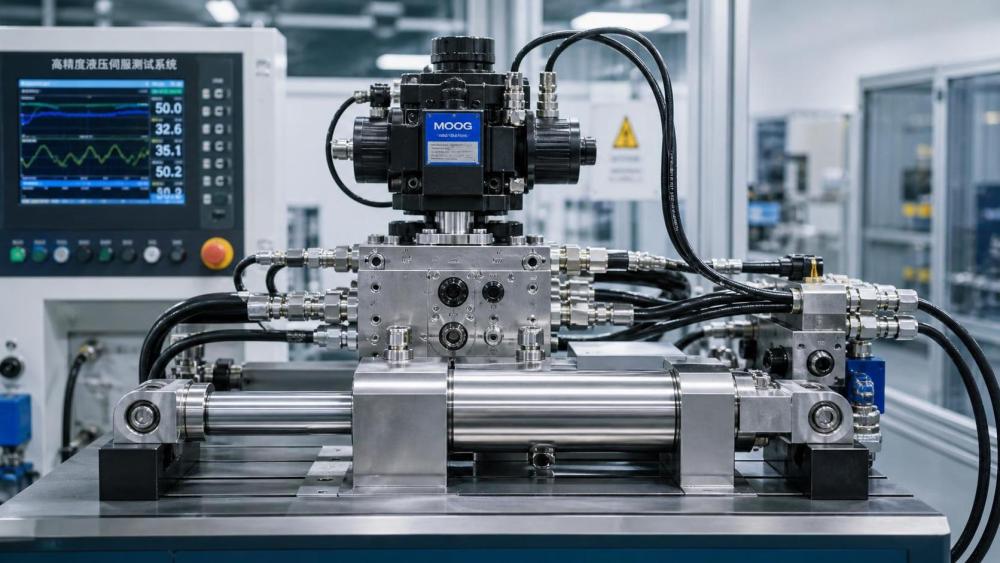
Then there is load handling. A servo valve does not eliminate load disturbance, but it helps the system react to it with less error. For example, when a press ram encounters a material variation or a test actuator sees a sudden force reversal, the valve can adjust port flow rapidly enough to support pressure correction before motion quality collapses. That is one reason servo-controlled hydraulics still hold ground in applications where electric motion alone cannot deliver the same force density.
Where evaluators often make the wrong comparison
A common mistake is to compare servo valves mainly by nominal flow rating. Flow capacity matters, of course, but it does not tell you whether the valve will behave well in the real operating window. Two valves can look similar in catalog flow terms and still behave very differently in closed-loop control.
What usually deserves closer attention is the combination of rated flow, spool overlap condition, internal leakage behavior, hysteresis, threshold, contamination tolerance, and frequency response under stated test conditions. It also helps to confirm whether the published performance is based on no-load conditions, a standard pressure drop, or a specific signal amplitude. Those details affect how honestly the data translates into machine behavior.
Another frequent issue is assuming that a high-end valve will automatically create a high-accuracy system. It will not. If the cylinder has stick-slip, the feedback device has noise, the manifold passages are restrictive, or the power unit pressure is unstable, the servo valve ends up compensating for defects elsewhere. Sometimes the control team then blames tuning, when the real problem is hydraulic architecture.
What really affects long-term accuracy beyond the initial response
Initial dynamic performance gets most of the attention, but long-term control reliability is often the harder engineering problem. Servo valves have tight internal clearances and fine metering edges. That precision is exactly why they can control motion so accurately, and exactly why they are sensitive to contamination. In field use, degraded oil cleanliness may show up not as immediate failure, but as drift, sluggish correction, or inconsistent null behavior.
For technical evaluators, this links the valve directly to upstream filtration strategy, reservoir design, seal condition, hose cleanliness, and maintenance discipline. In industries covered by platforms such as IMPE, where buyers compare hydraulic equipment alongside pumps, fittings, machined manifolds, cast valve bodies, and power units, this broader systems view matters. A precisely built valve installed in a poorly controlled fluid circuit is still a risk.
Manufacturing quality also sits in the background more than many purchasing teams realize. Servo valve consistency depends on precision machining, spool-land geometry, fine surface finishing, fit control, and stable material behavior. This is one reason information about machining capability, inspection method, and production consistency is not just relevant to metalworking suppliers; it feeds directly into hydraulic control performance. Tiny geometric errors at the component level can become visible as control instability at the machine level.
Servo valves versus proportional valves: the practical boundary
There is no universal line where a proportional valve becomes “not good enough.” The decision depends on required motion quality, disturbance sensitivity, and economics. For moderate speed control, simpler proportional technology may be entirely adequate and easier to maintain. But when the application requires very low hysteresis, fast reversals, fine force regulation, or accurate tracking of dynamic command profiles, Hydraulic Servo Valves are often the safer engineering choice.
The trade-off is not subtle. Servo valves usually demand cleaner oil, tighter commissioning, and better supporting components. That is why experienced teams do not specify them casually. They specify them when performance targets justify the discipline the rest of the system must follow.
Evaluation points that matter more than marketing language
When reviewing a servo-controlled hydraulic package, it helps to ask a narrower set of questions:
- What motion variable is most critical: position, velocity, force, or synchronized multi-axis behavior?
- What is the actual disturbance profile—changing load, pressure fluctuation, thermal drift, or friction variation?
- How is valve performance stated, and under what hydraulic test conditions?
- What cleanliness level and filtration arrangement are required to sustain the published behavior?
- Is the manifold, actuator, and feedback hardware good enough to let the valve perform as intended?
- Can the supplier provide clear technical documentation, service guidance, and compatibility details for the full fluid power circuit?
Those questions are less glamorous than broad claims about precision, but they usually reveal more. In procurement and engineering review, especially for OEMs, EPC teams, and industrial equipment buyers, the best decision is often the one that reduces hidden integration risk rather than the one with the most impressive headline specification.
Standards, documentation, and the system view
Technical review of servo valve applications also benefits from attention to documentation quality. Hydraulic components are rarely judged only by dimensions and pressure class. Teams usually need to check performance curves, mounting interface details, fluid compatibility, filtration recommendations, electrical characteristics, failure mode considerations, and maintenance instructions. If the application sits in a regulated or safety-sensitive environment, project-specific standards or local requirements may also shape component selection and test expectations.
That broader discipline is where industrial knowledge platforms become useful. IMPE, for example, sits across machining, castings, piping, power transmission, and fluid power rather than treating each category in isolation. That makes sense in real projects. A servo valve may be the control element, but its behavior is influenced by manifold machining quality, seal selection, pressure line design, actuator fit, and contamination control throughout the hydraulic assembly.
A realistic way to judge performance potential
If you are evaluating whether Hydraulic Servo Valves will improve motion control accuracy in a high-response system, the honest answer is usually yes—but only when the rest of the design respects what servo control requires. They improve motion because they can meter flow more precisely, react faster to command and load changes, and support tighter closed-loop correction. That is the value.
The caution is just as important. High servo performance is not a standalone purchase. It is a system commitment involving oil cleanliness, component quality, machining precision, tuning discipline, and documentation clarity. If those pieces are weak, the valve may still function, but the expected accuracy will be harder to reach and even harder to keep.
For technical evaluation, that is usually the right place to end the discussion: not with a generic claim that servo valves are better, but with a project-specific question—does the machine actually need servo-level control, and is the hydraulic system built well enough to benefit from it?
Related News
- Using Industrial Air Blow Guns to Clear Chips Without Spreading DebrisOct 15, 2026Fluid Power Control Strategist
- Ductile Iron Pipe Valves: Which AWWA Standards Apply to Water Main Projects?Oct 15, 2026Dr. Elias Vance
- Why Vacuum Suction Cups Lose Grip on MDF in Woodworking MachinesOct 15, 2026CNC Kinematics Architect
- Choosing a Variable Displacement Piston Pump Manufacturer: What to VerifyOct 15, 2026Fluid Power Control Strategist
- Parallel vs. Angular Pneumatic Grippers for Confined Assembly StationsOct 15, 2026Fluid Power Control Strategist
- Die Castings vs. Investment Castings: Which Costs Less at Your Production Volume?Oct 14, 2026Foundry Phase-Change Fellow