
How Durable Are Ball Valves in Underground Water Networks?
The short answer: a buried ball valve can last for decades, but only when the whole installation is designed for burial
Ball valves can be durable components in underground water networks, especially where fast isolation, dependable shutoff, and low operating torque are required. Their compact quarter-turn design has fewer moving parts than many multi-turn valve types, and a properly selected valve can provide reliable service for a long period.
That answer has an important limitation. A ball valve’s service life underground is not determined by the ball and seats alone. The buried environment introduces corrosion exposure, external loading, poor access, water ingress around operating components, and the possibility that a small installation defect becomes expensive to correct. A valve that performs well in an accessible plant room may be a poor choice for direct burial if its body coating, stem sealing, operator arrangement, or end connections were not intended for that duty.
For water utilities and municipal EPC teams, the useful question is therefore not simply, “How long does a ball valve last?” It is: “Will this valve remain operable and leak-tight in this pipe section, soil condition, pressure regime, and maintenance arrangement?”
What usually determines underground durability?
In a buried water network, a ball valve has to resist two different kinds of stress. Internally, it must handle water pressure, flow conditions, operating cycles, and water quality. Externally, it must survive soil contact, groundwater, installation damage, settlement, traffic loading where applicable, and a lack of regular visual inspection. The external factors often decide whether an otherwise sound valve reaches its expected life.
Valve body material and external corrosion protection
The body material must be appropriate for both the conveyed water and the surrounding soil. Ductile iron, carbon steel, stainless steel, and copper alloys are used in different valve designs and pressure ranges, but no material selection should be treated as universally suitable below ground. Soil moisture, pH, chlorides, sulfates, stray-current exposure, and local groundwater conditions can change the corrosion risk substantially.
For metallic valves, coating quality matters as much as coating type. A durable coating system must cover the body, flange areas, bolt zones, and other vulnerable transitions. Damage during transport, lowering, backfilling, or connection work can expose bare metal. A minor scrape on an above-ground valve may be noticed and repaired. The same damage on a buried valve can remain hidden while corrosion progresses.
Where the network design uses cathodic protection or other corrosion-control measures, the valve, fittings, joints, and protective strategy need to be considered as one system. Treating the valve as an isolated catalog item can create a weak point at a critical isolation location.
Seat and seal compatibility
The sealing seats inside a ball valve are central to shutoff performance. Many ball valves rely on resilient polymer seats, which can provide excellent sealing but have operating limits related to temperature, pressure, chemicals, and deformation under sustained load. In clean, treated water at suitable operating conditions, this arrangement can be highly dependable. The same seat material may be less suitable where water carries abrasive solids, where pressure transients are severe, or where the valve remains in one position for very long periods without exercise.
Stem seals deserve equal attention. The stem is the path between the buried valve interior and the operator above ground. If the stem sealing arrangement is not robust, water and contaminants can reach areas that should remain protected. For direct-buried use, buyers should look beyond a general statement that a valve is “water service suitable” and examine whether the stem, packing, seals, and operator interface are designed for sustained underground exposure.
Pressure is not the same as pressure rating
A valve’s stated pressure class is necessary information, but it does not fully describe the conditions it will face. Water networks can experience pressure changes from pump starts and stops, rapid valve operation, line filling, air release events, and service interruptions. Repeated pressure surges can place more demanding stress on valve seats, stem seals, end connections, and adjacent pipework than steady-state pressure alone suggests.
This does not mean ball valves are automatically unsuitable for networks with changing pressures. It means the selection should account for the full pressure envelope, including transient conditions, rather than using normal operating pressure as the only basis for choice. The valve’s bore configuration, closing speed, actuator behavior, and placement in the network can all influence how it interacts with hydraulic transients.
Are ball valves suitable for direct burial?
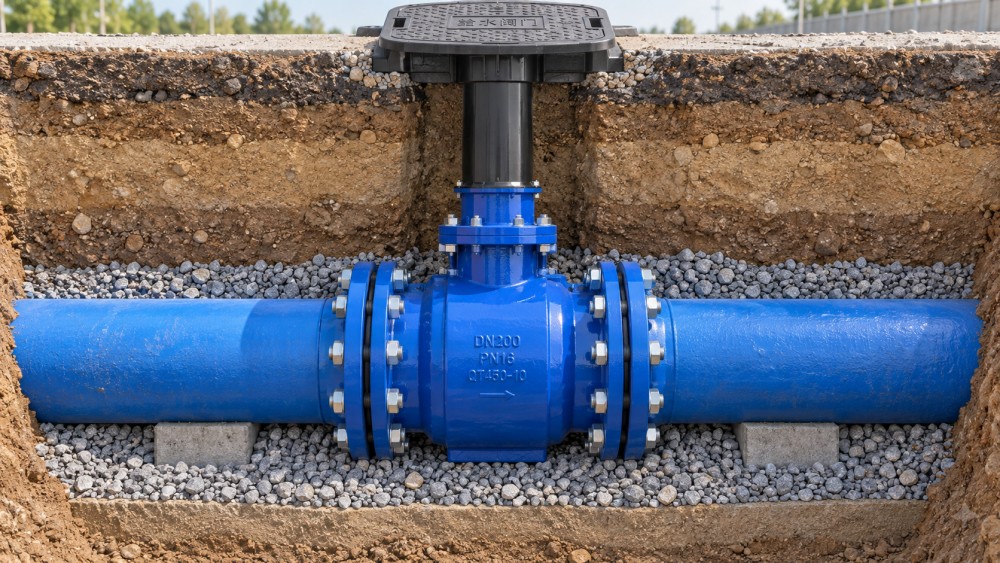
They can be, provided the specific valve assembly is built and installed for direct-buried service. This distinction matters because “underground installation” is sometimes used loosely. A valve installed in a dry accessible chamber faces a different risk profile from a valve placed directly in a trench and covered by soil.
For direct burial, the assembly generally needs a protected operating extension, a durable valve-to-extension connection, external corrosion protection, and a means of locating and operating the valve after paving, landscaping, or surface changes. The operating point should remain protected from debris and water entry while still being accessible to utility crews.
In many networks, a chamber or valve box is chosen because it improves access for operation and inspection. That can be a sound decision, but it does not remove all durability concerns. Chambers may flood, collect sediment, or become difficult to access. The design choice should weigh the cost of civil works against the operational consequence of a buried valve that cannot be reached or turned when an isolation event occurs.
What can shorten the life of an underground ball valve?
Premature failure is often linked to installation and system conditions rather than a dramatic defect in the ball itself. Several recurring issues deserve close review before the valve is buried.
- Incorrect pipe alignment: A valve should not be forced into place to correct a pipe run. Misalignment can load flanges, welded ends, or joint interfaces and may affect operating torque over time.
- Inadequate support and bedding: Large or heavy valves need stable support. Uneven bedding and later settlement can transfer bending loads into the valve body and connections.
- Backfill containing sharp or aggressive material: Rocks, construction debris, or unsuitable fill can damage coatings and create point loads. Compaction must secure the line without distorting it.
- Unprotected extension stems: A valve can remain mechanically sound while its extension stem, coupling, or operating nut corrodes or seizes. In that condition, isolation may fail when it is most needed.
- Wrong valve for the operating role: A ball valve intended for isolation should not automatically be used for frequent throttling or for fluids containing abrasive solids unless its design supports that service.
- No commissioning record: If the valve location, orientation, closure direction, installed position, and test results are not documented, later maintenance becomes slower and more uncertain.
One practical warning is that a buried valve does not need to leak to become a network problem. A seized operator, inaccessible valve box, damaged extension spindle, or unknown open/closed position can delay sectional isolation and extend outage time. Operational accessibility is part of durability because it determines whether the valve remains usable.
How should buyers evaluate a ball valve for a buried water network?
Catalog comparisons tend to focus on nominal size, pressure rating, and end connection. Those are baseline requirements. For underground service, the evaluation should move from the valve body outward: internal sealing, external protection, connection to the pipeline, operating mechanism, site conditions, and maintenance plan.
Documentation is also part of a defensible procurement decision. Material records, pressure-test evidence, dimensional information, coating details, operating-torque data where relevant, and installation instructions provide a clearer basis for matching the valve to project conditions. For critical isolation points, it is prudent to define inspection and acceptance requirements before delivery rather than attempting to resolve questions at the trench.
Does a full-port ball valve improve long-term performance?
A full-port design can be valuable where low pressure loss and unobstructed flow are important. Its bore is close to the nominal pipe bore, which can reduce restriction and may simplify cleaning or pigging in systems designed for those activities. It is often a strong option on transmission lines, pump-related pipework, and sections where hydraulic performance is sensitive.
It should not be treated as an automatic durability upgrade. Full-port valves can be larger, heavier, and more expensive, and their suitability still depends on pressure, available installation space, operator arrangement, and network function. A reduced-port valve may be acceptable on a branch or local isolation point where the hydraulic impact is limited. The decision should follow the pipe system’s duty, not a general preference for the larger bore.
How much maintenance does a buried ball valve need?
The internal ball and seats of an appropriately selected water-service valve may require little routine intervention, but “maintenance-free” is a risky assumption for any buried isolation asset. The realistic objective is low-maintenance, accessible operation.
Utilities commonly benefit from an asset routine that confirms the valve can be found, operated through its full travel, and returned to its documented position. Exercise frequency should reflect network criticality, water conditions, valve design, and the consequence of a failed isolation. Repeated unnecessary operation can create its own wear, while no operation for a very long time can allow deposits, corrosion, or stem problems to develop. The right approach is a defined asset-management practice rather than an arbitrary exercise interval applied to every valve.
Surface markers, accurate GIS or network records, accessible valve boxes, and closure-direction information can be as consequential as the valve specification. During emergency work, crews need to isolate a section quickly. A high-quality buried valve provides limited value if its location is uncertain or the operator cannot engage the stem.
When is another valve type a better choice?
Ball valves are highly effective shutoff devices, but the best buried valve depends on network function. Large municipal distribution systems often use other valve configurations where compact construction, lower installed cost at larger diameters, easier buried operation, or established network maintenance practices favor them. Control duties may call for a valve designed specifically for modulation rather than a quarter-turn isolation valve.
The decision should become more cautious where the fluid contains solids, where throttling is continuous, where rapid closure could contribute to harmful transients, or where the valve must remain reliable after very long periods without access. In those cases, a review of valve type, actuation method, closure characteristics, and lifecycle maintenance is more useful than selecting on initial purchase price.
A ball valve can be a durable underground water-network asset when its design matches the service and the installation protects its vulnerable interfaces. The most reliable selections treat the valve, pipe connection, corrosion system, extension stem, access point, and operating procedure as one buried isolation system. That perspective helps avoid the expensive outcome of discovering that a valve was technically installed, but no longer usable when the network needs it.
Related News
- Using Industrial Air Blow Guns to Clear Chips Without Spreading DebrisOct 15, 2026Fluid Power Control Strategist
- Ductile Iron Pipe Valves: Which AWWA Standards Apply to Water Main Projects?Oct 15, 2026Dr. Elias Vance
- Why Vacuum Suction Cups Lose Grip on MDF in Woodworking MachinesOct 15, 2026CNC Kinematics Architect
- Choosing a Variable Displacement Piston Pump Manufacturer: What to VerifyOct 15, 2026Fluid Power Control Strategist
- Parallel vs. Angular Pneumatic Grippers for Confined Assembly StationsOct 15, 2026Fluid Power Control Strategist
- Die Castings vs. Investment Castings: Which Costs Less at Your Production Volume?Oct 14, 2026Foundry Phase-Change Fellow