
Electro Hydraulic Proportional Valve Basics: Control Accuracy, Response, and Use Cases
An electro hydraulic proportional valve plays a critical role in modern fluid power systems by enabling precise control of pressure and flow. For engineers, buyers, and technical researchers, understanding its control accuracy, response speed, and practical use cases is essential when evaluating hydraulic equipment for automation, heavy machinery, and industrial performance.
In many industrial discussions, this type of valve is described too simply: as a “more precise hydraulic valve” or a “mid-range option between on/off valves and servo valves.” That description is not wrong, but it is incomplete. In practice, the real value of an electro hydraulic proportional valve lies in how well it matches machine behavior, control architecture, contamination conditions, and cost expectations.
For anyone researching hydraulic control components, the key question is usually not just what the valve is. The more useful question is: what level of control does it actually deliver in real equipment, and when is it the right choice?
What an electro hydraulic proportional valve actually does
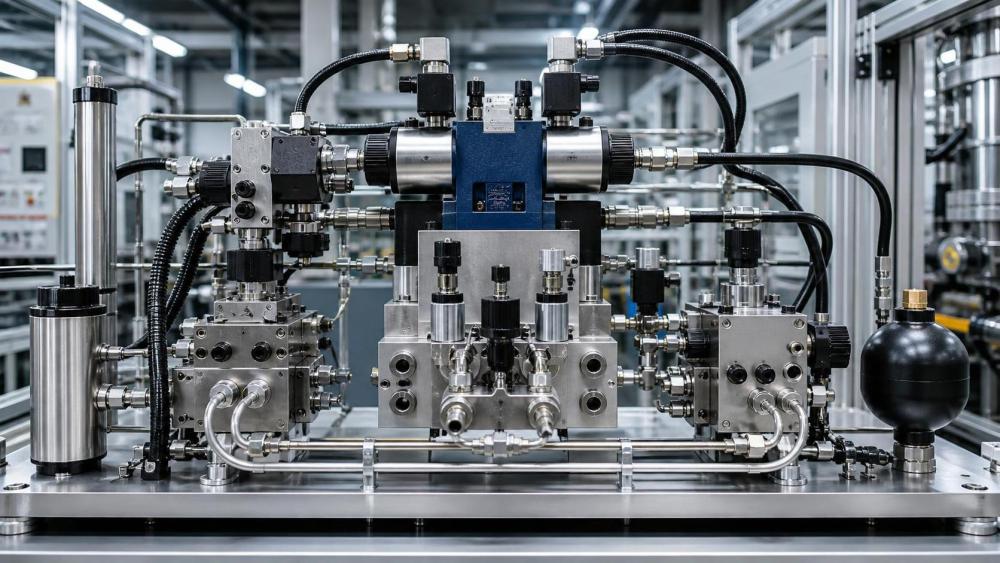
An electro hydraulic proportional valve converts an electrical input signal into a controlled hydraulic output. Instead of switching fully open or fully closed like a conventional solenoid directional valve, it adjusts spool position proportionally. That allows the system to modulate flow, pressure, or direction with variable rather than binary control.
In practical terms, this means smoother cylinder movement, adjustable motor speed, controlled clamping force, and more stable machine operation under changing loads. The input signal may come from a PLC, CNC system, mobile controller, or dedicated electronic driver. The valve then meters hydraulic energy according to that signal.
The category includes several functional types:
- Proportional directional valves for controlling actuator direction and speed
- Proportional pressure valves for regulating force or system pressure
- Proportional flow control valves for managing speed and movement consistency
- Pressure-flow combined control valves used in more complex hydraulic circuits
Not all proportional valves perform at the same level. Two units may both be labeled proportional, yet differ significantly in hysteresis, linearity, repeatability, bandwidth, and contamination tolerance. That is why the basic label alone is not enough for technical comparison.
Why proportional control matters in modern machinery
Hydraulic systems used to rely heavily on manual adjustment, fixed orifice logic, and simple directional switching. That still works in many robust applications, but modern equipment increasingly needs variable motion and tighter process control. Construction equipment, agricultural machinery, presses, material handling systems, marine winches, machine tools, and test rigs all benefit from more controllable hydraulic behavior.
The shift is also linked to broader industrial trends. Equipment builders are under pressure to improve energy efficiency, operator comfort, automation compatibility, and safety performance. A machine that can accelerate smoothly, maintain stable pressure, and react predictably to control commands is easier to integrate into modern production and less likely to cause mechanical shock or process inconsistency.
This is one reason the electro hydraulic proportional valve occupies such an important position in the market. It offers a practical balance between basic hydraulic control and high-end servo performance.
Control accuracy: what it means beyond catalog numbers
Control accuracy is often the first specification people look for, but it is also one of the most misunderstood. In proportional hydraulic control, accuracy is not a single number. It depends on several interacting characteristics.
Linearity describes how closely valve output follows the input signal across the operating range. If a 50% command does not produce a predictable intermediate flow or pressure condition, the machine becomes harder to tune.
Hysteresis refers to the difference in output when approaching the same command from different directions. High hysteresis makes motion less repeatable, especially in reversing or fine positioning tasks.
Repeatability indicates whether the valve can reproduce the same response under the same conditions over time. This is especially important in production equipment where cycle consistency matters.
Resolution concerns how small a control change the valve can meaningfully respond to. In slow-speed motion control, poor resolution can create stick-slip or unstable movement.
Null stability matters when the actuator should remain still near zero command. Drift around the neutral point can affect clamping, holding, or positioning functions.
What makes evaluation difficult is that actual control accuracy depends not only on the valve but also on the full hydraulic loop. Pump ripple, oil temperature, internal leakage, actuator friction, load variation, hose elasticity, and controller tuning all influence final performance. A proportional valve with good published specifications can still behave poorly in a badly designed circuit.
For this reason, experienced users often judge proportional control quality in terms of system behavior: smooth starts, stable low-speed travel, controllable deceleration, repeatable force output, and limited overshoot under changing load.
Response speed: fast enough is more important than “fastest”
Response is another specification that can be misleading if taken out of context. A faster valve is not automatically a better valve. The useful question is whether the valve response matches the dynamics of the machine and the control objective.
Response time is typically influenced by solenoid design, spool mass, spring characteristics, pilot stage design where applicable, onboard electronics, oil condition, and pressure differential. Some proportional valves are designed for relatively moderate response in rugged mobile systems. Others are optimized for faster control in industrial automation.
In practical applications, response quality includes:
- How quickly the valve begins reacting to a command
- How accurately it reaches the target output
- Whether it overshoots or oscillates
- How stable it remains during repeated dynamic cycles
This is where the distinction between proportional valves and servo valves becomes important. Servo valves usually provide higher dynamic response and finer precision, but they are also generally more sensitive to fluid contamination, more expensive, and less forgiving in rough field environments. Proportional valves are often chosen because they deliver sufficient control performance without imposing the same operating discipline and cost burden.
For many real machines, “fast enough with stable behavior” is commercially better than “extremely fast but difficult to maintain.”
Where electro hydraulic proportional valves are commonly used
The strongest use cases are applications where hydraulic output needs to vary continuously rather than switch abruptly.
In construction and mobile equipment, proportional valves help control boom movement, steering behavior, travel functions, and attachment motion. Operators benefit from smoother control and reduced shock loading. In this sector, durability and tolerance to field conditions are often as important as control performance.
In industrial presses, they are used to regulate approach speed, pressing force, dwell pressure, and return motion. Here, stable pressure control directly affects process consistency and tooling life.
In plastic, forming, and metalworking machines, proportional valves support repeatable actuator movement and controlled force application. Better hydraulic modulation can improve part quality and reduce waste.
In material handling and lifting systems, they help manage acceleration and deceleration, making operation safer and reducing load swing or impact.
In agricultural and forestry machinery, they are used where multiple hydraulic functions must be controlled with variable speed under changing loads.
In test benches and specialized automation systems, proportional valves often provide a practical level of analog hydraulic control when full servo performance is unnecessary.
The common thread is not the industry itself, but the control requirement: variable motion, pressure, or force with repeatable behavior.
When a proportional valve is the right choice—and when it is not
An electro hydraulic proportional valve is usually a strong fit when a system needs better controllability than on/off hydraulics can provide, but does not justify the complexity of a servo system.
It is often the right choice when:
- Motion must be smoother or more adjustable
- Pressure or force needs to be modulated during operation
- Machine control is being integrated with electronics or automation
- Cost and robustness matter as much as precision
- Operating conditions are too harsh for highly contamination-sensitive servo hardware
It may not be the best choice when:
- The application requires ultra-high dynamic response and micron-level positioning
- Fluid cleanliness cannot support precision hydraulic control at all
- A simple fixed-function hydraulic circuit would meet the need more economically
- The machine controller cannot provide stable command signals or proper tuning support
A common mistake in early-stage research is assuming proportional control is automatically an upgrade in every machine. In reality, if the load is simple, the duty cycle is rough, and the process does not benefit from variable control, the extra electronics and tuning effort may offer limited return.
Common misconceptions that affect decisions
One misconception is that all proportional valves are inherently precise. In fact, there is a wide performance range within the category. Some are suitable for relatively coarse mobile control; others are built for much more refined industrial behavior.
Another is that the valve alone determines machine smoothness. Poor filtration, unstable power supply, inappropriate spool sizing, bad manifold design, and mismatched actuator characteristics can all undermine performance.
A third misconception is that proportional valves are mainly about automation. They are certainly important in automated systems, but they also improve manually operated equipment by making movement more controllable and reducing shock, noise, and wear.
There is also a frequent purchasing assumption that a higher-rated valve gives better control margin. Oversizing can actually reduce low-flow controllability and make tuning harder. Correct sizing matters more than buying the largest available valve.
What to review before comparing suppliers or specifications
For readers moving from basic understanding to practical evaluation, a few checkpoints matter more than marketing descriptions.
Look at the valve’s control function first: pressure, flow, direction, or combined control. Then review rated flow, pressure range, command signal type, onboard electronics, hysteresis, repeatability, and environmental protection level where relevant.
It is also worth checking whether the valve uses open-loop or closed-loop spool control. Closed-loop designs with position feedback typically offer better consistency, though they may come with higher cost and added electronics complexity.
Fluid cleanliness requirements should not be treated as a side note. Precision hydraulic control degrades quickly when contamination is not managed. ISO cleanliness targets are often specified by manufacturers, but exact values should be verified against the supplier’s documentation rather than assumed universally.
Compatibility with the broader system is equally important:
- Available controller outputs
- Power supply stability
- Manifold or mounting interface
- Hydraulic fluid type
- Duty cycle and ambient temperature
- Maintenance capability in the end-use environment
For global sourcing teams, after-sales support and documentation quality also matter. A proportional valve is not a commodity in the same way as a basic shutoff component. Tuning guidance, test records, replacement lead times, and application support can materially affect project risk.
Why these valves remain relevant as hydraulic systems become smarter
Hydraulic systems are evolving alongside digital controls, remote diagnostics, and higher machine intelligence. That does not make proportional valves obsolete. In many cases, it makes them more relevant. As machines demand variable, software-driven behavior, hydraulic output must become more controllable and more predictable.
The market is also moving toward better integration between valve electronics, sensors, and machine control networks. In some segments, this supports condition monitoring, parameter adjustment, and more refined energy use. Exact adoption rates vary by region and equipment class, but the broader direction is clear: hydraulic control components are expected to work as part of an intelligent system, not only as standalone hardware.
For researchers and decision-makers, the practical takeaway is straightforward. An electro hydraulic proportional valve should be understood not simply as a valve type, but as a control strategy component. Its value depends on how much controllability the machine truly needs, how stable the hydraulic environment is, and whether the full system can support the level of performance being expected.
That is why discussions about control accuracy and response should always return to the application itself. In hydraulic engineering, the best component is rarely the one with the most impressive isolated specification. It is the one that delivers predictable performance, manageable maintenance, and clear operational value in the real machine.
Related News
- Using Industrial Air Blow Guns to Clear Chips Without Spreading DebrisOct 15, 2026Fluid Power Control Strategist
- Ductile Iron Pipe Valves: Which AWWA Standards Apply to Water Main Projects?Oct 15, 2026Dr. Elias Vance
- Why Vacuum Suction Cups Lose Grip on MDF in Woodworking MachinesOct 15, 2026CNC Kinematics Architect
- Choosing a Variable Displacement Piston Pump Manufacturer: What to VerifyOct 15, 2026Fluid Power Control Strategist
- Parallel vs. Angular Pneumatic Grippers for Confined Assembly StationsOct 15, 2026Fluid Power Control Strategist
- Die Castings vs. Investment Castings: Which Costs Less at Your Production Volume?Oct 14, 2026Foundry Phase-Change Fellow