
Diagnosing Uneven Stroke and Seal Failures in Double-Acting Tie-Rod Cylinders
Uneven stroke and recurring seal failures in double acting tie rod cylinders are rarely isolated seal problems. A cylinder may continue to extend and retract, yet show slower movement in one direction, hesitation near the end of travel, unstable speed, external oil leakage, or a repeated need for gland seal replacement. Treating each event as a routine service item often restores operation only briefly. The underlying mechanical or hydraulic condition remains, and the next seal set fails under the same stress.
The practical task is to separate symptoms caused by pressure and flow conditions from those caused by side loading, misalignment, contamination, internal wear, or an unsuitable repair method. This distinction matters because a double-acting cylinder has two working areas: the full piston area on the cap end and the annular area on the rod end. Even under equal pressure, extension and retraction forces are not equal. Differences in speed are normal when flow is not compensated; erratic or worsening differences are not.
Begin by defining what “uneven stroke” means on the machine
Maintenance records often describe a cylinder as “slow,” “uneven,” or “not reaching stroke,” but those terms can point to very different faults. Before removing the cylinder, establish whether the issue occurs during extension, retraction, both directions, or only under load. Observe whether the piston rod moves smoothly throughout the stroke or whether it slows at a repeatable point.
A slow extension with normal retraction may indicate inadequate flow to the cap-end port, a directional valve restriction, a blocked line, a counterbalance or flow-control valve setting, or excessive load. Slow retraction with normal extension may instead be connected to rod-side flow restriction, reduced return-line capacity, back pressure, or an incorrect cushion adjustment. If the speed changes only after the machine warms up, viscosity, leakage across valve spools, seal friction, or thermal expansion should be considered.
A useful early distinction is between a hydraulic speed problem and a mechanical motion problem:
- Hydraulic problems tend to change with pressure, load, valve position, temperature, or flow setting.
- Mechanical problems often remain linked to a physical rod position, a particular machine posture, mounting geometry, or side load.
- Seal-related friction problems may be most evident at breakaway, during cold starts, or after a gland has been overtightened or fitted with incompatible seals.
Measure stroke time in both directions under comparable operating conditions. Record system pressure at each cylinder port where practical, rather than relying only on the pump gauge. A pump pressure reading cannot reveal a restriction or pressure loss between the valve and the cylinder.
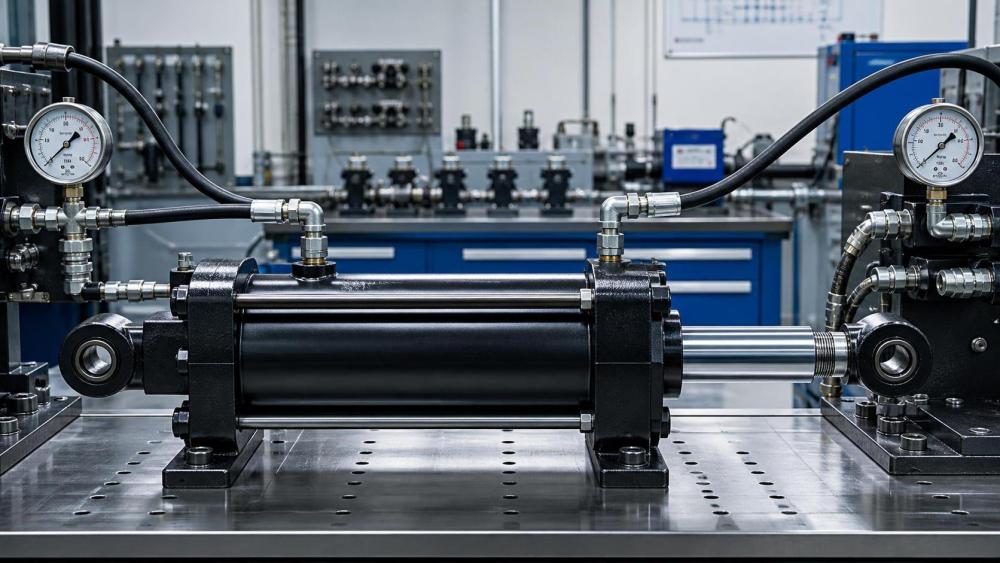
Do not mistake normal area differences for a cylinder fault
In a conventional single-rod double-acting cylinder, the cap-end effective area is larger than the rod-end annular area. With identical supplied flow, extension is usually slower than retraction. With identical pressure, extension force is higher than retraction force. This is basic geometry, but it is often overlooked when a machine has been modified, a replacement cylinder has a different rod diameter, or a flow-control valve has been reset after service.
The governing relationships are straightforward:
Force = Pressure × Effective area
Speed = Flow ÷ Effective area
If replacement work has changed bore size, rod diameter, stroke, port size, or hose routing, the original machine motion may not be reproduced even if the cylinder physically fits. A larger rod reduces the retract-side effective area, increasing retract speed at a given flow but reducing retract force. It can also increase the risk of return-side restrictions becoming visible as unstable motion.
Check the cylinder identification and drawing against the installed unit before assuming an internal defect. Important details include bore, rod diameter, stroke, mounting style, port thread, rated pressure, cushion arrangement, seal material, and whether the original design uses a special piston seal or wear-ring configuration.
Pressure comparison reveals more than a visual inspection
A double acting tie rod cylinder should be evaluated as part of the circuit. Isolating it too early can lead to unnecessary teardown. Where the system design permits safe testing, compare pressure at both ports during commanded extension and retraction, with and without normal load. Follow the equipment manufacturer’s lockout, depressurization, and stored-energy procedures before connecting gauges or loosening any hydraulic connection.
Several patterns are particularly informative:
- High pressure on the supply side with little movement: likely excessive external load, side loading, a bent rod, seized linkage, blocked return flow, or a mechanically damaged cylinder.
- Low pressure where normal force is expected: possible pump, relief-valve, directional-valve, proportional-valve, or upstream leakage issue.
- Pressure rising sharply near one end of stroke: cushion misadjustment, blocked exhaust path, trapped fluid, damaged cushion components, or an incorrect stroke/mounting arrangement.
- Pressure decay while a load is held: may result from internal piston-seal bypass, external valve leakage, load-holding valve leakage, or thermal effects. The cylinder should not be condemned until the circuit has been isolated sufficiently to distinguish these causes.
Internal bypass across the piston seal commonly produces reduced force, poor load holding, and heat generation. It does not always create external leakage. A cylinder with severe bypass may reach the end of stroke unloaded but stall or drift under production load. Conversely, external leakage at the rod gland may be obvious while the true source of seal damage is rod scoring, side loading, or pressure spikes.
Rod condition and alignment are central to recurring gland-seal failure
When rod seals fail repeatedly, inspect the rod surface before installing another seal kit. A rod that looks acceptable at a glance may have longitudinal scoring, chrome damage, corrosion pits, embedded contamination, weld spatter, impact dents, or a surface finish unsuitable for dynamic sealing. Each defect can act as a cutting edge or pumping path for oil.
Run a clean fingernail carefully across suspected marks. A defect that can be felt is likely to damage the sealing lip. Circumferential marks deserve attention, but longitudinal scratches are especially problematic because they create a direct leakage path along the rod. Corrosion often becomes more destructive after the cylinder has been parked outdoors or operated intermittently: the seal may survive normal cycling but tear when it passes over pitted areas after a long idle period.
Rod straightness must also be checked where uneven motion, gland wear, or localized seal damage is present. A bent rod may cause the piston and gland to run off-center. The result is uneven loading on guide rings and bearing surfaces, elevated seal friction, and premature extrusion or lip wear. A small bend can become significant on a long-stroke cylinder or where the machine linkage amplifies side forces.
Inspect the rod in extended, mid-stroke, and retracted positions where access permits. A rod may appear straight when extended but encounter side load as the attachment geometry changes. Look for polished areas on one side of the rod, uneven wear on gland bearings, asymmetric piston wear bands, and rubbing marks inside the barrel. These are evidence of lateral load, not merely seal deterioration.
Mounting stress can distort an otherwise sound tie-rod cylinder
Double acting tie rod cylinders are robust and serviceable, but they are not designed to compensate for poor machine alignment. Rigid mounting styles, such as flange or side-mounted arrangements, require accurate alignment with the moving load. Pin-mounted cylinders need pivots that move freely through the operating arc. When a pinned cylinder is installed with seized pins, worn bushings, incorrect spacers, or mispositioned clevises, the rod is forced to carry side load.
Mounting errors are frequently introduced after field repair. Common examples include tightening mounts while the mechanism is at an unfavorable position, installing unequal spacer packs, replacing a clevis with a dimensionally different part, or welding brackets without checking cylinder centerline. Excessive paint, burrs, corrosion scale, or distorted mounting plates can also prevent full contact and introduce twist into the cylinder body.
Tie rods deserve inspection as well. Loose tie rods can allow end-cap movement and compromise sealing between the barrel and end caps. Unevenly tightened tie rods may distort components or create uneven compression. They should be tightened in the manufacturer’s specified sequence and torque, not “balanced” by feel. If specifications are unavailable, obtain them from the cylinder manufacturer rather than applying a generic torque value; thread size, material grade, lubrication condition, and design all affect the correct setting.
Contamination damages seals, but the contamination source matters
Darkened oil, metal particles, elastomer fragments, water ingress, and abrasive dust can all shorten seal life. However, replacing fluid and filters without identifying the contamination path may only delay another failure. A torn wiper, damaged rod surface, contaminated service tools, poorly cleaned hose ends, failing pump components, or deteriorating hose lining can continuously reintroduce debris.
Inspect the removed seals rather than discarding them immediately. Their appearance often provides useful direction:
- Cut or nicked lips: contamination, sharp assembly edges, damaged rod finish, or poor installation tools.
- Hard, glazed, or brittle seals: excessive temperature, incompatible fluid, age-related degradation, or chemical exposure.
- Extruded seal material: pressure spikes, excessive clearance, worn gland or piston grooves, or incorrect seal selection.
- One-sided wear: rod misalignment, side load, bent rod, or worn guide elements.
- Swollen or softened elastomer: fluid incompatibility or contamination by solvents and incorrect lubricants.
Filter condition and oil analysis can support the diagnosis, particularly when more than one actuator is failing. A single cylinder with repeat damage often indicates a local mechanical issue. Multiple cylinders showing similar scoring, sluggishness, or seal distress point more strongly toward fluid cleanliness, temperature control, pump wear, or maintenance practices across the system.
Barrel, piston, and guide-ring inspection should be evidence-led
Once removal and disassembly are justified, inspect the barrel bore under good lighting. Look for scoring, corrosion, heat discoloration, and a distinct wear track. Deep scratches or chrome transfer from a damaged rod can rapidly destroy new piston seals. Light marks may be repairable only if the bore size, surface finish, and roundness remain within the cylinder manufacturer’s limits. Aggressive honing without dimensional control can increase clearance and make internal bypass worse.
Examine piston seals, wear rings, piston nut retention, cushion spear components, and gland bearings. Wear rings are not secondary parts: they keep the piston centered and prevent hard contact between metal surfaces. If worn rings are reused, new seals may fail quickly because they are asked to compensate for mechanical clearance they were not designed to control.
Check gland bore condition and seal grooves for burrs, deformation, corrosion, and sharp edges. A seal can be damaged during assembly before the cylinder returns to service. Use proper installation sleeves or tapered tools where needed, lubricate with a fluid compatible with the seal material and hydraulic medium, and protect seals from threaded sections, keyways, and port edges.
End-of-stroke faults may involve cushions, trapped pressure, or machine geometry
A cylinder that moves normally through most of its stroke but bangs, slows abruptly, or stalls near the end should not be diagnosed solely as a seal problem. Adjustable cushions restrict flow during the final part of travel. If the cushion needle is set too far closed, contaminated, damaged, or installed incorrectly, motion may become inconsistent near the end position. A blocked return path can create similar symptoms.
Also confirm that the cylinder is not reaching an external mechanical stop before its intended internal stop. An altered linkage, changed attachment, or incorrect replacement stroke can impose compressive loading at the end of travel. This can bend rods, loosen mounts, damage piston components, and create pressure spikes that extrude seals.
For applications with frequent high-speed reversals, evaluate valve switching characteristics, load inertia, accumulator behavior, and pressure relief performance. Repeated transient spikes may not appear on a standard gauge. If the failure pattern suggests pressure shock, a suitably rated pressure transducer and data logging may be needed to capture the event.
A repair is complete only when the cause has been removed
The most reliable repair sequence is not “seal kit first.” Confirm the motion complaint, compare pressure and flow behavior, inspect mounting and rod condition, review contamination evidence, and then disassemble with a defined inspection purpose. This approach prevents a common cycle in which a new seal kit masks the fault for a few weeks before external leakage returns.
Before commissioning, verify port connections, mounting hardware, pivot movement, tie-rod torque, fluid cleanliness, and correct bleeding procedures. Cycle the cylinder at low load first, inspect for leakage, then test under normal operating load while monitoring speed and temperature. Record the replaced components, measured rod condition, observed seal damage, pressure findings, and any alignment correction. Those records are often the fastest route to diagnosing the next issue—especially where the same machine family uses multiple double acting tie rod cylinders under similar duty conditions.
Recurring seal failure is usually a symptom of a system that is asking the cylinder to absorb contamination, misalignment, pressure events, or wear that should be controlled elsewhere. Finding that condition takes longer than replacing a seal, but it is the difference between restoring movement and restoring reliable service life.
Related News
- Using Industrial Air Blow Guns to Clear Chips Without Spreading DebrisOct 15, 2026Fluid Power Control Strategist
- Ductile Iron Pipe Valves: Which AWWA Standards Apply to Water Main Projects?Oct 15, 2026Dr. Elias Vance
- Why Vacuum Suction Cups Lose Grip on MDF in Woodworking MachinesOct 15, 2026CNC Kinematics Architect
- Choosing a Variable Displacement Piston Pump Manufacturer: What to VerifyOct 15, 2026Fluid Power Control Strategist
- Parallel vs. Angular Pneumatic Grippers for Confined Assembly StationsOct 15, 2026Fluid Power Control Strategist
- Die Castings vs. Investment Castings: Which Costs Less at Your Production Volume?Oct 14, 2026Foundry Phase-Change Fellow