
Compact Cylinder Price Factors: Comparing Bore Size, Stroke, and Mounting Costs
Compact Cylinder Price Factors: Comparing Bore Size, Stroke, and Mounting Costs
For procurement teams, compact cylinder price is shaped by more than the unit’s basic dimensions. Bore size, stroke length, mounting configuration, material selection, sealing requirements, and operating pressure can all change manufacturing complexity and total sourcing cost. Understanding how these factors interact helps buyers compare pneumatic or hydraulic compact cylinders accurately, avoid specification gaps, and select solutions that balance installation space, performance reliability, and long-term project value.
This matters because compact cylinders are often purchased as apparently simple catalog components, then installed in applications where access is limited, loads are offset, cycle rates are high, or replacement downtime is expensive. A lower quoted unit price can be valid for a basic actuator, yet become misleading when the buyer later adds mounting hardware, sensors, special ports, corrosion protection, or modifications required to make the cylinder fit the machine.
The useful question is therefore not “Which compact cylinder is cheapest?” It is “Which cylinder configuration delivers the required force, motion, mounting stability, and service life at the lowest credible total cost?”
Start With the Cylinder Type, Not the Price List
The term compact cylinder usually refers to a short-body actuator designed for machines with limited installation space. Pneumatic compact cylinders are common in packaging, assembly, material handling, fixtures, and automation equipment. Hydraulic compact cylinders may be selected where substantially higher force is required within a constrained envelope, such as clamping systems, lifting mechanisms, mobile equipment attachments, or industrial presses.
A direct price comparison only works when the fluid medium, rated pressure, bore, stroke, rod design, mounting interface, and included accessories are aligned. Comparing a standard pneumatic unit with a heavy-duty hydraulic unit, for example, says little about supplier competitiveness. Even two nominally similar pneumatic cylinders may have different body construction, piston materials, seal compounds, guide arrangements, port threads, and dimensional conventions.
Buyers should also identify whether the request is for a catalog-standard item or a modified version. Standardized dimensions generally make sourcing easier and reduce setup effort. A custom port position, nonstandard rod extension, special clevis, unusual thread, or integrated mechanical stop can move a purchase from routine assembly into engineering and low-volume production work.
Why Bore Size Has a Strong Effect on Compact Cylinder Price
Bore size is one of the clearest cost drivers because it determines the piston area and therefore the theoretical output force at a given operating pressure. As bore diameter increases, the cylinder typically requires a larger body, end covers, piston, seals, fasteners, and often a more substantial rod. Material consumption rises, but that is not the whole story.
Larger bores can require tighter control of machining surfaces and sealing interfaces. The manufacturer may need more robust fixtures, larger cutting tools, longer machining time, or a different production route for the body and covers. For hydraulic designs, pressure containment becomes especially relevant: wall thickness, thread engagement, seal groove geometry, and test procedures all need to suit the stated working conditions.
Procurement should resist selecting the next larger bore merely as a safety margin. Oversizing can increase purchase cost, air consumption or hydraulic flow demand, valve size, tubing requirements, and end-of-stroke impact. In a pneumatic system, excess force can also make delicate handling or controlled positioning harder. A sensible force calculation should include the actual operating pressure, expected load, friction, orientation, acceleration, and any external resistance. The calculation should then be reviewed with the equipment designer rather than treated as a procurement-only decision.
Stroke Length Changes More Than Overall Length
Stroke is often treated as a linear pricing factor: more travel means a slightly longer cylinder and a slightly higher cost. In reality, its impact depends on the combination of bore, rod diameter, load direction, speed, and mounting method. A longer stroke needs a longer cylinder tube and rod, but it may also raise concerns about rod deflection, side load, buckling in compression, guide wear, and end-of-stroke energy.
For a short-stroke clamping movement, a basic compact cylinder may be entirely appropriate. When travel becomes longer, the buyer should ask whether the compact body format still suits the duty. The cylinder may require a larger rod, external guide, cushioned end positions, shock absorbers, or a different actuator family. These additions can change the installed cost more than the extra tube length itself.
A further complication is the retracted and extended envelope. A cylinder with the required nominal stroke may interfere with guards, tooling, cables, or adjacent mechanisms when fully extended. If engineers later request a revised port location or altered rod end to solve that problem, the original low quote is no longer comparable.
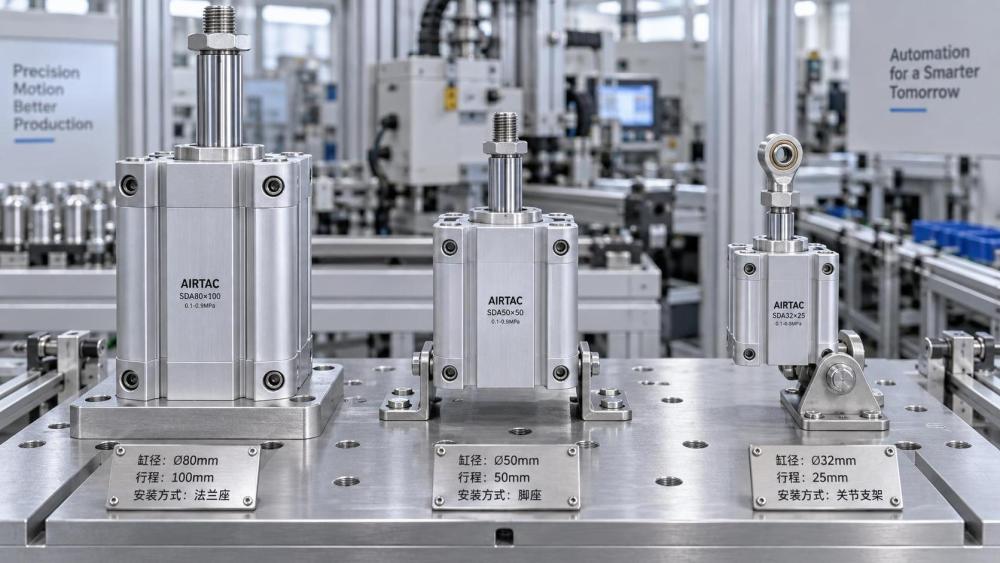
The most economical stroke is normally the one that provides the necessary movement with a realistic allowance for tolerances and adjustment—not the shortest possible stroke on paper, and not a generously oversized travel length that introduces stability issues. For repetitive machinery, it is worth documenting whether the actuator will run near full stroke every cycle or only use a limited part of travel. That distinction can affect cushioning, sensing, and maintenance expectations.
Mounting Costs Are Frequently Underestimated
Mounting is where many compact cylinder price comparisons become incomplete. A cylinder body may be economical, but the installation may need a front flange, rear flange, foot mount, clevis, trunnion, pivot bracket, rod-end joint, special fasteners, or a custom adapter plate. Some options are standard accessories; others require machining or fabrication around the machine interface.
The selection should follow the load path. A rigidly mounted cylinder can work well where the rod travels in a carefully aligned linear path. It is less forgiving where the driven part moves through an arc or where assembly tolerances introduce lateral force. In those situations, a pivoting arrangement or rod-end joint may reduce binding, but the additional components increase initial cost and may need periodic inspection.
Side loading deserves particular attention. Compact cylinders are designed to produce linear motion; they are not always intended to act as structural guides. A low-cost installation that relies on the piston rod to stabilize an offset load can lead to seal wear, rod scoring, sticking, or premature leakage. Adding a separate guide unit may look expensive in a quotation, yet it can be the more economical design when the application includes eccentric loads or repeated lateral forces.
For purchasing purposes, mounting should be listed as a separate line in the comparison sheet. This makes it clear whether a supplier’s offer includes brackets, nuts, pivot pins, rod-end hardware, and installation fasteners, or only the actuator itself.
The Configuration Details Behind Price Differences
Once bore, stroke, and mounting are aligned, several smaller details can still explain a meaningful price gap. They should not automatically be treated as optional extras. Their value depends on the operating environment and expected duty cycle.
- Body and rod materials: Aluminum-bodied pneumatic cylinders may suit dry indoor automation, while corrosive, washdown, outdoor, or chemically exposed environments can justify different materials or protective finishes.
- Seal selection: Seal compatibility must match the working medium, temperature range, lubrication conditions, and contamination risk. An unsuitable seal may reduce service life even when the cylinder dimensions are correct.
- Magnetic piston and sensors: Position sensing requires compatible internal construction and often separate sensor hardware, brackets, and cable management.
- Cushioning or external deceleration: Fast-moving loads can require controlled deceleration. Buyers should clarify whether cushioning is integrated, adjustable, unavailable, or expected to be provided elsewhere in the mechanism.
- Port, thread, and rod-end requirements: A supplier may quote the correct cylinder but with connections that do not match the plant’s fittings or existing machine drawings.
Custom engraving, special packaging, inspection records, material traceability, and application-specific testing can also affect price and lead time. These requirements are not equally necessary for every order. The practical approach is to separate what is essential for acceptance from what is merely preferred, then make that distinction visible in the request for quotation.
Comparing Quotes on a Like-for-Like Basis
A compact cylinder quotation is reliable only when the specification is controlled. Sending suppliers a brief description such as “compact cylinder, 50 mm bore, 100 mm stroke” will often result in offers that look comparable but are built around different assumptions. One supplier may include a magnet, another may not. One may price a mounting nut or flange separately. One may assume standard seals and indoor service, while another has allowed for a more demanding environment.
A useful RFQ should state the cylinder type, fluid medium, working and maximum pressure where applicable, bore, stroke, action type, rod-end geometry, mounting arrangement, port specification, required sensors, operating environment, estimated cycle pattern, quantity, and any drawing or interchangeability requirement. If the cylinder replaces an existing unit, photographs and dimensional drawings can prevent confusion over interfaces that are not visible in a basic part number.
Price should then be reviewed in layers: unit price, accessory cost, tooling or engineering charge if any, inspection and documentation, packaging, freight terms, duty exposure where relevant, and expected spare-parts availability. For recurring production, the cost of maintaining compatible inventory may matter as much as the initial purchase order.
Low Initial Cost Can Create a Higher Installed Cost
The least expensive compact cylinder can be the right choice for a simple, low-risk duty. Problems arise when a basic configuration is used outside its intended conditions. Common warning signs include a cylinder being asked to guide a load, an underspecified rod end transmitting misalignment, seals exposed to unsuitable media, or a long-stroke unit operating without adequate support.
Failures do not always begin with a dramatic breakdown. They may appear as inconsistent motion, increased air use, oil seepage, noisy end stops, sensor faults, or frequent adjustment by maintenance personnel. In an automated line, the cost of diagnosis and lost production can outweigh the original price difference quickly, even though the actuator itself is physically small.
This is why procurement teams benefit from involving maintenance and engineering before finalizing a high-volume or application-critical order. Their input often reveals installation constraints that a catalog comparison cannot capture.
A More Practical Buying Framework
Global Industrial Machining & Piping Equipment Network (IMPE) approaches fluid power purchasing as part of a wider mechanical system rather than an isolated component exercise. A cylinder interacts with valves, hoses or air lines, brackets, fixtures, load structures, controls, and maintenance practices. The same broader review is useful across hydraulic and pneumatic equipment, precision-machined parts, power-transmission assemblies, and heavy-duty industrial components: dimensional fit, material suitability, inspection expectations, and long-term service conditions all belong in the sourcing decision.
Before approving a compact cylinder purchase, confirm the actual force requirement, usable stroke, mounting load path, environmental exposure, connection interfaces, accessory scope, and replacement strategy. If any of these items remains uncertain, request drawings, dimensional data, and a clear statement of what the quoted configuration includes. That discipline produces a more meaningful compact cylinder price comparison—and reduces the chance that an apparently inexpensive actuator becomes an unplanned engineering correction after installation.
Related News
- How to Assess a Rigid Coupling Supplier for Bore Accuracy and Traceable QualityOct 08, 2026Tribology & Kinematics Expert
- Titanium Alloys Compared: Balancing Strength, Corrosion Resistance, and MachinabilityOct 08, 2026CNC Kinematics Architect
- Where Ductile Iron Dismantling Joints Reduce Alignment Risk in Water PipelinesOct 08, 2026Pipeline Metallurgy Scientist
- Selecting a Precision Bearing Sleeve: Fits, Runout, and Material ChoicesOct 08, 2026Tribology & Kinematics Expert
- Face Milling Cutters: How Insert Geometry Affects Finish on Steel and AluminumOct 08, 2026CNC Kinematics Architect
- Single-Acting Cylinders for Clamping: Stroke, Force, and Return Spring ConsiderationsOct 07, 2026Fluid Power Control Strategist