
Choosing High Pressure Hydraulic Cartridge Valves for Leak Control and Fast Response
On many projects, hydraulic valve selection becomes urgent only after something has already gone wrong: a cylinder drifts when it should hold position, a manifold runs hot under load, a machine reacts a fraction too slowly, or an operator reports inconsistent motion at peak pressure. For project managers responsible for uptime, safety, and delivery schedules, choosing high pressure hydraulic cartridge valves is rarely a small procurement task. It sits at the intersection of leak control, response speed, maintenance burden, and system stability.
In demanding hydraulic circuits, especially those used in construction equipment, industrial presses, material handling systems, and high-load mobile or stationary machinery, the right cartridge valve can reduce internal leakage, sharpen actuation response, and preserve performance where pressure spikes and continuous cycling would quickly expose weak component choices. The challenge is that valves with similar labels may behave very differently once installed in a real system.
That is why selection should start not with a catalog page, but with the actual operating reality of the machine.
Why leak control and fast response often pull selection in two directions
Project teams usually want both: near-zero leakage and very fast response. In practice, these goals are related, but not identical.
A valve optimized for extremely tight sealing may require closer tolerances, cleaner fluid, more careful material pairing, or a specific seat design. A valve optimized for rapid switching may prioritize flow path efficiency, moving element mass, pilot ratio, spring behavior, and pressure balance. Under high pressure, every design compromise becomes visible. Even minor internal leakage can create heat, drift, energy loss, or loss of holding accuracy. At the same time, sluggish response can reduce cycle efficiency, soften machine control, and affect safety in systems where timing matters.
This is especially important in modern heavy industry, where hydraulic systems are expected to behave with the same discipline as precision mechanical assemblies. Whether the application is a forging line, a high-force clamping unit, or a mobile boom under dynamic loading, the valve must do more than “open and close.” It must hold, meter, release, and recover predictably.
What project managers should clarify before comparing cartridge valves
Before evaluating brands, cavity compatibility, or unit cost, it helps to answer five practical questions with the engineering and maintenance teams:
- What kind of leakage is unacceptable? External leakage is obvious, but internal leakage is often the more expensive hidden issue because it affects heat generation, load holding, and repeatability.
- Is the application pressure steady or highly dynamic? A valve that performs well at stable pressure may behave differently under shock loads, pressure pulsation, or rapid reversal.
- How critical is response time to the machine cycle? In some circuits, milliseconds matter. In others, stable modulation matters more than raw speed.
- What is the fluid cleanliness reality on site? Tight-clearance valves can deliver excellent performance, but contaminated systems punish them quickly.
- Is field serviceability part of the selection priority? Cartridge valves are often chosen for compact manifold integration, but accessibility and replacement simplicity still matter over the project life cycle.
These questions sound basic, yet they often separate a durable valve choice from an expensive mismatch.
Not all cartridge valve designs manage high pressure the same way
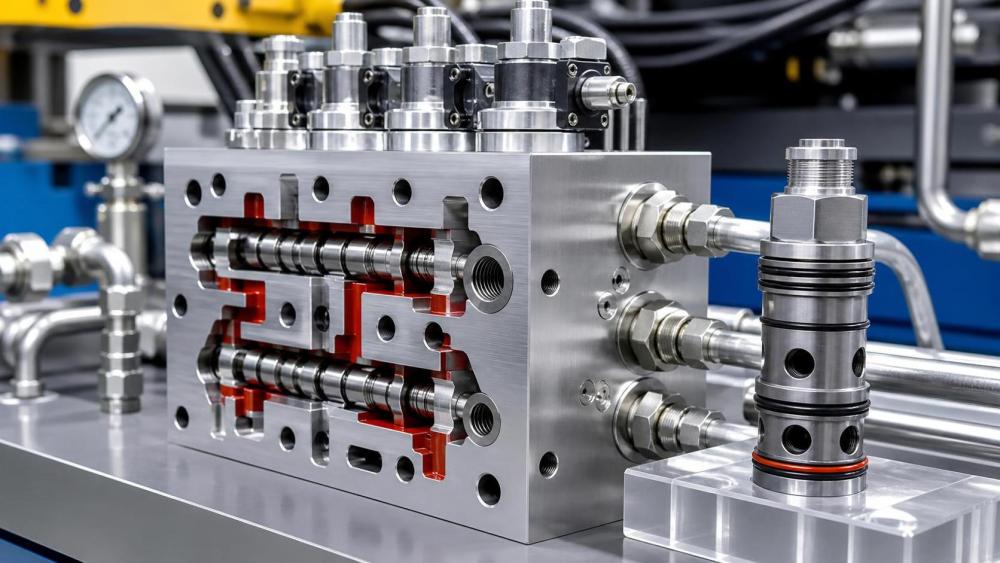
When buyers search for high pressure hydraulic cartridge valves, they are often comparing products within a broad category that includes check valves, relief valves, counterbalance valves, sequence valves, flow control valves, and logic elements. The term “cartridge” describes the format, not the function. What matters is how the internal design responds to pressure, flow demand, and sealing requirements.
A few design factors deserve close attention:
Seat-style versus spool-style sealing behavior
Seat valves are often preferred where very low leakage is essential, particularly in load-holding applications. Their sealing interface can provide stronger shutoff performance than spool-based designs, which naturally rely on close clearance control and may allow more internal leakage over time. That does not make spool valves a poor choice; they remain valuable for modulation and flow control tasks. But if the application cannot tolerate drift, a seated design is often the first place to look.
Pressure-balanced construction
Under high pressure, unbalanced hydraulic forces can slow actuation, increase wear, or make performance less predictable. Pressure-balanced cartridge valves help maintain consistent switching characteristics and can improve controllability where system pressure varies widely.
Pilot section sensitivity
In pilot-operated valves, response quality depends heavily on pilot flow path design, spring rate, damping, and cracking pressure behavior. A valve may look strong on paper but still react too slowly if the pilot circuit is not matched to the system.
Flow path geometry
Fast response is not only about actuation speed. Restrictive internal geometry can create pressure drop, local heating, and flow instability. In high-cycle systems, these losses add up.
For this reason, valve selection should always consider the manifold, not just the valve itself. A well-designed cartridge installed in a poorly conceived cavity layout can still underperform.
The hidden cost of internal leakage in high-pressure systems
Leak control is often discussed as a reliability concern, but for project managers it is also a cost-control issue. Internal leakage does not leave a puddle on the floor, so it is easy to overlook during early operation. Yet it can quietly drive several downstream problems:
- Unwanted actuator drift in lifting or holding applications
- Higher oil temperature and cooling demand
- Reduced energy efficiency from continuous pressure loss
- Inconsistent cycle repeatability
- Accelerated wear in pumps and other hydraulic components
In a pressurized industrial environment, heat is often the first symptom that leakage is doing damage. Teams may blame the pump, the fluid, or the duty cycle, when the real issue sits inside a valve that never seals as tightly as the application requires.
This is why “acceptable leakage” should be defined early. For a simple utility function, minor leakage may be manageable. For a suspended load, precision clamp, or safety-critical holding circuit, it may not be acceptable at all.
How to evaluate fast response without getting trapped by catalog language
Manufacturers often describe valves as “high response,” “fast acting,” or “optimized for dynamic performance.” Those descriptions are useful only if you connect them to the real operating conditions.
A cartridge valve that switches rapidly in a controlled test environment may respond differently once you add hose length, pilot line restrictions, fluid viscosity changes, manifold complexity, and pressure fluctuations. In field conditions, response is a system characteristic, not just a component specification.
For project evaluation, ask more grounded questions:
- How does the valve perform across the actual pressure range, not just at nominal pressure?
- What is the effect of temperature and viscosity change on switching behavior?
- Does the valve response remain stable after extended cycling?
- Is there evidence of chatter, overshoot, or hesitation under load reversal?
- How sensitive is the valve to pilot pressure quality and contamination?
If the machine requires precise motion control, response consistency matters more than a single impressive actuation number.
Selection criteria that matter more than price per piece
For large projects or fleet-based equipment planning, unit price naturally gets attention. But experienced project leaders know that the lowest valve cost can become the highest lifecycle expense if it creates field failures, excess heat, or unstable control.
Several criteria usually deserve more weight:
Cavity standardization and manifold fit
Compatibility affects sourcing flexibility, replacement speed, and maintenance planning. Standard cavity formats can reduce risk, but verify that “interchangeable” really means functionally equivalent under pressure, not just dimensionally similar.
Material and surface durability
At high pressure, wear resistance is not a detail. Surface finish, hardness, corrosion resistance, and contamination tolerance all influence sealing stability and spool or poppet life. This is especially relevant in harsh industrial settings where moisture, particulate ingress, or inconsistent maintenance practices are realities.
Seal selection
Elastomer compatibility with fluid type, temperature range, and pressure cycling affects both leakage control and service life. The wrong sealing material may survive initial testing and still fail prematurely in actual duty conditions.
Maintenance reality
A valve may be technically excellent yet impractical for a site where service windows are short and hydraulic cleanliness is difficult to maintain. Selection has to respect field conditions, not just engineering ideals.
Common mistakes when choosing high pressure hydraulic cartridge valves
Some selection errors appear again and again across industrial projects.
One is assuming pressure rating alone defines suitability. A valve may be rated for the target pressure and still perform poorly because its leakage behavior, response characteristics, or contamination tolerance are misaligned with the application.
Another is underestimating transient conditions. Machines do not always live at their nominal operating point. Pressure spikes, rapid reversals, shock loads, and thermal swings often reveal weaknesses that steady-state calculations miss.
A third mistake is treating all load-holding requirements the same. Holding a static load is different from controlling an overrunning load or stabilizing a suspended mass under vibration. The valve function must match the motion risk.
There is also a recurring integration error: selecting a capable valve but neglecting manifold machining quality, cavity finish, or assembly cleanliness. In sectors shaped by precision expectations, whether in machining, forging, or fluid systems, micron-level deviations can still influence hydraulic behavior in very practical ways.
A practical decision framework for project teams
If you are narrowing options for a new build or retrofit, a useful approach is to score candidates against operational priorities rather than reviewing them feature by feature in isolation.
Start by ranking the application in four dimensions: leakage sensitivity, response sensitivity, pressure severity, and maintenance exposure. A machine that must hold position with minimal drift under severe pressure should push low-leakage sealing to the top of the list. A machine built around rapid repetitive motion may prioritize dynamic response and flow stability. If the installation environment is remote or service conditions are rough, contamination tolerance and replacement simplicity become far more important.
Then involve more than one discipline in the final evaluation. Design engineers understand circuit intent, maintenance teams understand what actually fails, and project managers understand the cost of downtime. The best valve choices usually emerge where those perspectives meet.
Where this matters most in heavy industrial applications
Within the broader IMPE landscape of machining, piping, forging, bearings, and fluid power, hydraulic cartridge valve selection matters most where force and timing must coexist. Forging presses require stable pressure control under punishing loads. Material handling systems need secure load holding without drift. Mobile equipment depends on fast, repeatable hydraulic reaction in environments that are far less clean than laboratory conditions. Industrial automation cells often need compact manifold-mounted solutions that fit tight layouts without sacrificing reliability.
Across these settings, the same principle holds: the valve is small, but its consequences are not. It influences thermal behavior, motion quality, safety margins, and maintenance intervals in ways that ripple through the entire hydraulic architecture.
Choosing with fewer surprises later
The best high pressure hydraulic cartridge valves are not simply the highest-rated or the fastest-advertised options. They are the ones whose sealing method, pressure balance, pilot behavior, material durability, and manifold compatibility match the machine’s real demands.
For project managers, that usually means resisting the temptation to buy by label alone. Ask where leakage would hurt most. Ask whether response must be fast, stable, or both. Ask how the valve behaves after long cycling, under contamination risk, and during pressure transients. Those are the questions that protect schedules and reduce unpleasant surprises after commissioning.
In high-pressure hydraulics, good selection work is rarely dramatic. It simply shows up later as smoother operation, fewer callbacks, less heat, and a system that behaves as intended when pressure is at its worst.
Related News
- How to Assess a Rigid Coupling Supplier for Bore Accuracy and Traceable QualityOct 08, 2026Tribology & Kinematics Expert
- Titanium Alloys Compared: Balancing Strength, Corrosion Resistance, and MachinabilityOct 08, 2026CNC Kinematics Architect
- Where Ductile Iron Dismantling Joints Reduce Alignment Risk in Water PipelinesOct 08, 2026Pipeline Metallurgy Scientist
- Selecting a Precision Bearing Sleeve: Fits, Runout, and Material ChoicesOct 08, 2026Tribology & Kinematics Expert
- Face Milling Cutters: How Insert Geometry Affects Finish on Steel and AluminumOct 08, 2026CNC Kinematics Architect
- Single-Acting Cylinders for Clamping: Stroke, Force, and Return Spring ConsiderationsOct 07, 2026Fluid Power Control Strategist