
Are Globe Valves Still Preferred for Throttling in Water Networks?
Are Globe Valves Still Preferred for Throttling in Water Networks?
Are globe valves still preferred over ball valves for throttling in water networks? For many municipal and industrial applications, yes, but only where controllable regulation outweighs pressure-loss penalties.
Ball valves remain the stronger choice for rapid isolation, minimal head loss, and compact installation. Globe valves remain valuable when operators need stable, repeatable adjustment across changing flow and pressure conditions.
The practical decision is not whether one valve is universally better. It is whether the selected valve matches the control duty, system hydraulics, maintenance strategy, and operating risk.
Municipal utilities, EPC contractors, and water-system designers should evaluate valve selection as a lifecycle decision. Initial purchase price matters, but unstable control, cavitation damage, leakage, and difficult servicing can cost far more.
This article explains where globe valves continue to serve water networks effectively, where ball valves should take priority, and how project teams can make a defensible selection.
Why Globe Valves Remain Relevant for Water Flow Control
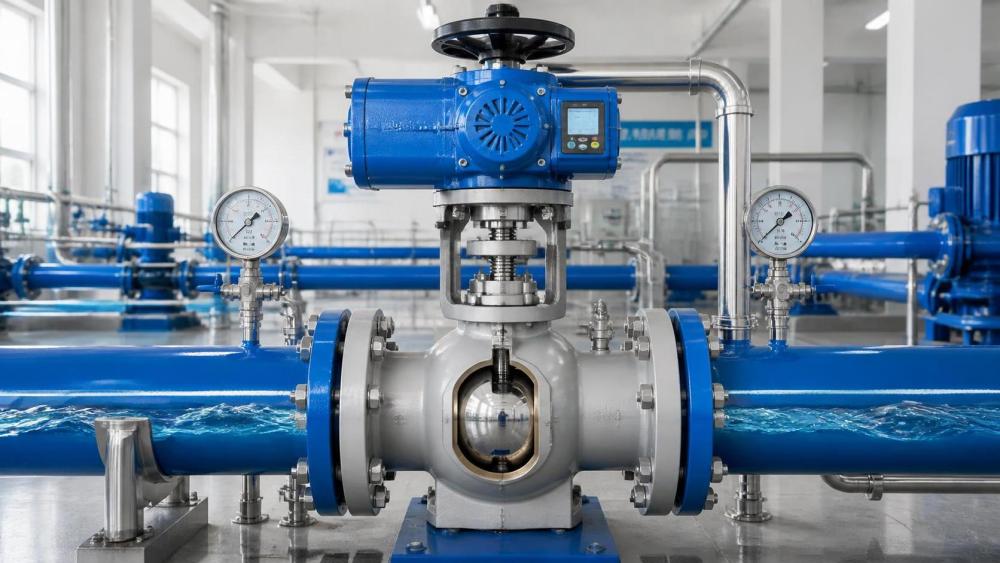
Globe valves were designed around a flow path that supports regulation. Their plug-and-seat arrangement allows operators to make gradual changes in opening position with relatively predictable flow response.
That characteristic matters in water networks where flow must be adjusted rather than simply started or stopped. Typical examples include bypass lines, treatment-plant processes, reservoir outlets, and pressure-management stations.
A conventional globe valve produces higher resistance than a full-port ball valve. However, that resistance is often accepted when it helps create more stable control at intermediate positions.
In throttling service, the valve may operate partially open for extended periods. Globe valve trim is generally better suited to this duty than the soft seats commonly used in many standard ball valves.
Globe valves can also be equipped with specialized trims, balanced plugs, hardened seating surfaces, and actuators. These options support closer control in demanding applications with varying differential pressure.
For water utilities, the key advantage is operational predictability. Operators can use valve position as a meaningful adjustment tool instead of treating the valve as an imperfect restriction device.
Where Ball Valves Perform Better Than Globe Valves
Ball valves are exceptionally effective for isolation. A quarter-turn motion provides fast opening or closing, and full-bore designs can maintain a flow path close to the connected pipe diameter.
Low head loss is a major advantage in long transmission mains, pump discharge lines, and systems where available pressure is limited. Every unnecessary restriction increases pumping energy requirements.
Ball valves are also compact, relatively simple, and easy to automate for on-off duties. Their short face-to-face dimensions can simplify installation in constrained valve chambers and packaged systems.
For emergency isolation, maintenance shutdowns, or sectionalizing a distribution network, ball valves often provide a better operational result than globe valves. They can close rapidly with suitable actuator design.
Standard ball valves are less attractive when held partly open for continuous regulation. High-velocity water can erode seats, damage coatings, generate noise, and make actual flow response difficult to predict.
Some characterized ball valves are engineered specifically for control duties. These products can be appropriate, but project teams should evaluate their trim design and control curve rather than assuming every ball valve throttles well.
Control Accuracy Depends on the Entire Valve Assembly
A globe valve does not automatically deliver precise control simply because of its body style. Control quality depends on valve sizing, trim geometry, actuator capability, positioner performance, and system pressure conditions.
An oversized globe valve can be difficult to control because small movements near the closed position may produce disproportionate flow changes. Oversizing is a frequent source of poor throttling performance.
Valve authority is especially important in automated water systems. A control valve should absorb enough differential pressure to influence flow, without consuming excessive pressure that should remain available downstream.
Engineers should compare the installed flow characteristic, not only the manufacturer’s inherent characteristic. Pipe friction, pumps, elevation changes, and parallel flow paths can substantially alter actual performance.
Equal-percentage trim is useful where pressure drop varies widely during operation. Linear trim may better suit applications where the valve differential pressure remains relatively stable across the control range.
For manually operated systems, stem position indicators and repeatable handwheel adjustment are important. Operators need practical feedback when setting bypass flow, tank filling rates, or process-water distribution.
For automated systems, specify an actuator and positioner capable of stable modulation. A well-designed globe valve with an unsuitable actuator can hunt, oscillate, or fail to achieve the intended flow setpoint.
Pressure Loss Is the Main Trade-Off in Globe Valve Selection
The most significant disadvantage of globe valves is pressure loss. Their internal flow path changes direction, which creates turbulence and requires more pump energy than a comparable full-port ball valve.
In a gravity-fed network, this additional loss can reduce useful downstream pressure. In pumped systems, it can increase energy consumption and potentially affect pump operating efficiency.
That does not mean globe valves should be excluded from water projects. A throttling valve must create some pressure drop to control flow, and this loss may be intentional within the hydraulic design.
The question is whether the valve creates the required controllable restriction efficiently. A poorly selected ball valve may appear hydraulically efficient but create unstable control and repeated maintenance problems.
Teams should calculate pressure loss at minimum, normal, and maximum operating flow. Reviewing only the design flow can conceal unacceptable conditions during low-demand, startup, or emergency operation.
Use manufacturer flow coefficients, such as Cv or Kv, with verified fluid conditions. Do not rely solely on nominal valve size, because different valve designs can have very different effective capacities.
In large municipal mains, dedicated control valves, butterfly valves with suitable control characteristics, or pressure-reducing valves may also be better candidates than either globe or standard ball valves.
Cavitation, Noise, and Erosion Can Change the Decision
Cavitation is a critical concern when water passes through a restriction under a large pressure drop. Local pressure can fall below vapor pressure, creating bubbles that collapse downstream.
The collapse of vapor bubbles can cause vibration, severe noise, trim erosion, coating damage, and pitting in valve bodies or connected piping. These effects shorten service life.
Globe valves can be configured with anti-cavitation trim, multi-stage pressure reduction, or hardened internal components. Such options make them suitable for severe service when properly specified.
A ball valve operating partially open can create high-velocity jets around the ball and seat. This geometry may increase local turbulence and make cavitation damage more difficult to manage.
However, a globe valve is not immune to cavitation. A standard single-seat design may fail quickly if it is placed across excessive differential pressure without appropriate trim selection.
Water-network designers should review upstream pressure, downstream pressure, water temperature, expected flow range, and transient events. Hydraulic modeling should include abnormal operating scenarios, not only normal demand.
Pressure surges from pump starts, pump trips, and rapid valve movement can alter the risk significantly. Valve closing speed and actuator control logic must be coordinated with surge-management measures.
Maintenance Access and Lifecycle Cost Matter More Than Purchase Price
Globe valves often require more maintenance attention than simple isolation ball valves, particularly in systems with abrasive solids, scale, or poor water quality. Their trim components experience continuous flow exposure.
At the same time, many globe valves offer maintainable internal parts. Depending on the construction, seats, plugs, packing, and guides may be inspected or replaced without removing the entire valve body.
Ball valves can have long service lives in clean water isolation duty. Their simplicity becomes a major lifecycle advantage when they remain fully open or fully closed most of the time.
When a soft-seated ball valve is used for repeated throttling, seat wear may lead to increased operating torque, leakage, or poor shutoff. Replacing a failed valve can disrupt service.
Utilities should consider accessibility before choosing any control valve. A technically suitable valve becomes expensive when it is installed in a chamber that requires shutdown, confined-space entry, or extensive excavation for service.
Procurement teams should request spare-parts availability, material certificates, pressure-test records, coating details, actuator documentation, and local service capability. These factors affect long-term ownership risk.
Lifecycle cost should include energy loss, scheduled maintenance, outage consequences, spare parts, labor, and asset replacement. The lowest quoted valve price rarely represents the lowest total project cost.
How to Select the Right Valve for Common Water Network Duties
For main-line isolation, choose a ball valve when low pressure loss, quick operation, and reliable shutoff are the primary requirements. Confirm pressure rating, seat material, and actuator torque.
For continuously adjusted bypass flow, a globe valve is usually the stronger starting point. Select the trim according to expected flow range, differential pressure, cavitation potential, and required control precision.
For pump recirculation and minimum-flow protection, the decision depends on flow stability and pressure drop. Globe-style control arrangements often provide better modulation, especially under changing pump conditions.
For reservoir filling, level control, and treatment-process dosing, stable response is generally more important than minimal valve loss. Globe valves or purpose-built control valves are commonly appropriate.
For emergency shutoff, sectional isolation, and distribution-zone isolation, ball valves offer clear advantages. Their quarter-turn action can support rapid response when paired with correctly configured automation.
For high-pressure reduction, evaluate specialized pressure-control valves before selecting a general globe valve. Multi-stage designs may be required to reduce cavitation, noise, and erosion risk.
For wastewater or raw-water service with solids, assess clogging tolerance carefully. A conventional globe valve may not be suitable where debris accumulation can obstruct trim movement or compromise shutoff.
Questions EPC Teams Should Ask Before Finalizing Specifications
First, define whether the valve is intended for isolation, occasional adjustment, continuous control, pressure reduction, or surge protection. Mixing these duties in one generic specification causes selection errors.
Second, establish the complete operating envelope. Include minimum and maximum flow, upstream and downstream pressure, water temperature, solids content, water chemistry, and expected operating hours.
Third, identify the required shutoff class and acceptable leakage. A valve selected for excellent throttling may need additional features if tight isolation is also essential for maintenance safety.
Fourth, review material compatibility. Ductile iron, carbon steel, stainless steel, bronze, rubber linings, epoxy coatings, and trim alloys should match water quality, corrosion exposure, and project standards.
Fifth, confirm installation orientation and available maintenance clearance. Globe valves may have preferred flow direction, while actuator access and lifting space can determine whether future servicing is practical.
Sixth, require documented factory testing and traceability. For municipal and industrial projects, hydrostatic testing, dimensional checks, coating inspection, and material documentation support commissioning and asset records.
Finally, evaluate the supplier’s application engineering capability. A supplier that can calculate sizing, recommend trim, and explain limitations is more valuable than one offering only a catalog selection.
Globe Valves Are Preferred When Control Value Justifies Their Losses
Globe valves are still preferred for throttling in water networks when the duty requires controlled, repeatable, and stable flow adjustment. Their continued role is based on function, not tradition.
Ball valves remain excellent for isolation and low-resistance flow paths. They should not be dismissed, but standard designs should not automatically be assigned to sustained throttling duty.
The most reliable selection method starts with the operating duty, then checks hydraulic capacity, pressure loss, cavitation risk, materials, automation requirements, maintenance access, and lifecycle cost.
For municipal utilities and EPC contractors, the correct choice is often a combination of valve types. Ball valves isolate the network, while globe or specialized control valves regulate critical flow conditions.
Choosing between globe valves and ball valves should therefore be a system-engineering decision. When control accuracy protects service continuity, equipment life, and energy performance, globe valves remain highly relevant.
Related News
- How to Assess a Rigid Coupling Supplier for Bore Accuracy and Traceable QualityOct 08, 2026Tribology & Kinematics Expert
- Titanium Alloys Compared: Balancing Strength, Corrosion Resistance, and MachinabilityOct 08, 2026CNC Kinematics Architect
- Where Ductile Iron Dismantling Joints Reduce Alignment Risk in Water PipelinesOct 08, 2026Pipeline Metallurgy Scientist
- Selecting a Precision Bearing Sleeve: Fits, Runout, and Material ChoicesOct 08, 2026Tribology & Kinematics Expert
- Face Milling Cutters: How Insert Geometry Affects Finish on Steel and AluminumOct 08, 2026CNC Kinematics Architect
- Single-Acting Cylinders for Clamping: Stroke, Force, and Return Spring ConsiderationsOct 07, 2026Fluid Power Control Strategist