
Where Do Vacuum Generators with Integrated Silencers Reduce Noise in Automation Cells?
In a busy automation cell, the sharp exhaust sound from compressed-air vacuum equipment can be more disruptive than the movement of the robot or conveyor itself. The noise is often most noticeable when a pick-and-place unit releases a part, when several suction cups cycle together, or when a pneumatic ejector is mounted close to an operator access point. Vacuum generators with integrated silencers reduce noise most effectively where the exhaust is released inside or immediately beside the guarded working area, rather than being routed to a remote pneumatic panel.
The best locations are typically end-of-arm tooling, compact handling modules, packaging stations, assembly fixtures, and machine-tending cells with frequent vacuum cycles. An integrated silencer does not eliminate every source of cell noise, but it attenuates the exhaust discharge at its source and can avoid the need for separate mufflers, extra fittings, and exhaust tubing. The practical question is not simply whether the cell is noisy; it is whether exhaust noise is occurring close enough to people, sensors, inspection activities, or open work areas that local noise control improves the cell without creating maintenance or vacuum-performance problems.
Where integrated silencers make the clearest difference
Robot end-of-arm tooling
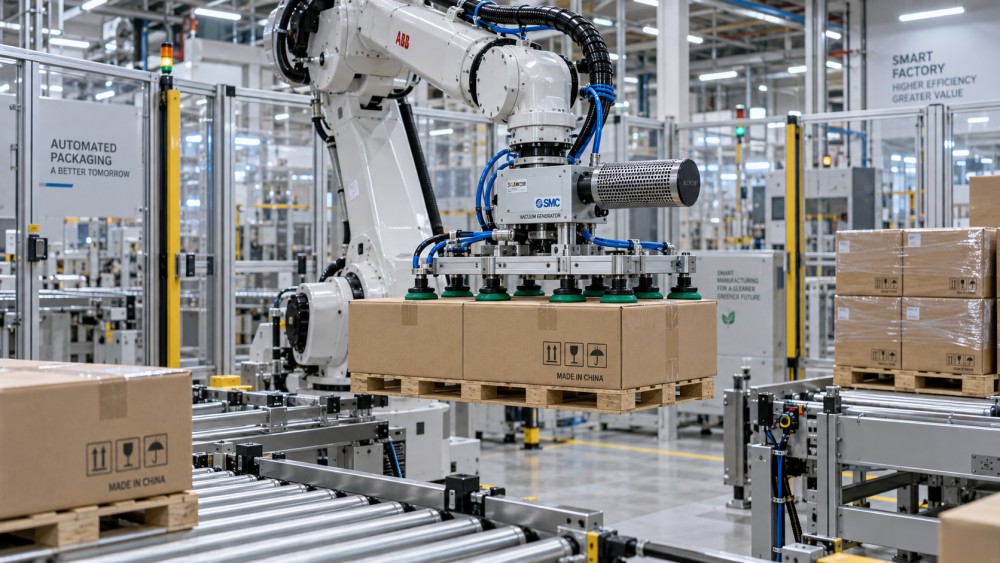
Robot-mounted vacuum grippers are among the strongest applications for an integrated silencer. The generator is often installed directly on the tool to reduce the volume between the vacuum source and suction cups. This arrangement can improve response time, but it also places the exhaust close to the robot path, loading zone, and sometimes the operator side of the cell.
During carton handling, sheet transfer, plastic-part picking, or bin unloading, the exhaust pulse may occur hundreds or thousands of times during normal production. A standalone exhaust muffler can be difficult to fit on a compact end effector. It may add mass, protrude beyond the tool envelope, or create another part that can be struck during a robot recovery move. A vacuum generator with an integrated silencer keeps the noise-control element within the unit body, making it especially useful where payload, clearance, and cable-and-hose routing are already tightly controlled.
The benefit is greatest when the end effector works near an open loading station or a manual replenishment zone. It is less decisive when the robot is fully enclosed and the main audible issue comes from other equipment, such as a vacuum pump, blower, conveyor drive, or unguarded compressed-air blow-off nozzle.
Packaging and palletizing stations
Packaging equipment often uses vacuum to pick blanks, lids, pouches, labels, trays, and finished cartons. These stations can have multiple vacuum circuits operating in a short sequence: pick, verify, place, release, and return. Even when each individual ejector is small, several un-silenced exhausts cycling in the same enclosure can create a persistent high-frequency sound.
Integrated silencers are useful on compact vacuum modules installed beside magazine feeders, carton erectors, case packers, and palletizing grippers. They reduce the need to locate separate silencers in narrow spaces where adjustment access is already limited. In cells where operators regularly clear jams or replenish materials, reducing local exhaust noise can also make abnormal sounds easier to notice. A loose chain, an air leak, or a failing actuator may be easier to identify when it is not masked by repeated exhaust bursts.
There is an important boundary: high-speed packaging lines may consume enough vacuum flow that a small built-in silencer becomes a maintenance-sensitive restriction point. The generator must still be selected for required suction flow, evacuation time, and release behavior. Noise reduction should not be achieved by fitting a silencer arrangement that slows part release or causes vacuum recovery to become unstable.
Machine tending and CNC loading
In machine-tending cells, vacuum grippers may handle machined plates, stamped components, sealed housings, lightweight castings, or finished parts that cannot be gripped on cosmetic surfaces. The robot may stand near a CNC machine door, a gauge station, and a part tray that personnel approach during shift change or material loading. Noise control at the vacuum source matters here because the cell often has intermittent quiet periods. A sudden ejector exhaust can be particularly noticeable when the machine spindle is stopped, the door is open, or an operator is inspecting parts.
A compact generator with an integrated silencer is also easier to protect from chips and coolant than a loosely mounted external muffler. That does not mean it is immune to contamination. Fine metal particles, coolant mist, and oily shop air can still affect the exhaust path. The installation should keep the exhaust side away from direct chip spray, washdown streams, and areas where debris can settle into ports.
Assembly and test fixtures near people
Manual-assisted assembly cells often use vacuum nests to hold gaskets, covers, electronic housings, thin metal parts, or delicate components while another process is completed. The fixture may be quiet except for air-driven functions. In this setting, a brief exhaust event can be more noticeable than it would be on a large production line.
Integrated silencers are well suited to low-profile fixtures where the generator is mounted beneath a work surface, inside a compact guard, or beside a locating nest. They help reduce the exposed hardware around the fixture and can prevent a separate exhaust muffler from becoming a snag point for cables, workpieces, or cleaning tools. The placement still needs review: a silenced exhaust that vents directly into an enclosed fixture cavity can create heat buildup, retain contamination, or complicate cleaning. The exhaust must have a clear path to the surrounding atmosphere unless the system is intentionally designed for remote exhaust handling.
Noise symptoms that point to the vacuum exhaust
Not every pneumatic sound calls for a silenced vacuum generator. Before changing hardware, separate vacuum exhaust noise from other sources in the cell. Exhaust noise usually has a short, sharp character tied directly to vacuum generation or release. It may be heard when a suction command starts, when the generator switches between energy-saving modes, or when the part is released.
- A hiss appears only while vacuum is being generated and stops when the ejector valve closes.
- The sound is strongest around the gripper body, vacuum manifold, or local pneumatic module rather than the air preparation unit.
- Noise increases when more suction cups are exposed, such as during a failed pick or an open-cup condition.
- The sound changes after a tool change, gripper adjustment, or replacement of a vacuum component.
- A separate muffler is present but appears dirty, damaged, loose, or incorrectly installed.
A continuous loud hiss may indicate more than normal exhaust discharge. It can result from a leaking supply fitting, a failed valve, an open vacuum cup, worn cup lip, cracked hose, or an ejector that remains energized because of control logic. Installing a quieter unit without correcting that underlying condition can hide a useful warning sign while compressed-air consumption remains excessive.
Choosing the location instead of treating every generator the same
When reviewing a cell layout, start with the generator’s physical location and duty cycle. A unit mounted on a robot wrist has different priorities from one mounted in a cabinet. On-tool installations benefit from compactness and reduced local exhaust noise, but they are exposed to movement, vibration, and possible collisions. Panel-mounted units are easier to service, yet exhaust tubing may be required if noise must be controlled near the point where air is discharged.
Sound pressure at the operator position is affected by guarding, wall reflections, machine enclosures, and the direction of the exhaust. A silenced generator pointed toward a solid guard panel may still create a noticeable reflected sound. Conversely, a standard generator located inside a well-designed acoustic enclosure may contribute little to the external workplace noise level. The selection should therefore be based on the actual acoustic path, not on the assumption that every ejector needs the same treatment.
Do not trade noise reduction for poor vacuum behavior
An integrated silencer is part of the exhaust path. Any restriction in that path can influence ejector performance, particularly when the silencer becomes loaded with dust, oil, fibers, or moisture. The risk is higher in applications handling corrugated packaging, powdered materials, machining debris, or products that shed fragments. Project requirements should identify the expected environment before specifying the unit.
Check the vacuum generator’s documented operating conditions against the application, including supply pressure, required vacuum level, suction flow, and installation orientation where relevant. Then examine the process behavior rather than relying only on a nominal specification. Does the gripper reach a stable vacuum before the robot accelerates? Does the part release fully at the required point in the cycle? Does a failed pick create a prolonged high-flow condition? Are cups exposed to dust or coolant that may be drawn toward the generator?
For porous materials such as corrugated board, foam, textiles, or unfinished wood, the vacuum circuit may deliberately operate with ongoing airflow. In these cases, exhaust noise can be sustained rather than momentary, so a silencer has clear value. At the same time, the generator must be sized for the leakage inherent in the material. A quiet but undersized unit can create missed picks, weak holding force, and repeated retries that make the overall cell less efficient.
Installation details that affect real-world results
Noise reduction depends on installation quality as much as on the component itself. Place the unit where its exhaust port remains unobstructed throughout robot motion, fixture adjustment, and normal cleaning. Avoid sealing the generator into a small enclosure without adequate ventilation. Do not place labels, protective films, cable ties, or machine covers across the silencer outlet.
Supply-air quality also matters. Water, compressor oil carryover, and particulate contamination can degrade pneumatic components and shorten the useful service interval of exhaust-silencing elements. Appropriate filtration and drainage upstream help preserve consistent operation. Where the compressed-air system serves multiple machines, confirm that pressure drops during peak demand are not mistaken for a silencer-related vacuum problem.
Maintenance access deserves attention during cell design, not after commissioning. An integrated silencer reduces separate hardware, but it does not remove the need to inspect the exhaust area. Technicians should be able to see whether the outlet is blocked, remove the unit when necessary, and identify the correct replacement configuration without dismantling unrelated guarding or robot tooling.
When a remote exhaust or different vacuum architecture is more appropriate
Integrated silencers are not always the preferred answer. A cell may need remote exhaust when air discharge must be directed away from a clean process, a temperature-sensitive area, or a zone where airborne residue cannot be tolerated. Centralized vacuum pumps may also be more suitable for systems with many distributed pick points, long operating periods, or process requirements that favor continuous vacuum generation over compressed-air ejectors.
Likewise, when the main problem is air consumption rather than local noise, the review should include vacuum control logic, leakage detection, cup condition, and whether vacuum needs to remain on through the entire cycle. A silencer improves the character of exhaust noise; it does not correct unnecessary compressed-air use. Cells with high operating pressure, unusual exhaust routing, or safety-critical load retention should be reviewed against the machine’s pneumatic design requirements before a vacuum source is changed.
Used in the right places, vacuum generators with integrated silencers are a practical way to quiet the most immediate pneumatic noise in automation cells: at the gripper, beside the fixture, and inside compact high-cycle modules. Their value is strongest when the exhaust is close to people or process activity, the unit can remain clean and accessible, and the selected generator still meets the real vacuum demand of the application.
Related News
- How to Assess a Rigid Coupling Supplier for Bore Accuracy and Traceable QualityOct 08, 2026Tribology & Kinematics Expert
- Titanium Alloys Compared: Balancing Strength, Corrosion Resistance, and MachinabilityOct 08, 2026CNC Kinematics Architect
- Where Ductile Iron Dismantling Joints Reduce Alignment Risk in Water PipelinesOct 08, 2026Pipeline Metallurgy Scientist
- Selecting a Precision Bearing Sleeve: Fits, Runout, and Material ChoicesOct 08, 2026Tribology & Kinematics Expert
- Face Milling Cutters: How Insert Geometry Affects Finish on Steel and AluminumOct 08, 2026CNC Kinematics Architect
- Single-Acting Cylinders for Clamping: Stroke, Force, and Return Spring ConsiderationsOct 07, 2026Fluid Power Control Strategist