
When Do Stainless Steel Pneumatic Actuator Valves Justify Their Cost?
When Do Stainless Steel Pneumatic Actuator Valves Justify Their Cost?
Stainless steel pneumatic actuator valves are rarely the lowest-cost option on a quotation sheet. Their price reflects more than the valve body material: buyers are also paying for corrosion-resistant construction, machining quality, compatible seals, an actuator assembly, control accessories, and often more demanding inspection or documentation requirements. The practical question is not whether stainless steel is “better” in general. It is whether avoiding corrosion, leakage, manual intervention, or unplanned replacement is worth the additional capital cost in a specific line.
For a low-risk water line in a dry indoor utility area, the answer may be no. A coated carbon steel, ductile iron, brass, or plastic valve may provide an appropriate service life at a lower initial cost. The economics change sharply when the valve controls corrosive fluid, operates outdoors near salt air, cycles frequently, sits in an inaccessible position, or becomes a source of costly production interruption if it fails.
That is why procurement should assess stainless steel pneumatic actuator valves as an operating system rather than as a single catalogue item. Body alloy, trim, seat material, actuator torque, air quality, valve sizing, end connections, automation architecture, and maintenance access all influence whether the investment pays back over the equipment lifecycle.
The Purchase Price Is Only One Part of Valve Cost
A valve that costs less to buy can be more expensive to own if it requires repeated coating repair, frequent seal replacement, shutdown labor, or emergency procurement. This is especially relevant in process plants, water treatment facilities, chemical handling systems, food and beverage lines, marine-facing installations, and OEM equipment built for harsh service environments.
The total cost discussion should include installation time, commissioning effort, compressed-air consumption, routine inspection, spare-part availability, expected replacement work, and the consequence of a failure. In many applications, the cost of isolating a line, draining media, arranging a maintenance crew, and restarting production exceeds the price difference between basic and higher-specification valve assemblies.
Automation adds another layer. A pneumatic actuator can provide repeatable on-off operation, remote control, and a defined fail position when correctly selected. Yet it is not automatically economical just because it is automated. A manually operated valve used a few times per year may not justify an actuator, solenoid valve, air-preparation equipment, position feedback, and control wiring. Conversely, a manually operated valve that requires frequent operator access, creates inconsistent switching, or sits in an unsafe location can make automation a straightforward risk-control decision.
Where Stainless Steel Has a Clearer Economic Case
Stainless steel earns its premium where the fluid or surrounding environment attacks less resistant materials. This is not limited to highly aggressive chemicals. Moisture, chlorides, washdown procedures, condensate, mildly acidic or alkaline media, and outdoor exposure can gradually compromise ordinary carbon steel components and protective coatings. The severity depends on concentration, temperature, cleaning regime, crevice conditions, and exposure time, so material selection should not be based on a broad description such as “chemical service” alone.
Grade selection matters as much as the word “stainless.” Common grades such as 304 and 316 have different resistance characteristics, while duplex grades, higher-alloy materials, and specialized trim may be considered for more demanding duties. A 316 valve body is not a blanket solution for chloride-bearing service, and a stainless external surface does not prove that every wetted component is equally suitable. Buyers should request the material specification for the body, ball or disc, stem, seats, seals, fasteners, and any wetted internals.
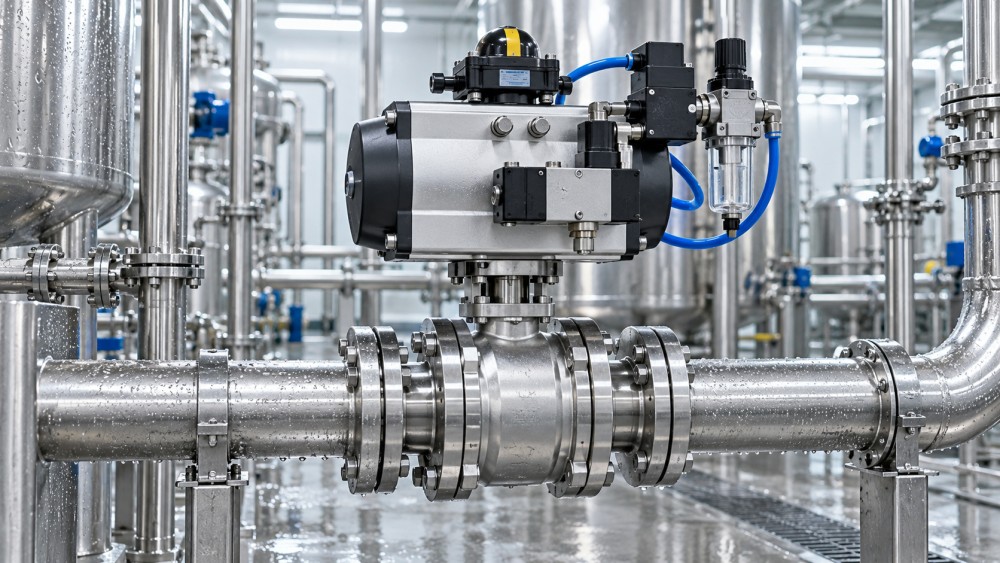
The case is also stronger where hygiene and cleanability matter. In applications requiring regular washdown or fluid purity control, smooth surfaces, appropriate seal materials, and traceable wetted materials may be more valuable than a low upfront valve price. The same logic applies to systems where even a small leak creates contamination, worker-safety, environmental, or cleanup concerns.
Do Not Buy “Stainless” Without Defining the Assembly
One recurring procurement mistake is treating the phrase “stainless steel pneumatic actuator valve” as a complete technical description. It is not. It may describe a stainless valve body paired with an aluminum actuator, a stainless steel actuator housing, a stainless body with non-stainless mounting hardware, or an assembly whose corrosion resistance varies substantially by component. None of these configurations is inherently wrong; the right choice depends on exposure conditions and project requirements.
A buyer should distinguish between wetted corrosion and external corrosion. Wetted materials determine compatibility with the process fluid. External materials determine resistance to weather, washdown, plant atmosphere, and mechanical damage. The actuator itself may never contact process media, but actuator failure can still stop a line. If the installation is exposed to offshore air, aggressive wash chemicals, or persistent condensation, actuator housing, springs, fasteners, solenoid enclosure, tubing, and mounting bracket deserve the same attention as the valve body.
Valve type also changes the calculation. A pneumatically actuated ball valve may suit quick isolation and full-bore flow requirements. Butterfly valves can be economical in larger sizes, though seat and disc selection remain critical. Globe-style control valves may be used where throttling performance is more important than simple open-close duty. It is risky to choose solely on material price before confirming flow behavior, allowable pressure drop, shutoff expectation, and the process consequences of a valve that cycles too quickly or too slowly.
Actuator Selection Can Protect—or Undermine—the Investment
An undersized actuator is a false economy. Required torque is affected by valve design, line pressure, differential pressure, seat friction, media characteristics, operating temperature, and the torque peak that can occur at breakaway or end of travel. A supplier should be able to explain the torque basis for the proposed assembly, rather than simply matching actuator size to nominal valve diameter.
For critical isolation, the intended failure position must be specified early: fail closed, fail open, or remain in position. Double-acting actuators require air for both opening and closing, while spring-return versions move to a predetermined position when air is lost. The preferred arrangement depends on process hazard and operating philosophy. It should be agreed with engineering, operations, and safety stakeholders rather than left as a purchasing default.
Compressed-air quality deserves similar attention. Contaminated, wet, or inadequately regulated air can shorten the life of pneumatic components regardless of how corrosion-resistant the valve body is. Confirm available air pressure at the point of use, expected pressure variation, filtration and drainage arrangements, and whether lubricated or non-lubricated operation is expected by the actuator supplier. A technically correct valve package can still perform poorly when connected to an unstable air system.
Compare Quotes on a Like-for-Like Basis
Price comparisons become misleading when suppliers quote different scopes. One quotation may include a valve, actuator, solenoid, position indicator, mounting kit, and tested assembly. Another may show only the valve and actuator. One may specify threaded ends while another assumes flanged or welded connections. A lower quotation can therefore shift costs and integration risk downstream.
Before awarding, establish a comparison sheet that identifies the valve design, nominal size, connection standard, pressure and temperature conditions, body and trim materials, seal material, actuator type, control voltage where relevant, fail position, accessory package, inspection documents, and requested marking. If a mounting interface is required, buyers may also need to confirm compatibility with the selected valve and actuator standard, such as ISO 5211 where applicable. Project specifications and local requirements should determine the documentation level rather than an assumption that every valve needs the same paperwork.
Material traceability can be particularly important when a project specifies stainless construction for a defined reason. Ask what documents are available for pressure-retaining parts, how materials are identified during production, and whether the offered documentation corresponds to the actual batch supplied. This is not bureaucracy for its own sake; it helps prevent a mismatch between drawing requirements, quoted materials, and delivered hardware.
When the Premium Is Hard to Defend
There are situations where stainless steel pneumatic actuator valves add cost without producing proportionate value. A clean, dry, non-corrosive utility service with modest cycling may not need a stainless body. An accessible valve that is manually operated only during scheduled maintenance may not need automation. In some large-diameter water or infrastructure duties, properly specified ductile iron or coated steel valve systems can be more practical, provided their lining, coating, pressure rating, installation environment, and maintenance plan suit the project.
Over-specification can be as damaging to a procurement decision as under-specification. It ties up budget that may be more effectively spent on better filtration, stronger corrosion protection elsewhere in the system, spare actuators, improved access platforms, or inspection capability. The right question is not “What is the most durable option?” but “What failure mode are we paying to prevent, and is this assembly the most credible way to prevent it?”
A More Defensible Buying Decision
Stainless steel pneumatic actuator valves usually justify their cost when corrosion exposure, process cleanliness, automation frequency, access difficulty, or failure consequences make basic alternatives expensive over time. They are most defensible when the specification is built around actual media conditions and operating duty—not around a vague preference for stainless steel or automation.
For procurement teams, the useful next step is to gather the operating envelope before requesting final quotations: fluid chemistry, temperature, pressure, cycle frequency, installation environment, required end connections, fail position, available air supply, and documentation needs. IMPE’s coverage of fluid-control equipment, industrial materials, machining, piping systems, and maintenance factors is intended to help project teams connect those technical details with lifecycle cost. A valve purchase becomes easier to defend when engineering requirements, supplier scope, and long-term operating risks are all visible in the same comparison.
Related News
- Why Is Your Heavy-Duty Piston Pump Losing Pressure Under Load?Nov 09, 2026Fluid Power Control Strategist
- Cartridge Valves for Manifold Blocks: Avoiding Cavity Fit ProblemsNov 09, 2026Fluid Power Control Strategist
- Large-Diameter Forged Rings: How Seamless Rolling Affects Grain FlowNov 09, 2026Foundry Phase-Change Fellow
- Sealed Heavy-Duty Roller Bearings: Choosing Seals for Dust and WaterNov 09, 2026Tribology & Kinematics Expert
- Sprockets and Chain Drives: What Determines Replacement Cost?Nov 08, 2026CNC Kinematics Architect
- Monoblock Hydraulic Control Valves: Flow Rating and Spool SelectionNov 08, 2026Fluid Power Control Strategist