
Using Industrial Air Blow Guns to Clear Chips Without Spreading Debris
A machine table can look clean a few seconds after an air blast while the surrounding workstation becomes a mess. Sharp chips land in the walkway, fines settle on nearby equipment, and coolant droplets drift toward another operator. The chips have moved, but the cleanup problem has not been solved.
Used correctly, industrial air blow guns can help remove loose machining chips without turning them into uncontrolled projectiles. The key is to remove bulk material first, use a suitable safety nozzle, and direct the remaining chips toward a contained collection area. Air should finish the cleaning job—not replace chip handling, guarding, or dust extraction.
For operators working around CNC mills, turning centers, fixtures, or machined castings, the practical question is simple: can the chips be moved safely to somewhere they will stay? If the answer is no, a brush, chip hook, or suitable industrial vacuum is usually the better choice.
Decide whether compressed air belongs in this cleanup
Before picking up the blow gun, look at the material, the chip shape, and the surroundings. A few loose chips on an accessible fixture surface are different from a nest of turning swarf wrapped around a chuck or a layer of fine powder inside a casting.
Material matters. Fine aluminum, magnesium, titanium, and other combustible metal residues may require specialized collection equipment and procedures. A general-purpose shop vacuum is not automatically safe for metal dust, hot chips, or coolant. Do not use compressed air to disperse potentially combustible dust; follow the site’s material-specific controls.
Likewise, blowing dry residue from cast components or abrasive operations may create an inhalation hazard. If you cannot identify the residue, stop and establish an approved cleaning method rather than treating it as ordinary swarf.
Set up industrial air blow guns for control, not maximum force
A powerful jet feels productive because chips move immediately. But excessive force also increases ricochet, airborne contamination, noise, and compressed-air consumption. The useful setting is the lowest airflow and pressure that moves the remaining loose chips into the collection zone.
Understand the safety nozzle and pressure requirement
Use a blow gun designed for industrial cleaning, with a safety nozzle appropriate to the task. Safety designs may incorporate relief passages or other features that limit pressure when the outlet is obstructed. Those passages must remain clear, and the nozzle must not be modified.
For U.S. workplaces, OSHA’s compressed-air cleaning rule requires air pressure to be reduced to less than 30 psi, together with effective chip guarding and personal protective equipment. OSHA interprets this pressure limit under static, dead-ended conditions at the nozzle. It is not simply a rule about the normal supply-line gauge reading.
A compliant nozzle does not, by itself, make the operation safe. Obtain the manufacturer’s operating limits and compliance information, verify the approved supply-pressure range, and follow your employer’s procedure. Outside the United States, check the applicable local requirements. Never block the outlet with a finger to test its pressure.
Match the outlet to the work area
A narrow jet may reach a small recess, but it can also drive chips deeper into it. A broader airflow pattern can move loose chips across an accessible surface with less point concentration, yet may spread debris beyond the intended collection zone. Choose based on reach, chip behavior, and containment—not just advertised blowing force.
Extension nozzles can reduce awkward reaching. They should not become a reason to place hands inside an unsafe machine or to probe around seals, bearings, and electrical components. Inspect the gun, hose, fittings, and connection before use. A leaking fitting or damaged hose adds another hazard to a task that already involves flying debris.
Build a collection path before pulling the trigger
Controlled chip removal needs three things: an origin, a path, and a destination. The origin is the dirty surface. The path is the route the chips will travel. The destination is a tray, collection pocket, or other approved containment point.
If the destination is merely “away from the part,” debris will eventually reach the floor, a neighboring machine, or somebody’s clothing.
Position a stable collection tray close to the work and use suitable barriers to intercept escaping chips. Account for rebound: a chip striking a hard vertical wall may bounce back toward the operator. A machine enclosure may provide useful containment, but only when used according to the machine manufacturer’s instructions and the site’s cleaning procedure. Do not defeat door interlocks to use a blow gun.
Protect the surrounding area as well. Cover or isolate exposed components where appropriate, keep people out of the potential chip path, and avoid directing airflow toward control panels, electrical cabinets, guideway seals, bearing seals, or open lubrication points.
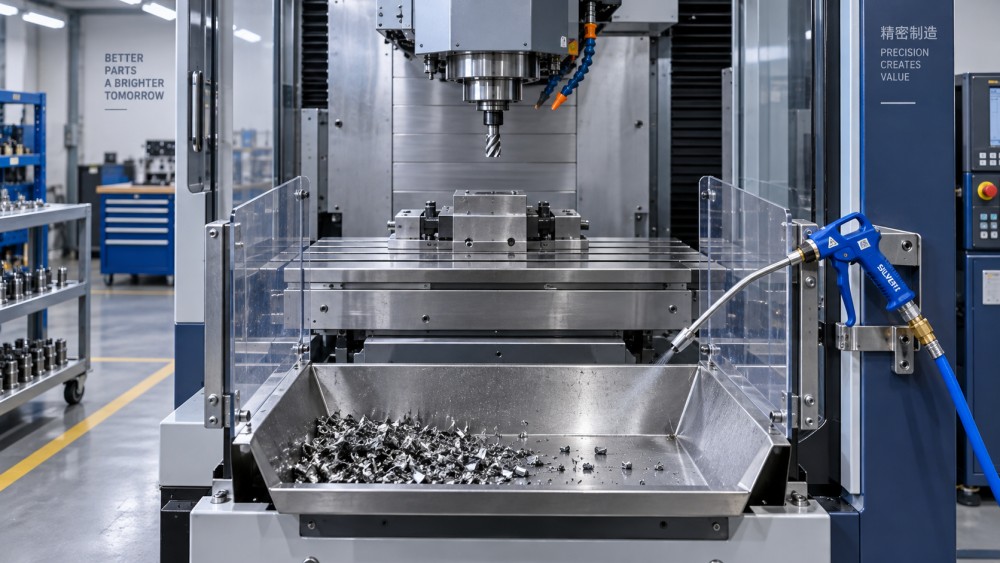
A useful visual check is to imagine the airflow continuing beyond the collection tray. If that line reaches another person or an unprotected area, change the setup before cleaning.
A controlled sequence for clearing a milling table or fixture
The following sequence suits loose chips on accessible surfaces. It does not replace machine-specific instructions or a required energy-control procedure.
-
Make the machine safe. Stop machining and wait for the spindle and other moving parts to stop completely. Follow the prescribed access procedure. Where cleaning exposes you to unexpected startup or hazardous stored energy, apply the required isolation and lockout/tagout measures.
-
Remove the bulk chips mechanically. Use a suitable brush, scraper, scoop, or chip hook. Do not sweep sharp swarf with bare hands. Avoid reaching around cutting tools; use the approved method for removing or safeguarding tooling when necessary.
-
Prepare the collection area. Position the tray and guarding so chips cannot easily escape underneath or around them. Check that the intended discharge path is clear of coworkers.
-
Start with a brief test pulse. Use the lowest effective regulated setting within the equipment’s approved limits. Keep the nozzle at a practical working distance rather than pressing it against the surface. Observe where the first few chips land.
-
Move chips toward the tray in small sections. Direct airflow across the surface toward the collection point, rather than straight down into the chip pile. Use short pulses and progress gradually. Avoid sweeping the gun through a wide arc.
-
Stop if chips rebound or become airborne. Change the angle, reduce airflow, improve shielding, or switch tools. Repeatedly blasting the same troublesome area is a warning that the method is not controlling the debris.
-
Inspect and finish without another unnecessary blast. Check locating surfaces, accessible slots, and fixture contact areas. Use an appropriate brush, cloth, or approved vacuum for residue. Remove the collection tray safely and clean any escaped chips from the floor.
Listen as well as look. A continuous hiss often means the trigger is being held longer than necessary. Short bursts make it easier to track chip movement and stop before the jet begins spreading coolant or fines.
Clean the locating surface without contaminating the machine
For precision machining, chip removal is part of setup quality. A chip trapped beneath a workpiece or against a locating face can prevent proper seating, affect alignment, or mark a finished surface. That makes careful inspection more valuable than simply making the table look clean.
Airflow can also hide the problem. It may push a chip into a blind hole, under a fixture, or into a slot where it becomes difficult to retrieve. When cleaning fixture pockets, work toward an accessible opening and collection point. If there is no controlled exit path, choose another method.
Avoid blowing directly at spindle interfaces, bearing arrangements, seals, or hydraulic and pneumatic connections. These areas need their specified cleaning methods. Air that removes visible chips can simultaneously force fine contamination into an interface that is harder—and more expensive—to clean.
After cleanup, inspect critical contact surfaces using the checks required by the setup procedure. A clear view and a clean-looking surface do not prove that every locating point is free of debris.
Protection matters even when the chips stay inside the tray
Wear the eye protection specified by the risk assessment and site rules, typically safety glasses with side protection or suitable goggles. Where flying-chip exposure warrants a face shield, use it over the required eye protection—not as a substitute. Nearby workers also need protection from any remaining exposure.
Compressed-air cleaning can produce significant noise. Select hearing protection according to the workplace noise assessment, and consider a lower-noise nozzle where suitable. If cutting fluid becomes a visible mist, stop and reassess the cleaning method and ventilation. Respiratory protection, where required, belongs within the employer’s respiratory protection program rather than an improvised response.
Never direct compressed air at skin or use it to clean clothing. Injection injuries and damage to eyes or ears can occur even when the jet seems manageable. Use approved garment-cleaning arrangements instead.
Gloves may be appropriate for handling sharp chips when the machine is safely stopped and isolated as required. They must not be worn where they could become entangled in rotating machinery. Keep chip handling and machine operation clearly separated.
When to put the blow gun down
Switch methods when the chip stream cannot be contained, when fine material hangs in the air, or when fluid splashes beyond the collection area. A larger nozzle or higher pressure is not the answer to poor containment.
A brush is often better for moving coarse chips a short distance. A suitable industrial vacuum can capture material instead of relocating it, provided it is explicitly appropriate for the chips, dust, temperature, and liquids involved. Packed swarf may need a handling tool; persistent contamination inside an assembly may need a dedicated cleaning process.
For teams comparing industrial air blow guns, useful purchasing questions concern the safety nozzle’s documented pressure behavior, permitted supply pressure, airflow pattern, noise information, trigger control, and spare-part availability. As IMPE’s equipment-selection approach emphasizes, the tool should be evaluated as part of the working system—not in isolation from the material, machine, and operator.
The best result is not the strongest blast or the fastest-looking cleanup. It is a clean locating surface, chips retained in a designated collection area, and no new hazard left for the next person at the machine.
Related News
- Sprockets and Chain Drives: What Determines Replacement Cost?Nov 08, 2026CNC Kinematics Architect
- Monoblock Hydraulic Control Valves: Flow Rating and Spool SelectionNov 08, 2026Fluid Power Control Strategist
- Cement Mortar Linings for Ductile Iron Pipes: Inspection and StandardsNov 08, 2026Pipeline Metallurgy Scientist
- Why Needle Roller Thrust Bearings Fail: Loads, Lubrication and WearNov 08, 2026Tribology & Kinematics Expert
- Selecting Machine Tool Bearings for Machining Center SpindlesNov 08, 2026CNC Kinematics Architect
- Industrial Gearbox Drive Shafts: Torque, Alignment and Fatigue LifeNov 07, 2026Tribology & Kinematics Expert