
Stainless Steel Tie Rod Cylinders: Seal and Material Choices for Washdown
Repeated washdown can leave a cylinder looking clean while moisture remains beneath tie rod nuts, cleaning solution attacks a wiper, or a damaged rod surface carries contamination into the gland. The result may be external corrosion, increased breakaway force, or leakage that appears only after several cleaning cycles. Selecting stainless steel tie rod cylinders therefore requires more than specifying a stainless barrel.
Match every exposed material to the cleaning chemistry, and evaluate each seal against both its process fluid and its external exposure. A 316-series exterior is often a stronger starting point than 304 for chloride-bearing environments, but neither grade guarantees resistance to hot, concentrated sanitizers. Seal compound, rod finish, drainage, and access around the tie rods can determine whether the assembly remains serviceable.
Define the washdown exposure before comparing cylinders
“Suitable for washdown” is not a complete operating specification. A cylinder exposed to occasional rinsing has a different duty from one receiving hot detergent foam, disinfectant, and a directed pressure rinse every shift. Residues can become more concentrated as water evaporates, especially around gland recesses and threaded joints.
Build the exposure description from the actual cleaning procedure rather than the equipment’s normal operating temperature. Record:
- Chemistry: detergent and sanitizer names, active ingredients, dilution ranges, pH, and any chloride content.
- Thermal conditions: cleaning-fluid temperature, contact duration, cooling time, and whether the cylinder is hot before rinsing.
- Application: spray pressure, nozzle distance, impingement direction, foam dwell time, and rinse completeness.
- Mechanical duty: operating pressure, stroke, speed, cycle frequency, mounting orientation, and expected side loading.
- Internal environment: hydraulic fluid or compressed-air quality, lubrication requirements, and possible condensate.
Specify whether the actuator moves during cleaning. A retracting rod can carry residual liquid toward the wiper; a stationary rod still leaves exposed surfaces and seal lips subject to chemical attack. Compatibility data should reflect the full sequence, not just isolated contact with diluted detergent.
Compare the material map, not the exterior description
A catalog description may refer only to the barrel and end caps. Request a component-level material list covering tie rods, nuts, mounting hardware, piston rod, gland, ports, fittings, cushions, and adjustment screws. One exposed carbon-steel accessory can become the first corrosion site on an otherwise stainless assembly.
304 and 316: a useful distinction with limits
304 stainless steel may be adequate for mild rinsing and compatible detergents where chloride exposure is limited. Molybdenum-bearing 316 generally offers better resistance to chloride-induced pitting and crevice corrosion. It deserves consideration where wet residues persist or sanitizer chemistry creates a more aggressive environment.
Neither is immune to hypochlorite attack, especially as concentration, temperature, or dwell time increases. A recommendation for 316 should therefore include the permitted cleaning conditions. Choosing a low-carbon grade such as 316L can help control sensitization concerns in welded components, but it does not make the assembly universally resistant to chlorides.
The piston rod needs a separate decision
The rod must combine corrosion resistance with sufficient strength, hardness, and a surface suitable for dynamic sealing. A precipitation-hardening stainless rod may offer useful mechanical properties, but its corrosion performance depends on the grade and heat-treatment condition. It should not automatically be treated as equivalent to a 316 wetted surface.
Ask whether the sealing surface is bare stainless, plated, or otherwise coated. For coated rods, establish the substrate, coating specification, allowable defects, and repair policy. Scratches or coating damage may expose a less resistant substrate and create an abrasive track through the seal.
Passivation can remove free-iron contamination and support a clean passive surface; electropolishing may improve surface condition and cleanability. Neither treatment compensates for an unsuitable alloy or trapped sanitizer. Request the treatment scope and acceptance criteria, rather than accepting “passivated stainless” as the complete specification.
Select seals by location and exposure
The piston seal, rod seal, static seals, and wiper do not necessarily need the same material. Internal seals primarily encounter the operating medium. The wiper sees cleaning chemicals directly, while the rod seal may encounter both environments if liquid passes the exclusion system.
These families are screening categories, not approval criteria. Two compounds with the same generic designation can differ in curing system, fillers, hardness, compression set, and resistance to cleaning chemicals. Obtain the seal supplier’s assessment for the named fluid at the proposed concentration and temperature.
A common selection error is replacing every seal with EPDM because it tolerates the wash solution, while retaining mineral-oil hydraulic fluid inside the cylinder. Another is selecting FKM solely for its temperature capability without checking hot alkaline exposure. Mixed seal packages can resolve conflicting requirements, provided their locations and replacement part numbers are documented.
Where product contact is possible, request the relevant declarations for the exact compound and intended use. A food-contact declaration does not establish chemical compatibility, hygienic cleanability, or suitability for the cylinder’s pressure and motion.
The gland and tie rod interfaces often decide the outcome
External tie rods introduce joints and sheltered surfaces that are harder to rinse and inspect than a smooth enclosure. Inspect the spaces beneath nuts, end-cap interfaces, mounting feet, and port adapters. Cleaning solution can remain in these locations even when the barrel drains freely.
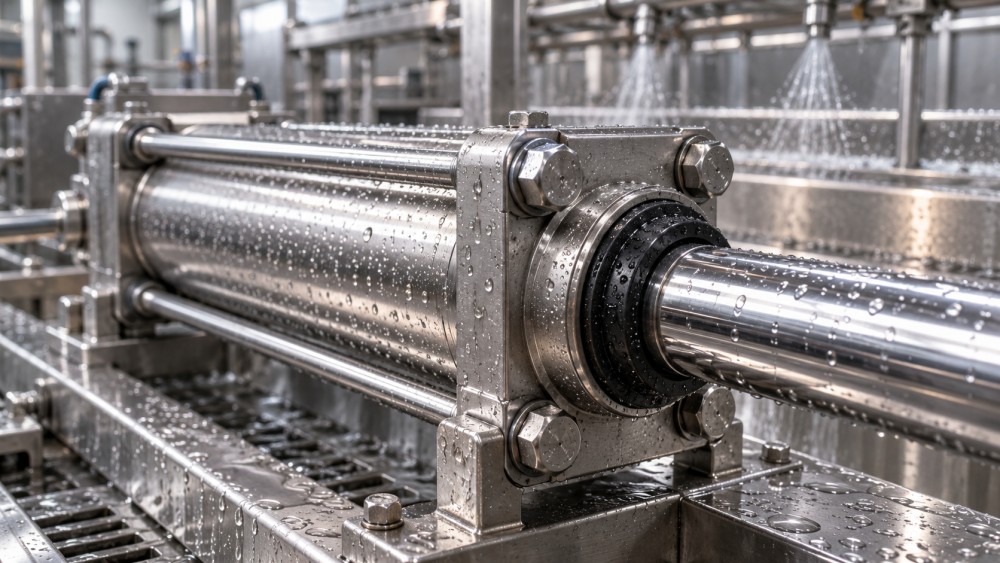
Corrosion-resistant construction and hygienic construction are different requirements. Stainless steel tie rod cylinders may be suitable for exposed machinery where cleaning access is adequate, yet remain a poor fit for a strict hygienic zone with inaccessible crevices. Where residue removal cannot be demonstrated, evaluate a smoother actuator architecture rather than trying to solve the problem with alloy selection alone.
At the gland, review wiper profile, retention, recess geometry, and any external exclusion features. A wiper designed primarily to remove dry particles may not exclude a directed wash jet. Protective boots or covers also need scrutiny: they can shield a rod but may trap moisture or conceal contamination unless designed for drainage and cleaning.
Mounting orientation should allow liquid to escape rather than collect around the rod entry. Route pneumatic exhausts and breathers so they cannot readily draw in spray during pressure changes. Avoid directing the cleaning jet into seals, ports, or adjustment features; hardware selection cannot compensate indefinitely for an incompatible cleaning method.
Specify the rod surface beyond a single roughness value
A rod can meet an average roughness requirement yet contain directional grinding marks, isolated scratches, or peaks that damage a seal lip. Conversely, an excessively smooth surface may not retain the lubricating film required by a particular seal design. The acceptable finish must come from the selected sealing system.
Request the seal manufacturer’s recommended surface parameters, finishing method, hardness, and inspection approach. Include limits for surface defects and, where relevant, texture direction or lead. Do not copy a generic roughness value from another cylinder: seal materials, pressure, speed, and lubrication conditions may differ.
Mechanical alignment belongs in the same review. Side loading can accelerate bushing wear and create uneven rod-seal contact, opening a path for cleaning liquid. Confirm that the mounting arrangement and external guides keep transverse loads within the manufacturer’s stated limits throughout the stroke.
Turn supplier claims into evidence you can compare
Ask competing suppliers to respond to the same exposure specification. A useful comparison package identifies exact materials, seal compounds, operating limits, and exceptions. A statement that a cylinder is “washdown rated” is insufficient unless the supplier explains the test method, configuration, and acceptance criteria.
- Resolve material substitutions. Require approval before changing rod alloy, exposed fasteners, surface treatment, or seal compound. Broad descriptions such as “stainless or equivalent” leave critical differences uncontrolled.
- Separate cleaning limits from operating limits. Establish permitted cleaning temperature, dwell time, chemistry, and whether the cylinder must be depressurized or stationary. Follow the machine’s isolation requirements.
- Define functional acceptance. Agree on leakage, breakaway pressure, stroke completion, and inspection criteria before evaluating a sample.
- Preserve serviceability. Obtain seal-kit identifiers, replacement instructions, compatible assembly lubricants, and restrictions on cleaning or polishing the rod.
A claim associated with an electrical enclosure’s ingress-protection classification should not be assumed to qualify a cylinder’s dynamic seals or chemical resistance. Even a relevant water-ingress test may not represent repeated hot detergent exposure. The test conditions must match the failure mechanism being evaluated.
Validate the assembly through representative cleaning cycles
For demanding service, assess the assembled cylinder rather than relying exclusively on material immersion charts. Those charts help screen chemical compatibility but do not reproduce seal motion, retained solution, pressure changes, or wear at the rod interface.
Use a controlled evaluation that reproduces the intended cleaner concentration, temperature, application method, dwell, rinse, and drying sequence. Operate the cylinder under representative loading between cleaning exposures. Record baseline motion and leakage, then examine changes in breakaway behavior, wiper condition, rod appearance, and accessible joints. Establish the duration and acceptance limits with the supplier according to the application’s risk.
Disassembly can reveal swelling, hardening, cracking, or liquid retention that an external inspection misses. Rust-colored staining alone does not identify the cause: investigate transferred iron contamination as well as corrosion of the underlying component. Pitting near the gland, recurring seal damage, or unexplained internal moisture warrants investigation before extending the design to additional equipment.
The release specification should capture the approved component materials, seal package, rod finish, cleaning envelope, and mounting restrictions. If a supplier cannot support the intended sanitizer exposure—or the tie rod geometry prevents reliable cleaning—the unresolved issue is a design constraint, not a maintenance task to defer until installation.
Related News
- Why Is Your Heavy-Duty Piston Pump Losing Pressure Under Load?Nov 09, 2026Fluid Power Control Strategist
- Cartridge Valves for Manifold Blocks: Avoiding Cavity Fit ProblemsNov 09, 2026Fluid Power Control Strategist
- Large-Diameter Forged Rings: How Seamless Rolling Affects Grain FlowNov 09, 2026Foundry Phase-Change Fellow
- Sealed Heavy-Duty Roller Bearings: Choosing Seals for Dust and WaterNov 09, 2026Tribology & Kinematics Expert
- Sprockets and Chain Drives: What Determines Replacement Cost?Nov 08, 2026CNC Kinematics Architect
- Monoblock Hydraulic Control Valves: Flow Rating and Spool SelectionNov 08, 2026Fluid Power Control Strategist