
Stainless Steel Pneumatic Actuator Valves: Which Specs Matter in Washdown Lines?
On washdown lines, valve selection often looks easy until the first few cleaning cycles expose the weak points. A valve that seemed acceptable on a general process skid may start showing moisture ingress, sticky actuation, seal swelling, external corrosion marks around fasteners, or residue buildup in corners that are hard to rinse. The trouble is that these failures rarely begin as dramatic breakdowns. More often, they show up as nuisance stoppages, inconsistent movement, or maintenance questions that keep returning after every sanitation round.
That is why choosing stainless steel pneumatic actuator valves for washdown duty usually needs a more careful review than simply checking whether the body material is stainless. In practical terms, the valve has to survive repeated water exposure, cleaning chemicals, pressure variation, air quality issues, and operating cycles without becoming a hygiene risk or a maintenance trap. If you are trying to specify valves for a food, beverage, packaging, chemical, or utility line where washdown is part of routine operation, a few specifications matter much more than others.
Where selection usually goes wrong
A common mistake is to treat “stainless steel” as the complete answer. It solves only part of the problem. Washdown environments attack the full valve assembly, not just the wetted metal. Actuator housing joints, solenoid interfaces, visual indicators, mounting hardware, seals, and even nameplates can become failure points if the assembly was designed for dry service and later moved into a wet area.
Another frequent issue is focusing too much on nominal size and pressure class while leaving out details that affect day-to-day cleanability. A valve can meet the flow requirement and still create headaches if the exterior geometry traps residue, if the actuator finish is rough enough to hold contaminants, or if the seal material reacts badly to alkaline or acidic cleaning media. In washdown lines, reliability is often lost through these small mismatches.
Start with the washdown reality, not the catalog headline
Before comparing models, define the actual cleaning conditions. “Washdown” can mean anything from light hose rinsing to frequent high-pressure cleaning with hot water, foaming agents, and aggressive detergents. That difference changes the risk profile.
If the valve sits near splash zones, conveyor transfers, filler stations, or equipment that gets direct spray, ingress protection and external finish become more important than they would be on a protected utility branch. If the line is cleaned with chlorinated products, stainless grade and elastomer compatibility deserve extra attention. If cleaning crews use inconsistent spray angles or extended contact time, the assembly should be chosen with some tolerance for real-world variation rather than ideal procedures.
In other words, the best specification work starts by asking where the valve is mounted, how often it is washed, what chemical agents are used, whether water pools around it, and whether the compressed air side is exposed to humid conditions.
The specifications that usually matter most
1. IP rating and enclosure integrity
For pneumatic actuators in washdown service, ingress protection is one of the first points to verify. This is not just a paperwork item. The actuator enclosure, position indicator, limit switch box, solenoid coil, and cable entry all need to withstand repeated water exposure. A high IP rating helps, but the practical question is whether the whole mounted package maintains that protection after installation.
Many washdown problems come from accessory interfaces rather than the main actuator body. A stainless actuator paired with a poorly protected switch box or a standard solenoid can undermine the entire assembly. If the line receives direct spray, review every mounted component as part of the same exposure level.
It also helps to ask whether the actuator design resists water entry during temperature changes. In plants with hot cleaning and cooler operating periods, pressure differentials can pull moisture into weak seals if the housing is not well designed.
2. Seal and seat compatibility
Seal material often decides whether a valve remains stable over time. In washdown lines, elastomers are challenged by process media and by cleaning chemicals. A seal that performs well in compressed air or neutral fluids may swell, harden, crack, or lose elasticity after repeated exposure to caustics, acids, steam, or sanitizer residues.
That means you should not review seat and seal materials in isolation from sanitation practice. EPDM, FKM, NBR, PTFE-based configurations, and other options each have different strengths and limitations. The right choice depends on actual fluid temperature, CIP chemistry, rinse conditions, and actuation frequency. When teams skip this cross-check, they often end up blaming the actuator for leakage that really began with chemical attack on the sealing elements.
If replacement intervals are difficult or sanitation validation is strict, this material review becomes even more important. A slightly more careful selection up front can prevent repeated disassembly later.
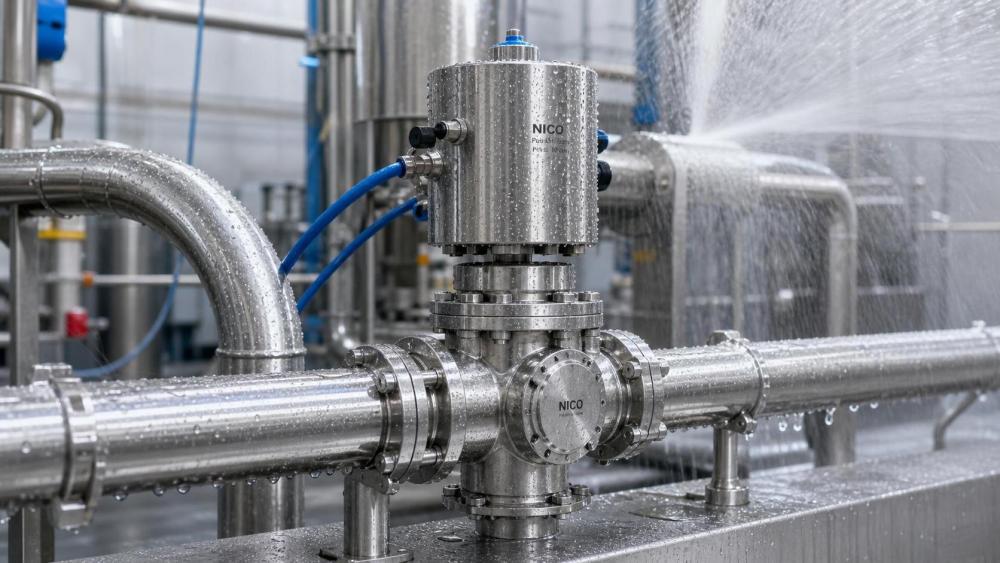
3. Surface finish and external geometry
Cleanability is not just a matter of whether the valve can be sprayed. It is also about whether residues and moisture can leave the surface easily. On washdown equipment, smoother finishes are usually easier to clean and inspect. Sharp edges, exposed threads, dead corners, and awkward mounting positions tend to hold water and process residue longer than operators expect.
For stainless steel pneumatic actuator valves, the exterior actuator housing, valve body transitions, mounting brackets, and fasteners should all be reviewed with the cleaning route in mind. Even a robust stainless assembly can become troublesome if crevices around accessories trap residue. In many facilities, maintenance teams notice this only after sanitation checks or corrosion marks begin appearing at interfaces.
Electropolished or finely finished surfaces are not always necessary for every line, but a rough or irregular exterior can add unnecessary cleaning effort. The more direct the product-area exposure, the more this point matters.
4. Stainless grade and hardware consistency
Washdown selection should also look beyond the headline phrase “stainless steel.” Different stainless grades handle chloride exposure, cleaning chemistry, and long-term moisture differently. The right choice depends on the environment. A valve body may be acceptable in one grade while bolts, brackets, springs, or accessory housings in lower-grade materials become the first visible corrosion points.
This is one reason mixed-material assemblies create confusion. Buyers may assume they are specifying a stainless package, but only the main body is stainless while ancillary hardware is not aligned with the same duty level. In wet environments, those small components matter. Corrosion around external fasteners can complicate maintenance and create hygiene concerns long before the valve body itself shows trouble.
5. Pressure range and torque margin
In theory, a pneumatic actuator only needs enough torque to move the valve under expected conditions. In practice, washdown lines may introduce friction changes, temperature shifts, or pressure variation that make narrow sizing risky. If the selected actuator has too little margin, movement can become sluggish or inconsistent, especially after wear begins or when supply air quality is less than ideal.
Review the operating pressure range of both the process side and the actuator supply side. Then compare that with the torque requirement of the valve under real opening and closing conditions, not just ideal bench values. This matters even more for butterfly and ball valves that may see infrequent cycling followed by sudden demand for reliable operation.
Oversizing is not automatically better, since it can increase mechanical stress or cause abrupt movement, but undersizing tends to reveal itself at the worst time: after installation, during sanitation schedules, or under variable plant air pressure.
6. Response speed and control behavior
Response speed matters differently depending on the line. On some washdown systems, fast actuation helps maintain sequence timing and avoid fluid upset. On others, an overly abrupt valve movement may cause pressure shock, splashing, seat wear, or unstable dosing. The important point is that actuator speed should match the process function rather than be treated as a generic preference.
If the valve is tied into automated wash cycles, transfer isolation, or utility switching, consistent actuation time can be just as important as absolute speed. Check whether speed control accessories are needed and whether those accessories are also appropriate for wet service.
7. Air quality and breathing concerns
One issue that gets overlooked is the compressed air feeding the actuator. Wet or contaminated plant air shortens actuator life, especially where washdown temperature cycles already increase condensation risk. If the line is in a humid zone, air preparation should be reviewed along with the valve itself. A robust actuator can still suffer if internal corrosion or seal wear is accelerated by poor air quality.
Some teams focus heavily on external stainless surfaces while forgetting that internal actuator reliability depends on dry, clean air and sensible maintenance intervals. Where sanitation is frequent, it is worth checking whether venting, exhaust paths, and accessory mounting are protected against water intrusion.
A practical way to compare options
When several valve packages appear similar, it helps to narrow the decision through use conditions rather than brand language. Start by separating valves in direct washdown zones from those in indirect splash areas. Then compare them based on enclosure protection, seal suitability, surface finish, external geometry, and material consistency across accessories. After that, confirm torque margin, actuation behavior, and maintenance accessibility.
This order matters because washdown failures usually begin with exposure mismatch, not with flow coefficient calculations alone. Once the assembly is known to suit the environment, process performance details become much easier to evaluate properly.
If the specification sheet is vague, ask targeted questions instead of broad ones. For example: Are all exposed fasteners stainless of a comparable grade? Is the actuator supplied as a washdown-ready assembly with accessories, or only as a base unit? Which seal materials are available for the actual cleaning chemistry? Are there external pockets where water can sit after cleaning? Can the actuator and mounting arrangement be cleaned without disassembly?
When a simpler valve becomes expensive to maintain
There is a pattern many facilities recognize: a lower-detail specification may reduce upfront complexity, but it often moves the burden to maintenance and sanitation. Replacing swollen seals, drying out enclosures, reworking corroded hardware, or troubleshooting intermittent position feedback can consume more time than expected. The cost is not only parts. It also shows up in line interruptions, verification work, and repeated engineering review.
That does not mean every washdown line needs the most specialized assembly available. It means the chosen valve should reflect actual exposure and operating discipline. In protected areas with mild cleaning, a simpler configuration may be perfectly reasonable. In direct washdown zones with aggressive sanitation and frequent cycling, stronger attention to enclosure integrity, finish, materials, and accessory selection is usually justified.
Useful questions before sign-off
Before final approval, it is worth pausing on a few points that often reveal hidden risk. Will operators be able to inspect the valve exterior easily after cleaning? Can maintenance replace seals or accessories without disturbing surrounding hygienic piping? Is the actuator orientation likely to trap water? Does the assembly include standard components that may need upgrading for wet service? Is the valve expected to fail safe, and if so, does the spring-return configuration still meet torque requirements under worst-case conditions?
These are not exotic questions. They are the practical details that separate a valve package that looks acceptable on paper from one that holds up in daily operation.
Final thought
For washdown lines, the right stainless valve package is usually the one that balances corrosion resistance with enclosure protection, seal chemistry, smooth cleanable surfaces, realistic torque sizing, and reliable accessories. That is why stainless steel pneumatic actuator valves should be reviewed as complete operating assemblies rather than isolated metal components. When teams look at the actual cleaning environment first, the specification choices become clearer, and the chance of recurring sanitation-related valve problems drops noticeably.
Related News
- How to Assess a Rigid Coupling Supplier for Bore Accuracy and Traceable QualityOct 08, 2026Tribology & Kinematics Expert
- Titanium Alloys Compared: Balancing Strength, Corrosion Resistance, and MachinabilityOct 08, 2026CNC Kinematics Architect
- Where Ductile Iron Dismantling Joints Reduce Alignment Risk in Water PipelinesOct 08, 2026Pipeline Metallurgy Scientist
- Selecting a Precision Bearing Sleeve: Fits, Runout, and Material ChoicesOct 08, 2026Tribology & Kinematics Expert
- Face Milling Cutters: How Insert Geometry Affects Finish on Steel and AluminumOct 08, 2026CNC Kinematics Architect
- Single-Acting Cylinders for Clamping: Stroke, Force, and Return Spring ConsiderationsOct 07, 2026Fluid Power Control Strategist