
How to Evaluate an Air Blow Gun Manufacturer for Industrial Plant Supply
How to Evaluate an Air Blow Gun Manufacturer for Industrial Plant Supply
An air blow gun is a small item in most plant purchasing lists, yet a poor choice can create recurring maintenance, safety, and operating-cost problems. These tools are used to clear chips from machine fixtures, dry components after washing, remove dust from enclosures, cool workpieces, clean conveyors, and support general maintenance. In facilities with many workstations, a low unit price multiplied by frequent replacement, excessive air use, or inconsistent fittings can become a much larger cost than expected.
For procurement teams, evaluating an air blow gun manufacturer is therefore not simply a matter of comparing catalog photos and quoted prices. The useful question is whether the supplier can repeatedly provide a tool that fits the plant’s air system, operating environment, safety rules, connection standards, and replenishment model. A practical evaluation should connect the product itself with the conditions under which it will actually be used.
Start with the task, not the catalog description
“Air blow gun” covers several quite different requirements. A compact gun used occasionally at an assembly bench does not need the same construction as a tool kept beside a CNC machine throughout every shift. Likewise, a long-reach gun for cleaning inside equipment guards is not interchangeable with a safety nozzle intended for open work areas.
Before approaching suppliers, define the use case in operational terms. Identify the material being removed, the target distance, expected frequency of use, available line pressure, hose type, required inlet thread, and any limits on noise or air consumption. Ask whether operators need a straight nozzle, angled extension, flexible tube, protective tip, or a narrow jet for confined spaces. If the tool will be used around machined surfaces, coated parts, electronics, food-contact areas, or hot workpieces, that context should be part of the specification rather than an afterthought.
This early definition prevents a common sourcing mistake: selecting a high-flow gun because it appears more powerful, then discovering that it wastes compressed air or disturbs surrounding chips and debris. More force is not automatically better cleaning. The required flow pattern and controllability often matter more than maximum outlet velocity.
Examine performance as part of the pneumatic system
A manufacturer should be able to provide clear, internally consistent information about operating pressure range, air consumption, inlet configuration, nozzle options, and product dimensions. Buyers should not assume that two guns with similar external shapes deliver comparable performance. Trigger geometry, internal passage design, nozzle bore, and flow restrictions can all change how the tool behaves at the same supply pressure.
It is especially important to distinguish supply pressure from usable performance at the point of work. Long hoses, undersized couplings, pressure drops through filters and regulators, and simultaneous demand from other equipment can reduce actual output. A technically competent air blow gun manufacturer will usually ask about the plant connection and application rather than quote a generic pressure figure without context.
For plant standardization, request a sample or trial batch where practical. Test the tool with the intended hose, quick coupling, regulator setting, and nozzle configuration. Operators can quickly identify issues that a data sheet may not show: a trigger that is difficult to modulate, a nozzle that is too short, an uncomfortable grip, a connection that rotates poorly, or a jet that scatters contaminants instead of directing them.
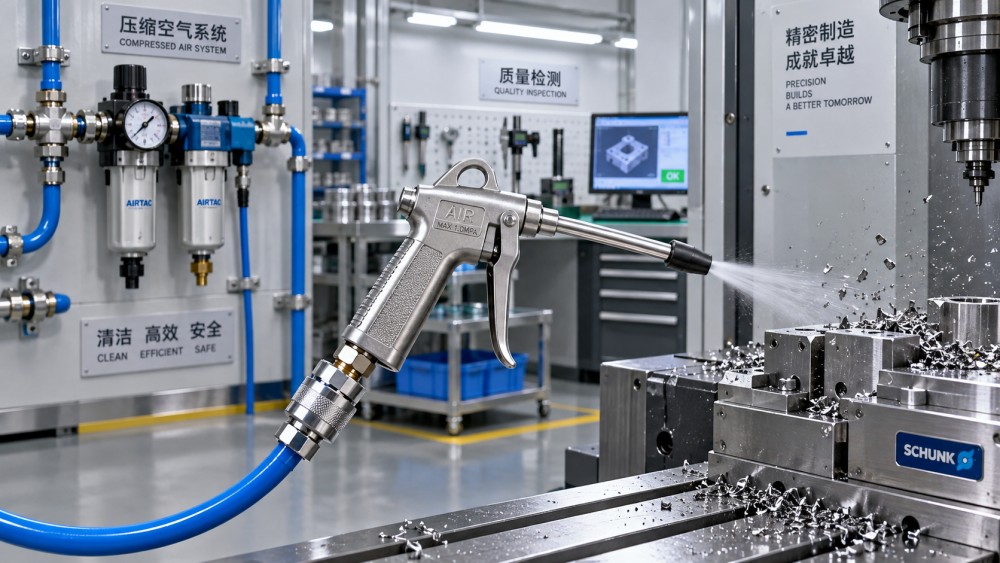
Material selection reveals whether the tool matches the environment
Material is not a cosmetic detail. The body, trigger, valve components, seal materials, nozzle, and inlet thread all face different forms of wear. A plastic-bodied tool may be entirely suitable for light, dry assembly work and can reduce hand fatigue. In a fabrication area, machine shop, foundry, or maintenance department, buyers may instead need greater resistance to impact, oils, cleaning fluids, heat, or abrasive dust.
Metal-bodied models are often chosen for demanding environments, but the evaluation should go beyond the word “metal.” Ask what alloy is used, whether the surface is protected, how the inlet threads are formed, and whether exposed parts are likely to corrode in humid conditions. A body can look robust while its trigger pin, spring, or threaded interface becomes the weak point. Similarly, a low-cost nozzle may deform or loosen after repeated contact with fixtures and machine guards.
Seal compatibility deserves a direct question. Compressed-air systems may carry moisture, oil aerosols, or residues from upstream equipment. Where plant air quality is inconsistent, seals and valve action can deteriorate faster than expected. The supplier should identify the sealing material where relevant and explain any limits related to lubricated air, temperature, or cleaning chemicals. If that information is unavailable, the buyer is being asked to accept unnecessary lifecycle risk.
Safety is a specification issue, not a purchasing footnote
Compressed air can move particles at high speed, create noise exposure, and present a hazard when used improperly. A blow gun should never be assessed only for how aggressively it clears a surface. Procurement should involve plant safety personnel when tools are intended for broad deployment, particularly where nozzles may be used close to skin, around loose debris, or in shared work areas.
Different markets and facilities may require particular nozzle designs, pressure-limiting arrangements, labeling, or documentation. The exact requirement depends on local rules, site policy, and application. A supplier’s claim that a product is “safe” is not enough; request the technical basis for the claim and confirm it against the applicable project or facility requirements. Noise also deserves attention. Air jets can be disruptive in dense production environments, and a quieter nozzle design may be justified even if its purchase price is higher.
The safest procurement approach is to state the intended use clearly: cleaning machinery, drying parts, clearing swarf, or maintenance. This makes it easier to identify situations where a vacuum system, guarded cleaning station, brush, coolant wash, or another method may be more appropriate than open compressed-air blowing.
Look beyond assembly: assess manufacturing control and inspection
Many suppliers can source or assemble a basic pneumatic gun. Fewer can demonstrate stable quality across repeated orders, mixed configurations, and export packaging requirements. When evaluating an air blow gun manufacturer, buyers should ask how incoming parts are controlled, how threads and valve assemblies are checked, and whether functional air-leak or actuation tests are performed before packing.
The goal is not to demand unnecessary paperwork for a simple hand tool. It is to establish whether the supplier understands consistency. A useful response may include a product drawing, bill of materials at an appropriate level, inspection points, sample approval process, and traceable lot identification where the project justifies it. Vague assurances about “strict quality” provide little basis for comparing offers.
Thread compatibility is one area where preventable failures occur. Plants and export markets may use different thread conventions and quick-coupler systems. A gun that cannot connect directly to the installed hose fleet invites improvised adapters, leakage, and confusion in maintenance stores. Confirm thread type, nominal size, coupler interface, and whether sealing depends on tape, an O-ring, or another method. Put these points on the purchase order rather than relying on a product image.
Compare total supply cost, not just the quoted unit price
The lowest quotation can be appropriate for low-duty use, but it should survive a basic total-cost review. For air blow guns, the recurring cost drivers may include compressed-air consumption, service life, replacement frequency, downtime caused by leakage or broken triggers, adapter purchases, inventory complexity, and freight for urgent replenishment.
A useful comparison normalizes all bids to the same configuration. If one supplier prices a basic body with a short nozzle and another includes an extension, quick coupling, retail pack, or custom marking, the difference is not yet a like-for-like cost comparison. Clarifying this before negotiation is faster than resolving discrepancies after goods arrive.
Test the supplier’s ability to support change
Industrial plant requirements rarely remain fixed. A maintenance department may want color coding by utility line, an OEM may require private labeling, or a new production cell may need a different nozzle length. Customization is valuable only when it is controlled. Ask whether modified versions require new tooling, whether minimum order quantities change, how samples are approved, and how the supplier prevents an old configuration from being mixed with the revised one.
Communication quality is part of this assessment. Suppliers that answer technical questions with drawings, specifications, and clear revision references are generally easier to manage than suppliers who rely on informal descriptions. This matters when purchasing teams work with engineering, EHS, maintenance, and overseas logistics at the same time.
For distributors and multi-site buyers, continuity is equally important. Determine whether replacement nozzles or related accessories will remain available, whether part numbers are stable, and how product changes are communicated. A silent material or thread change can create an expensive compatibility problem even if the tool still looks identical.
A disciplined supplier review produces better plant decisions
The most reliable way to evaluate an air blow gun manufacturer is to combine technical fit, factory control, and commercial execution. Begin with a defined application, confirm the pneumatic interface and safety expectations, examine materials and valve construction, then compare bids on a fully aligned specification. For high-volume or operationally critical supply, test samples under normal plant conditions before standardizing the item.
This method reflects a wider reality in industrial purchasing: small pneumatic components are connected to larger issues of compressed-air efficiency, operator safety, maintenance reliability, and inventory discipline. Global Industrial Machining & Piping Equipment Network (IMPE) organizes this type of equipment knowledge alongside hydraulic, pneumatic, machining, piping, and heavy-duty industrial component topics, helping decision-makers assess technical details in their operational context.
Before issuing a final purchase order, document the approved sample, nozzle type, inlet connection, permitted operating conditions, packing expectation, inspection requirement, and delivery schedule. Those details are more useful than a generic promise of quality—and they give both buyer and manufacturer a clear basis for long-term supply.
Related News
- Using Industrial Air Blow Guns to Clear Chips Without Spreading DebrisOct 15, 2026Fluid Power Control Strategist
- Ductile Iron Pipe Valves: Which AWWA Standards Apply to Water Main Projects?Oct 15, 2026Dr. Elias Vance
- Why Vacuum Suction Cups Lose Grip on MDF in Woodworking MachinesOct 15, 2026CNC Kinematics Architect
- Choosing a Variable Displacement Piston Pump Manufacturer: What to VerifyOct 15, 2026Fluid Power Control Strategist
- Parallel vs. Angular Pneumatic Grippers for Confined Assembly StationsOct 15, 2026Fluid Power Control Strategist
- Die Castings vs. Investment Castings: Which Costs Less at Your Production Volume?Oct 14, 2026Foundry Phase-Change Fellow