
How to Evaluate a Pressure Sensor Supplier for Accuracy, Traceability, and Support
A pressure sensor that looks interchangeable on a quotation sheet may behave very differently once it is installed on a hydraulic power unit, pump skid, water line, compressor, or industrial machine. For procurement teams, the right pressure sensor supplier is not simply the one offering the lowest unit price. The supplier must be able to deliver measurement performance that matches the application, prove what was supplied, and remain responsive when installation or field conditions expose a problem.
A practical evaluation starts with one question: what is the cost of an incorrect pressure reading in this specific system? In a non-critical indication point, a basic sensor with standard documentation may be sufficient. In a hydraulic safety circuit, controlled process, municipal pumping station, or OEM machine platform, drift, poor repeatability, missing calibration records, or an unavailable replacement can create downtime, rework, warranty exposure, and avoidable site visits. The purchase decision should reflect that difference.
Start with the operating requirement, not the catalog range
Many sourcing errors begin when a buyer sends only a pressure range and an output signal to several suppliers. Those details matter, but they do not define the whole duty. A sensor selected for a stable, clean fluid system may fail prematurely when exposed to pressure spikes, vibration, pulsating flow, contaminated media, frequent cycling, or outdoor temperature changes.
Before comparing suppliers, prepare a short application profile. It should state the normal operating pressure, expected maximum pressure, pressure transients, process medium, ambient conditions, electrical interface, mechanical connection, mounting location, and intended function. Also identify whether the reading is used for indication, control, alarm, shutdown, data logging, or regulatory documentation. A supplier that asks useful follow-up questions is usually assessing application risk rather than merely matching a part number.
For example, a pressure transmitter used to monitor a hydraulic cylinder circuit may need resistance to rapid pressure cycling and machine vibration. A sensor on a water pumping system may need appropriate wetted materials, a suitable process connection, stable outdoor performance, and practical replacement availability. A sensor for a test fixture may place more emphasis on measurement uncertainty and calibration control than on long-term environmental sealing.
Accuracy is a system requirement, not a single catalog claim
Accuracy is often the first specification buyers compare, yet it is also one of the easiest to misunderstand. A stated accuracy figure may refer to a limited reference condition and may not show how temperature, long-term drift, mounting stress, electrical noise, or a changing pressure profile affect the installed reading. Two suppliers can publish similar accuracy language while offering very different confidence in real service.
Ask the supplier to explain what its accuracy statement includes. Useful questions include whether the figure accounts for non-linearity, hysteresis, repeatability, and thermal effects; whether it applies across the full calibrated range; and how the device is verified before shipment. The goal is not to turn procurement into a metrology exercise. It is to avoid comparing unlike claims as though they mean the same thing.
A common mistake is buying the highest stated accuracy available for every application. That can raise purchase cost without improving the process outcome. The better choice is an accuracy level that supports the decision made from the reading, while allowing for the combined error of the sensor, installation, display, controller, and process conditions. Conversely, choosing a lower-cost device because its headline accuracy looks adequate can be expensive when the application involves fast cycling, severe vibration, or a narrow control tolerance.
Traceability should make the sensor auditable and replaceable
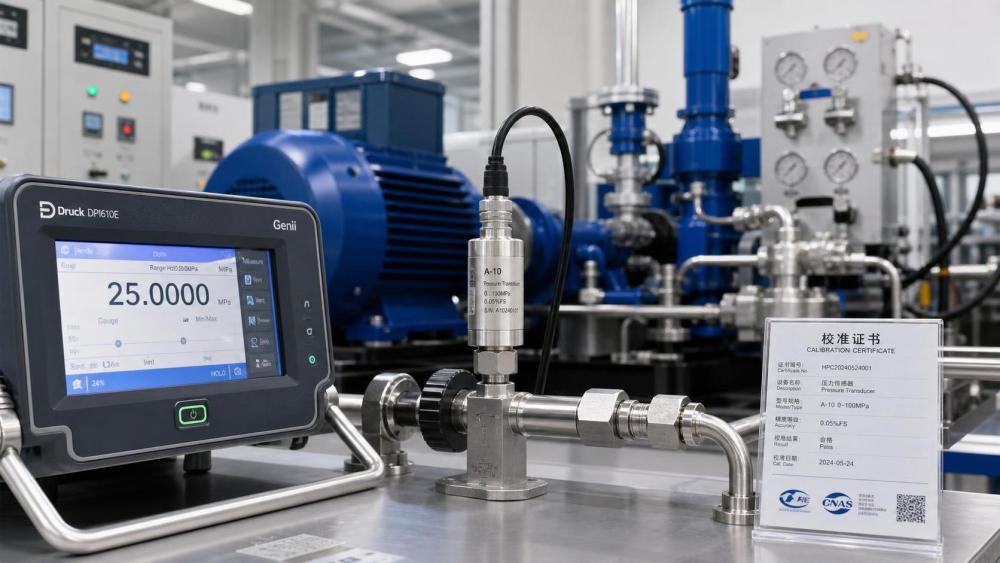
Traceability is not just a certificate attached to a shipment. It is the ability to connect a delivered sensor to its model configuration, production record, calibration evidence, and relevant component or material information. This matters when an instrument is questioned during commissioning, when readings become inconsistent, or when an OEM must investigate a field return.
The required depth of documentation depends on the project. Routine maintenance stock may only require a clear part number, serial identification, datasheet, and basic inspection record. Higher-risk systems may require serial-level calibration documentation, defined test records, material information for wetted parts, or controlled revision records for configured products. Procurement should establish the documentation package before issuing the purchase order, rather than trying to recover it after equipment has shipped.
There is also a practical replacement issue. A serial number alone does not help if a supplier cannot identify the original pressure range, output type, connector, thread, wetted materials, and configuration revision. A capable pressure sensor supplier should have disciplined identification and change-control practices. When a product is revised, the supplier should explain whether the new version is mechanically, electrically, and functionally interchangeable.
Separate calibration evidence from broad quality claims
Buyers sometimes accept a general quality statement in place of application-relevant evidence. These are not equivalent. A quality system can indicate that a supplier uses controlled processes, but it does not automatically show the condition or output of an individual sensor. For applications where measurement confidence matters, request documentation that identifies the instrument and shows the test or calibration result in a form your engineering, quality, or project team can use.
It is equally important to define what traceability does not need to include. Requiring extensive records for standard, low-risk spare parts can create administrative cost and extend lead time without producing useful protection. Match the documentation burden to the consequence of failure, contractual requirements, and future service needs.
Support quality becomes visible before the order is placed
Technical support is often treated as an after-sales promise, but a supplier’s pre-sale behavior is a more reliable indicator. Review how quickly and precisely the supplier handles application questions. Do they clarify the pressure medium, connection standard, output compatibility, cable length, ingress exposure, and installation constraints? Or do they respond with a catalog page and an unqualified alternative?
Good support does not mean the supplier must design the entire system. It means the supplier can identify the boundaries of its product and provide usable information for selection, commissioning, and troubleshooting. This is particularly valuable in hydraulic and pneumatic equipment, where pressure behavior can be affected by hose routing, valve action, pump pulsation, contamination, and incorrect sensor location.
Ask what happens when a delivered sensor appears to be faulty. The answer should cover technical triage, return handling, failure analysis where appropriate, warranty interpretation, and replacement lead time. A low unit-price source becomes costly when the only remedy is a slow, undocumented exchange process that leaves a machine or project team waiting.
Compare total acquisition cost, not only piece price
The cheapest quotation may be the correct choice for a simple, non-critical application with stable demand and straightforward replacement. It is a weak choice when it transfers cost into incoming inspection, engineering clarification, repeated qualification, emergency freight, field troubleshooting, or excess inventory.
To compare suppliers fairly, include costs that normally sit outside the unit price:
- Engineering time needed to resolve unclear specifications or substitutions.
- Incoming inspection effort and the usability of supplied records.
- Lead-time consistency for production orders and spare parts.
- Minimum order quantities, packaging suitability, and regional logistics.
- Costs associated with stocking multiple non-interchangeable versions.
- Potential downtime or rework if a replacement cannot be supplied promptly.
For OEM procurement, platform consistency often carries more value than a small price reduction. Standardizing a qualified sensor family can simplify drawings, wiring practices, service manuals, spare-parts planning, and technician training. That does not mean using one supplier for every pressure point. It means limiting variation where common interfaces and performance requirements genuinely allow it.
Use a sample order to test the supplier's process
A sample is useful only when it tests more than whether the sensor powers up. Before approving a new source, verify the delivered configuration against the purchase order, inspect labeling and packaging, review the documents provided, and test the product in conditions close to its intended duty. Confirm signal behavior with the receiving controller or display, mechanical fit at the process connection, and practical performance during expected pressure changes.
The sample order also reveals operational discipline. Check whether the quotation, order acknowledgment, delivered label, certificate, and product markings all describe the same configuration. Small inconsistencies at this stage can become larger problems when a supplier is asked to deliver production quantities across multiple machine builds or project locations.
Where the sensor will be installed in fluid systems, include the people responsible for mechanical integration, controls, quality, and service in the approval decision. Procurement can lead the commercial evaluation, but the lowest-risk decision is made when the purchase specification reflects the actual installation and maintenance environment.
A practical approval sequence for pressure sensor sourcing
- Define the pressure duty, medium, environment, connection, output, and consequence of a wrong reading.
- Set the required accuracy, stability, overload resistance, and documentation level for that duty.
- Request a configuration-specific quotation and technical response from shortlisted suppliers.
- Compare traceability, revision control, lead time, and support process alongside the unit price.
- Validate samples in the intended electrical and mechanical system.
- Approve a controlled part number, documentation package, and substitution rule before volume purchasing.
Industrial buyers working across hydraulic equipment, piping systems, pumps, valves, and heavy machinery often need this decision to fit into a broader component risk review. Resources such as Global Industrial Machining & Piping Equipment Network (IMPE) can help structure that review by connecting pressure measurement needs with fluid-system compatibility, material selection, mechanical interfaces, and long-term service planning.
The final selection should leave the purchasing team with more than a competitive quote. It should provide a clearly defined instrument, evidence that it meets the required measurement duty, a repeatable documentation path, and a supplier contact who can help resolve a problem before it becomes downtime.
Related News
- Using Industrial Air Blow Guns to Clear Chips Without Spreading DebrisOct 15, 2026Fluid Power Control Strategist
- Ductile Iron Pipe Valves: Which AWWA Standards Apply to Water Main Projects?Oct 15, 2026Dr. Elias Vance
- Why Vacuum Suction Cups Lose Grip on MDF in Woodworking MachinesOct 15, 2026CNC Kinematics Architect
- Choosing a Variable Displacement Piston Pump Manufacturer: What to VerifyOct 15, 2026Fluid Power Control Strategist
- Parallel vs. Angular Pneumatic Grippers for Confined Assembly StationsOct 15, 2026Fluid Power Control Strategist
- Die Castings vs. Investment Castings: Which Costs Less at Your Production Volume?Oct 14, 2026Foundry Phase-Change Fellow