
How Blow-Off Vacuum Generators Reduce Part Release Delays in Automated Handling
A release delay of only a fraction of a second can become a persistent production problem when it occurs at every pick-and-place cycle. The robot may reach the drop point on time, but the workpiece remains attached to the suction cup, shifts during separation, or falls after the arm has already started its next motion. In automated handling, that kind of inconsistency can lead to missed placement, fixture interference, double picks, rejected parts, and unnecessary recovery stops.
Vacuum generators with blow off function address this problem by introducing a brief, controlled positive-pressure pulse when vacuum holding is no longer required. The pulse helps break the seal between the suction cup and the part, allowing the component to leave the gripper at the intended point in the machine sequence. For operators, the practical benefit is not simply faster release. It is a more repeatable release event that can be synchronized with robot motion, conveyor timing, inspection stations, presses, packaging equipment, or downstream fixtures.
The function is especially useful where ordinary vacuum release is inconsistent: smooth sheet metal, oily machined components, thin plastic parts, glass, coated surfaces, flexible packaging, and components with shallow or irregular contact areas. It should not be treated as an automatic answer for every vacuum application, however. Blow-off pressure, pulse duration, cup design, air supply condition, and release timing must all match the part and the handling motion. A poorly adjusted blow-off setting can introduce its own problems, including part displacement, surface damage, or unstable placement.
Why Parts Do Not Release Immediately
When vacuum is switched off, the workpiece does not always separate at the same moment. Residual vacuum can remain in the cup, hose, fitting, or internal chamber of the generator. The amount depends on the length and internal diameter of the vacuum line, the size of the suction cup, the volume of the gripper circuit, and restrictions in valves or silencers. A large-volume system may hold enough negative pressure for the part to remain attached longer than the motion program expects.
Surface conditions add another layer of uncertainty. A flat, nonporous workpiece can form a strong seal against a soft cup. Oils, coolants, moisture, protective films, or cleaning residues can sometimes increase adhesion by helping the cup conform closely to the surface. Thin materials may flex into the cup under vacuum. Lightweight parts may also stay attached through static charge or simple mechanical friction even after the vacuum level has fallen.
In many cells, the delay is not visibly dramatic. The part may release after the robot has stopped, but before the next programmed move. The problem becomes more serious when cycle times are reduced, when parts must land in a narrow fixture, or when several vacuum cups need to release together. A small variation between cups can rotate a panel, twist a gasket, or leave one edge hanging while the rest of the part has already been placed.
Operators should therefore distinguish between a vacuum holding problem and a release problem. Increasing vacuum level may improve pickup security, yet it can make a release delay more noticeable if the system has no efficient way to vent or counteract the retained vacuum. The goal is to maintain reliable gripping during transport and obtain predictable separation at the drop point.
How the Blow-Off Pulse Changes the Release Event
A vacuum generator creates suction by using compressed air to produce a vacuum effect, or by integrating with a separate vacuum source depending on the system design. When the handling sequence reaches the release position, the blow-off function sends compressed air into the vacuum side of the circuit. This rapidly raises the pressure at the suction cup and breaks the pressure difference that was holding the part.
The air pulse is usually brief. It is intended to clear residual vacuum rather than continuously push the workpiece away. When it is properly adjusted, the cup separates cleanly and the part remains where the machine intended to place it. In a vertical placement sequence, for example, the pulse can help the part settle into a nest instead of remaining partly suspended from the gripper. In a high-speed transfer, it can prevent the robot from dragging the part as the arm changes direction.
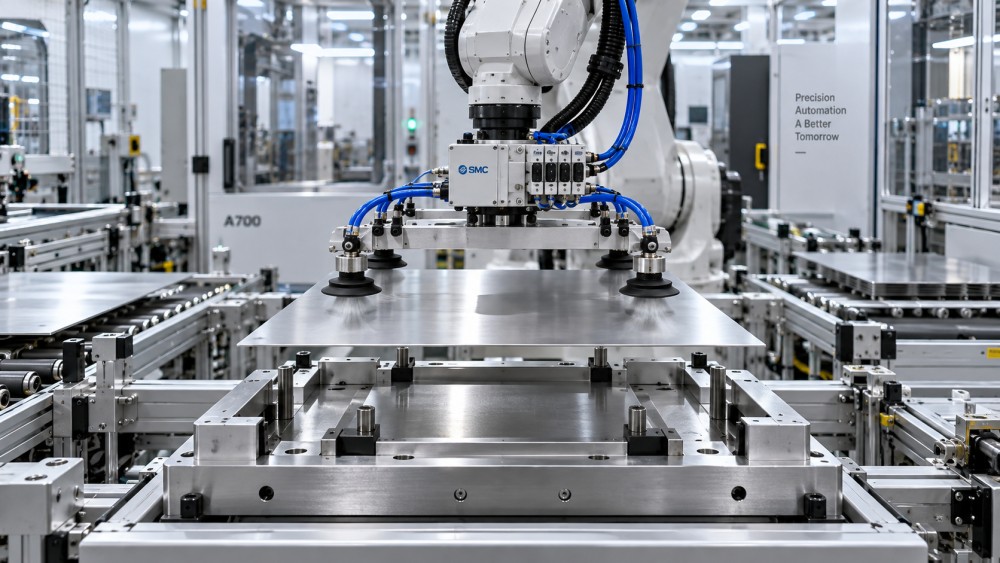
The difference is easiest to understand in terms of control. A basic vacuum-off command relies on air entering the system naturally through a vent path. That may be adequate for a small suction cup with short tubing and a porous workpiece. Blow off actively changes the pressure in the circuit. It shortens the time needed to neutralize the vacuum and reduces the influence of small changes in hose volume, cup condition, or surface finish.
That does not mean a stronger pulse is always better. Excess blow-off pressure can cause a light part to bounce, slide across a fixture, rotate before it settles, or eject from a poorly contained drop area. Delicate films, labels, painted surfaces, and loosely stacked pieces require particular care. The correct setting is the lowest pressure and shortest pulse that produces a dependable release under normal operating variation.
Where Blow Off Usually Has the Greatest Value
Applications with a narrow placement tolerance tend to benefit first. A robot placing machined castings into a machining fixture may need the part to release before clamp closure begins. A transfer unit feeding sheet metal into a press may need every panel to separate evenly so that edge alignment remains stable. Packaging equipment may require pouches, lids, trays, or cartons to leave a suction head without a trailing edge that catches on guides.
Vacuum generators with blow off function are also useful when the part surface changes from batch to batch. A component may arrive with different oil levels, protective coatings, temperature, roughness, or flatness. A system that releases reliably on a dry sample part may hesitate on a production part with a more effective cup seal. Blow off can reduce the sensitivity of the release step, although it cannot compensate for major changes in part geometry or severely contaminated cups.
- Stamped and formed metal: Flat blanks, shallow panels, and coated sheets can seal strongly to cups, particularly where handling speeds are high.
- Machined components: Parts carrying coolant or machining oil may adhere longer than expected, and reliable release matters when they are placed into gauging, washing, or assembly fixtures.
- Plastic and composite panels: Smooth surfaces and light weight can make delayed release visible as shifting or rotation during placement.
- Glass and polished surfaces: These materials often form an effective seal, so controlled release helps avoid pulling or dragging during set-down.
- Thin packaging materials: Films, labels, trays, and flexible packs may remain attached due to vacuum, static, or material flexing.
The feature can also simplify timing in multi-cup end effectors. If a large panel is held by several cups, operators need all contact points to release within a controlled window. A blow-off circuit can help minimize the situation in which one cup remains attached after others have released, causing the workpiece to pivot or scrape across the placement surface.
Set the System Around the Part, Not Around a Default Pressure
A blow-off function performs well only when the handling system is configured as a whole. Operators sometimes focus on the generator specification and overlook the vacuum circuit between the generator and the cup. Long hoses, unnecessary fittings, oversized cup volumes, clogged filters, and restricted exhaust paths can all affect both pickup and release behavior.
Begin with the release requirement. Observe where the part must be when separation occurs and what happens immediately afterward. Does it need to remain exactly located in a nest? Is the robot already accelerating sideways? Is a clamp closing? Is the part one item in a stack where air movement could disturb adjacent pieces? These conditions determine how forceful and how early the pulse can be.
Then evaluate the cup and contact surface. A soft, wide cup may provide excellent holding force but create a large sealed volume. A smaller cup may release more quickly, though it may not provide adequate stability during transfer. Cup lip geometry, material hardness, and the number of cups should be reviewed before compensating solely with higher air pressure. In some cases, an adjustment to cup selection or hose routing removes much of the delay without requiring an aggressive blow-off pulse.
The following operating questions are useful during setup:
- Does the workpiece release at the same location throughout the production run?
- Does it remain attached after the vacuum command is removed, or does it release but move unpredictably?
- Are all cups releasing together on multi-cup tooling?
- Is compressed-air pressure stable while other pneumatic devices in the cell are operating?
- Does the release behavior change after cup replacement, cleaning, or material changeover?
- Is the blow-off pulse creating enough force to disturb the part after it has been placed?
A practical adjustment sequence is to establish stable pickup first, then use a modest blow-off setting and test release at production speed. Increase pulse strength or duration only until the attachment delay disappears consistently. Test with parts representing normal variation in surface condition and geometry, not only with one clean, dry sample. The release should be checked during the full machine cycle, because a setting that looks correct in manual mode can behave differently when the robot, conveyor, clamps, and other pneumatic circuits operate together.
Timing Matters as Much as Air Pressure
The release command has to be coordinated with motion. If blow off begins while the gripper is still traveling toward the fixture, the part can lose positional control too early. If it begins too late, the robot may pause while waiting for separation, or it may move away with the part still attached. Either condition reduces repeatability.
For a stable placement, the gripper should generally reach the intended release height and orientation before the vacuum is removed and the pulse begins. The required dwell can be very short, but it must account for the mechanics of the system. A part placed onto locating pins, for instance, may need to be fully seated before the cup is vented. A part placed onto a moving conveyor may need a different sequence, with release synchronized to conveyor motion and sufficient clearance for the cup to lift away.
In applications where the part is intentionally blown clear of the cup, such as certain reject or sorting systems, the settings may be more forceful. That is a different use case from precision placement. Operators should avoid carrying settings from a discharge application into a fixture-loading cell simply because the same vacuum hardware is used.
Common Problems That Blow Off Does Not Solve by Itself
Blow off helps release a part from the suction cup. It does not correct every source of unstable handling. If the part slips during transport, vacuum loss, cup selection, center-of-gravity position, acceleration, or gripping layout may be the actual issue. If the workpiece is mislocated after release, the fixture design, robot repeatability, conveyor position, or cup alignment may require attention.
Air quality is another frequent source of inconsistent behavior. Moisture, oil carryover, particulate contamination, or pressure fluctuations can affect valves and generators over time. A blocked silencer or restricted exhaust can change the generator's response. Leaks in hoses, worn cups, loose fittings, and damaged seals can create a system that appears to need more blow-off pressure when the basic problem is deteriorating vacuum performance.
Static electricity also deserves separate consideration, especially with lightweight films, plastic sheets, and some packaging materials. A part that remains on the cup after pressure is neutralized may be held by static charge rather than residual vacuum. Blow off may reduce the symptom, but it may not fully resolve it. In those cases, grounding, ionization, material handling conditions, and surface cleanliness should be reviewed alongside the pneumatic setup.
What Operators Should Monitor After Setup
Once the cycle is stable, the release step should become part of routine observation rather than a setting left untouched. A gradual increase in release delay can indicate cup wear, internal contamination, a change in supply pressure, or a modification to tubing and tooling. A sudden change may follow a material changeover, fixture adjustment, valve fault, or maintenance work on the compressed-air system.
Useful signs include a robot pause at the release point, occasional parts hanging from one cup, parts shifting after placement, a rise in mispick recovery events, or a need to increase blow-off settings over time. These symptoms should be checked before operators compensate by extending cycle dwell. Adding extra time may keep production running temporarily, but it can conceal a fault and spread an avoidable delay across every cycle.
For automated handling systems where release consistency affects placement quality or machine uptime, a controlled blow-off function is often a practical addition. Its value comes from making separation predictable, not from producing the strongest possible air pulse. When cup selection, vacuum volume, air quality, pressure setting, and sequence timing are treated as one handling system, parts leave the gripper more cleanly and the rest of the cell can operate on a more reliable rhythm.
Related News
- Using Industrial Air Blow Guns to Clear Chips Without Spreading DebrisOct 15, 2026Fluid Power Control Strategist
- Ductile Iron Pipe Valves: Which AWWA Standards Apply to Water Main Projects?Oct 15, 2026Dr. Elias Vance
- Why Vacuum Suction Cups Lose Grip on MDF in Woodworking MachinesOct 15, 2026CNC Kinematics Architect
- Choosing a Variable Displacement Piston Pump Manufacturer: What to VerifyOct 15, 2026Fluid Power Control Strategist
- Parallel vs. Angular Pneumatic Grippers for Confined Assembly StationsOct 15, 2026Fluid Power Control Strategist
- Die Castings vs. Investment Castings: Which Costs Less at Your Production Volume?Oct 14, 2026Foundry Phase-Change Fellow